If you are a family of means, you have the incentive to rely less and less on the public sector. So we used to want to be free of bosses, but now we want to be free of bus drivers. We don't want to take the bus. We don't want to often enroll our kids in the public school system. We don't need to play in the public park or swim in the public pool. We have our own clubs, our own schools. We have our own cars. And as we withdraw into the private opulence, we have less and less incentive to invest in public services.
A lot of us are getting these tax breaks and we don't see that as a government helping us. We see that as us getting to keep more of what is rightfully ours. And often that leads to a kind of attitude, a political attitude, where we don't think the government is in our lives. And so those of us who are more apt to take that mortgage interest deduction are also more apt to vote against affordable housing proposals. Those of us who already have employer-sponsored health insurance — which by the way, is government subsidized in a massive way — we're often apt to vote against the Affordable Care Act. And so it does have this kind of strange political, maddening irony in our lives.
Desmond's 2017 book Evicted, for which he won the Pulitzer Prize, examined the nation's affordable housing crisis through the lens of those losing their homes.
Desmond's new book is Poverty, By America, studies various factors that contribute to economic inequality in the U.S., including housing segregation, predatory lending, the decline of unions and tax policies that favor the wealthy. Desmond says that affluent Americans, including many with progressive political views, benefit from corporate and government policies that keep people poor.
A community's mental health isn't something you kick down the road - unless you're Sarasota County's Board of Commissioners. Local experts volunteered 526 hours to review and recommend the most valuable mental health services for our citizens -- only to watch Moran, Maio, Ziegler, Cutsinger and Detert punt -- incoherently. Carrie Seidman.
The same five Commissioners agreed there's no space west of I-75 left for affordable housing, then granted Pat Neal's request to dodge a formal commitment to build affordable housing east of it. Sarasota's moneybags developer apparently can't afford affordable housing -- details in The Sarasota News Leader.
As in my July 23 email to the Planning Commission (which I copied to you), this is to urge that at your meeting Tuesday [September 22] you vote against transmitting to the state a Comprehensive Plan amendment to delete the requirement of affordable housing as a trade-off for the incentives of the Sarasota 2050 Plan.
The claim that this is required by state law is flatly false. The law allows a requirement for affordable housing in exchange for voluntary incentives which fully compensate the developer for the lost profit. It is beyond question that the Sarasota 2050 Plan does that.
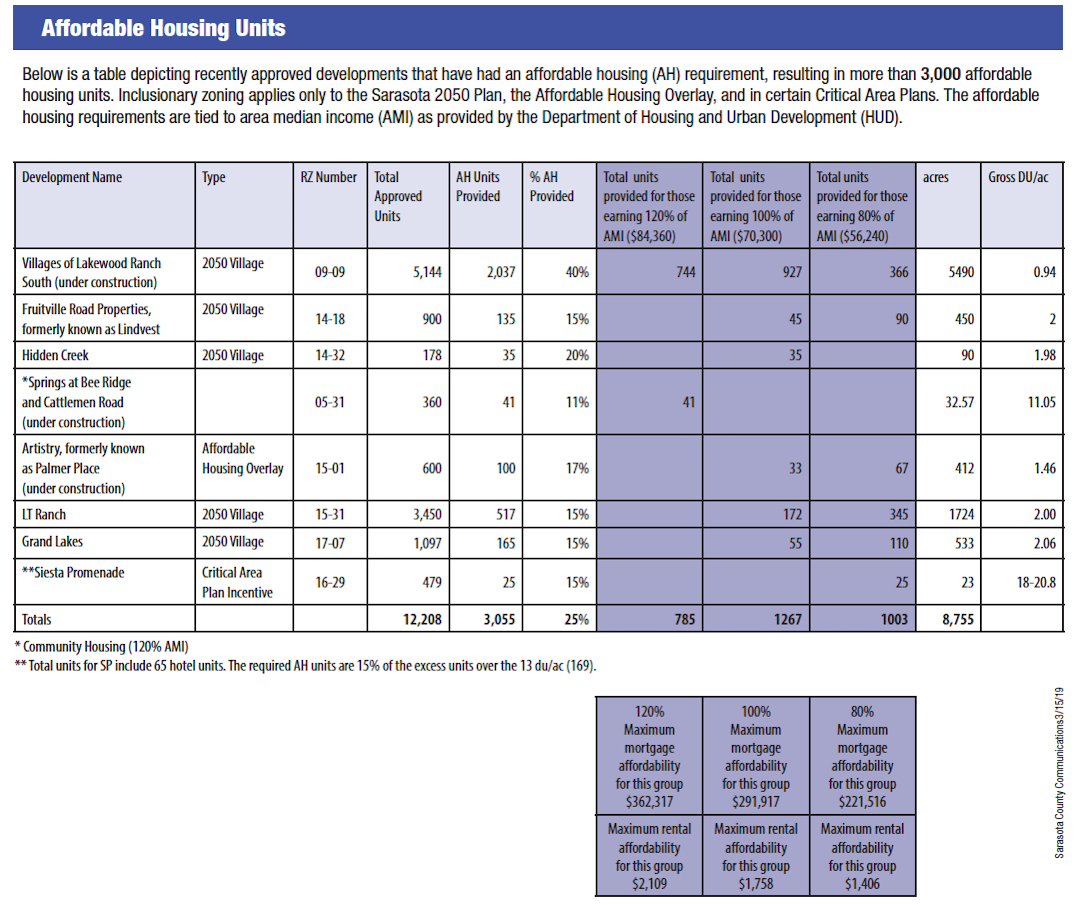
The amendments would repeal the current requirement that in order to receive the incentive under the Sarasota 2050 Plan to build at urban densities and commercial uses rather than rural densities, not less than 15% of the units must be affordable housing, that is sold to families at under 100% of Area Median Income (with 2/3 of those homes at 80% AMI).
Instead, a developer would be allowed to build at up to 5 dwelling units per acre in the developed area with no affordable housing. All that would be left is the current “incentive” that a developer could go up to 6 dwelling units per developed area acre if the extra units are affordable housing.
Given the densities that developers have been building in Sarasota 2050 developments, the 5 units per acre will not be exceeded and developers will have no desire to get the 6th by affordable housing. So, goodbye affordable housing in Sarasota 2050 developments if this is adopted.
The affordable housing standard would be further weakened in the UDC because this amendment provides that while 2/3 of the homes must be for families with 80% of AMI, half of the remainder would be for 100% AMI and half of the remainder would be for 120% AMI. This would unlawfully conflict with VOS Policy 1.4 in the Comprehensive Plan, which provides a goal that at least 15% of the housing will be available “for families with incomes below the median family income for Sarasota County.”
These changes are based on a complete misunderstanding or mischaracterization of new state legislation as applied to the current affordable housing requirements of the Sarasota 2050 Plan.
Section 125.0155, Florida Statutes now bans a requirement for affordable housing, sometimes known as “inclusionary zoning.” Instead, it allows a local government to seek affordable housing by “incentives.” Paragraph (2)(a) of the statute provides that the incentive may be “allowing the developer density or intensity bonus incentives or more floor space than allowed under the current or proposed future land use designations.” [Paragraph (2)(c) broadly includes “granting other incentives.”]
Sarasota County is already complying with this requirement today. The entire Sarasota 2050 Plan is a voluntary incentive which grants developers increased urban densities and commercial (“more floor space”) uses on land which is otherwise limited to rural densities, if the developer complies with various requirements in return. One of those requirements is that 15% of the housing be for persons below the Area Median Income. The incentive has been enhanced since adoption by exempting affordable housing from Greenway density transfer requirements and any fiscal neutrality requirements (although those measures have not been enforced and are proposed to be weakened as well, such as by including the 120% AMI standard).
Note: Confirmed by an Orlando Sentinel editor: In the April 6 editorial below, "she" is Sarasota County Commissioner Nancy Detert, who when a state Senator co-sponsored a disastrous unemployment bill:
Rick Scott instigated the movement a decade ago to deny unemployment to the unemployed, but he couldn’t have done it without help.
Republican lawmakers were squarely behind the the newly elected governor’s agenda in 2011, passing a sweeping unemployment compensation law designed to punish workers who lost their jobs — “slackers and malingerers” as one state senator [Nancy Detert] put it at the time. She [Detert] perfectly summarized the contempt some felt for the unemployed, which led to the overwhelming passage of a law that:
reduced the number of weeks someone can collect unemployment to as few as 12,
required workers to prove they had contacted five potential employers each week,
expanded the types of fireable offenses that disqualified an employee for benefits, and
cut benefits if an employee received severance pay.
Workers also were forced to apply for benefits online, which was bad under the existing computer system and calamitous today under the one Scott’s administration replaced it with.
As others have observed, it was a system designed to help business by failing workers, those “slackers and malingerers.”
We’ve built a rigged economy, particularly in Florida, where people in this ongoing crisis are among the most essential workers, alongside police and firefighters and doctors and nurses.
How has this state treated them before now?
Our lawmakers have been dead-set against a meaningful increase in the minimum wage, prompting a successful campaign to get a $15 an hour minimum wage on the ballot this fall.
They refused to do anything about businesses failing to offer paid sick leave, and then passed a law that stopped communities like Orange County from doing something on their own.
Dist. 3 Commissioner Nancy Detert
Over the course of a decade, they skimmed nearly $2 billion from a fund that was supposed to provide money for affordable housing.
In 2011, urged on by then Gov. Rick Scott, they stacked the deck against workers trying to collect unemployment benefits. The Legislature cut the number of weeks unemployed workers were eligible for unemployment — to as low as just 12 weeks, depending on the unemployment rate — and made it easier for employers to deny benefits. All this while keeping one of the worst weekly benefits in the nation — $275 max. A Republican state senator at the time, Nancy Detert, said she wanted to be rid of “slackers and malingerers.”
More on Florida's appalling unemployment predicament:
To: County Commissioner Charles Hines
cc: SRQ County Commissioners Maio, Moran, Ziegler and Detert
cc: SRQ Affordable Housing Advisory Committee
cc: Facebook Celery Fields Group, SRQ Citizens for Sarasota, Personal Facebook Page
From: Adrien Lucas
Re: Board decision approving affordable housing on parcel #2 by July 22 / Chronic Sewage Dumps into the Sarasota Gulf waters
Commissioner Hines,
I began this email a few weeks ago when I read an article published by the Sarasota News Leader regarding the County Commission board’s latest absurd affordable housing proposal to be plopped down on Quad Property Parcel #2 adjacent to the Celery Fields. I continue to be fuming angry and I am also very frustrated that I am not living in Sarasota full time because I would, again, devote any free time, to fight the BOCC's proposal for putting affordable housing on Parcel #2.
Before I begin, I want to stress that affordable housing, even if the Celery Fields were not adjacent to the quad property you have suggested for affordable housing, is no gift to people who are in real need of affordable housing.
The road that you propose this project on has a grade rating that is as close to failure as it gets. With Mr. Gabbert’s waste transfer facility, along with other industrial trucking in the area, placing affordable homes on a street that is never going to be widened, improved or having traffic thinned out, is about the biggest insult you can gift the poor or working middle to lower class. Oh yes, let’s put these poor people on a road that is dangerous and heavily trafficked with semis. What a blessing that our children can play outside next to these traffic jams and semi exhaust fumes. Seriously, shame on you. This quad parcel is not a place for healthy living.
Time and time again, you all ignore what the public has asked, begged, written, tons of personal time spent trying to show you what these quads could do by way of enhancing the area and complimenting what already exists, to have a Quad Property back on the agenda, especially for affordable housing, illustrates how self serving politicians are. I digress.
I will be sharing Commissioner Hines' affordable housing proposal for Quad #2, coupled with the Conservation Foundation of the Gulf Coast’s attempt to acquire acreage adjacent to the Celery Fields. It's sad that the evidence is so brightly shining regarding what the Celery Field Quads and local area can be, however, none of you are capable of seeing a Golden Nugget that exists as is and will take very little effort on your part to do what your constituents and people around the world have asked all of you and your predecessors in loud community abundance. FOLD THE CELERY FIELD QUAD PROPERTIES into the existing Celery Field storm water management lands and designate them as parkland.
If the County Commission had enforced the numerous "affordable housing" constructs they created for the top developers (who clearly run the county) then this flimsy discussion regarding selling surplus county owned land for affordable housing would not be a discussion.
Al Maio
If Commissioner Hines were truly concerned about affordable housing then he would have addressed this issue years ago when it became very clear that the Developers were ignoring any concessions they had agreed to commit to for affordable housing. Instead Commissioner Hines, you rolled over every time Christine Robinson raised an eyebrow and you folded every time. Same with you, Commissioner Maio.
Commissioner Hines clearly wants to leave some kind of redeeming legacy because he has acquiesced to every Benderson, Neil, Gabbert (etc.) request and he has never ever made the developers follow anything they had said they would do regarding affordable housing for their Sarasota developments.
Shame on you Commissioner Hines and shame on the rest of you for acting like sheep and agreeing that Parcel 2 is just a dazzling piece of property for affordable housing. It is so unctuous to think that Mr. Neal or Mr. Benderson continue to skate on by with county corporate welfare and you all think you are going to save the day by building affordable housing units on a crappy street that has D grade for its quality with large trucks now zooming up and down from Gabbert’s little stinkin’ waste transfer sty, zoned light industrial, with all of you refusing to change zoning and now all of a sudden it’s paradise for the poor? Puh’leeze. Shame on all of you. This presents as the biggest insult to every person who has contacted you to consider saving the Celery Fields Quad properties and the communities who have grown and flourished in that area. You all are failing the people who live out there.
This is not representation. Between redistricting, ignoring amendments voted in by Sarasota constituents and now this, you, the Commission, act solely based upon any self serving whim that strikes your fancy. I bet an email inquiry to public records will show how little county citizens are emailing Commissioner Detert telling her the Celery Quads should be developed into affordable housing/apartments. I bet the emails that all of you are receiving regarding the Quad properties demonstrate majority opposition to developing or selling the Quad properties will outweigh affordable housing email.
As for the Housing Affordability Initiative you all passed on November 28, 2018, seriously, this is the best scheme you can come with? And while I appreciate the members on the board trying to address this serious issue of affordability in the county, the boards should be preparing a lawsuit against Benderson, Neal and any other developer who has failed to honor the contracts they created with the county regarding affordable housing.
The Celery Field Quads are not and should not be considered for affordable housing. It is not an appropriate place for housing. Period.
Furthermore, I end this with the chronic sewage spill catastrophes that keep occuring. You are all responsible for maintaining the safety of our county and have failed us for decades. None of you do the county any favors when it comes to public relations. Your focus should be on preserving existing nature because the future of our beaches does not bode hopeful. People will be coming in land to experience nature in the future. Wake up, climate change is real, red tide will continue to grow as will this flesh eating bacteria because these “natural occurring” dangerous issues thrive in warm waters and are exacerbated by man. It is as if the county is giving a free lunch of poo flushes on a regular basis to these awful things that exist in the gulf, so please turn your attention to infrastructure and having the developers really kick in monetarily what is needed for all their new building sprawl.
Mr. Hines, you all want to leave a legacy for Sarasota? Then please, help clean it up and make the developers build affordable housing in a place, other than the Quad parcel, where parents, children and the working class will be safe.
County Commission needs to take action on its own — perhaps selling surplus land to a private developer — to spur affordable housing projects, chair says
Hines voices frustration that, in spite of County Code changes designed to facilitate such developments, no private developer has proceeded with one
Chair Charles Hines. File photo
Because private companies have not been coming to the Sarasota County Commission to propose affordable housing projects, the board chair told his colleagues this week that he believes the commissioners themselves need to take action that will spur such initiatives.
And he wants to see some action before the board begins its annual summer recess in July. That vacation officially starts on July 22. The last regular meetings for the board are set for July 9 and 10.
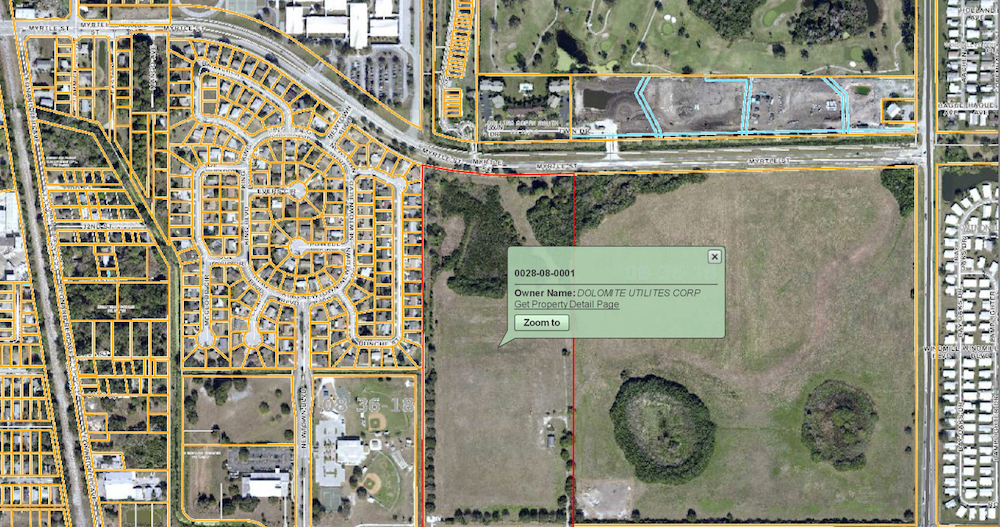
During a June 4 discussion, Chair Charles Hines and other commissioners broached the idea again of selling county property for affordable housing projects. Focus centered on a surplus 10-acre parcel next to the Celery Fields that is known as the Southwest Quad, as well as a portion of a 115-acre site adjacent to Newtown Estates.
Perhaps the county could sell 20 acres of the latter, Hines said, for a workforce housing initiative.
In December 2017, Hines first talked of the potential of the Newtown property. He raised the issue as his board debated negotiations with the City of Sarasota in an effort to settle a dispute over a final county payment city staff argued that the county owed into the Downtown Sarasota Community Redevelopment Area (CRA) Trust Fund.
The North Sarasota parcel is just east of the Betty J. Johnson North Sarasota Library in Newtown.
When the county purchased the land approximately six years ago, the intent was for it to become a major athletic complex for North County. However, after the Great Recession struck, the plans were put on hold.
In December 2018, Sarasota City Commissioner Willie Shaw brought up the property in a discussion about the city board’s efforts to spur more affordable housing projects.
In response, City Manager Tom Barwin said he had asked County Administrator Jonathan Lewis about the land when he saw Lewis at a recent luncheon. Lewis told him that the land remained listed among properties for the county’s Parks, Recreation and Natural Resources Department (PRNR). However, Barwin added, Lewis indicated the County Commission would be open to discussing the future of the site.
When The Sarasota News Leader asked county staff for a comment on Barwin’s remarks after the City Commission’s Dec. 3, 2018 meeting, Media Relations Officer Ashley Lusby reported in an email, “The county has not changed its plan for the north county land. The county is still following the parks master plan for that location to be the North County Sports Complex.”
A 2013 graphic shows the 115-acre property planned for the North County Sports Complex. Image courtesy Sarasota County
On June 4, Hines acknowledged that county staff had continued to focus on the property for a purpose consistent with planning for future parks.
Commissioner Alan Maio said he doubted staff would come back to the board with a proposal entailing the utilization of a portion of the property for workforce housing. “We need to make those policy decisions.”
Maio also suggested that if the board were to put property it owns on the market — “and not at sky-high prices” — with the necessary rezoning completed beforehand to facilitate development, “that eliminates the last supposed obstacle to [creation of an affordable housing project],” which is the cost of land.
As for the Southwest Quad: Hines pointed out that some advocates of the Celery Fields have proposed the county keep that property free of development. “That’s not gonna happen. That’s never been one of our ideas.”
Commissioner Nancy Detert noted that she has been advocating for a project on property next to the Celery Fields for months. An apartment complex would be one possibility on the Southwest Quad, she continued. Another, she said, is a tiny homes project. “I still like tiny houses. I think that’s an absolute perfect spot for tiny houses, because [such a project] goes with the whole ambiance [of the Celery Fields].”
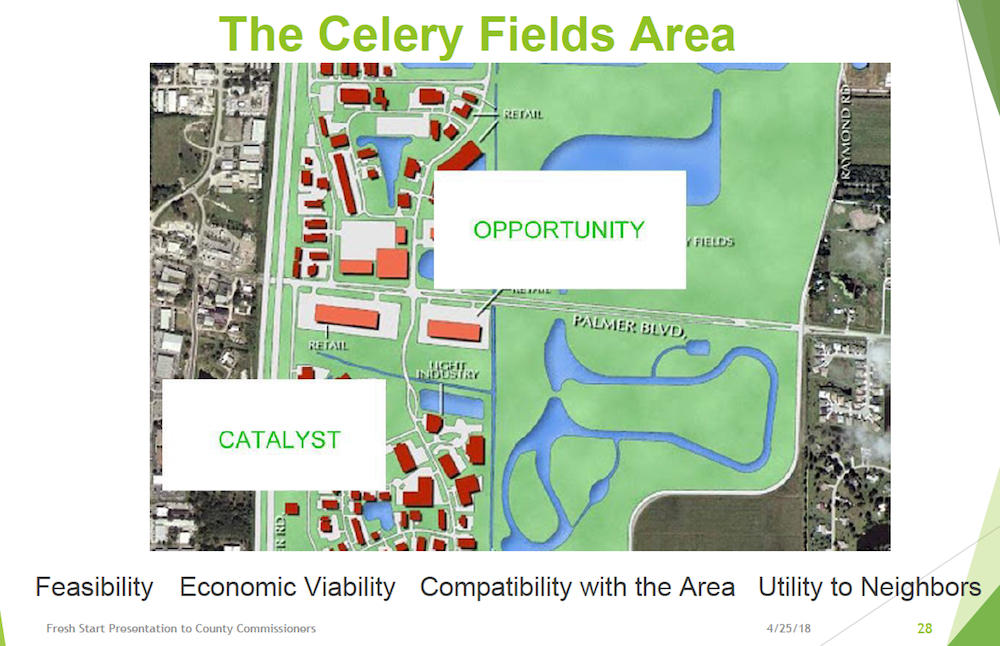
In April 2018 and again in September 2018, representatives of a group called the Fresh Start Initiative worked — at the commission’s behest — to propose what they characterized as compatible uses of the four county parcels known as “the Quads” adjacent to the Celery Fields.
A graphic prepared for the Fresh Start Initiative in early 2018 shows potential for compatible development near the Celery Fields. Image courtesy Fresh Start Initiative
Although the Celery Fields began and still functions as a major county stormwater project, it has acquired an international reputation for the vast variety of birds seen there throughout the year, especially during the winter migratory season.
Yet a third surplus county parcel that potentially could serve as an affordable housing project site is close to the county’s Emergency Operations Center on Cattlemen Road, Hines pointed out on June 4. “It’s been sitting there [for about 10 years].”
The land once was home to the county Building Department, he said.
Frustrations, fixes and a new focus
Exactly six months ago, Hines reminded his colleagues on June 4, the commissioners expressed frustration that ordinance changes they had sought in an effort to make affordable housing proposals more enticing to developers were not coming fast enough from staff in forms for them to enact.
“I don’t think anyone on this board is satisfied with the progress that’s been made,” Maio said at the time.
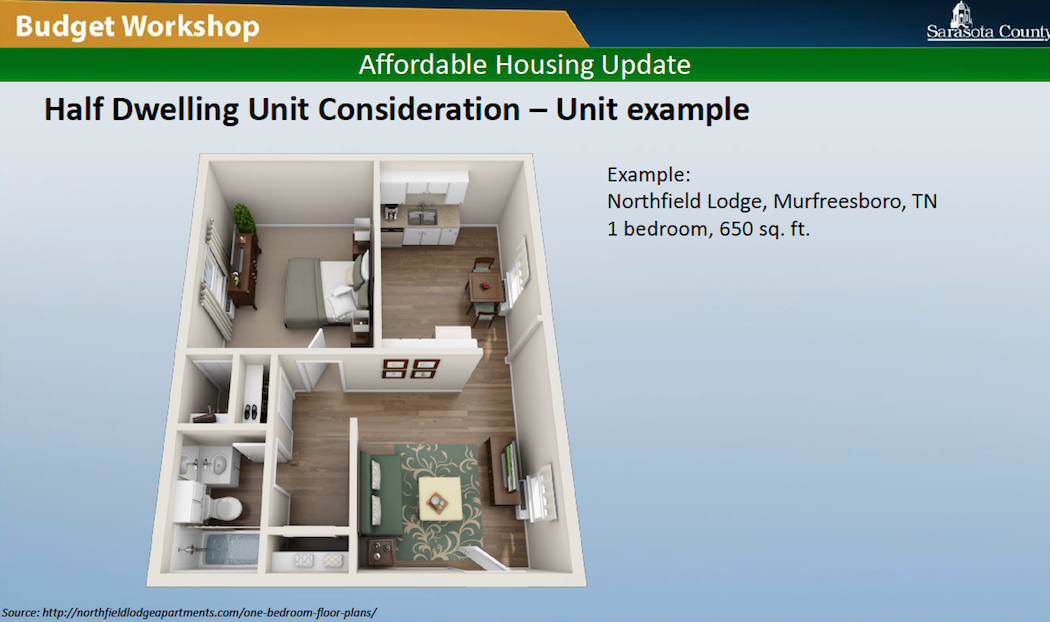
Since then — on March 13 — the board has approved one further change in the county’s Unified Development Code. That modification allows half-dwelling units no larger than 750 square feet, enabling developers to double the density of projects if they construct the smaller apartments or condominiums.
Altogether, Maio pointed out on June 4, the board has voted on about half-a-dozen changes to county regulations — reducing impact fees and capacity fees and reducing parking requirements, for other examples — to encourage private companies to build workforce housing.
This is an example of a half dwelling unit, as presented to the County Commission in May 2018. Image courtesy Sarasota County
Two more measures are in the works, he continued. One involves accessory buildings, such as dwelling units over garages; the other pertains to creation of apartments in upper stories over retail centers, especially those older complexes that might no longer be as active commercially but still have plenty of available parking.
Yet, those two latter changes would not be necessary, Maio stressed, if the board were to try to work with a private developer on a sale of property it owns.
Referencing the Newtown land Hines had mentioned earlier, Maio concurred that 20 acres might be appropriate for a project. “I just don’t think [developers] realize what they could build there and how affordable it could be.”
“What has been holding up a private sector developer from coming in here and saying, ‘I’ll do a 300-, 400-unit project” designed for workers such as firefighters, law enforcement officers and teachers, Hines asked. “The impediment’s been fees, regulations and land costs.”
Referring to the ordinance changes Maio had noted, Hines said he felt that it was even more important for the county to make land available.
The ombudsman proposal and a tangential request
This is the cover of the 2018 Blueprint for Workforce Housing. Image courtesy City of Sarasota
“I wouldn’t be opposed to one dedicated staffer [in the county’s Planning and Development Services Department],” Maio said, preferably if the person’s salary could be covered by permitting fees. If that funding source could be used, Maio added, “Hire them as soon as possible.”
Yet, Commissioner Detert responded, the Office of Housing and Community Development already has that responsibility, and that department is a joint initiative of the City and County of Sarasota.
She also brought up the fact that the county used to help first-time homeowners by providing down payments on houses.
For 25 years, she pointed out, she owned a mortgage business in the county. She talked about one client who was able to get help through the Down Payment Assistance Program. “It gives people a hand up, not a handout,” she explained.
To qualify for the help, she said, a person had to learn how to manage a budget, for example.
The money the county lent the homebuyer became a lien, she continued. When the house was sold, Detert added, the money for the down payment came back to the county, which could put the funds to use for another person’s down payment.
She wanted to know what became of that program, she said.
This information is included in a March fact sheet that county staff provided about affordable housing initiatives in the county. Image courtesy Sarasota County
Deputy County Administrator Steve Botelho, who was sitting in for County Administrator Jonathan Lewis, told her that staff would check on that. He added that he expected a memo with the results of the research could be provided to the commissioners prior to their next regular meetings, in July.
Botelho replied that he would make certain that information was in the memo, as well.
Detert pointed out that Don Hadsell, the long-time director of both programs, recently retired. Detert said she recently asked her county assistant to contact the new director, saying Detert wanted to set up an appointment for a meeting. The response Detert’s assistant received, Detert continued, was a question about why Detert wanted to have that meeting.
“What does it say on the outside of that building [where the Office of Housing and Community Development operates]?” Detert added of her reaction. “That ought to be a tipoff.”
Detert then asked Matt Osterhoudt, director of the county’s Planning and Development Services Department, to ensure that the memo Botelho promised the board also would have a “fleshed-out summary” of how both the city’s Housing Authority and the Office of Housing and Community Development function. She suggested that the results could lead to County Commission tweaks about the operations of the latter agency.
A recent Sarasota County survey on affordable housing recently circulated. Daniel Herridges, a member of the Citizens for Sarasota County group on Facebook, posted his responses. Herridges is doing graduate work in Urban and Regional Planning.
1. Do you believe it is important for housing to be affordable for people who work in our community? Why or why not?
It is extremely important. Sarasota's quality of life depends on broadly shared prosperity. Our region's economy is heavily dependent on service-industry jobs. If enough affordable, decent housing is not available for those who work those jobs, we can expect to see worse traffic and environmental impacts as workers commute from far from their jobs; higher cost of living combined with slower economic growth; increased health problems as more people live in housing that is in poor condition; increased homelessness (already a pressing quality-of-life issue in downtown Sarasota and elsewhere); and potential negative effects on schools, crime rates, and neighborhood stability resulting from high socioeconomic inequality.
2. What type of workers is it important to have housing for? ( i.e. teachers, nurses, construction, manufacturing, government/private sector, etc.)
All types of workers need reasonable, healthy, safe housing, whatever their occupation or income level. I see the most dire need in Sarasota County being among low-wage service-industry workers, however—retail salespeople, servers, bartenders, customer service / receptionists, etc. I am dismayed that nearly all of the discourse around affordable housing from the County centers around "workforce housing" for moderate-income teachers, police, firefighters, etc.—while these groups do need housing as well, this focus is limiting. The most dire housing need is among residents with low and very low incomes (under 80% of AMI). I understand the political palatability of "workforce" versus "affordable" or "low-income" housing, but I hope County officials can also show the political courage to pay due attention to their neediest citizens.
Affordable Housing
3. What makes it difficult for these workers to find affordable housing?
Wages in Sarasota County, as in all of Florida, are below average for the United States. The region has a disproportionate concentration of low-wage jobs in the service industries, and a relative dearth of scientific and technical jobs. This means there is structurally high demand for affordable housing. At the same time, with high migration driven by retiring baby-boomers, there is steady demand from outside the region for larger and more expensive homes, thus our home builders see little incentive to build "starter homes" or apartments when they have a profitable business model in higher-end, single-family subdivisions. Finally, the region's land-use policies stifle the organic growth of an affordable housing stock by largely disallowing "missing middle" housing types (buildings with 2-20 units), disallowing multifamily housing entirely in many locations, disallowing ADUs almost everywhere, and making it difficult to economically build small "starter" homes on small lots due to lot size and setback requirements. Sprawling, low-density suburban growth and a lack of infill development means that transportation costs eat up a high share of many households' budgets. Finally, the large-scale subdivision growth model (as opposed to incremental infill) means that whole neighborhoods are built out at the same time and age at the same rate; thus, almost nowhere in Sarasota County is there a diversity of housing age, size, condition, and thus affordability within one neighborhood like you find in many older U.S. cities. This makes it hard for young professionals to establish themselves here and for older people to downsize and age in place.
4. What creative ideas do you have to removing the barriers to finding affordable housing?
Dedicate county-owned properties acquired through tax forfeiture to permanently-affordable housing. Seek to create a permanent, replenishable fund at the county level for gap financing to help nonprofit developers make affordable projects pencil out (meeting the “gap” between federal / state subsidies, the developer’s own financing sources, and total development costs). Reform land-use policy to broadly allow small, inherently affordable housing types like ADUs. Couple mandatory inclusionary zoning with density bonuses / exemption from things like setback requirements to incentivize the building of smaller housing units. Identify infill opportunities for larger multifamily projects on key transportation corridors (such as aging shopping centers in places like Clark Road and Tamiami Trail), zone these sites in advance for high-density mixed-use to ease the regulatory process, and work with land owners and developers if and when redevelopment occurs to ensure that plans have a housing component. New supply overall will help restrain prices in the region's housing market, but priority should be on encouraging rental housing, smaller units whether rental or ownership, and infill rather than greenfield development. "Affordable" housing in remote areas of North Port or east of I-75 is NOT affordable once transportation costs are factored into a household's budget! Do not let developers use "affordable housing" as a pretext for accelerated greenfield sprawl or exemption from the letter or spirit of 2050 requirements.
5. What are the five most important reasons having housing affordable to these workers positively impacts the community?
Less inequality is associated with stronger economic growth. Workforce housing helps area employers attract workers and diversify the regional economy. Diversity of housing types and price points will help Sarasota weather boom-and-bust cycles better. Affordable housing near jobs restrains sprawl, resulting in less traffic and cleaner air. It's the right thing to do. Everyone should have access to adequate, safe housing.
6. Are there any particular areas or locations that make more sense than others to encourage or allow additional housing? (i.e. address, parcel, new developments, in existing developments, west of I-75, etc.)
Along existing major transit corridors (coupled with increased transit investment to meet mobility needs that come with greater population). In existing neighborhoods in the form of ADUs. In older retail centers ripe for redevelopment—many of these have huge parking lots that are sparsely used even at peak hours and could be partially redeveloped as housing. Near major job concentrations (downtowns, hospitals, on the mainland near barrier islands). West of 75 almost exclusively! (Only exception: Lakewood Ranch) We have so much room for infill that it is environmentally and fiscally irresponsible to allow continued sprawl into greenfield areas, whether in the name of affordable housing or not.
Important Sarasota races will be decided on November 8th. As party lines blur nationally, local elections may be similar. Party affiliation may not be the best guide in identifying who will effectively steward our community, especially since effective oversight of development decisions is no longer found at the state level. Important decisions lie ahead, and they will be decided by the County Commission. Siesta Key’s south bridge at Stickney Point and US 41, a major gateway to a local economic engine and prized beach, may suffer a suffocating traffic future. County government is responsible for creating safe and economically viable development. The County Commission election matters.
We used to be able to count on the Department of Community Affairs for wise development standards in Florida.* The state agency, established in 1969, worked to reduce sprawl and congestion for 42 years. DCA was abolished in 2011. In Sarasota, the most obvious evidence of the absence of DCA oversight is traffic at University Parkway and I75. Without DCA’s usual oversight requirements (e.g. a DRI – Development Regional Impact study), Sarasotans have seen the new mall create dangerous congestion and siphon retailers from existing commercial centers. The traffic fix—a cumbersome diverging diamond—comes with an $80-million priceYou may remember that when approving the new Benderson mall, the County removed a requirement to build over 400 affordable housing units. Affordable housing for those working nearby could have alleviated some traffic near the mall. No affordable housing is planned at Stickney Point and 41.
In the County Commission race between Fredd Atkins and Mike Moran, Benderson’s choice is clear, as evidenced by Moran campaign signs at Stickney Point and 41. Fredd Atkins has pledged to listen to the people. Who will you support? tag.
Gov. Rick Scott signed a bill (SB 2156) Tuesday that dismantles the growth management agency and merges it with several other agencies, such as the Agency for Workforce Innovation, to form a new state agency. The Department of Economic Opportunity will officially be created on Oct. 1, [2011]. Source.
Some of the people's voices heard at the Final Sarasota County Comprehensive Plan hearing - apologies for inaccuracies, just fragments. If you spoke at the Oct. 25th hearing, you are welcome to send a full copy of your comments to sarasotavision@gmail.com and we'll post them. The Comprehensive Plan was approved at the meeting. Mr. D.
"We need a clear picture of what we don't want."
Jono Miller -
The plan needs measures/benchmarks/dates to track progress.
Find better way to better engage the community on planning related projects
Slow the Comp Plan update process down
Staff is proposing vaguer language
We’ve lost ⅕ of our beach - replaced with rock
Margaret C. - (shows images of torn up wetlands at Whole Foods site on University Parkway)
Wetlands in process of being destroyed
Not against development - do it in thoughtful, gentle way
Environmental part of plan - “required” and “shall” being replaced by “may, voluntary,” etc.
Mike Cosentino
I feel I’m protecting the biz community and the public from the County Commission
The only way to help us - make the County Charter like a phone book
Woman -
I would like to know how we keep natural parts safe from developers
I do not hear why the controversial changes are needed or beneficial - I end with doubts.
I respectfully request that the Comm address the criticisms the main ones - write an article, or be interviewed, answering in-depth questions.
Margaret Jean Cannon
In 2010 - Sarasota came in 11th in growth - adding another city the size of Venice - we had been 18th
Hypergrowth - challenges - look at 2050 plan
County mission statement - enhanced quality of life -
1. protect the quality and integrity of our established neighborhoods
2. Storm surge
3. Looking at siloes - need traffic studies
4. “Should” and “shall”
Linda Hunter
I’ve lived here 26 years - love Sarasota
I’m sure your goal was to protect the citizens
Compatibility with neighborhoods
Traffic - do you want to sit on 41, or drive on it?
Environmental impact - Once you pave paradise, it’s gone
Make intelligent choices
The plan seems to remove a lot of your ability to protect our interests
Geraldine Swarmsted
One member of Sierra Club - 2,100 members -
I wish this were an update, not an evisceration
Meetings when 19 people speak against something, 3 or 4 speak for, and it goes thru
Tom Matrullo
"This new Comp plan is a behemoth. Few other than highly paid, specialized experts will master its intricacies."
Do you aim to govern? Or just “encourage?”
"This is a moment of gigantism, and the new Comp Plan, in its size, complexity, and lack of clarity, looks strangely like the outsized growth it was supposed to control."
Dan Lobeck
Density or intensity “may be lower” - it doesn’t talk about mitigation measures
This is an evisceration of the neighborhood compatibility plan - you are taking away a very important provision
Traffic - you are not required by state law to eliminate concurrency. If you do, your cty attorney has pointed out that you can limit a proposed rezone or special exception based on traffic considerations
1.3.12 - if you mean what you say, amend this to add “rezoning and special exceptions.”
The people are right -
Took out regs that affect mobility, environment - evisceration of 72? Policies.
Wade Matthews
Conservation chair of Audubon Society
We have about 1200 members
What I hope you do is don’t approve this today
Take some of the changes they have brought up
Pervasive elimination of “shall”
Majority of people don’t like the loosening of the comp plan
Susan McManus - study - prime concerns of people of Sarasota Cty - principle concern is overdevelopment, congestion, too many people, 2nd issue is traffic
I hope it’s not required that you make your decision today - deserves more time
Take account of the clear feelings of the people of Sarasota County
Man from Osprey
Your emphasis should be for the people
Do not adopt this current update as it stands.
Commissioner Robinson should recuse herself from this vote.