Showing posts with label hamlets. Show all posts

Friday, May 31, 2019

Huge Hi Hat seeks up to sixfold increase in density

Courtesy of the Sarasota News Leader

Subscribe to the SNL


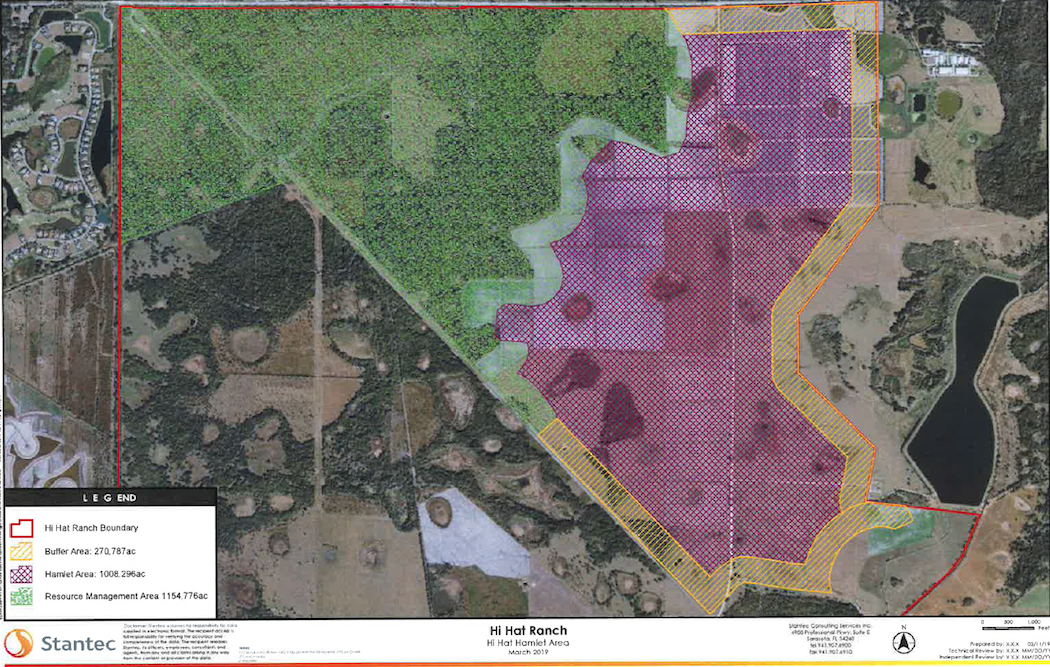
Privately initiated county Comprehensive Plan amendment seeks up to six-fold increase in density for development of part of Hi Hat Ranch


A map submitted to the county shows the area where the density change is being sought. Image courtesy Sarasota County

The Sarasota County Commission has authorized staff to proceed outside the normal cycle with a proposed, privately initiated revision of the Sarasota 2050 Plan that could lead to a significant increase in the number of new homes planned near the intersection of Fruitville Road and Utopia Road.
The property is close to the Mote Aquaculture Park, based on documents filed with the county.
Owned by Hi Hat Ranch LLLP of Sarasota, the approximately 1,000-acre parcel is designated for a 2050 Plan Hamlet, which, the County Code says, is “entitled to a base residential density of 0.29 dwelling units per acre of Developed Area.” The maximum density allowed within the Developed Area is one dwelling unit per acre.
The owners of Hi Hat Ranch are seeking to change the designation of the property to Village Land Use, which has a maximum density of five dwelling units per gross developable area, or six, if the additional units are planned for affordable housing.
The property is in what has been classified as the Central Village Area of the county’s 2050 Resource Management Area, according to a May 21 county staff memo. The owners wanted staff to process the proposed Comprehensive Plan amendment at the same time staff works on a Development of Critical Concern (DOCC) for Hi-Hat Ranch, the memo said.
“The balance of the Hi-Hat Ranch lands are designated Village Land Use and Greenway,” the memo pointed out.
County staff has scheduled a Neighborhood Workshop on the proposed amendment on Tuesday, June 4. The session will be held from 6 to 7 p.m. at St. Margaret Episcopal Church, which is located at 8700 State Road 72 (Clark Road).
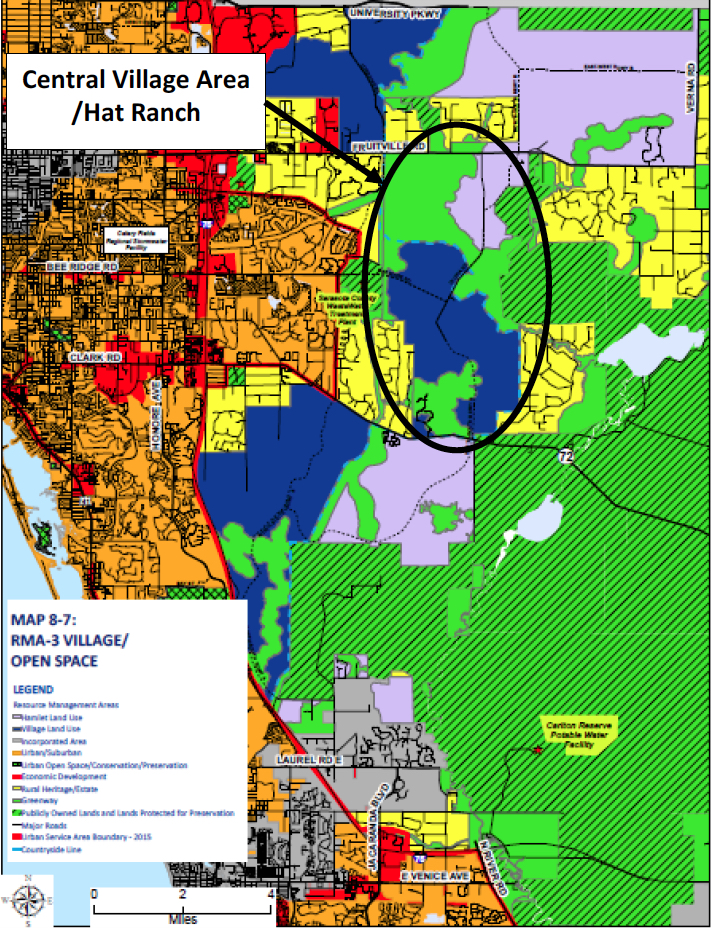
A graphic included with the May 21 county staff memo shows more details of the affected portion of the Sarasota 2050 Resource Management Area. Image courtesy Sarasota County

As part of their May 21 Consent Agenda of routine business items, the county commissioners — without any comment — agreed unanimously that staff could work on the proposed Comprehensive Plan amendment outside the annual cycle approved for such staff undertakings.
The County Code that covers the Sarasota 2050 Plan explains that the Hamlet Planned Development District “provides for detached residential uses, protected open space, Public/Civic uses and limited neighborhood type commercial. The district is not commercial in character.” The Code adds, “Hamlets are collections of rural homes and lots clustered together around a crossroads that may include small-scale commercial, Public/Civic buildings or shared amenities.”
The maximum number of dwelling units is 400, the County Code notes, but the “Preferred Size” is 50 to 150 dwelling units
At least 60% of the area must remain open space, the County Code points out.
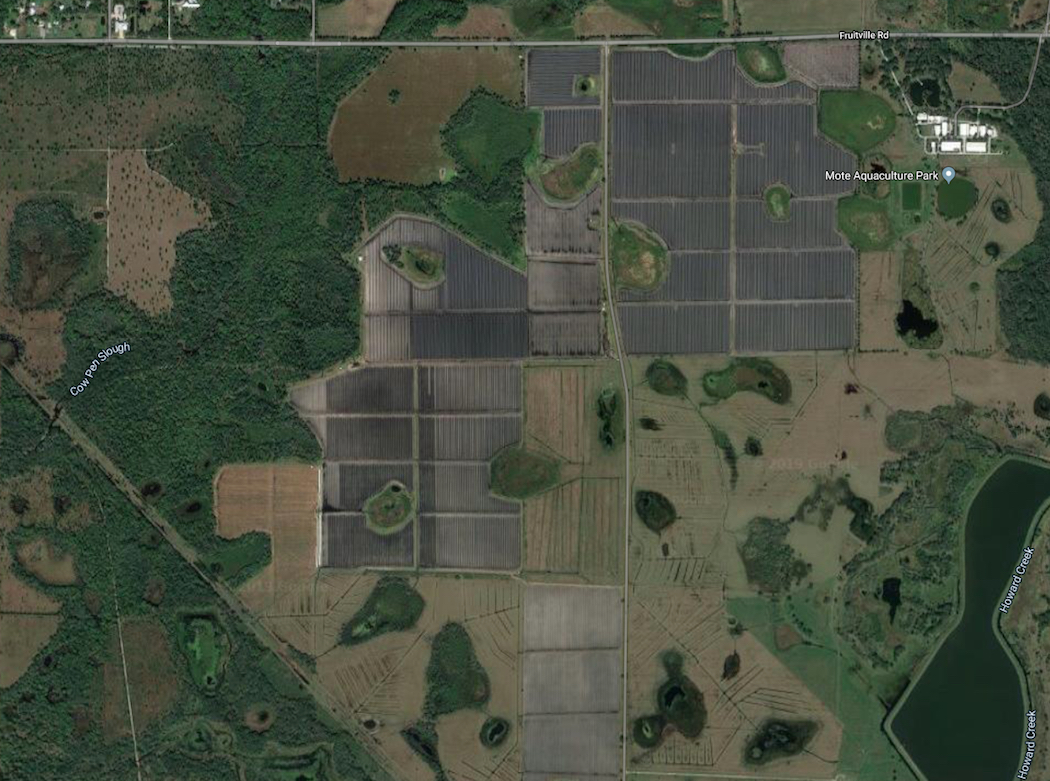
An aerial map shows most of the property where the modification is being sought. Utopia Road is the north-south road west of the Mote Aquaculture Park. Image from Google Maps

On the other hand, the Code says, “A Village is a collection of Neighborhoods that have been designed so that a majority of the housing units are within a walking distance or one-quarter mile radius of a Neighborhood Center. A Village shall be supported by a mixed-use Village Center (designed specifically to serve the daily and weekly retail, office, and Public/Civic use and services needs of Village residents), and the Village shall generally be surrounded by large expanses of Open Space that are designed to protect the character of the rural landscape and provide separation between the Village and existing low density rural development.”
A minimum of 50% of the space must remain open, except for Villages in the Clark Road Properties area of the county, which is south of Clark Road and east of Interstate 75.
Sarasota News Leader review of Hi Hat Ranch parcels on the Sarasota County Property Appraiser’s website found several out of which the designated Hamlet area appears to have been carved. One of them, which comprises 378 acres, had a value of $3,006,700 in 2018, county records show. A portion of that parcel has been deeded to the City of Sarasota, which has a water reclamation distribution system in that area.
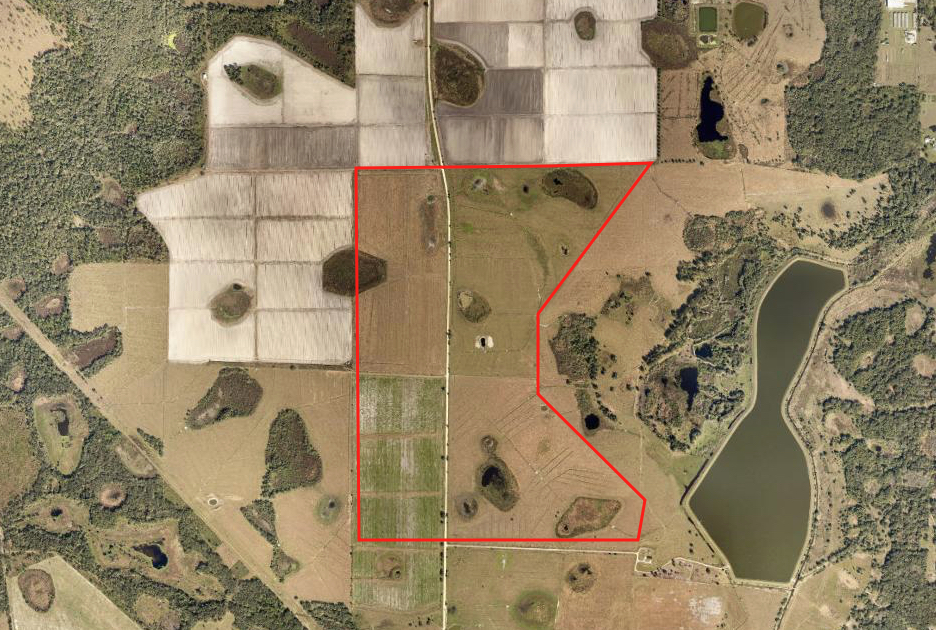
This is one of the Hi Hat Ranch LLLP parcels affected by the Comprehensive Plan amendment that is being sought. Its 2018 value is more than $3 million, the Sarasota County Property Appraiser’s Office records show. Image from the Sarasota County Property Appraiser’s Office

A second parcel, which contains about 388 acres, had a 2018 value of $3,319,700, according to Property Appraiser William Furst’s office’s records.
Hi Hat Ranch LLLP lists its address as 11708 Fruitville Road in the documents it has filed with the Florida Division of Corporations. Its registered agent is Richard E. Turner Jr. of the same address.
News Leader check of the Property Appraiser’s Office records found 22 parcels in the county belonging to Hi Hat Ranch LLLP. All but five of them came under ownership of the company in August 1988, the records show.

Courtesy of the Sarasota News Leader

Subscribe to the SNL


Friday, November 30, 2018

Court hearing in Citizen suit against Sarasota County Tuesday Dec. 4

Citizens sued Sarasota County with respect to the Grand Lakes development. The court has scheduled an Administrative hearing for Tuesday Dec. 4, 9 a.m.:

The suit, David Anderson vs Sarasota County and Ibis Rd. Investors LLC, argues that the Board of Sarasota County Commissioners violated terms of its own Comprehensive Plan in approving Pat Neal's proposed 1,000-home development without including a commercial component. Background on the lawsuit here.

Pat Neal, developer of Grand Lakes

The Dec. 4 hearing details:

David Anderson vs Sarasota County and Ibis Rd. Investors LLC

Tuesday 9 a.m. Justice Center 2071 Ringling Blvd. (NW corner of Ringling Blvd and East Ave little doorway) 

Courtroom #2 6th floor Judge Ffolks

The hearing go two days, more or less.

At stake, in the county's own words, is a core principle of 2050: integrating uses to avoid sprawl:
"the provision for non-residential uses through the establishment of mixed use Village and Neighborhood Centers is central to the concept of Villages as an alternative to urban sprawl. … Without the non-residential uses in close proximity and integrated into the residential uses, the Villages resemble other suburban residential development typical of Sarasota County and other communities.”  (SNL 8.16.18)
The homeowners contend that if Pat Neal is allowed to proceed under the proposed changes to the rules, the development of Grand Lakes
will promote sprawl and encourage disjointed patchwork development—exactly the things the 2050 plan is meant to discourage.
 The county is ignoring its own rules, the citizens say. Future developments could take the County's approval in Pat Neal's case as precedent for coming large-scale developments:
. . . relaxation of the core 2050 principles would open the way for future, large-scale developments such as 12,000-unit Hi Hat Ranch to sprawl rather than conform to contained village templates that link residential and commercial use in a constructive and meaningful manner. (Press release of plaintiffs).
In essence, without public sector stewardship, the business models for single family development could very well lead to sprawl.

Sprawl

Friday, October 17, 2014

Letter from a former Planning Commissioner

October 17, 2014

Becky Ayech
421 Verna Road
Sarasota, Fl.  34240

Sarasota County BCC commissioners@scgov.net

VIA EMAIL

Re:  Sarasota County’s proposed changes to Sarasota’s Comprehensive Plan, Specifically 2050

Mr. Eubanks and Ms. Brookens,

I have been a resident of Miakka (also known as Old Miakka) for 34 years.  I am also the president of the Miakka Community Club Inc. (MCC).  The MCC was formed in 1948 to give a voice to the rural residents in Miakka for preserving and conserving the rural Miakka Community.  Since the Growth Management Act required counties to adopt comprehensive plans, MCC has been an active participate.

When the first Comprehensive Plan (Apoxsee) was adopted in Sarasota, there were provisions to protect the rural area of the county.  Apoxsee recognized the need to have areas in Sarasota for food and fiber production.  Over the years this rural protection has been eroded away.  The “food and fiber” protection was removed several years ago.  The urban service boundary has been moved into the rural area allowing removal of prime agricultural lands1 and replacing them with urban development.  The proposed amendments do nothing to further agriculture protection or rural lifestyles.  The clustering of hamlets under the guise of allowing more land available for agriculture is a ruse.  No data or analysis was presented to identify what lands would be used for agriculture and which lands would become the clustered hamlets.  My experience, as well as experience throughout this country, has been for urban developments to drive agriculture away because of neighbors’ complaints about odors, sounds and smells.  To place 2,400 homes, roughly 5,000 people (the average household in Sarasota is 2.2 persons) in the midst of agriculture is a death toll.  The “hamlets” are supposed to represent a transitional area from urban to rural. This volume of people and the urban style development does not represent or function as a transition. 

The proposed reduction in green space between the “hamlets” also is not a functional transition between developments.  Most property in the area identified for “hanlets” is zoned at one unit per 5 acres and one unit per ten acres.  The property sizes are generally 330 feet by 660 feet and 660 feet by 660 feet, with some at 330 feet by 1320 feet.  A 50-foot setback between “hamlets” isn’t indicative of any rural or agricultural lifestyle or practice.  It is merely “urban sprawl” in the rural area.
   
As a former Sarasota Planning Commissioner, I am cognizant of the requirements of comprehensive plans.  The proposed amendments are not consistent with 163.3177(1), F.S.; 163.3177(1) (a) 9, F.S. and 163.3177(1) (b), F.S. i.e. predictable development standards, urban sprawl and mitigation standards.  The data and analysis as required by 163.3177(1) (f), F.S. were not met. Therefore, DEO has no other alternative than to deny these proposed amendments.

I challenged the 2050 plan per se, and know these amendments would not rise to the “reasonable person” standard in the administrative hearing process.

During a very rigorous DOAH proceeding, there wasn’t any testimony presented to show that these proposed changes were necessary.  Additionally, there weren't any amicus briefs filed to support the proposed changes.

Growth management isn’t about granting privileges to a few but rather about managing growth in a way that protects the existing residents , supports urban infill, protects natural resources and offers a diverse economic base.

Becky Ayech

1 History of Agriculture in Sarasota County.  The Sarasota County Fair Directors and the Sarasota county Historical Commission

Find more letters here, here, and here.

Monday, September 22, 2014

Alternative Models: Poundbury


Not every Florida place has to have walls, deed restrictions and the same narrow series of variations on a theme.

 Poundbury is an experimental new town or urban extension on the outskirts of Dorchester in the county of Dorset, England.
The development is built on land owned by the Duchy of Cornwall. It is built according to the principles of Prince Charles, who is known for holding strong views challenging the post-war trends in town planning that were suburban in character. 
The development is built to a traditional high-density urban pattern, rather than a suburban one, focused on creating an integrated community of shops, businesses, and private and social housing. There is no zoning. The planners say they are designing the development around people rather than the automobile, and they aim to provide a high-quality environment, from the architecture to the selection of materials, to the signposts, and the landscaping. To avoid constant construction, utilities are buried in common utility ducts under the town. Common areas are maintained by a management company to which all residents belong.[1]