Showing posts with label marketing. Show all posts

Friday, May 24, 2019

Benderson Rowing Park gets cut in funding

Courtesy of the Sarasota News Leader


Subscribe to the SNL


County Commission cuts SANCA’s 10-year funding request to three and emphasizes need for better outreach to the public


New board chair and SANCA CEO cite economic impact of Benderson Park events
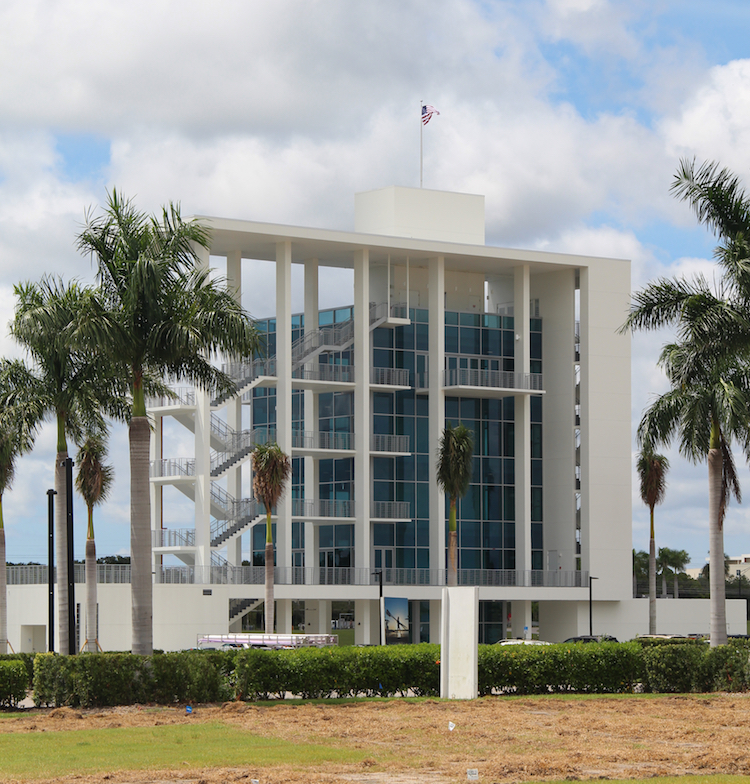

The Finish Tower has become the key landmark at Benderson Park. File photo

The new chair of the board of directors of the Suncoast Aquatic Nature Center Associates (SANCA), which manages Sarasota County’s Nathan Benderson Park, came before the County Commission on May 17 with figurative hat in hand.
Ronald Shapo asked for a 10-year funding commitment, stressing that that would give SANCA better standing as it seeks private financial support for the park.
The county commissioners agreed unanimously to three years, on a motion by Commissioner Alan Maio, and emphasized to Shapo the need for SANCA to do a better job of marketing the park to the public. (Commissioner Nancy Detert was absent from the discussion and vote.)
Nicole Rissler, director of the county’s Parks, Recreation and Natural Resources Department (PRNR) told the commission during its May 17 budget workshop that her staff already had built into its Fiscal Year 2020 budget a request of $1,189,000 for SANCA. Rissler also explained that, after months of analysis, staff had determined that, based on SANCA’s budget for the current fiscal year, it would be more expensive for her staff to manage the park.
The SANCA FY19 budget, she noted, is $2,102,595. If PRNR employees were handling all the work, it would cost at least $2,304,689, Rissler said. That figure did not include expenses associated with events or the necessity of one-time payments for additional county vehicles for staff, she added.
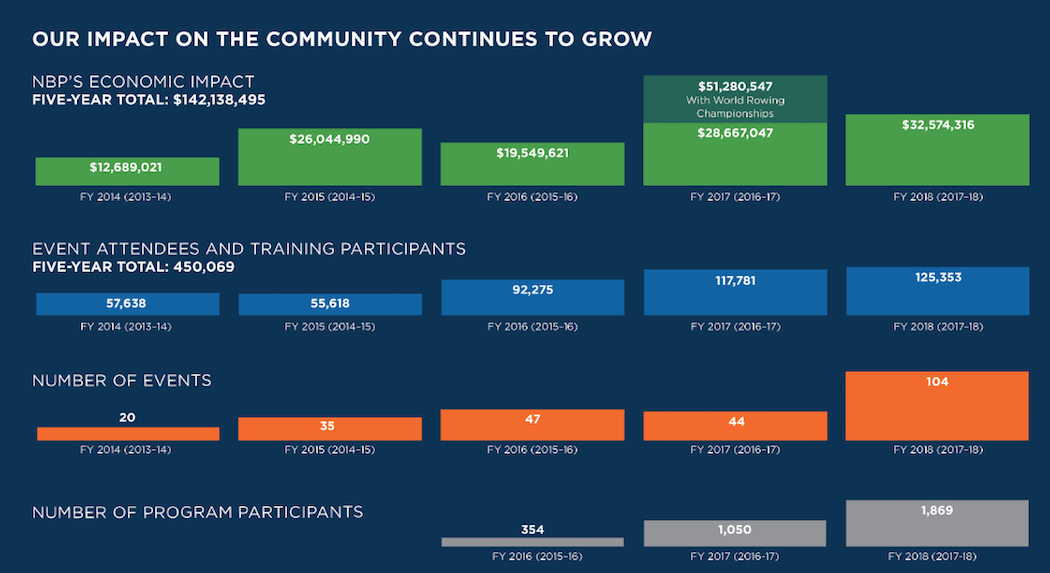


This slide offers information about Benderson Park’s impact on the local economy. Image courtesy Sarasota County

Last year, the commission agreed to give SANCA $858,353 in additional funding for the 2019 fiscal year. During a June 20, 2018 budget workshop, they also suggested that their staff and SANCA representatives consider a host of possibilities for generating extra revenue — from T-shirt sales to charging more for parking during events to dining options.
On May 17, Shapo said the SANCA board members’ top commitment to the commission is to focus on marketing. They recognize, he continued, that the nonprofit has not done an adequate job of publicizing SANCA’s role with Benderson Park.
Moreover, Shapo told the commissioners, the SANCA board is committed to doing a better job of communicating with them.
Chair Charles Hines pointed out that he has stressed over the past year the need for SANCA to “take the time and educate our community” about why SANCA exists.
As he has spoken with legislators in Tallahassee, Hines continued, he has had to explain to them what SANCA does.
“Some people still think it’s Randy Benderson’s for-profit entity,” Hines said of the president of Benderson Development Co.
And although Shapo talked of the recent expansion of the SANCA board, Hines also suggested even greater local representation among the members. “We have the two premier rowing clubs in our community that are probably the envy of the entire country.”
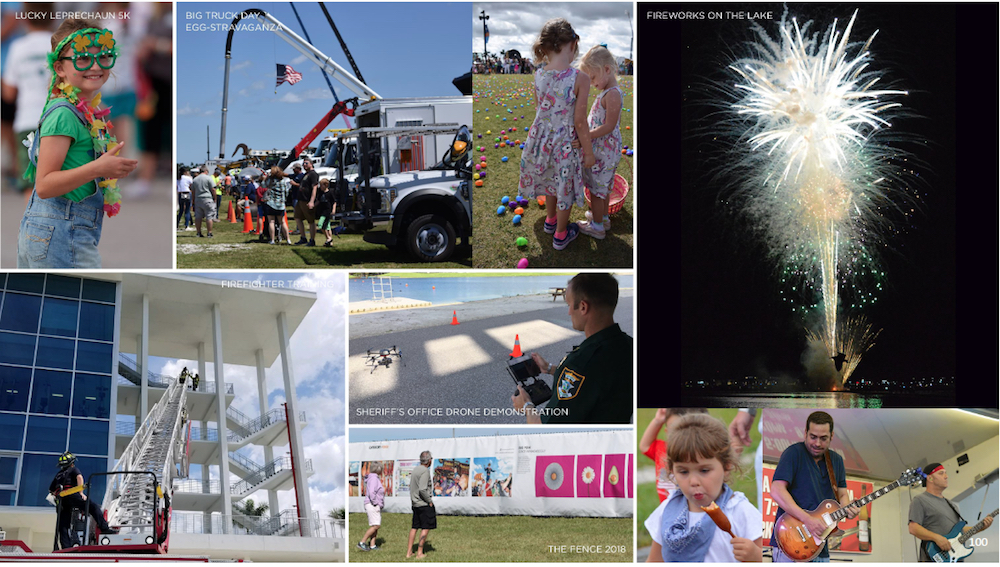


A slide offers a sampling of events at Benderson Park. Image courtesy Sarasota County

As Rissler noted earlier, the park was renamed Nathan Benderson Park in 2007 “after a generous donation by the Benderson Family.” Nathan Benderson, who established Benderson Development Co., was Randy Benderson’s father.
As the first commissioner to respond to the SANCA funding request, Maio explained that he and his family “have an extreme fondness for Nathan Benderson Park.”
Maio related a couple of anecdotes to underscore that statement.
Then he was blunt with Shapo: “I’m not going to commit to 10 years. I think that our staff has already supported your first year,” Maio continued, referring to Rissler’s comment about the funding for 2020.
“I don’t feel comfortable to committing further boards to this,” Maio added, noting also that he was just re-elected in November 2018, so he would be on the board through November 2022 — unless, he joked, he drowned at Benderson Park.
Shapo said that the current contract between SANCA and the county already makes it clear that the county’s funding level for the nonprofit is tied to the availability of funds. He understood, Shapo said, that one commission cannot legally bind future commissions to funding commitments.
“What I’m proposing for my one vote,” Maio responded, “you take something less than 10 years,” perhaps three. “I think it would be better at that point to renegotiate. … You don’t want the public relations of us ending a contract with you. I offered the three years as a very amicable way to move this forward after expressing my love for Nathan Benderson Park, a love that not 100% of our citizens, as you know, have.”
“And I appreciate the three years,” Shapo said, though he added that he would toss out the idea of five years as a compromise.



These are the members of the SANCA board. Image courtesy Sarasota County

Commissioner Michael Moran talked of the “very successful” public/private partnership between Sarasota County and SANCA. Still, Moran continued, “This is where we represent the taxpayer dollars.”
Commissioner Christian Ziegler concurred on the latter point, “We’ve got to be good stewards of the tax dollars.”
Moran told Shapo that he believes SANCA needs to work harder to realize the full potential of the 600-acre park. “This is a massive facility that needs to be maximized,” Moran said, calling for a faster pace for entrepreneurial sales and marketing efforts.
He asked Shapo if the SANCA board takes a monthly look at sales projections and revenue. What pressure is the board putting on staff in regard to improved sales and marketing, Moran asked.
“I think the pressure is being put on by ourselves,” Shapo replied, reprising his earlier comment that better marketing is the board’s top priority going forward.
Shapo then talked of his faith in the impact one new board member will have on the marketing initiatives. Shapo mentioned Randy Mallitz, president of the U.S. division and CEO of the Asia division of EAR Specialty Composites, which one of SANCA’s slides identified as a “global technology company.”
Shapo added, “I think he’s going to be an incredible asset.”
Moran once again asked Shapo if the SANCA board members each month talk about revenue generation.
Shapo responded that they review and discuss their success — or lack thereof — every month in regard to fundraising and income-producing goals. “We will be doing that, I believe, at an increasing level.”
For example, Shapo continued, the Finish Tower on the property has been host to 250 events. “But there’s the potential to do many, many more.”
Past, present and future
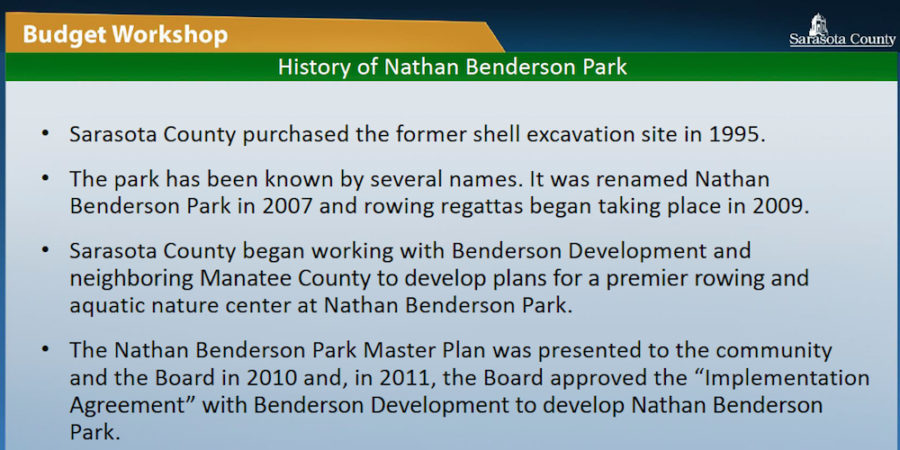
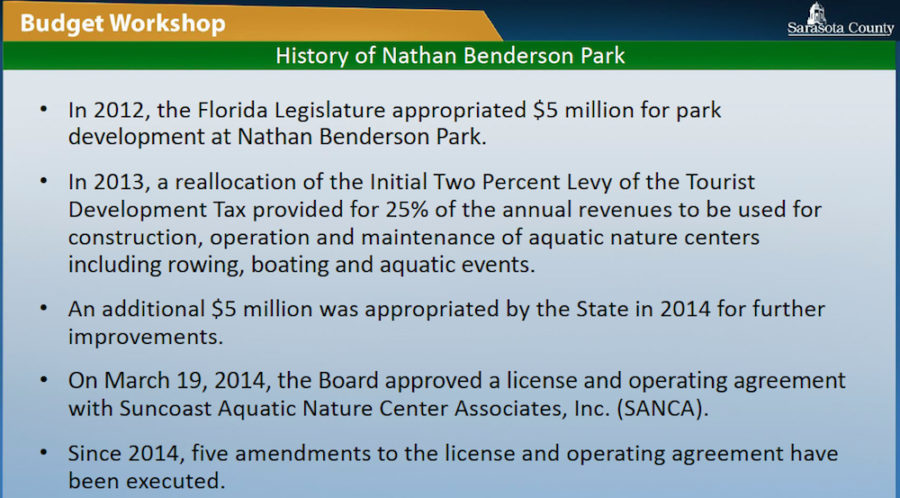

These May 17 slides provide a history of Benderson Park. Image courtesy Sarasota County

During her opening remarks on May 17, Rissler, the PRNR director, pointed out that numerous events do take place at Benderson Park each year. “We also look at this as a significant regional park for our system,” with “thousands of people very day” using it.
Shapo quickly put the focus on numbers. For the past five years, he said — from 2014 through 2018 — Visit Sarasota County has estimated that the total economic impact of the park on the county was $142,138,495. He stressed that that was an average of more than $28 million per year.
It hosted 14 major national and international events during that period, including the 2017 World Rowing Championships, and it will be the site in late July of the Under 23s World Rowing Championships. SANCA is projecting 40 nations will participate in the latter event, generating 5,000 room nights during a time of year Shapo called the “slow season” for tourism.
Stephen Rodriguez, president and CEO of SANCA, noted that, among upcoming event commitments, the Florida Scholastic Rowing Association plans to hold both its Sculling and Sweeps championships at the park through 2021. Each of those events, he said, brings in about 9,000 attendees.
Even more important, Rodriguez continued, the park will host the 2020 Olympic and Paralympic Rowing Trials. USRowing is in discussions with NBC about televising those competitions, Rodriguez added.
Moreover, “The National Rowing Foundation is prepared to commit to make Sarasota the home of the National Rowing Hall of Fame and Museum,” Rodriguez said. The permanent home for the memorabilia would be the Aquatic Nature Community Center, or boathouse. In the meantime, he noted, one floor of the Finish Tower would be dedicated to changing displays featuring items in the Hall of Fame’s collection.
(Later, Shapo framed the Hall of Fame discussion in a slightly different way, saying, “[It] is seriously considering coming here.”
Rodriguez noted, “Rowing [was] the first collegiate sport in the U.S.”
In 2018 alone, Shapo continued, 475,000 local residents used the park.
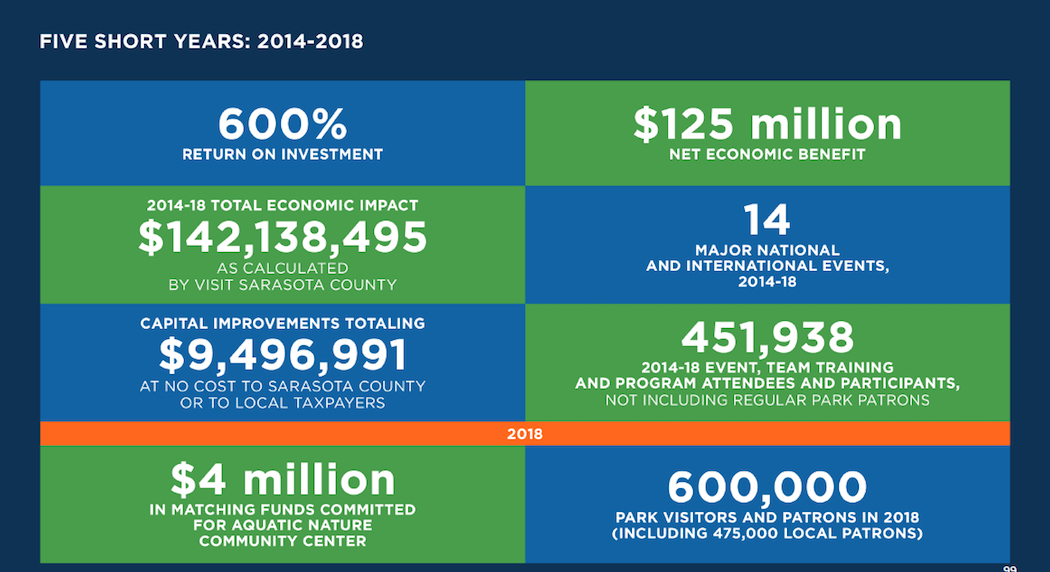


This slide offers more figures about the park’s impact on the economy. Image courtesy Sarasota County

He also pointed to the board’s plans for the next major improvement to be the Aquatic Center, which generally has been referred to as the “boathouse.”
That facility was touted for years by Benderson Park representatives as the key means of making the park financially self-sustaining, as it not only would be a storage facility for rowing equipment for park users but also a place that could be rented for many types of functions.
The SANCA board has $4 million in commitments as matching funds for the project, Shapo told the commissioners.
Already, he continued, his board is searching for a full-time employee whose job it will be to raise private money for the park. Extensive public outreach will be needed, he said, to persuade regional and national companies of the benefit of being affiliated with the complex.
The county money the board was seeking for 10 additional years, he emphasized, would go only toward park maintenance and operations.
Shapo asked the commissioners to keep in mind “this was a borrow pit. It is nothing short of amazing” that it has undergone such a transformation, he added.
“I want this to be our Central Park,” Maio told Shapo as the discussion neared its end. He suggested Shapo and his colleagues on the SANCA board take the next three years of county funding support to achieve that vision. Then the commission could consider funding for the nonprofit for another five years, Maio said.


Courtesy of the Sarasota News Leader

Subscribe to the SNL


Sunday, September 30, 2018

Stadium deal could devastate Sarasota's tourism marketing


Courtesy of the Sarasota News Leader

Subscribe to the SNL


Tourist Development Council members say promotional funding critical for county’s tourism agency to fight widespread negative publicity over red tide


County Commission to have final say about how to pay for needed repairs to Ed Smith Stadium
(Editor’s note: This article was updated late in the morning of Sept. 21 to make it clear that the $97 million figure for the Baltimore Orioles’ economic impact on Sarasota County is the latest annual figure, based on research undertaken for Sarasota County.)

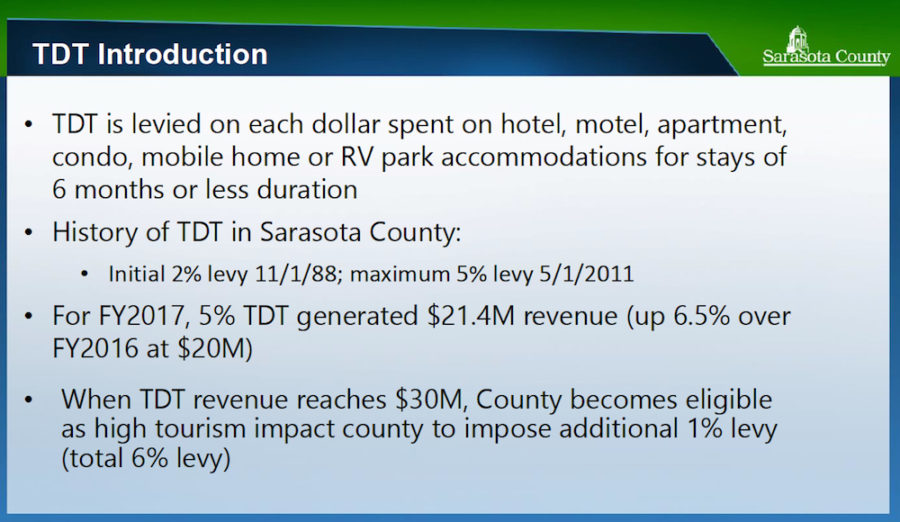
A county fact sheet offers details about the Tourist Development Tax. Image courtesy Sarasota County

Given the significant downturn in business and resulting employee layoffs since early August because of red tide, the members of Sarasota County’s Tourist Development Council (TDC) this week voted to recommend the County Commission not reduce the marketing budget in coming years for Visit Sarasota County.
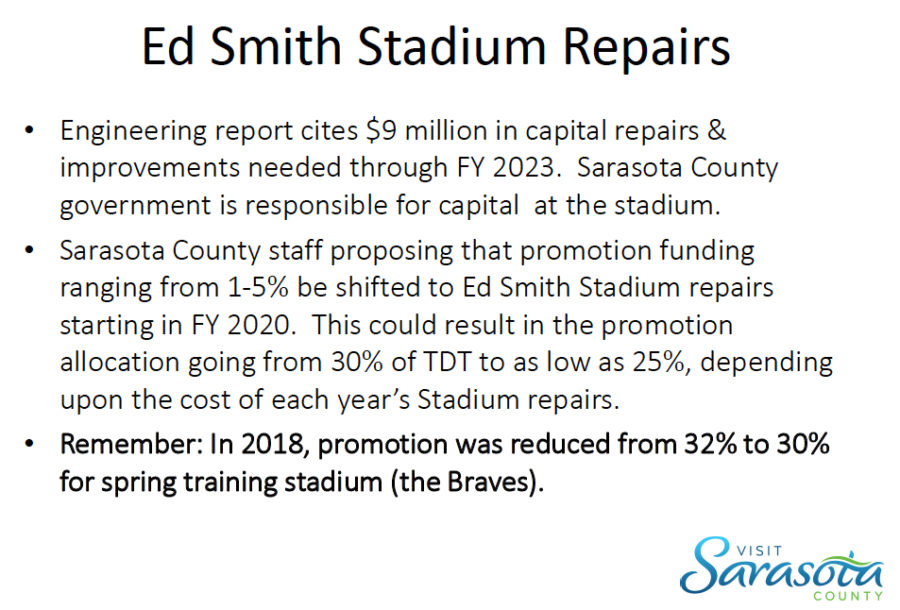
As she had during the commission’s Aug. 22 budget workshop, Carolyn N. Brown, director of the county’s Parks, Recreation and Natural Resources Department, explained to the TDC members on Sept. 17 that staff had considered a variety of options to pay for repairs the county is obligated to make to Ed Smith Stadium in Sarasota within the next five years. A decrease in promotional funding for the county’s tourism agency budget was deemed the best of those, Brown added.
An independent assessment — completed in July — of the county-owned stadium and Buck O’Neil Baseball Complex at Twin Lakes Park on Clark Road showed that about $16.5 million will be needed over the next 10 years for the repairs and improvements, Brown said. The county’s General Fund — which covers the operations of most county departments and those of the majority of the county’s constitutional officers — is too constrained to handle the expenses, she added.
The Baltimore Orioles use both facilities; they have been conducting Spring Training at Ed Smith Stadium since 2010.
Brown also noted that the county is obligated, under the terms of a Memorandum of Understanding with the Orioles, to keep Ed Smith Stadium “at a Major League Baseball standard.” The agreement calls for periodic assessments of the facilities, she explained.

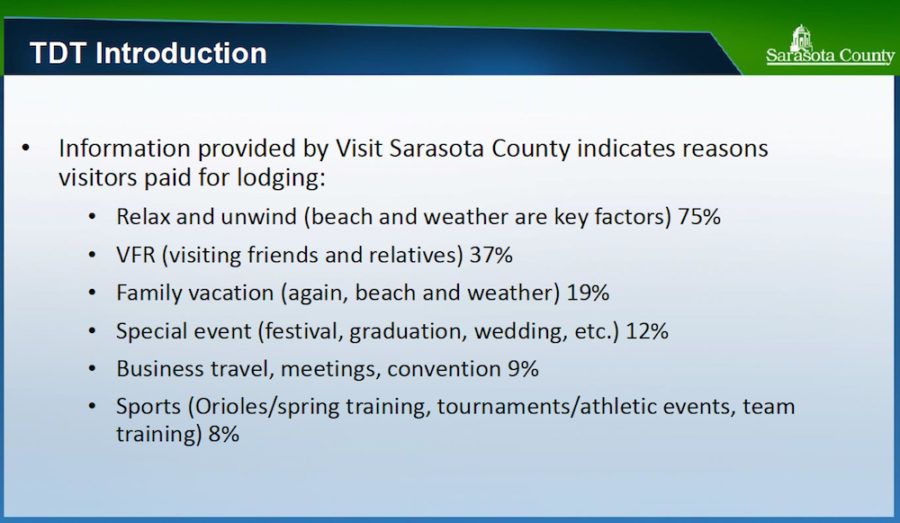
These are the top reasons people visit Sarasota County, according to research undertaken for Visit Sarasota County. Image courtesy Sarasota County

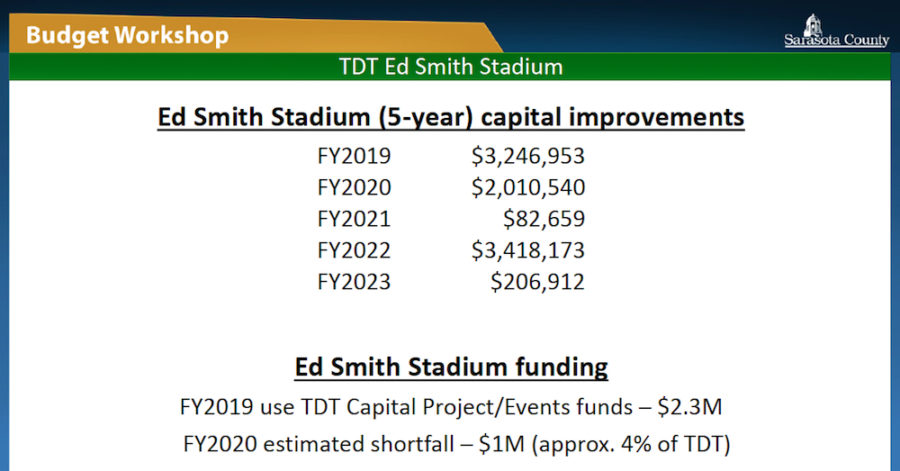
The county has sufficient revenue in the Tourist Development Tax (TDT) reserve fund for Capital Projects/Events to cover $2.3 million of the approximately $3.3 million the county will have to spend at Ed Smith in the 2019 fiscal year, Brown said. The extra $1 million will come out of TDT revenue allocated for sports stadiums. However, staff does not anticipate having enough TDT money for the projects planned for the 2020 and 2022 fiscal years, she continued. Therefore, staff recommended reducing the money allocated to VSC for promotional purposes by about 5% in those two fiscal years, Brown pointed out, to cover the stadium expenses.
During the County Commission’s Aug. 22 budget workshop, the board members concurred with the staff recommendation. However, Commissioner Charles Hines, who chairs the TDC, noted that that advisory council would have an opportunity to review the issue and offer its opinion.
Hines did not vote at the conclusion of the presentations and discussion during the Sept. 17 TDC meeting. He abstained, he said, as he would be participating later in a formal vote as a member of the County Commission.
Media Relations Officer Drew Winchester told The Sarasota News Leader this week that the commission is scheduled to vote during its Oct. 9 regular meeting on whether to authorize a public hearing on staff’s proposed change to the TDT ordinance to shift funds from the promotional efforts for VSC to the stadium account. If the commission approves holding the hearing, Winchester added, that would be conducted on Oct. 23.
Vice Chair Norman Schimmel initially said he wanted to abstain from the vote, as well. Schimmel added that he first wanted to see a presentation Visit Sarasota County (VSC) President Virginia Haley plans for the TDC in October, showing how her staff would be modifying its business plan for the 2019 fiscal year to try to counter all the negative national publicity about red tide.
After Hines said he did not believe the TDC’s governing rules would allow Schimmel to abstain, Schimmel decided to join his advisory council colleagues in unanimously opposing any reduction in the VSC marketing funds.

This Visit Sarasota County graphic argues against the change in allocation of revenue to promotional initiatives. Image courtesy Sarasota County

“It is devastating,” TDC member Bob Daniels, who serves on the Venice City Council, said of the loss of tourism business — and worker layoffs — because of red tide. “It’s a shame we have to put the Orioles on the same table” as promotional funding.
Nine representatives of tourism-related businesses implored the TDC members not to take money from VSC.
“I can’t believe that this group is even considering cutting the marketing [money] for Visit Sarasota!” Paul Parr, who owns 12 vacation rental condominiums on Siesta Key, told the council.
Before red tide began plaguing the shoreline, Parr said, his August bookings were 30% ahead of the number for August 2017. “We ended up closing out August 30% behind last year.”
All of his September guests cancelled, he added. “I got the last two today. So my numbers are 30% down for August and 100% down for September …”
John Tanner, general manager of Innisfree Hotels, which manages the Indigo and the Embassy Suites in downtown Sarasota, told the TDC members, “It’s imperative now” to ensure Visit Sarasota County has sufficient marketing funds.

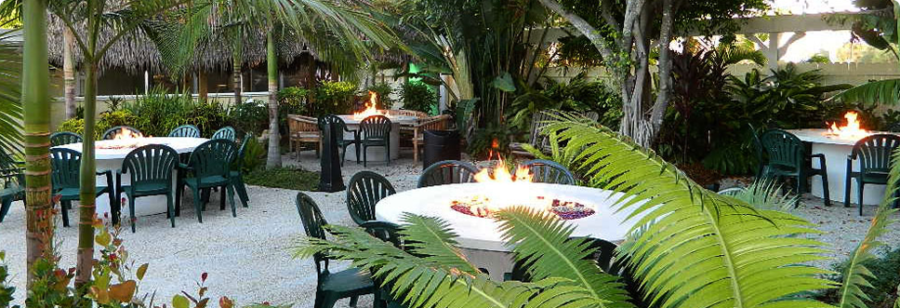
This is one of the dining areas at Pop’s Sunset Grill on the Intracoastal Waterway in Nokomis. Photo from the restaurant website

Joe Farrell, owner of Pop’s Sunset Grill on the Intracoastal Waterway (ICW) in Nokomis, said, “We’re down 60% in the last nine weeks.”
TDC member Erin Silk, CEO of Venice MainStreet, reported that that nonprofit had undertaken a survey since red tide had worsened. Of the 134 businesses that responded, she said, 72% were located within 3 miles of the beach or the ICW. Two “outliers” reported losses of $1 million and $3 million, Silk continued. Without them, the average loss for each of the other businesses was about $15,800.
Altogether, she continued, 10% said their revenue was down more than 50% for the month of August; 30% said business was down from 25% up to 50%; and 36% had had to cut employees.
“It is our duty to protect our local businesses,” Silk added.
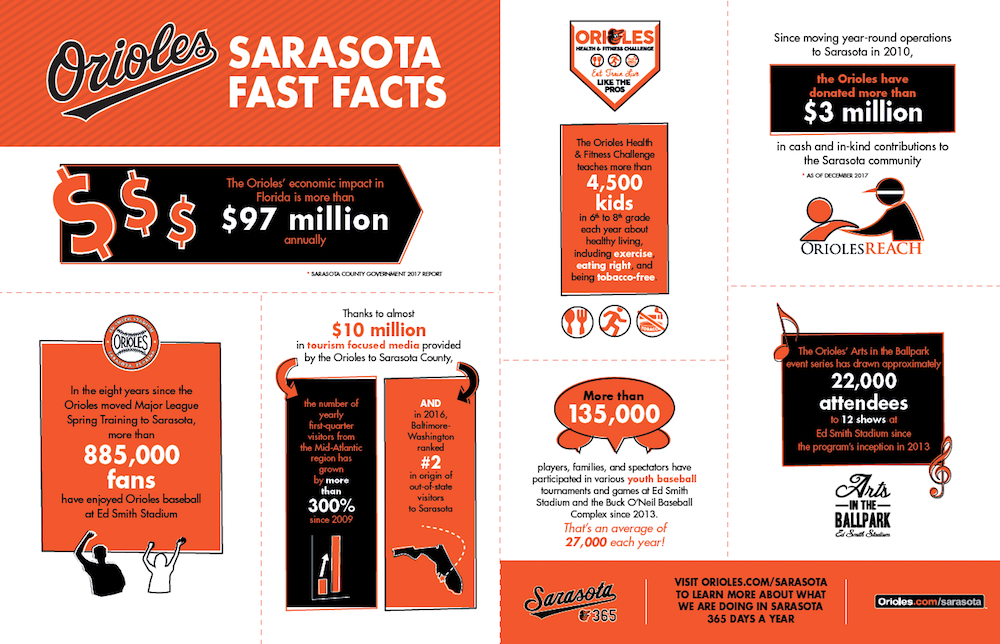
Yet, David Rovine, vice president for the Orioles in Sarasota, pointed out that the team has provided more than $10 million to Visit Sarasota County for promotional efforts over the past nine years. “This investment is not mandated by our contract with the county,” he added. “It’s a commitment from the Orioles … that is unmatched in Major League Baseball and possibly in professional sports.”
Rovine noted that since the team began Spring Training in Sarasota, the number of annual visitors to Sarasota County from the Mid-Atlantic States during the first quarter of each year had grown 300%.

A graphic provides details about the Baltimore Orioles’ impact on Sarasota County’s economy. Image courtesy Sarasota County

The Orioles do not just conduct Spring Training, he stressed. They also host events throughout the year, including Fall Instructional League games and youth baseball tournaments, which generate hotel stays.
Moreover, Rovine said, the team elected not to construct dormitories for players, as many other teams have done in areas where they hold Spring Training. Instead, Rovine pointed out, the Orioles have spent more than $15 million on hotel room nights in the county for players and staff.
Brown of the Parks, Recreation and Natural Resources Department also pointed out that the Orioles contribute about $97 million a year to the county’s economy, based on research undertaken for the county.
“This is probably one of the hardest debates and discussions I’ve had,” Commissioner Hines said, since he became the TDC chair in late 2014.
The stadium issues and the money

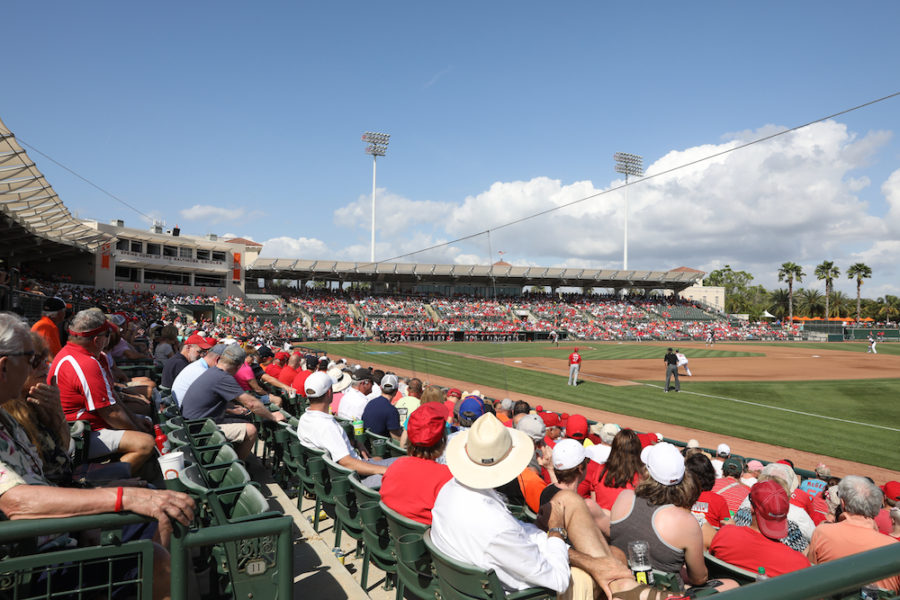
Fans watch a game on Feb. 28 at Ed Smith Stadium. Image copyright by the Baltimore Orioles

During her Sept. 17 presentation, Brown explained that the comprehensive facilities assessment for Ed Smith Stadium and the Buck O’Neil Baseball Complex determined a number of issues that needed to be addressed over the next decade.
The projects planned for the 2019 fiscal year, she continued, will include renovations of practice fields 2 and 3 and the main field at the stadium; replacement of the remaining parts of the irrigation system installed in 1989; replacement of the top coat on the flooring in various areas; and the installation of equipment for lightning protection.
The biggest estimated expense listed in the report for FY19 is $1.5 million to raise the outfields to the infield level on practice fields 1, 2 and 3 and laser-grading of the fields. That work would cost $500,000 per field, the report said.
Brown noted that the study was undertaken by an Orlando firm called ZHA, which focuses on professional sports facilities.
The county and the Orioles each contribute $150,000 per year to a “CAPX” — capital expenditures — fund, she said, but that revenue cannot begin to cover the expenses outlined in the study.

A chart shows the funds needed over the next five years for repairs and renovations at Ed Smith Stadium. Image courtesy Sarasota County

In response to a question, Kim Radtke, director of the county’s Office of Financial Management, explained that if the county were to borrow the $8 million for five years to cover the repairs and renovations, the debt service would be $1.7 million per year, plus the county would incur expenses for issuing the bonds. VSC staff had suggested the bond issue as an alternative.
Brown also noted that staff had considered other ways of reapportioning the TDT revenue, but she stressed the need for continued beach maintenance and renourishment, as well keeping intact the funding dedicated to the arts in the community and to Nathan Benderson Park, which hosts national and international rowing events, among other activities.
The Visit Sarasota County perspective

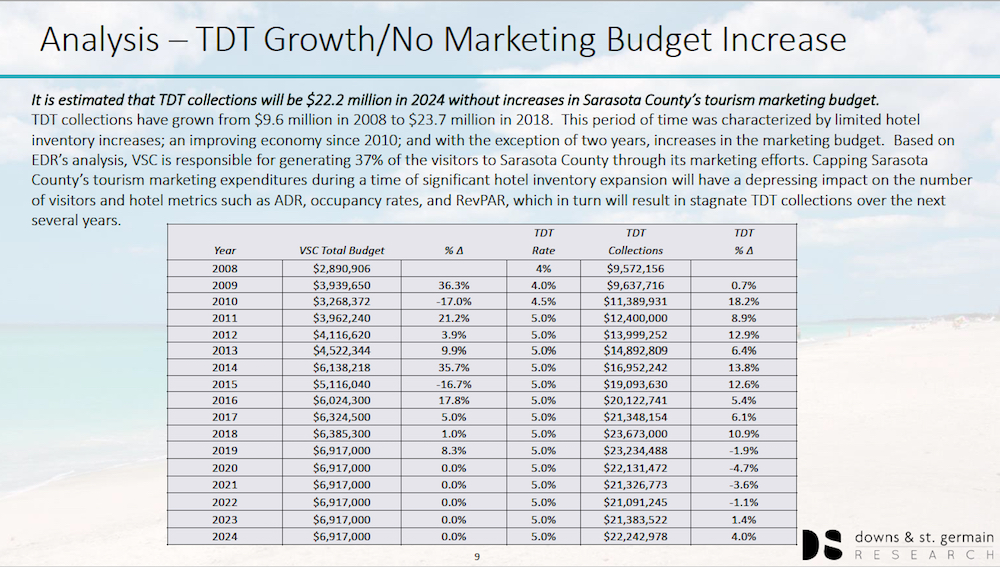
A chart prepared for Visit Sarasota County by Downs & St. Germain Research offers the tourism agency’s perspective on anticipated growth in TDT revenue. Image courtesy Sarasota County

During her portion of the presentation, Haley, the president of Visit Sarasota County (VSC), pointed out, as she had earlier this year to the TDC, that the county will see an addition of 1,177 hotel rooms by the end of this year. That represents a 23% increase, she said.
To maintain the current occupancy levels, she continued, 225,000 more room nights would have to be sold in FY19, which would mean drawing 10% more visitors. “We are averaging 2 to 3% a year,” she said of the growth in the number of tourists.
The less demand for rooms, Haley stressed, the lower the room rates hotels can charge. The lower the rates, she continued, the less Tourist Development Tax revenue is produced, as the tax is 5% on accommodations rented for less than six months a year.
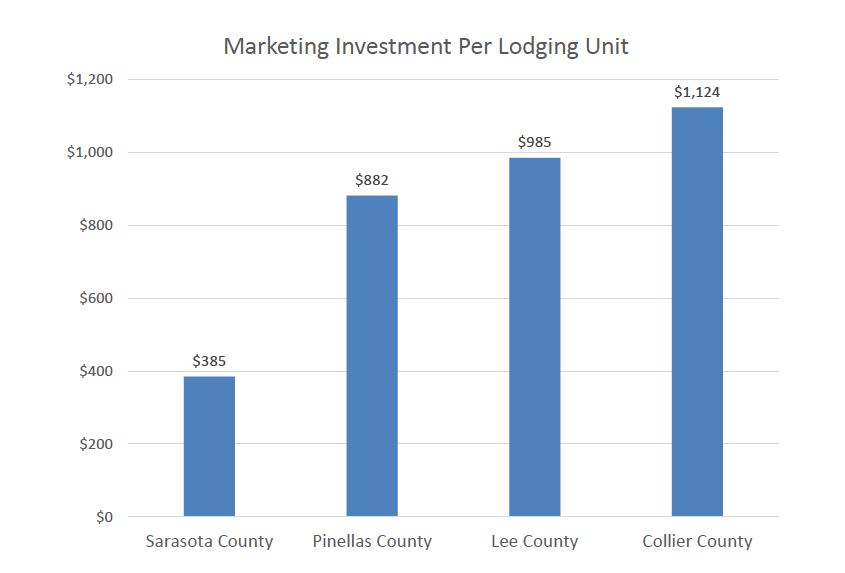
She showed the council a slide that said the county’s tourism promotion investment per lodging unit is $385. Through June of this year, the slide noted, the revenue per available room averaged $134.43, a 2.5% drop from the figure for the same period of the 2017 fiscal year.

A bar graph compares promotional investments of Sarasota County and neighboring counties. Image courtesy Sarasota County

In Pinellas County, the slide said, the revenue per available room had grown 2.9% for this fiscal year, through June. Pinellas invests $882 per lodging unit, the slide noted.
Sarasota County has lagged behind its competitor counties in terms of tourism promotional spending for the past 25 years, Haley said. “It’s just gotten worse over time.”
“We’re warning you,” she added: “Continual nibbling away of tourism marketing dollars” will continue to lead to negative consequences for TDT revenue.