Showing posts with label orioles stadium. Show all posts

Saturday, March 16, 2019

Antunes: Bayfront Park -- Another Big Promise?

Cathy Antunes's blog, TheDetail.net, is the intelligent reader's guide to Sarasota politics.

This column, entitled Bayfront 20Money, appeared in The Detail 3.13.19:


When it comes to achieving a big goal, good intentions are not enough. Commitment is essential. Commitment is what separates doers from dreamers. Planning for the City of Sarasota’s future Bayfront Park—the public’s 53 waterfront acres including the greening of the Van Wezel parking lot—has now moved beyond the “vision” stage into the “make it happen” stage.

Historically, this is where big plans in Sarasota can go very wrong.

We’ve seen big promises when it comes to public-private partnerships before.

The Benderson Rowing Park nonprofit, SANCA (Suncoast Aquatic Nature Center Associates), said they would raise $22 million to construct a boathouse, grandstand and finish tower in time for the 2017 World Rowing Championships at the rowing park. Instead of SANCA raising that $22 million, a second nonprofit, the Benderson Foundation, funded the $5 million finish tower just in time for the event. The rowing p ark still lacks a boathouse and grandstand.

Public money—over $50 million—has been the main source for the rowing park’s construction. Sarasota County is the ongoing source of funds for park maintenance. SANCA has not brought the funding it promised.

In 2009, as part of their stadium deal, the Orioles promised to raise $10 million to construct a Cal Ripken Youth Academy out at Twin Lakes Park. This was the sweetener, the game-changing project that was going to “re-invent spring training.” Kids playing with the pros, a great economic engine that would fuel our local economy! Today there is no Cal Ripken Youth Academy. Taxpayers funded the stadium but didn’t get the baseball academy they were promised in return.

Tangible commitments are SMART—Specific, Measurable, Attainable, Relevant and Time-Bound. Both the rowing park and Cal Ripken Youth Academy were promises, not commitments. The associated contracts between the County a nd SANCA, and between the County and the Orioles were effective at compelling the County to spend public money, but worthless regarding ensuring the promised private sector financial support.

Enter the Bayfront Park Conservancy agreement.

Everyone agrees a 53-acre bayfront park is a great idea. The park vision includes a softened shoreline, transformation of the Van Wezel parking lot into green space and a new performing arts hall. Estimates for the cost of the envisioned Bayfront Park are up to $500 million.  The contract currently being hammered out between the BPC and the City of Sarasota should answer a fundamental question: Why does the City need the BPC? What tangible value does the conservancy bring to the table? Among other problems, there is no dollar amount specified that the BPC will raise and no associated deadline.

Funding the ongoing costs of operation and maintenance of this new park will be critical to its financial sustainability and the financial health of the City of Sarasota. The annual operations and maintenance costs for the proposed park has been estimated at $5 million to $6 million. The draft agreement says the BPC will develop an operating and maintenance plan for each phase of the park, but there is no requirement that the BPC plan actually be successful.

This park plan began with an emphasis on private money. However, it has become clear that the lion’s share of the project financing will come from public coffers. The current contract obligates the City financially, but fails to spell out the financial commitment of the private sector. Come on people. We’ve been down this road before. Show us the money

The more specific the contract is about the City’s obligations, and the more vague the contract is about the conservancy’s obligations, the more reason there is to for City residents to be concerned.  The City Commission must get this right.

Cathy Antunes is host of The Detail on WSLR. 


Sunday, September 30, 2018

Stadium deal could devastate Sarasota's tourism marketing


Courtesy of the Sarasota News Leader


Subscribe to the SNL


Tourist Development Council members say promotional funding critical for county’s tourism agency to fight widespread negative publicity over red tide


County Commission to have final say about how to pay for needed repairs to Ed Smith Stadium
(Editor’s note: This article was updated late in the morning of Sept. 21 to make it clear that the $97 million figure for the Baltimore Orioles’ economic impact on Sarasota County is the latest annual figure, based on research undertaken for Sarasota County.)

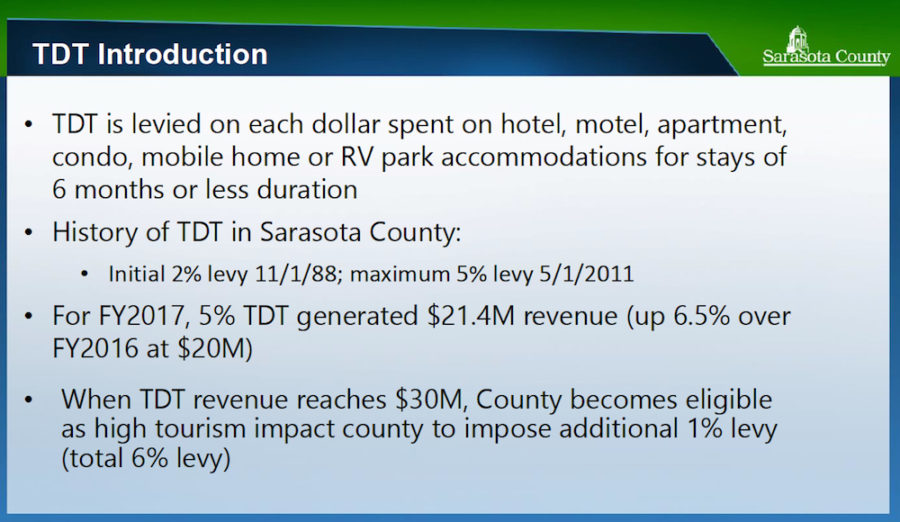
A county fact sheet offers details about the Tourist Development Tax. Image courtesy Sarasota County

Given the significant downturn in business and resulting employee layoffs since early August because of red tide, the members of Sarasota County’s Tourist Development Council (TDC) this week voted to recommend the County Commission not reduce the marketing budget in coming years for Visit Sarasota County.
As she had during the commission’s Aug. 22 budget workshop, Carolyn N. Brown, director of the county’s Parks, Recreation and Natural Resources Department, explained to the TDC members on Sept. 17 that staff had considered a variety of options to pay for repairs the county is obligated to make to Ed Smith Stadium in Sarasota within the next five years. A decrease in promotional funding for the county’s tourism agency budget was deemed the best of those, Brown added.
An independent assessment — completed in July — of the county-owned stadium and Buck O’Neil Baseball Complex at Twin Lakes Park on Clark Road showed that about $16.5 million will be needed over the next 10 years for the repairs and improvements, Brown said. The county’s General Fund — which covers the operations of most county departments and those of the majority of the county’s constitutional officers — is too constrained to handle the expenses, she added.
The Baltimore Orioles use both facilities; they have been conducting Spring Training at Ed Smith Stadium since 2010.
Brown also noted that the county is obligated, under the terms of a Memorandum of Understanding with the Orioles, to keep Ed Smith Stadium “at a Major League Baseball standard.” The agreement calls for periodic assessments of the facilities, she explained.

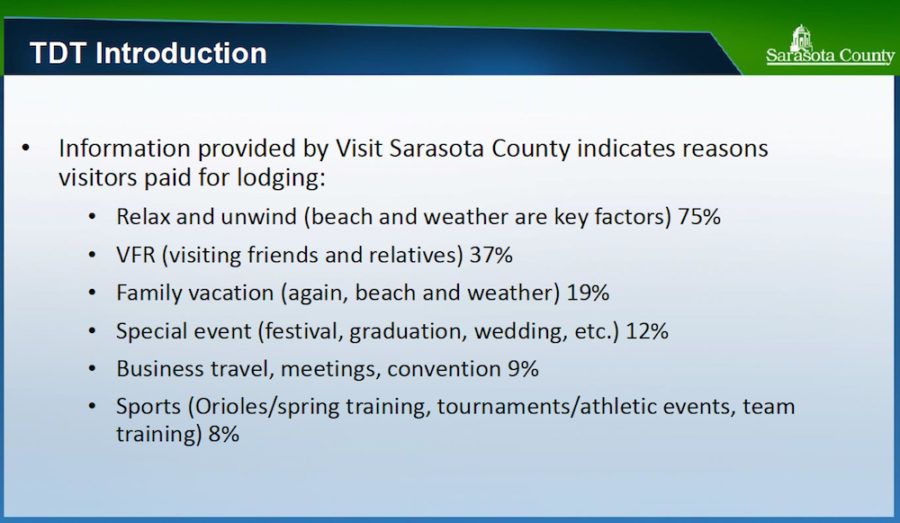
These are the top reasons people visit Sarasota County, according to research undertaken for Visit Sarasota County. Image courtesy Sarasota County

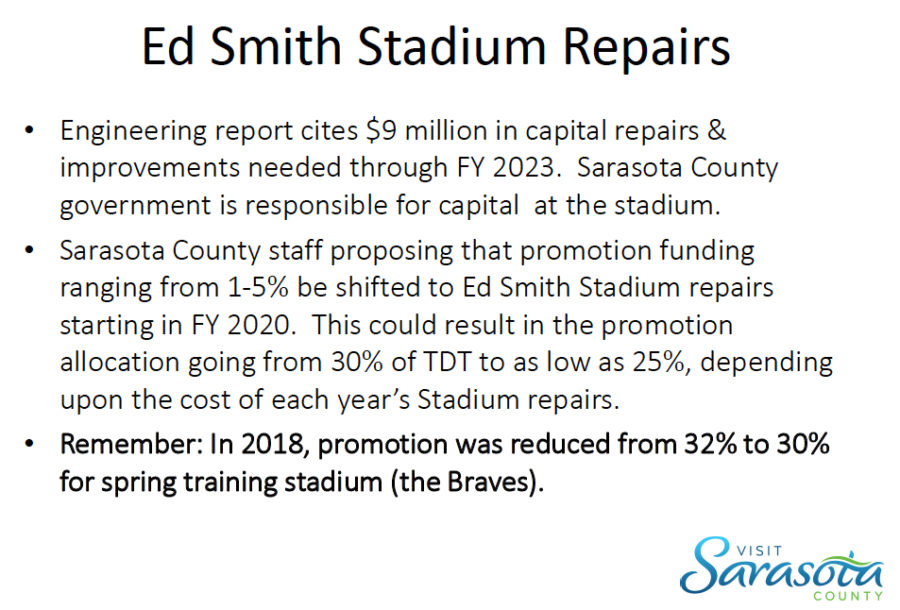
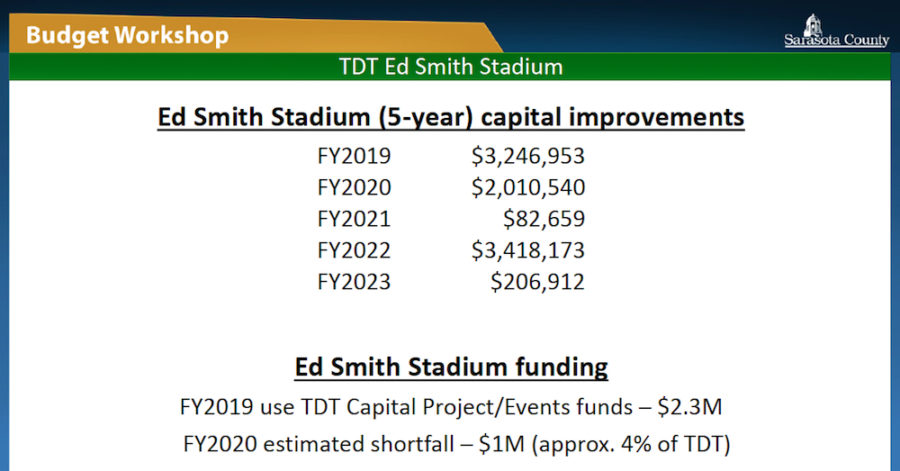
The county has sufficient revenue in the Tourist Development Tax (TDT) reserve fund for Capital Projects/Events to cover $2.3 million of the approximately $3.3 million the county will have to spend at Ed Smith in the 2019 fiscal year, Brown said. The extra $1 million will come out of TDT revenue allocated for sports stadiums. However, staff does not anticipate having enough TDT money for the projects planned for the 2020 and 2022 fiscal years, she continued. Therefore, staff recommended reducing the money allocated to VSC for promotional purposes by about 5% in those two fiscal years, Brown pointed out, to cover the stadium expenses.
During the County Commission’s Aug. 22 budget workshop, the board members concurred with the staff recommendation. However, Commissioner Charles Hines, who chairs the TDC, noted that that advisory council would have an opportunity to review the issue and offer its opinion.
Hines did not vote at the conclusion of the presentations and discussion during the Sept. 17 TDC meeting. He abstained, he said, as he would be participating later in a formal vote as a member of the County Commission.
Media Relations Officer Drew Winchester told The Sarasota News Leader this week that the commission is scheduled to vote during its Oct. 9 regular meeting on whether to authorize a public hearing on staff’s proposed change to the TDT ordinance to shift funds from the promotional efforts for VSC to the stadium account. If the commission approves holding the hearing, Winchester added, that would be conducted on Oct. 23.
Vice Chair Norman Schimmel initially said he wanted to abstain from the vote, as well. Schimmel added that he first wanted to see a presentation Visit Sarasota County (VSC) President Virginia Haley plans for the TDC in October, showing how her staff would be modifying its business plan for the 2019 fiscal year to try to counter all the negative national publicity about red tide.
After Hines said he did not believe the TDC’s governing rules would allow Schimmel to abstain, Schimmel decided to join his advisory council colleagues in unanimously opposing any reduction in the VSC marketing funds.

This Visit Sarasota County graphic argues against the change in allocation of revenue to promotional initiatives. Image courtesy Sarasota County

“It is devastating,” TDC member Bob Daniels, who serves on the Venice City Council, said of the loss of tourism business — and worker layoffs — because of red tide. “It’s a shame we have to put the Orioles on the same table” as promotional funding.
Nine representatives of tourism-related businesses implored the TDC members not to take money from VSC.
“I can’t believe that this group is even considering cutting the marketing [money] for Visit Sarasota!” Paul Parr, who owns 12 vacation rental condominiums on Siesta Key, told the council.
Before red tide began plaguing the shoreline, Parr said, his August bookings were 30% ahead of the number for August 2017. “We ended up closing out August 30% behind last year.”
All of his September guests cancelled, he added. “I got the last two today. So my numbers are 30% down for August and 100% down for September …”
John Tanner, general manager of Innisfree Hotels, which manages the Indigo and the Embassy Suites in downtown Sarasota, told the TDC members, “It’s imperative now” to ensure Visit Sarasota County has sufficient marketing funds.

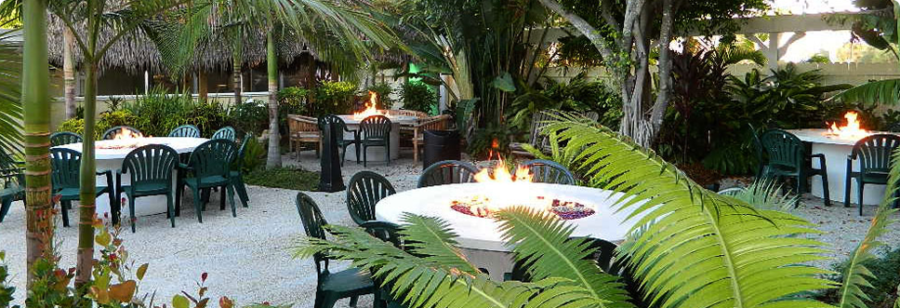
This is one of the dining areas at Pop’s Sunset Grill on the Intracoastal Waterway in Nokomis. Photo from the restaurant website

Joe Farrell, owner of Pop’s Sunset Grill on the Intracoastal Waterway (ICW) in Nokomis, said, “We’re down 60% in the last nine weeks.”
TDC member Erin Silk, CEO of Venice MainStreet, reported that that nonprofit had undertaken a survey since red tide had worsened. Of the 134 businesses that responded, she said, 72% were located within 3 miles of the beach or the ICW. Two “outliers” reported losses of $1 million and $3 million, Silk continued. Without them, the average loss for each of the other businesses was about $15,800.
Altogether, she continued, 10% said their revenue was down more than 50% for the month of August; 30% said business was down from 25% up to 50%; and 36% had had to cut employees.
“It is our duty to protect our local businesses,” Silk added.
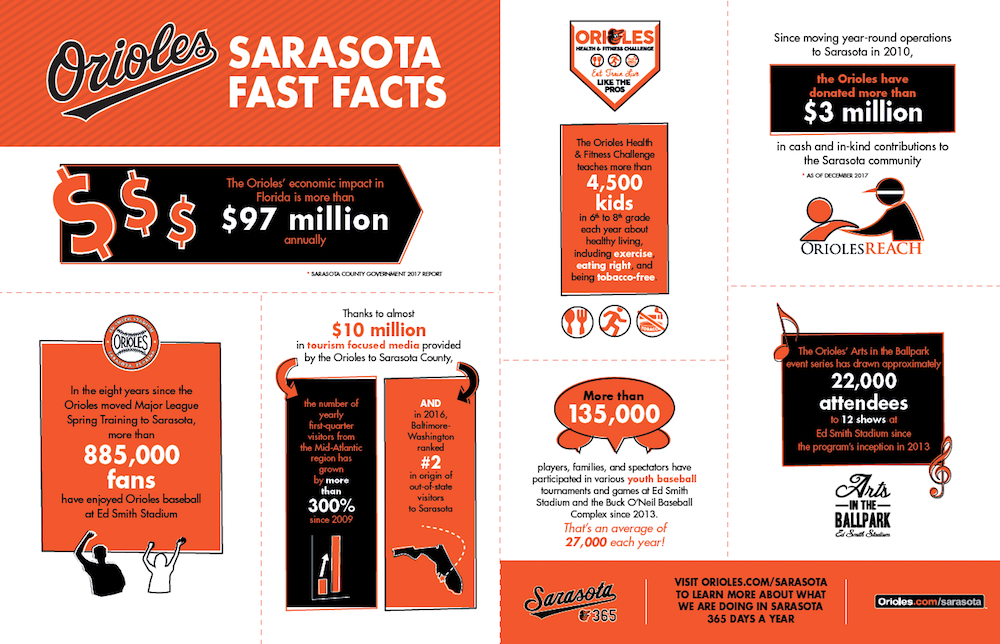
Yet, David Rovine, vice president for the Orioles in Sarasota, pointed out that the team has provided more than $10 million to Visit Sarasota County for promotional efforts over the past nine years. “This investment is not mandated by our contract with the county,” he added. “It’s a commitment from the Orioles … that is unmatched in Major League Baseball and possibly in professional sports.”
Rovine noted that since the team began Spring Training in Sarasota, the number of annual visitors to Sarasota County from the Mid-Atlantic States during the first quarter of each year had grown 300%.

A graphic provides details about the Baltimore Orioles’ impact on Sarasota County’s economy. Image courtesy Sarasota County

The Orioles do not just conduct Spring Training, he stressed. They also host events throughout the year, including Fall Instructional League games and youth baseball tournaments, which generate hotel stays.
Moreover, Rovine said, the team elected not to construct dormitories for players, as many other teams have done in areas where they hold Spring Training. Instead, Rovine pointed out, the Orioles have spent more than $15 million on hotel room nights in the county for players and staff.
Brown of the Parks, Recreation and Natural Resources Department also pointed out that the Orioles contribute about $97 million a year to the county’s economy, based on research undertaken for the county.
“This is probably one of the hardest debates and discussions I’ve had,” Commissioner Hines said, since he became the TDC chair in late 2014.
The stadium issues and the money

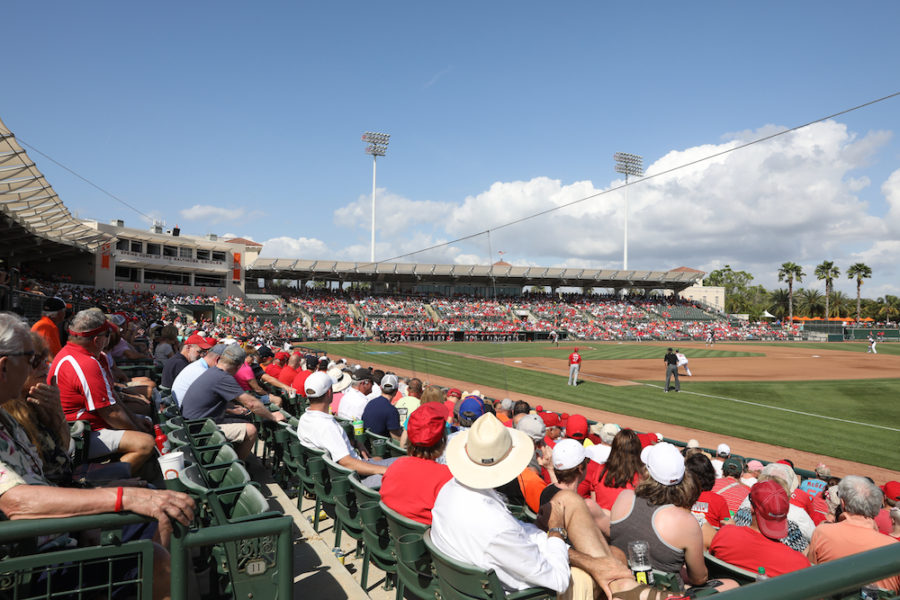
Fans watch a game on Feb. 28 at Ed Smith Stadium. Image copyright by the Baltimore Orioles

During her Sept. 17 presentation, Brown explained that the comprehensive facilities assessment for Ed Smith Stadium and the Buck O’Neil Baseball Complex determined a number of issues that needed to be addressed over the next decade.
The projects planned for the 2019 fiscal year, she continued, will include renovations of practice fields 2 and 3 and the main field at the stadium; replacement of the remaining parts of the irrigation system installed in 1989; replacement of the top coat on the flooring in various areas; and the installation of equipment for lightning protection.
The biggest estimated expense listed in the report for FY19 is $1.5 million to raise the outfields to the infield level on practice fields 1, 2 and 3 and laser-grading of the fields. That work would cost $500,000 per field, the report said.
Brown noted that the study was undertaken by an Orlando firm called ZHA, which focuses on professional sports facilities.
The county and the Orioles each contribute $150,000 per year to a “CAPX” — capital expenditures — fund, she said, but that revenue cannot begin to cover the expenses outlined in the study.

A chart shows the funds needed over the next five years for repairs and renovations at Ed Smith Stadium. Image courtesy Sarasota County

In response to a question, Kim Radtke, director of the county’s Office of Financial Management, explained that if the county were to borrow the $8 million for five years to cover the repairs and renovations, the debt service would be $1.7 million per year, plus the county would incur expenses for issuing the bonds. VSC staff had suggested the bond issue as an alternative.
Brown also noted that staff had considered other ways of reapportioning the TDT revenue, but she stressed the need for continued beach maintenance and renourishment, as well keeping intact the funding dedicated to the arts in the community and to Nathan Benderson Park, which hosts national and international rowing events, among other activities.
The Visit Sarasota County perspective

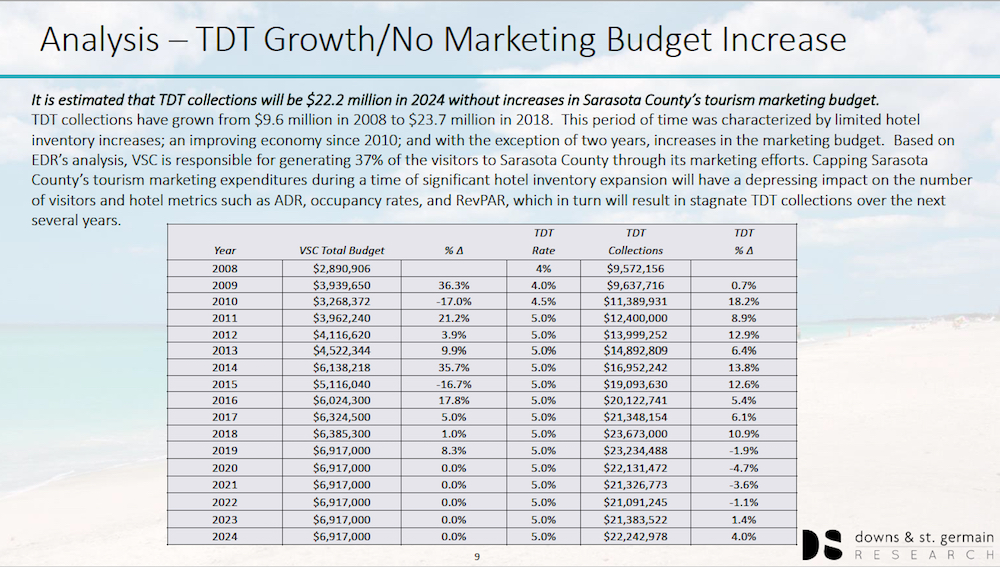
A chart prepared for Visit Sarasota County by Downs & St. Germain Research offers the tourism agency’s perspective on anticipated growth in TDT revenue. Image courtesy Sarasota County

During her portion of the presentation, Haley, the president of Visit Sarasota County (VSC), pointed out, as she had earlier this year to the TDC, that the county will see an addition of 1,177 hotel rooms by the end of this year. That represents a 23% increase, she said.
To maintain the current occupancy levels, she continued, 225,000 more room nights would have to be sold in FY19, which would mean drawing 10% more visitors. “We are averaging 2 to 3% a year,” she said of the growth in the number of tourists.
The less demand for rooms, Haley stressed, the lower the room rates hotels can charge. The lower the rates, she continued, the less Tourist Development Tax revenue is produced, as the tax is 5% on accommodations rented for less than six months a year.
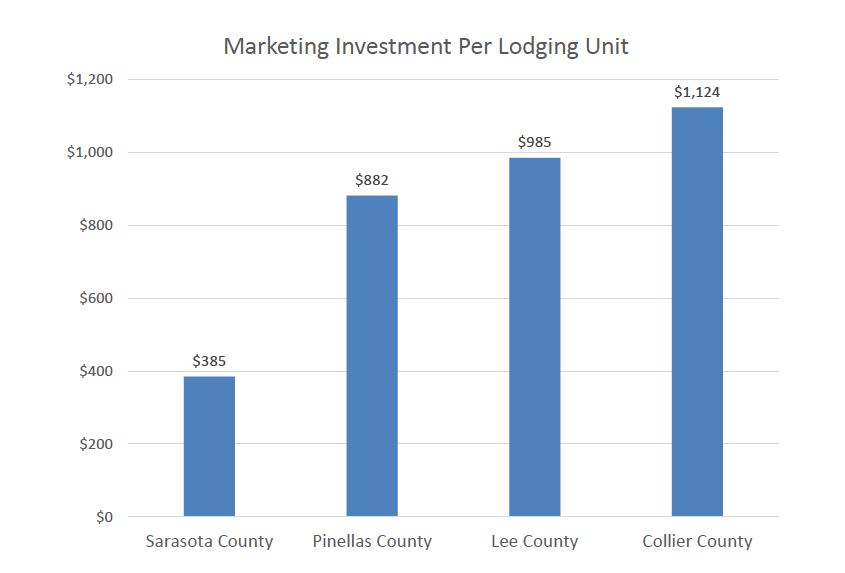
She showed the council a slide that said the county’s tourism promotion investment per lodging unit is $385. Through June of this year, the slide noted, the revenue per available room averaged $134.43, a 2.5% drop from the figure for the same period of the 2017 fiscal year.

A bar graph compares promotional investments of Sarasota County and neighboring counties. Image courtesy Sarasota County

In Pinellas County, the slide said, the revenue per available room had grown 2.9% for this fiscal year, through June. Pinellas invests $882 per lodging unit, the slide noted.
Sarasota County has lagged behind its competitor counties in terms of tourism promotional spending for the past 25 years, Haley said. “It’s just gotten worse over time.”
“We’re warning you,” she added: “Continual nibbling away of tourism marketing dollars” will continue to lead to negative consequences for TDT revenue.