Saturday, April 29, 2023

Some Florida counties don't leave their people in the dark

In some Florida counties, elected officials meet with constituents, take calls, and reach out through emails. If Sarasota County Commissioners ever did much of this, that ship long since has sailed. 

Our public hearings are often divisive, with poor information and little public awareness. These days the very time of a "public" hearing might be shifted at the last minute, without notice to the public.

How might our county be different if our elected representatives shared information about upcoming agendas the way this Board Member from Orange County has been doing?

May 2, 2023 BCC Meeting Preview

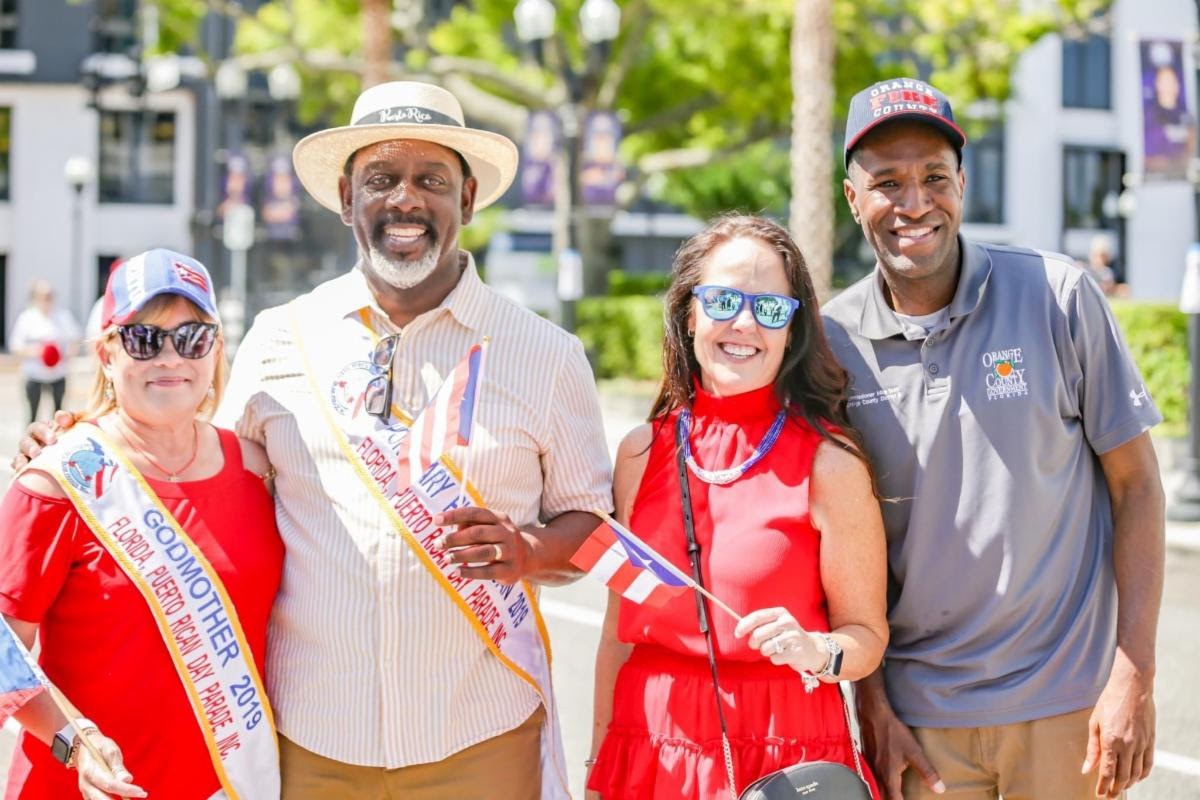
Celebrating at the Florida Puerto Rican Day Parade & Festival on April 22nd

Board of County Commissioners Update

Happy Friday, West Orange County!


Our next Board of County Commissioners meeting is on Tuesday, May 2nd. Residents are able to attend these meetings and speak about any specific item for which a Public Hearing is scheduled. This portion of the meeting begins around 2:00pm. We'll be happy to see you participate.


It's been a busy month in District 1. If you haven't yet, follow us on Facebook and Instagram for daily updates from our side of Orange County. Also, Be sure to check out our Year in Review where we celebrate all of our office's accomplishments, progress, and fun times from 2022.

Watch the BCC Meeting Live!

Proclamations

  • Proclamation recognizing May as Asian Pacific American Heritage Month — click here to find a list of upcoming events to celebrate!

Consent Agenda

  • Item J-5: Approval to decrease the speed limit on Turkey Lake Road from Central Florida Parkway to Vineland Avenue from 45 mph to 40 mph. (click here for full report)
  • Item J-8: Approval to decrease the speed limit on Town Loop Boulevard from John Young Parkway to East Town Center Boulevard from 35 mph to 30 mph. (click here for full report)
  • Item J-9: Approval to decrease the speed limit on John Young Parkway from Equity Row to Central Florida Greenway from 55 mph to 45 mph. (click here for full report)
  • Item J-11: Approval of a multi-way stop condition at the intersection of Summerport Village Parkway and Lake Smith Circle. (click here for full report)

Discussion Agenda

  • Item A-1: Visit Orlando Annual Update from Cassandra Matej, the company's President and CEO.

Work Session Agenda

  • Item 1: Stormwater Management - Moving Towards a Resilient Future


Since entering office, I've requested updates to our stormwater management standards and formulas, often after hearing from D1 residents experiencing standing water in areas that were dry in the past. In the aftermath of 2022's hurricanes, these concerns were amplified by the entire Board.


As a result, two stormwater management work sessions have been scheduled for the May 2, 2023 and May 23, 2023 Board meetings. The first work session will review the impacts of the 2022 flooding events and will review the County's existing stormwater-related programs. This will include our design standards, basin studies, maintenance and inspection, and capital improvement

program.

Public Hearings

Item G-14: Lake Dennis Planned Development/Lake Dennis PSP (Case # LUPA-21-11-335)

  • Applicant is requesting to to subdivide 45.17 acres, generally located north of Lake Star Road and west of Avalon Road, in order to construct 95 single-family residential dwelling units. Click here for full report.

Item H-17: Waterleigh Planned Development/ Land Use Plan (Case # CDR-22-11-355)

  • The applicant is seeking to update the conceptual Village Center layout and add two new permitted uses in the Village Center District. including a liquor store and a self-storage facility. Click here for full report.

Item I-18: Hamlin West Planned Development (Case # LUPA-21-11-335)

  • The applicant is seeking to rezone 19.11 acres from A-1 (Citrus Rural District) to PD (Planned Development District) and add the property to the existing Hamlin West PD; and designate the area as Corporate Campus Mixed Use District on the Horizon West Land Use Map. Click here for full report.


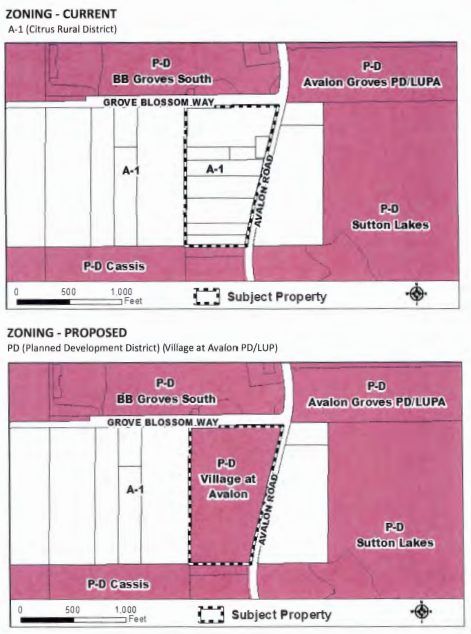
Item K-20: Village at Avalon PD/LUP (Case # LUP-22-06-199)

  • Applicant is seeking to rezone property located west of Avalon Road, south of Grove Blossom Way, and east of the Lake County line from Village (V) to Growth Center-Planned Development-Commercial/Medium Density Residential in order to build housing units and commercial space. Click here for full report.

ABC's of the BCC

The Board of County Commissioners meets every other Tuesday.

Come on down!


Board of County Commissioners meetings occur every other Tuesday with a morning agenda and an afternoon agenda.


The morning agenda allows public comment on any topic at 9:00am, where a constituent may come to the Orange County Administration Building in person and give your thoughts on any item except for a public hearing, which is later.


Work Sessions or items on the Discussion Agenda are up for debate by the Board and are not voted on.


Public hearings begin after 2:00pm, which include zoning variances, public appeals, ordinances, and more. This is where constituents can submit public comments in person on a specific issue.


To attend the BCC, please find information here.


As always, do not hesitate to reach out to our office with any questions or concerns at district1@ocfl.net

Orange County Commissioner Nicole Wilson, District 1 | 201 S. Rosalind Avenue, 5th Floor, Orlando, FL 32801

Friday, April 7, 2023

The decadent degradation of planning and community input in Sarasota County

In the wake of authoritarian Board actions with regard to LWR and Benderson proposals, the Neighborhood Workshop format has become a desiccated shadow of its former self.

Instead of an actual meeting with live human beings, a recent workshop about the expansion of Lakewood Ranch - a proposal that threatens the very existence of Old Miakka, a rural community older than the county itself - we were treated to a glitchy, unresponsive meeting via Microsoft Teams. 

There was no help for residents seeking to get into the Teams meeting - by accident we discovered that "anonymous" worked - nor was there clarity of sound or visual. I sent the Stantec presenter an email after the workshop - I received no response. 

This was a new low for the act of meeting a neighborhood to talk about a vast and dangerous developer's proposal. Is this how Sarasota County is going to push through its illegal approvals of absurdly overambitious plans? 

The unanswered email to Stantec's Katie Labarr is below: 


Hi Ms. Labarr,

You invited us to offer further comments after last evening's "workshop" regarding the Lakewood Ranch East Plan. I have attended many neighborhood workshops over the years - most were lively in-person presentations, with clear visuals, audible speakers, and valuable give-and-take. 

I believe a great deal is lost when such meetings are moved online, especially when captured through somewhat dysfunctional software like Microsoft "Teams."

There were problems with Teams last night meeting - these are detailed in the comment I posted online, and leave below.

More importantly, even if that app had worked well, the loss of the dimension of live interaction with people in the same room was a real deficit.  The significance of a live workshop is that the public sector matters; the input of residents that goes beyond just specific questions. With a live give and take, people can look closely at the images, hear each other, and develop a sense of whether a plan can be fashioned to take into account the realities of the community impacted by the developer's plan.

For years our Commission has shrunk from asserting the rights and values of the public sector, and holding up the Comp Plan values and framework that was fashioned through a challenging process of compromise. To subject the small chance a community has of meaningfully interacting with the County and developers using the detached, remote, glitchy and ineffective software of "Teams" is yet another layer of alienation. 

Below is my comment regarding specific difficulties:

Tom Matrullo
Citizens for Sarasota County

Ms. LaBarr,

An entirely new workshop should take place in East County at a location where real people show up, are seen and heard, and questions can be asked, with follow-ups, so that actual information is exchanged.

This online meeting had serious communications issues. E.g. 

1 - those unfamiliar with Microsoft Teams might have been foiled at the outset - the meeting was set up so that unless Stantec - the planning business that ran the meeting - recognized your email, it would not admit you. However, if you chose to be "anonymous," it would let you in - but no one would know who was there. 

2. The "Teams" software proved glitchy as hell - the only two voices on the meeting - the host and the person reading questions - dropped out often - leaving us to wonder what answers they had offered to questions that were read out, or what questions they were answering. 

3. Some images shown through the Teams software were blurry - so their value as illustrating the details of the development was virtually nil. See sample below. In brief, aside from the two Stantec people we heard no voices of any people in attendance, we saw nothing but the images presented, we had no visual or aural contact with the attendees to the meeting, and the entire presentation took only a few minutes. This is not how Neighborhood workshops used to be conducted, and given the failings of the software, this "workshop" was, for this attendee, pretty useless.

Monday, April 3, 2023

Tallahassee is about to destroy our right to protect Florida


1000 Friends of Florida says: 

SB 540, “Local Government Comprehensive Plans,” and its counterpart in the Florida House of Representatives, HB 359, have moved rapidly through the legislative process, with only one committee stop left in the Senate. Join us in calling for Senate leadership to stop SB 540 from being placed on the Rules Committee agenda and shut down this bad bill. More here.

Why is this crucial? Let's remember:


Rick Scott


'RedTideRick' defanged Florida's Regional Planning Councils, depriving them of enforcement power over large scale developments. This power had kept DRI's (Developments of Regional Impact) from their worst excesses.

 Scott also extinguished the Dept of Community Affairs (DCA). 


Without those regional and state regulatory layers, the only thing standing between Carlos, Pat, Randy, Rex and their unlimited ambitions was local government. So Carlos, Pat, Randy and Rex bought the Sarasota and Manatee Boards. 


That left only We the People to oppose developments with bad impacts. 


When (if) SB 540 and House Bill 359 pass, if we file suit to oppose a terrible project, like building right alongside wetlands, the state and DeSantis will make us liable for huge attorney fees. 


The Florida Chapter of the American Planning Association says 


Friday, March 24, 2023

If you oppose paving over Rural Sarasota, be online Monday, March 27, 6 pm

 ALERT: THIS MONDAY, 6 pm, online:

Neighborhood Workshop for proposed Lakewood Ranch Rezone  -  March 27, 2023 at 6pm (Online only)

NOTE: As of now, the Comp Plan chapter penned by Rex Jensen and Pat Neal has not yet taken effect. Yet Rex and Pat wish to power along their expansionary plans for thousands more "dwelling units" in East Sarasota.

Pat Neal

Rex Jensen

Do the developers simply assume the County will crater to their wishes? They're probably right. The public has a chance to weigh in on Monday - the workshop is online only - no chance to meet in person, see plans, talk directly to the players.


Lakewood Ranch wants to rezone from rural to RSF-2/PUD to develop 1,718 dwelling units and related buildings. This is just the first part of the 4,000 acres in the comprehensive plan amendment that has been legally challenged and is not in effect.  The land in this rezone petition goes from the end of University Parkway at the north down to the entire north boundary of Bern Creek Ranches.  LWR doesn't care that this rezone is not legally authorized because of the pending challenge. 
 
Please participate in the online workshop and voice your concerns.  This rezone is incompatible with adjacent rural homesteads and agriculture. We need maintain our opposition to this development and to the breaking of all the promises the County made to us about protecting rural life.
 
The sign in for the online workshop is: https://bit.ly/LWRSEREZONE

     -- Or call in at 833-436-6264, Conf ID: 419 985 011#

From Becky Ayech, one of the Old Miakka leaders opposing the change to a higher density:

Lakewood Ranch Southeast is holding a virtual Neighborhood Workshop on March 27 at 6pm.

Below is the information from the county's webpage.  The link at the bottom will take you to the file on record.  It shows a map.  They say part of the land is OUA, but on their previous request that is being challenged, they said all the land was OUE, OUR and Hamlet.  Interesting.

Neighborhood Workshop: Lakewood Ranch Southeast Project Areas 1, 6, & 7

Date: 03/27/2023 6:00 PM - 7:00 PM  
Contact: Katie LaBarr, AICP (941) 907-6900

Link to Monday's meeting: https://bit.ly/LWRSEREZONE


Tuesday, March 21, 2023

Private opulence, Florida, and how this relates to Poverty in America

The quotes are from a brief interview with Matt Desmond on Fresh Air:

If you are a family of means, you have the incentive to rely less and less on the public sector. So we used to want to be free of bosses, but now we want to be free of bus drivers. We don't want to take the bus. We don't want to often enroll our kids in the public school system. We don't need to play in the public park or swim in the public pool. We have our own clubs, our own schools. We have our own cars. And as we withdraw into the private opulence, we have less and less incentive to invest in public services. 
A lot of us are getting these tax breaks and we don't see that as a government helping us. We see that as us getting to keep more of what is rightfully ours. And often that leads to a kind of attitude, a political attitude, where we don't think the government is in our lives. And so those of us who are more apt to take that mortgage interest deduction are also more apt to vote against affordable housing proposals. Those of us who already have employer-sponsored health insurance — which by the way, is government subsidized in a massive way — we're often apt to vote against the Affordable Care Act. And so it does have this kind of strange political, maddening irony in our lives.
Desmond's 2017 book Evicted, for which he won the Pulitzer Prize, examined the nation's affordable housing crisis through the lens of those losing their homes. 

Desmond's new book is Poverty, By America, studies various factors that contribute to economic inequality in the U.S., including housing segregation, predatory lending, the decline of unions and tax policies that favor the wealthy. Desmond says that affluent Americans, including many with progressive political views, benefit from corporate and government policies that keep people poor.  

Guardian interview“Bearing witness is the start” 


Friday, March 17, 2023

Bay Park under threat of commercialization, and a Control Growth Now Picnic

Development interests have their eyes on our parks. 

Both Warm Mineral Springs in North Port and The Bay Park in Sarasota are at risk.  Unfortunately, some in both City governments are supportive of plans to convert public lands to private gain.

Most immediately, on Monday March 20, the Sarasota City Commission will consider measures to facilitate opening up the 53 acres of City-owned bayfront known as The Bay to extensive private development.

The City Planning Commission voted 4 to 1 to recommend denial.  The City Commission should do the same.

Phase 1 of The Bay project has been wonderful, with environmental and civic improvements consistent with the present limits on development.

However, the private interests behind the Bay Park Conservancy, represented by Bill Merrill and Phil DiMaria, an attorney and planner respectively for developers including Benderson, are seeking changes that would open the door to extensive commercial and other private development in The Bay Park moving forward.

At present, most of The Bay Park is limited under the City’s Comprehensive Plan to “Recreation, Entertainment, Museum, and Cultural Facilities - (Civic Center Complex).”  That is exactly what is planned there now, in the City’s Master Plan for The Bay Park.

The north end, now called Centennial Park, is instead designated “Open Space-Recreation-Conservation.” Only “minimal” development for “food, beverage, and entertainment uses” is allowed, but “the type and scale of activities which have been associated with the ‘Marina Jack’ facility” are prohibited.  Again, this is consistent with the present Bay Park Master Plan, which includes only one modest “food and beverage” building in that area.

All of this would be replaced by the Comprehensive Plan amendments up for public hearing and approval Monday morning.

The new wording provides broadly for a “flexible mixed-used district” for all 53 acres.  Without any limits, the following would be allowed (emphasis added):  “uses including but not limited to parks and open space, government uses, restaurants, performing arts centers, museums and cultural facilities, galleries, retail, and mixed-use development with a maximum residential allowance for 10 live/work units within (The Bay Park).”

At present, the City Charter requires a supermajority vote of the City Commission (at least 4 to 1) to loosen the present restrictions on development in The Bay Park, as a Comprehensive Plan amendment.  If the amendments up on Monday are approved (by that supermajority vote) then any limits will only require a regular 3 to 2 vote, in the Zoning Code.

This is the same move in which development interests and their supporters in City government failed (by one vote short of a Commission supermajority) to move limits on downtown building heights from the Comp Plan to the Zoning Code.  It is the same as what they tried and succeeded (4 to 1) for density increases in much of the City.

Already, the Bay Park Conservancy has proposed massive restaurant development on the north end of The Bay Park, far more than in presently allowed by the Comprehensive Plan. In a Powerpoint to the City Commission, they presented plans for three-level restaurant buildings on all three sides of the boat basin, totaling 26,000 square feet of rooftop dining and 14,750 square feet of indoor dining, for a total of 40,750 square feet. Compare for example, the large Selva Grill restaurant in the UTC Town Center, at 5,000 square feet.   

Who knows what other commercial development they have planned in our public park?

The amendments would also eliminate public hearings and votes of the Planning Board and City Commission for Bay Park site plans and replace them with backroom administrative approval by supportive City staff.   

Although those site plans would have to be consistent with a one-page graphic which is the “Master Plan” adopted by the City Commission, already the Bay Park Conservancy shows how they can depart from that if they get administrative approval.  Amazingly, they contend that their extensive restaurant plan is consistent with the Master Plan when clearly it is not.

BPC leaders have also said that the Master Plan is “outdated” and should be changed in ways they do not disclose.

A requirement for a “public community workshop” prior to administrative approval “for structures of less than 10,000 square feet” was added.   That’s an obvious typo in that “less” should be “more.” Not only is that meaningless due to that size (none of the BPC’s restaurant buildings are over 10,000 square feet) but a workshop is no substitute for public hearings and Commission votes.

City Commissioners should vote NO on Monday.

Dan Lobeck, Esq.
Law Offices of Lobeck & Hanson, P.A.
2033 Main Street, Suite 403
Sarasota, FL  34237
(941) 955-5622

=======

Control Growth Now Annual Potluck Picnic


Saturday, March 25

11:30 am – 2 pm

Colonial Oaks Park, 5300 Colonial Oaks Blvd, Sarasota, FL


Please register today:  https://www.eventbrite.com/e/571055280717


Free and Open to the Public!  Come to Control Growth Now's Annual Meeting and Potluck Picnic at beautiful Colonial Oaks Park Saturday, March 25 from 11:30 am to 2 pm.  


Please register for yourself and anyone you are bringing with you. Enjoy our grilled burgers, hotdogs, veggie burgers and drinks -- bring a side dish or dessert to share if you like -- in the good company of people who care about the future of our community.  


At a short meeting in the clubhouse we will honor Valerie Buchand as our Citizen of the Year for her good work in bettering the quality of life in the Newtown Community and throughout Sarasota. Join Control Growth Now if you like, or renew your membership for 2023-24 (annual dues $20 – an option on the Eventbrite registration) or just be our very welcome guest!


                                                                                        -- Dan Lobeck    

Friday, March 3, 2023

DeSantis, Florida, and the seeds of Fascism


Heather Cox Richardson:

The attempt to take over schools and reject the equality that lies at the foundation of liberal democracy is now moving toward the more general tenets of authoritarianism. This week, one Republican state senator proposed a bill that would require bloggers who write about DeSantis, his Cabinet officers, or members of the Florida legislature, to register with the state; another proposed outlawing the Democratic Party.

DeSantis and those like him are trying to falsify our history. They claim that the Founders established a nation based on traditional hierarchies, one in which traditional Christian rules were paramount. They insist that their increasingly draconian laws to privilege people like themselves are simply reestablishing our past values.

But that’s just wrong. Our Founders quite deliberately rejected traditional values and instead established a nation on the principle of equality. 


NBC: Florida bill would require bloggers who write about the governor and legislators to register with the state

The bill proposed by Republican state Sen. Jason Brodeur would also require bloggers who write about state officials to disclose who is paying them and how much.


  . . . the seeds of Fascism begin in fear & contempt . . . 

Curmudgucation - The DeVos School Privatization Plan Turns Twenty-One: 

Way back in 2002, Dick DeVos, husband of Betsy, was at the Heritage Foundation, where he was introduced by former education secretary Bill Bennett. In a speech there, he laid out strategy for the dismantling of public education and replacing them with a privatized system. 

It would, he said, have to be done on the state level, with a certain amount of stealth. 

We need to be cautious about talking too much about these activities. Many of the activities and the political work that needs to go on will go on at the grass roots. It will go on quietly and it will go on in the form that often politics is done . . .
 

Daily Beast Batshit Bill Would Force Bloggers Who Write About DeSantis to ‘Register’ With the State: 

The bill, which sounds better suited to Soviet Russia than the Land of the Free, includes a dizzying list of requirements. If a blogger writes more than one blog post, they would have to submit monthly reports that disclose, among other things, the amount of compensation received for each post. Failure to do so would result in fines of at least $2,500 per article, and a subsequent requirement to file a notice of failure to file.


DeSatan Is A Stinking Fascist

Continued depravity by Republican Party in the longest state to hang precariously off the bottom of the eastern United States is reaching a fever pitch!

Governor Ron DeSantis leads his merry band of womb wreckers into “F*ck Free Speech” territory, inspiring the  one-upsmanship that is currently on display by  white nationalist legislators in New Disney—I mean Florida.


Holocaust Encyclopedia

Starting in 1934, it was illegal to criticize the Nazi government. Even telling a joke about Hitler was considered treachery. People in Nazi Germany could not say or write whatever they wanted.  

Book Burning


Herald Tribune: Banning books has nothing to do with liberty | Editorial

There are public school classrooms in Florida where teachers wrapped paper around bookshelves to shield the books from students. Why? If one of the books were to fall afoul of the new state law on book appropriateness, the teacher could face a felony charge.

Some, including Gov. Ron DeSantis, call this liberty and freedom.

To us, it looks anything but.

Book banning are two words that don't partner with the ideas of liberty and freedom. 


(How) Fascism Is When People Don’t Want You to Exist - Umair Haque

DeSantis banned…teaching…books…words…classes. He’s realized that, well, why bother with any of the niceties of democracy at all — let’s just ban people we don’t like from existing. Let’s disappear them — first, ideologically, in the mind, then socially, as in, they’re not really allowed to exist…and it hardly takes a genius to see where that particular road ends. 
Meanwhile, the new “Women’s Health and Safety Bill” makes it a crime for women to…use the internet. Remember when I pointed out that it wasn’t just “the end of Roe” that the Supreme Court had brought about, but had effectively eviscerated the rights women have, the basic ones, from expression to association to speech to privacy? Now — think about this — just using the internet in ways the GOP doesn’t want you to is to be a crime. More...


Thursday, February 23, 2023

What Is Ron DeSantis Doing to Florida’s Public Liberal-Arts College?


New Yorker, Feb. 22, 2023

The Political Scene

DeSantis is not simply inveighing against progressive control of institutions. He is using his powers as governor to remake them.

By Benjamin Wallace-Wells

In the context of other universities—the sort of assessment the Princeton Review’s guidebooks might do—New College of Florida, situated on the shores of the Gulf of Mexico, a few miles north of downtown Sarasota, has a number of standout features. Its curriculum is unusually self-directed: it gives out no letter grades, and has an academic research project built around independent study in partnership with professors. Two-thirds of its seven hundred students are women, and there is a prominent queer community; in the past, New College ranked among the most “gay-friendly” campuses in the country. Those attributes make it seem like a progressive northern liberal-arts college, to which alumni often compare it, but New College is a public school, which means that in-state tuition costs under seven thousand dollars annually—a bargain—and also that it is subject to the influence of Florida’s state politics.

Early in January, the governor of Florida, Ron DeSantis, announced that he would be making six new appointments to New College’s Board of Trustees, and, weeks later, the Florida Board of Governors appointed a seventh, which gave DeSantis’s incoming choices an immediate majority on the board. DeSantis’s chief of staff, James Uthmeier, told National Review that he hoped New College would become a “Hillsdale of the South”—a reference to the private, Christian conservative college in Michigan. Shortly afterward, Christopher Rufo, a conservative activist and one of DeSantis’s new appointments to New College’s board, gave an interview to the Times’ Michelle Goldberg that was even more pointed: he spoke of a “top-down restructuring” of the school’s curriculum and culture, and suggested that if professors and students weren’t in line with the changes, they could leave. The project, Rufo went on, could serve as a model for similar takeovers around the country. “If we can take this high-risk, high-reward gambit and turn it into a victory, we’re going to see conservative state legislators starting to reconquer public institutions all over the United States,” he said.

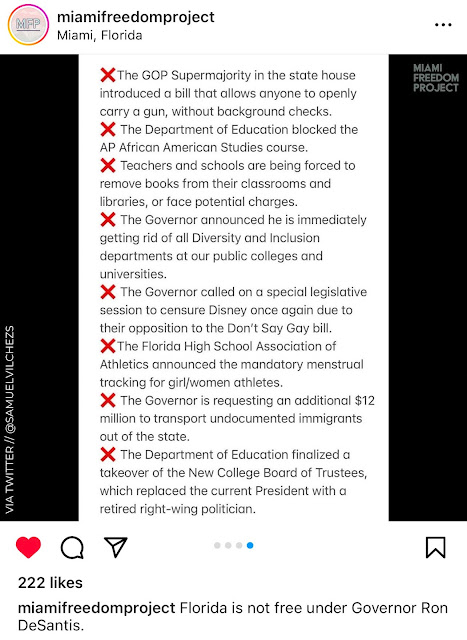
For the past few years, DeSantis’s culture-war campaigns have operated in American politics like a spooling synth loop: it keeps coming around. The Governor of Florida has sought to suspend the Walt Disney Corporation’s tax breaks because the company opposed his “Don’t Say Gay” bill; has moved to limit what teachers can say in public school classrooms about race and gender, and what books can be available in libraries; has encouraged state police to arrest and prosecute ex-felons for voting; and has flown migrants to Martha’s Vineyard as a political stunt. These campaigns have raised an enormous political war chest for DeSantis, and helped give him a regular perch on Fox News. But what distinguishes DeSantis from other culture warriors, especially in the eyes of conservative intellectuals, is that he not only uses his profile to inveigh against progressive control of institutions but also his powers as governor to remake them. After Rufo made his comments about New College to the Times, he called DeSantis’s aides. “I was, like, ‘Man, did I go too far?’ ” Rufo told me recently. “They were, like, ‘No, it’s great. Keep going.’ ”

Rufo (l.) first New College meeting

Rufo, a documentary filmmaker and senior fellow at the Manhattan Institute, has had one of the most dynamic trajectories of any conservative intellectual over the past few years, having been at the center of the right-wing campaign against critical race theory, which is what initially drew him into DeSantis’s orbit. He has since consulted with the Florida Governor on the Stop woke Act and aided DeSantis’s campaign against Disney by writing articles about its theme parks employing dozens of pedophilic sex predators and indoctrinating their employees with diversity politics. (A Disney spokesperson said that insuring “a safe environment for children and families is a responsibility” the company takes “very seriously.”) Rufo seemed to see his arrival in Sarasota as an event unto itself: he had with him an aide, a cameraman, and a security guard—a large, loping, bearded guy, who, Rufo told me, had been a golden-glove boxer in Ohio—which seemed an extreme precaution for a conservative trustee visiting the campus of a hippie college.

But Rufo’s arrival was hard for the New Collegers to dismiss. DeSantis had just won a large majority by running on aggressively defending social conservatism. Florida’s constitution and laws gave him the power to assert control over its public universities. Rufo explained to me the story, as he saw it. New College was a struggling campus. The most recent data shows that it accepted seventy-five per cent of students who applied, but enrolled only thirteen per cent of those who were accepted. Twenty per cent of students dropped out before the end of their first year; a third were not employed or in graduate school a year after they got their degree; and, of those who were employed, the median salary was thirty-two thousand dollars. The source of these failures, Rufo went on, was a culture that valued protest and activism over work. Consultants’ reports found that the top words students associated with New College’s culture were “politically correct,” “druggies,” and “weirdos.” The environment had become a problem, he said. “The trustees need to reëstablish authority.”

I asked for details about how the curriculum would change. “I’m the narrative guy, the political guy,” Rufo told me, waving off the question. “I’m a soldier in DeSantis’s army.” The sun was setting over the Gulf, leaving just a fuzzy pink line on the horizon. To our south, past downtown Sarasota, were the rich, beachy hubs of Longboat and Siesta Keys, with day-drunk strips of restaurants and residential roads that tracked the shore; most of the houses had a dock with a big boat out back. This has long been politically conservative territory; now it’s DeSantis country. “This is really a brilliant strategy on behalf of the Governor to say, we are losing our democratic control of these institutions because we aren’t using our democratic power at all,” Rufo said. “Let’s actually use the power of the Board of Trustees in the way that it was intended, in a way that is authorized in the Constitution, to turn political will into institutional outcomes. New board, new trustees, new majority, new vision. It’s either turn around or shut down.”

The next morning, Rufo and another new DeSantis-appointed trustee, Jason (Eddie) Speir, who co-founded and is the superintendent of a Christian school in Bradenton, held a public Q. & A. session with New College’s faculty and staff. (Someone had e-mailed the University threatening Speir just beforehand, and the Sarasota Police and campus administration had tried to cancel the event, only for Rufo and Speir to overrule them.) Rufo was challenged about whether he thought members of the L.G.B.T.Q. community were a threat to campus life. At one point, Rufo responded, “We should have a unified standard by which we treat people fairly. Identity-based preferences are policies that I strongly disagree with.” Mostly, though, the faculty tried to defend the curriculum. One reason that so many students quit after their first year, someone suggested, might be that New College was a very specific educational environment, and they hadn’t realized what they were getting into. Amid a generally tense conversation, some members of the faculty seemed to be searching for “where we can find common ground, particularly around the ideals of a liberal arts education,” as one history professor put it.

The academics in the audience might not have much liked Rufo—might even, in many cases, have feared what he represented—but there was no confusion: he was prepared and aggressive and camera-ready, a facsimile of DeSantis himself. Nearly all the questions went to him. Speir, buff and bearded, with a spacey manner and an elliptical speaking style that at times scanned as Christian and at others as stoner, was somewhat harder to fathom. He spent a couple of minutes detailing his complaints with his treatment at the hands of the local Sarasota paper, and his failed efforts to suspend the “unwelcoming” comments section. Later in the day, at a meeting with students, Speir spoke out in favor of increasing the number of Christian students on campus. When he was asked whether he favored open carry on campus, he said that “we cannot sacrifice our freedoms for safety.”As a conciliatory gesture to the faculty, Speir acknowledged that his own school’s philosophy was designed to be self-directed in a way somewhat similar to New College’s, but he also kept hinting that the Governor would send more money if the campus were to “go along” with the imminent changes.

At one point, when a student accused Rufo of being anti-science, Speir took out his microphone and said, “If there’s somebody that would be anti-science, that would be me.” He mentioned a social-media thread he had made, questioning whether the Buffalo Bills safety Damar Hamlin, who went into cardiac arrest after being slammed in the chest on the field, owed his near-death experience to the fact that he had taken the covid-19 vaccine. “I think questions need to be asked. I think that’s the beginning of science,” Speir said. (The following week, Speir would propose that the new Board of Trustees summarily fire every single faculty member—most of them unionized and most of them with tenure—by asking the Florida legislature to authorize a “financial emergency” as rationale. His idea was not formally presented to the board.) If Rufo represented a modern, media-savvy social conservatism, then Speir embodied a more atavistic traditionalism, both more wandering and more truculent. But that is part of DeSantis’s coalition, too.

DeSantis came to Sarasota a week later. He delivered a speech outlining some legislative proposals regarding public higher education in Florida: he would ban diversity, equity, and inclusion (D.E.I.) programs and the teaching of critical race theory, give trustees broader powers to review and fire faculty, and compel colleges to deprioritize fields deemed to fit a “political agenda.” At New College, the action was more direct, and swift. With each of DeSantis’s appointees voting in favor, the Board of Trustees fired the college’s president, Patricia Okker, a scholar of nineteenth-century literature, and replaced her with Richard Corcoran, a former Republican speaker of the Florida State House and DeSantis’s first Commissioner of Education. “It was very illustrative of their intentions, because with Dr. Okker you had someone who was a career educator,” Alex Obraud, a junior majoring in anthropology and a leader of recent student protests against DeSantis’s appointees, told me. “I didn’t agree with her about everything, but she was in it for the right reasons, and she was smart and effective. Getting rid of her summarily to pay more than twice as much money to a career politician who is coming in with an agenda—that’s not someone who’s in it for the students.”

In the public forums I attended, the students seemed more likely to perceive the takeover as an effort to make the campus less welcoming to gender difference, while the faculty were more inclined to see it as a misunderstanding of what made the college educationally distinct. Donal O’Shea, a math professor who served as New College’s president before Okker, told me, “If you think about the state-university system as an educational portfolio, then New College is an alternative investment that occasionally paid enormous dividends.” One year, O’Shea went on, New College had supplied four of the state university system’s six Fulbright scholars; another year, the school’s student scientists had won forty per cent of the Goldwater scholarships awarded in Florida.

Universities, like cities, often look politically uniform from a distance but have a dense and highly contested internal politics. The argument that New College was a political monolith is complicated by the most famous story told about the campus before the DeSantis takeover: the conversion of R. Derek Black, who had grown up in a prominent white-nationalist family, in West Palm Beach, before coming to New College in 2010. While on a study-abroad program, Black was exposed in campus-wide chat forums as the host of a white-nationalist Internet radio show. Demonstrations ensued. Black had chosen the school because it had an excellent medieval-studies department and because it was affordable. Family lore also held that one thing that the Blacks did at college was learn to argue with leftists. But after he had been exposed, Black found himself being drawn away from white nationalism by his classmates. There were small gestures—people making conversation in the lunch line—and large ones: a Jewish student invited him to attend weekly Shabbat dinners. By graduation, he had split with the white-nationalist movement and his family and now considers himself something of a progressive; he also married one of the women who had engaged with him after his return to campus.

Black is now a doctoral candidate in medieval history at the University of Chicago. When I spoke to him last week, I asked whether he thought his conversion would have happened at another college. “I really don’t think so,” he said. The key, Black went on, was New College’s small scale. In the school forum, “there were all these threads that said ‘Don’t speak to him, don’t acknowledge him, we want to make him feel like a pariah,” Black said. “But the underlying thing is that is so difficult to enforce.” Black has been involved in the campaign against the trustees. “I think the school is a good enough institution that the state should want to support it,” he said. His hope is that “DeSantis loses interest or it proves too difficult or they can’t figure out what victory looks like.”

I had been wondering about what victory might look like to the new trustees myself. Another new DeSantis-appointed trustee, Matthew Spalding, a former official at the Heritage Foundation and now a vice-president at Hillsdale College, took pains to explain that Hillsdale is “a private, Christian college” that accepts no government funds, while New College is public and funded by taxpayers. “That will not change,” Spalding wrote to me. “The legislatively defined ‘distinctive mission’ of New College is to be ‘the residential liberal arts college of Florida.’ This is important.”

Another board member I spoke with, Mark Bauerlein, a retired English professor at Emory, took a similar line. Bauerlein, a “vigorous, ruthless, and relentless” opponent of D.E.I. programs, has some quirky points of view—he wanted more organized sports and was bothered by a campus that was sixty-five per cent female. “Any society with that kind of gender imbalance is inherently unstable,” he said. But he also sounded like he mostly wanted a “great books” liberal-arts education; he told me that he would like to bring the academic Stanley Fish to campus. “The work demand, the intensity of the liberal-arts education—that’s pretty good,” Bauerlein said. “I do not doubt the commitment of the faculty.”

For the people at New College, this has been an often confusing situation to read. The sort of reforms that Bauerlein and Spalding were suggesting did not really seem so scary, but they also did not seem like they matched the more aggressive rhetoric coming from the Governor and Rufo. This is a characteristic of DeSantisism. Andrew Spar, the President of the Florida Education Association, which has battled DeSantis over separate laws regulating how race could be taught in Florida classrooms, how gender could be taught in Florida classrooms, and what materials should be allowed in school libraries, pointed out to me that, in each case, the law had created enormous confusion about what exactly schools were supposed to do, and led to different districts and teachers following the rules in different ways. “All three of those laws are really vague,” Spar said. “And because the laws themselves are so vague, and there’s so much confusion, the impacts of these policies are really damning, because people don’t know what to do.”

New College is dealing with a similar vagueness. With his new trustees, DeSantis has assembled some leading intellectuals who represent different strains within social conservatism, but among them there are internal contradictions. Did the new trustees want a traditional liberal-arts education, or a university that sends graduates to higher-paying jobs? Did they want to defend the rights of the faculty to say whatever they pleased, or ask the Florida state legislature to fire all of them? A Christian college or a secular one? Should it try to grow dramatically, or stay about the same size? If a woke culture was supposed to be the problem, how were they defining “wokeness,” anyway?

At times, DeSantis’s vagueness has been seen as a cover for a hidden agenda—for instance, to drain resources from public schools for private ones, or to keep Floridians from publicly acknowledging the existence of gay people. My own view is that his politics are less programmatic than that. DeSantis has pursued some of these campaigns extensively, and quietly dropped others not long after they made a splash. The process underway in Florida and at New College is less about ideology than about power. DeSantis’s culture war has teeth because he is the governor of a large and growing state with unified political control and—unlike Trump—he understands and can make use of his bureaucratic powers. What makes DeSantis both distinct and formidable is that his campaigns are about not ends but means. ♦

=====

Statement of New College alumni

Saturday, February 18, 2023

- Public Statement of the Alumnae/i of New College of Florida -


Since its founding, New College of Florida has represented excellence in liberal arts education. As the New College Alumni Association (NCAA), we are charged with representing New College’s largest constituent community: its 7,500+ alumnae/i. We are also charged with supporting the exceptional college and educational mission that produced those alumnae/i.

For more than 60 years, New College has stood as a bastion of academic freedom and rigor: a place where a wide diversity of ideas are fiercely debated by independent scholars from all walks of life. New College students are empowered and encouraged to self-direct their education and to conduct bold, original research. They are supported by world-class faculty who celebrate differences of background and opinion and who reward real-world contributions over rote recitations.

As a result, New College enjoys a formidable reputation as a top-five public liberal arts college and as the public college with the single highest proportion of students who go on to earn PhDs (including in STEM fields). Our alumnae/i include 86 Fulbright scholars, a Fields Medalist, a Federal Reserve Bank president, elected Republican and Democratic officials and luminaries in virtually every field in which New College has granted a degree. New College accomplishes all of this while graduating students with the second-lowest average federal loan debt of any public liberal arts college.

The rapid and drastic actions undertaken by the Governor and the new Board of Trustees – and the promises of more such actions to come – threaten New College’s long-standing tradition of academic freedom, undermine its history of excellence, and flout basic principles of good governance and community consultation.

Namely, we cite: the sudden firing of President Okker and installation of Interim President Corcoran without consultation with – let alone endorsement from – the campus community; attempts to dissolve the Office of Outreach and Inclusive Excellence; and suggestions by trustees that they intend ideologically-motivated overhauls of the school’s faculty and academic programs, such as the termination of tenured faculty or the elimination of entire departments.

These extreme actions and statements have been predicated on a mischaracterization of New College as a politicized institution that enforces left-wing ideologies and indoctrinates students. We strongly reject this ill-founded caricature of our school, students and faculty. New College teaches students how to think, not what to think; impassioned, informed academic debate is a hallmark of the New College experience, and that debate relies on a diversity of views and experiences.

In keeping with New College’s emphasis on the importance of open discourse, we strongly object to the exclusion of the New College community in planning and executing these extreme changes. New College is a prestigious institution with a long track record of excellence. Any and all changes intended to address New College’s challenges should rely on deep and careful consultation with the students, faculty and alumnae/i who have earned the school its many successes.

In stark contrast to its long-standing reputation, New College is now receiving a different kind of attention from the academic community: concern. Dozens of major academic organizations have issued or signed statements denouncing attempts to undermine New College’s academic freedom and integrity. We thank those organizations for their understanding and support. New College’s alumnae/i are similarly concerned about the future of their alma mater’s reputation and legitimacy.

New College’s students and faculty have been resolute in affirming their commitment to a superb academic experience replete with freedom – academic and otherwise. Today, as representatives of New College’s thousands of alumnae/i, we formally join that chorus. We ask the Board of Trustees to avoid preconceptions; to listen; to learn; to ask questions; to truly seek to understand New College’s unique excellence – and to do all of that before seeking drastic changes to an irreplaceable school.

=====


Action Item: Sign Petition against turning New College into DeSantis propaganda machine


More reporting about New College:

25 days that shook New College: How Ron DeSantis swiftly transformed the Sarasota school

New College faculty concerned about draining Foundation to pay president's $699,000 salary

New board member says his assignment is 'to lead New College of Florida out of wokeness'

SEIDMAN SAYS: What qualifies Richard Corcoran to make up to $1 million at New College?