From ManaSota-88, Inc. a 501.c3 Public Health and Environmental Organization:
THE COSTS OF MAINTENANCE DREDGING
The majority of waterways originally dredged in the Sarasota & Manatee were dredged before permitting was required. In most cases canals were dug as a source of fill for coastal wetlands to maximize the number of waterfront lots for the development. There was little or no thought given to the environmental consequences that occurred during the original dredging of these canals. As a result of inappropriate waterfront development, inadequate stormwater runoff control and habitat destruction, many of the original canals dredged have silted in and are restricting motorboat access for some waterfront property owners.
Dredging at New Pass, Sarasota
Instead of wasting taxpayers money on environmentally damaging maintenance dredging projects, Sarasota & Manatee should instead embark on a program of habitat restoration, stormwater runoff control, and enforcement of existing best management practices to reduce the problems of erosion and siltation.
The Florida Department of Environmental Protection (FDEP) has adopted and frequently references a series of studies whose primary goal is to prioritize channel dredging based on the greatest need for increasing motorboat access to public waterways. This has had the effect of impairing and polluting the waters and natural resources of the State of Florida directly, secondarily, and cumulatively.
The adverse secondary impacts from boating activities (i.e. prop scars, hydrocarbon pollution, boat paints ect.), frequent maintenance dredging, and wildlife disturbance are having long-term water quality impacts.
Maintenance dredging can channelize flows and sediments can be resuspended more readily. Dredging can also destabilize adjacent areas which have developed over time through succession. Impacts to bottom sediments result in reducing the chances for successful seagrass colonization and growth within the footprint of the dredge and immediately adjacent to a new channel.
There is no reason to extend a historic dredging mistake. The need for maintenance dredging indicates that the original dredge was historically a bad idea.If siltation of the waterway is the problem, then there are soil conservation problems, inadequate stormwater runoff controls, improper agricultural practices, or inappropriate urban development within the basin. It would be better to spend money fixing the problem than temporarily trying to fix the ailment.
To: County Commissioners / Planning Department / Florida Department of Environmental Services / Sarasota Press Outlets
cc: County Staff Contact: Donna LaDue / The Sarasota County Board of Zoning Appeals Members: Mr. Arthur, Mr. Malatesta, Mr. Mast, Mr. Piatchuk, Mr. Powell, Mr. Radauskas, Mr. Taylor, Sarasota Community Groups on Facebook, Anyone who is interested in how criminal development in Sarasota continues to be
From: Adrien Lucas
Re: Zoning Appeal 19-155651 ZZ: a request by TST Ventures LLC
Last night I attended the Zoning Appeal meeting for TST Ventures LLC and spoke to the Zoning Appeal board asking them to uphold Zoning Administrator Donna Thompson’s recommendations regarding Mr. Gabbert’s appeal to Ms. Thompson’s interpretation that a modification of the stormwater pond is a substantial modification to the binding concept plan and the approved Special Exception will need to be amended.
While I did not go to the meeting expecting Mr. Gabbert to announce he would not build his WTF or to miraculously realize that his open air Waste Transfer Facility:
will introduce daily trips of uncountable diesel semis and trucks driving in and out of his facility; or that Gabbert’s own fleet, will create an incredible carbon footprint in a county where air quality is already documented as less than stellar for healthy breathing;
Or that he would even acknowledge that his WTF is located at the headwaters of the Phillippi Creek and the particulates from construction material such as asbestos, lead paint, fiberglass, and who knows what else cancer causing agents will be filtered through waterway channels from his WTF, down Phillippi Creek, into Robert’s Way (where Gabbert lives) and into the struggling Gulf of Mexico.
I could go on about environmental concerns but I have learned from the get go that almost no one in the Sarasota County Commission (past and present board members) and almost no one in the Planning Board Commission or Zoning Appeal Commission give a rat’s bottom about environmental science that affects the welfare and safety of our Sarasota community. Attorney Merrill, Mr. Gabbert, Bo Medred and some of the Board members act like they know all about stormwater ponds, filtering systems, etc. and yet most of them do not have degrees in these types of sciences. But if they did, would our Gulf of Mexico be entering into a Failing Level of Service as far as being safe water to swim or eat in? But I digress, afterall, these elected officials and board members are truely sage men of development industry, they do know better, don’t they?
So what I did expect at last night’s Zoning Appeal meeting was the acknowledgement that our county and Mr. Gabbert have broken rules time and time again to suit developments that essentially would not exist if county and state protocol had been followed.
Remember Restaurant Depot? I do. County Attorney Alan Roddy (and this is on county video and in a court transcript), when it was clear that the county was breaking the Sarasota County Charter (our county constitution) by not requiring Restaurant Depot to disclose the owners of the LLC’s listed to buy county owned Celery Field Quad Properties, Alan Roddy responded “we do this all the time, we have done this before.” He openly admitted before a full house of witnesses that the county breaks the Sarasota Charter “All of the time.” Fortunately, the sale didn’t occur with Restaurant Depot, but the only reason the sale did not go through was because there were many constituents who were watching and refusing to let the Charter be broken.
Last night at the Zoning Appeal meeting I presented irrefutable information that Mr. Gabbert, his engineer Weber Engineering had lied on a document from submitted to the FDEP.
At the Board of Zoning Appeals last evening, the final vote sided with William W. Merrill III, James Gabbert, Bo Medred, and Jon Mast against County Zoning Administrator Donna Thompson. Ms.Thompson had ruled that Mr. Gabbert needed to get the County Commission's approval for two changes to the site design of his WTF. One of seven realtors, builders and architects on the BZA, Jon Mast is CEO of the Manatee Sarasota Building Industry Association. He deftly turned the Board around. At first the vote was 4-3 for Ms. Thompson's ruling, and against Gabbert. Mast then asked to "amend" the motion, and amended it so far as to fully approve Mr. Gabbert's appeal. Gabbert's new stormwater plan was unclear, without dimensions or even a structural drawings. The Board partly based its changed vote on answers to technical stormwater questions answered not by an independent expert or County stormwater engineer, but by Merrill III and Gabbert himself. So it is with all our Boards - the applicant is the authority. What a departure from Sarasota's enlightened past.
Board Member Mast kept insisting that “We do these types of exceptions all the time.” The problem is this isn’t just any exception. This is an open air WTF and Mr. Gabbert always had the intention of being the Waste King off of Palmer Boulevard, with not only his WTF but also his failed attempt to build a recycling dump. So Mr. Mast is wrong, entirely wrong, because the exception pushed Mr. Gabbert to change his build out plans for his WTF because by losing out on the Quad parcel, it was impossible for trucks to enter and leave his WTF without that extra acreage. With that he has had to modifiy and move his stormwater plans which I find to be completely incompatable with the area, especially now that we know the Quad parcels are going to be preserved.
But hey, “We do this all the time” and that is what is wrong with Sarasota government and development. [Ed.'s note: See for example this illustration of Mr. Gabbert's campaign "donations" to the Board.]
Below is the statement I read to the Zoning Appeal Board Members. Included are pictures of what I handed to them.
I will be filing an investigation complaint with the Florida Department of Environmental Services but I have learned to expect nothing when it comes to ethics in Florida pertaining to honesty, due diligence and following protocol.
Date: 11/18/19
To: The Sarasota County Board of Zoning Appeals Members: Mr. Arthur, Mr. Malatesta, Mr. Mast, Mr. Piatchuk, Mr. Powell, Mr. Radauskas, Mr. Taylor
cc: County Staff Contact: Donna LaDue / County Commissioners / Planning Department / Sarasota Press Outlets
From: Adrien Lucas
Re: Zoning Appeal 19-155651 ZZ: a request by TST Ventures LLC to appeal a Zoning Administrator's interpretation letter dated August 28, 2019, interpreting that the modification of the stormwater pond is a substantial modification to the binding concept plan and the approved Special Exception will need to be amended. The property is zoned Industrial, Light Manufacturing and Warehousing (ILW) and is located at 6150 Palmer Boulevard and 1099 Porter Road, Sarasota (Parcel ID No. 0237050001 and 0237120001). Willam W. Merrill, Esquire, Agent
Documents Attached:
9/19/19 Drainage Calculations cover page submitted to SRQ County from Weber Engineering
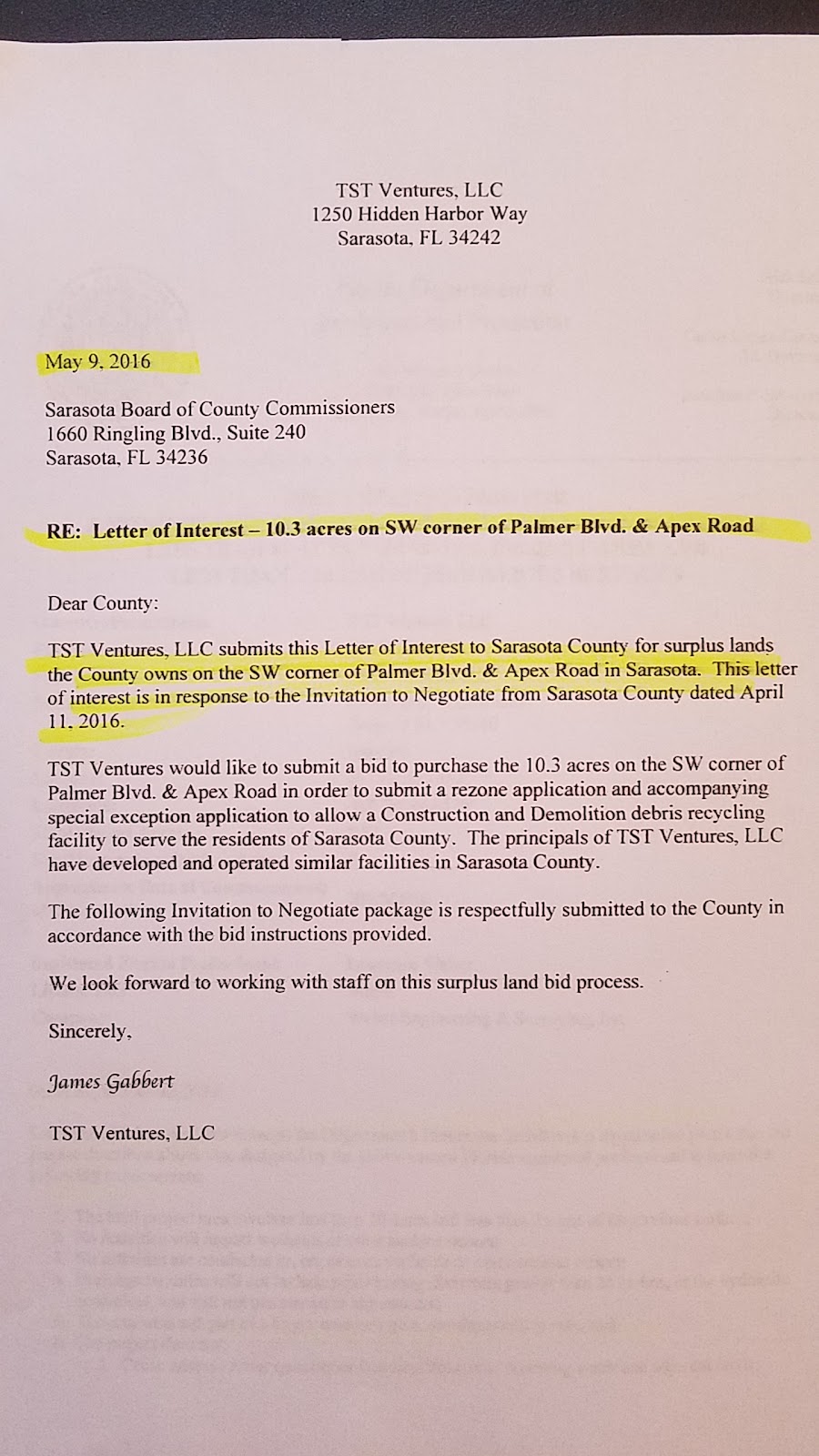
5/9/16 TST Ventures Letter of Interest - 10.3 acres on SW corner of Palmer Blvd. & Apex Rd.
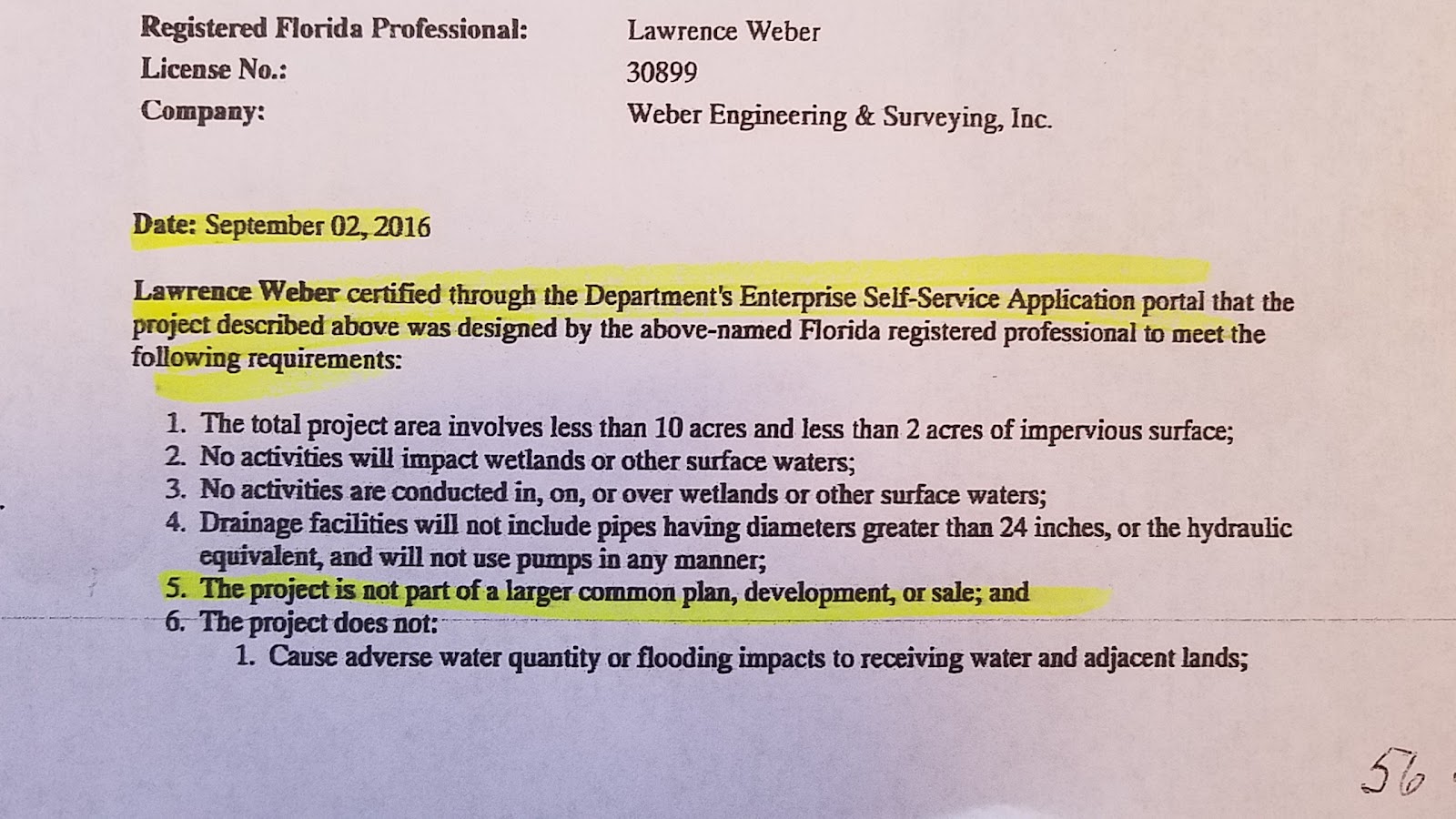
9/2/16 Self Certification form submitted to FDEP from Weber Engineering
The Weber Engineering packet submitted to the county on September 9, 2019 titled “Drainage Calculations” for 6150 Palmer Boulevard included a letter dated September 16, 2016 from the FDEP regarding “Self Certification for a Stormwater Management System...” and Mr. Weber submitted the certification specifically and only for the privately purchased 4.27 acres that Mr. Gabbert is developing his WTF on.
Lawrence Weber certified through the Department’s Enterprise Self-Service Application portal that the TST Ventures project was designed by the above named Florida registered professional to meet the following requirements and lists:
Item No. 5 - The project is not part of a larger common plan, development, or sale;
But that was not a truthful submission. On May 9, 2016 TST Ventures submitted a letter of interest to the Sarasota Board of County Commissioners to buy 10.3 acres of county owned surplus land on the SW corner of Palmer & Apex Road in order to allow a Construction and Demolition debris recycling facility to serve the residents of Sarasota County.
Weber Engineering "certification"
This means that the submitted project to the FDEP was presented falsely and was part of a larger common plan, development, or sale as and was submitted, four months before the September 16, 2016 letter from the FDEP.
TST Ventures (Gabbert) letter of interest May 9, 2016
I am asking the Board of Zoning appeals to uphold Zoning Administrator Donna Thompson’s recommendations regarding today’s zoning appeal for TST Ventures and let this go before the Board of County Commission for a decision. Any modification not specifically listed would require an amendment to the Concept Plan approved by the County Commission.
The State of Florida and Sarasota county development protocol exist for a reason. We, the people, should be able to trust that due diligence is applied to all development projects of such importance; especially a waste transfer facility (and Mr. Gabbert’s denied potential dump) being on top of the headwaters of the Phillippi Creek.
Time and time again, TST Ventures has put the cart in front of the horse regarding building out his WTF. What else exists with the current build out to the WTF that is being rushed?
We will be conducting a forensic file search on everything submitted for the WTF with county documents.
How can we trust that the FDEP form submitted by Weber Engineering is correct regarding:
That Item No. 6. The project does not:
Cause adverse water quantity or flooding impacts to receiving water and adjacent lands;
Cause adverse impacts to existing surface water storage and conveyance capabilities;
Cause a violation of state water quality standards; or
Cause an adverse impact to the maintenance of surface and ground water levels or surface water flows
We cannot trust the above to be true without substantial background materials that are really unknowns. With super storms staying not 24 hours but up to 72 hours hovering over smaller areas of land, it is awful to think of what awaits the untested Celery Field stormwater retention facility and the WTF being built on this unsuitable parcel for an open air construction waste transfer facility.
I am neither an attorney nor an engineer but I can assure you, the long trail of documents submitted to the County for Mr. Gabbert’s WTF provide little insight on numerous unanswered questions, especially when it comes to Mr. Gabbert’s assurance that his WTF will be able to keep the people and waters of Sarasota County healthy.
County would have to convert Bee Ridge Water Reclamation Facility to advanced treatment complex and pay $610,000 fine in latest draft of state consent order involving millions of gallons of spills
County countered at one point with proposal to construct more sewer systems in Phillippi Creek Basin
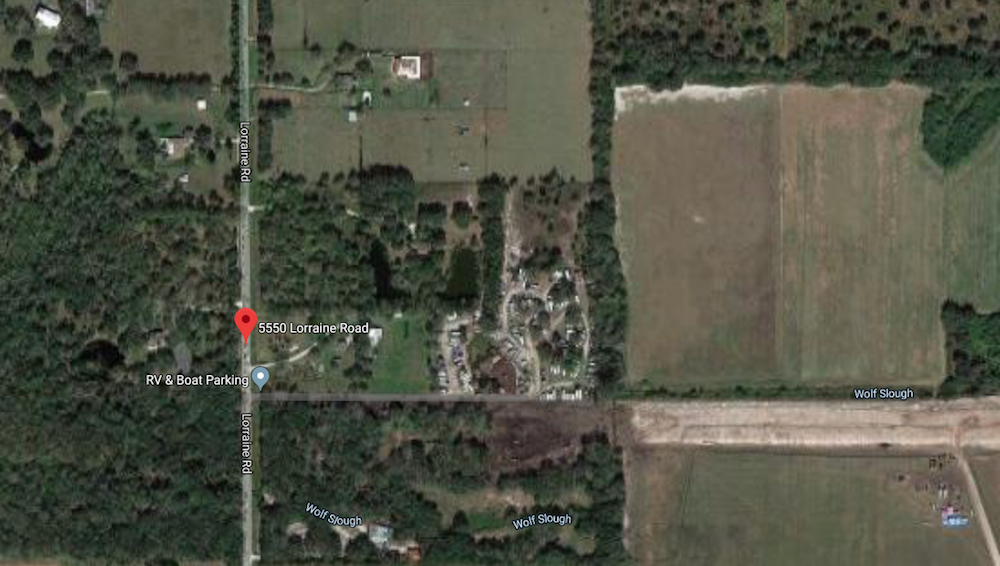
An aerial map shows the location of the Bee Ridge Water Reclamation Facility. Image from Google Maps
The latest draft of a consent order between the Florida Department of Environmental Protection (FDEP) and Sarasota County regarding spills from the county’s Bee Ridge Water Reclamation Facility calls for the conversion of that operation to an Advanced Wastewater Treatment plant by Dec. 31, 2024, The Sarasota News Leader has learned.
The proposed order also would require the county to pay $610,000 in state penalties.
The negotiations between FDEP and county staff members follow 24 incidents associated with the Bee Ridge plant since the summer of 2018, the draft order points out:
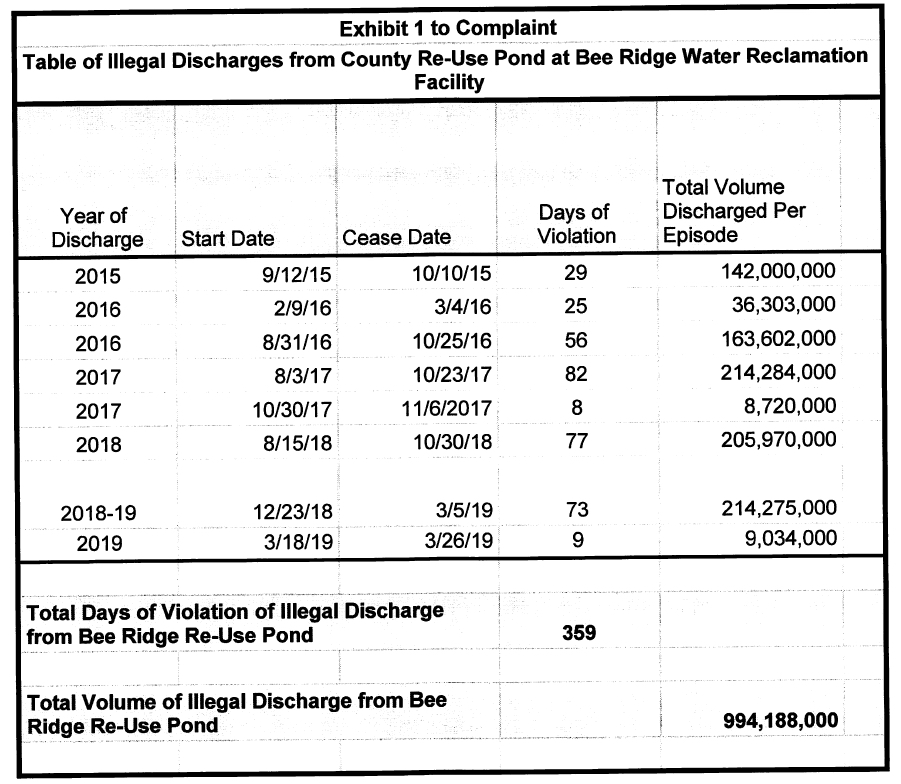
From Aug. 16, 2018 through Oct. 30, 2018, the draft says, the county discharged 205,197,000 gallons of treated effluent from the reclaimed water storage pond at the Bee Ridge site.
From Dec. 23, 2018 through March 12 of this year, discharges of treated effluent from that pond “were reported to have totaled 218,252,000 gallons.”
From March 18 through March 26, another 9,034,000 gallons was discharged from the pond.
Additionally, the draft order says that “22 wastewater spills (treated and untreated)” were associated with the Central County Water Reclamation Facility. One of them, the draft notes, “was treated effluent.” That facility is located at 7905 McIntosh Road in Sarasota.
Another 18 spills of untreated wastewater have been associated with the Venice Gardens Water Reclamation Facility, the draft says. That facility stands at 375 Venice E. Blvd. in Venice.
The county “failed to provide timely construction of wastewater facilities necessary to provide proper disposal, resulting in the multi-week discharges of treated effluent from the overflow weir in the reuse storage pond at the Bee Ridge Facility,” in violation of state regulations, the draft adds. FDEP has found that more than 420,000,000 gallons of treated effluent was discharged from the pond on the Bee Ridge plant site, the draft says.
In responding to News Leader requests for copies of FDEP documents, department spokeswoman Dee Ann Miller wrote in a June 11 email, “Protecting Florida’s environment and public health and safety is DEP’s top priority and we take every unauthorized discharge seriously.”
She added, “The Draft Consent Order includes corrective actions for the reuse disposal capacity issue as well as for the raw spills in the collection systems of all the county’s facilities (Bee Ridge and Central County and Venice Gardens). These include both short-term and long-term remedies. In the short-term the Bee Ridge facility will construct the necessary infrastructure to dispose of [its] reuse water in an existing Underground Injection Control well at the Central County Facility. This will cease the discharge,” she pointed out while the county undertakes a long-term fix, “which includes new Aquifer Recharge Wells being constructed.”
The conversion of the Bee Ridge plant to an Advanced Wastewater Treatment facility, Miller continued, “will significantly improve the quality of reuse water being utilized for irrigation in the watershed and reduce the amount of nutrients potentially running off into Sarasota Bay.”
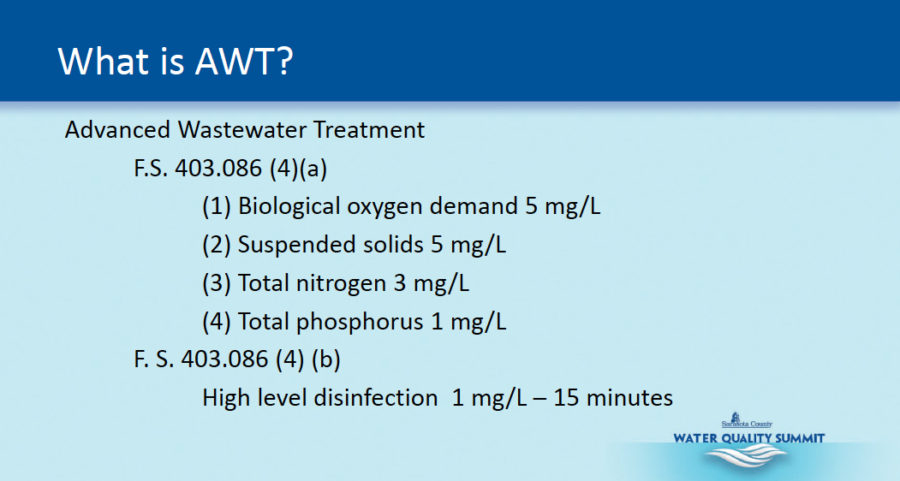
A graphic shown to participants at the June 5 Water Quality Summit explains advanced wastewater treatment. ‘F.S.’ refers to the Florida Statutes. Image courtesy Sarasota County
Miller also pointed out that for the draft order to be “finalized and executed it must be approved by the County Commission. Once it is executed, it will be a legally enforceable agreement.”
In early May, Mike Mylett, interim director of the county’s Public Utilities Department, told the commissioners that staff estimated the expense of converting all three county water reclamation facilities to advanced treatment centers would range between $70 million and $90 million.
Last week, during the county’s Water Quality Summit, Mylett told the approximately 650 people present that the expense for just the Bee Ridge facility would be between $50 million and $100 million. He also noted that of the three county water reclamation plants, only the Bee Ridge facility sits on a site large enough to make such a conversion possible.
On May 8, commissioners indicated a willingness to issue bonds to provide the necessary funding for major water quality projects, given the high bond ratings the county has received from the major rating agencies.
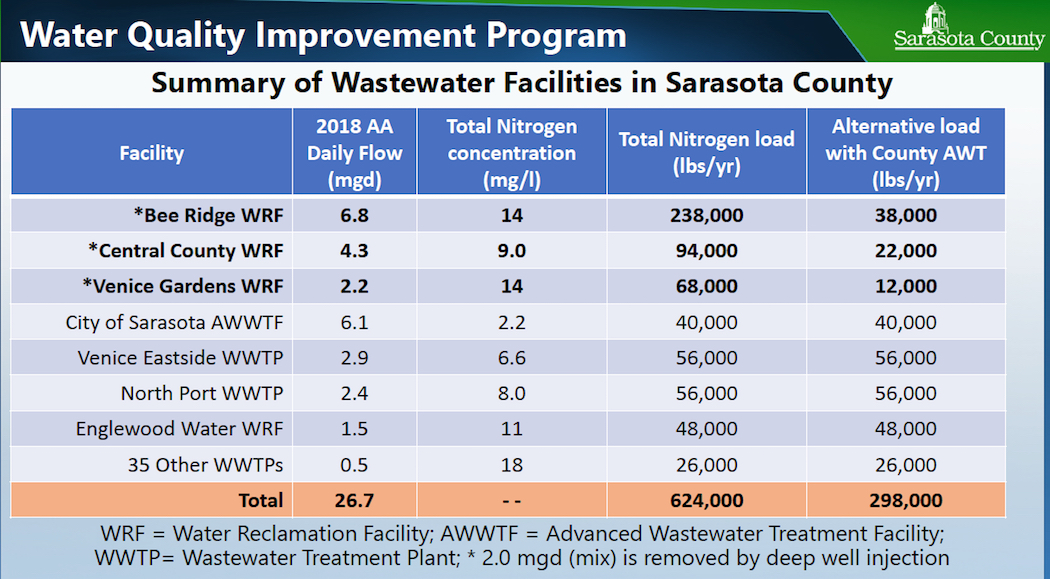
This graphic shows details about the nitrogen loads from water reclamation plants in the county. It was shown to the County Commission on May 8. Image courtesy Sarasota County
During that early May discussion, Walter also cautioned the commissioners that if they do not pursue measures to improve the quality of water in the bays — in the face of data showing demonstrated seagrass loss — then it is likely they will have to contend with state and federal regulatory action dictating such steps.
As negotiations proceed on the FDEP consent order, some discussion of potential expenses could arise as the County Commission conducts its annual, intensive workshops to finalize the county budget for the next fiscal year. Those sessions are scheduled for June 18 and 19, with a third set for June 21, in the event the board needs more time than the first two days will allow.
The commissioners this year have told staff that they do not want to raise the millage rate, though it will increase because of the voter-approved referendum allowing the county to issue $65 million in bonds to finance the North Extension and other improvements to The Legacy Trail.
Typically, during the June budget workshops, county administrative staff will bring to the board’s attention any new proposals for spending since the previous budget workshop. The last discussions the commission conducted about the fiscal year 2020 budget were on May 17.
Given the FDEP proposed fine of $610,000, staff next week may ask for direction — or offer suggestions — about how that could be covered.
A counterproposal
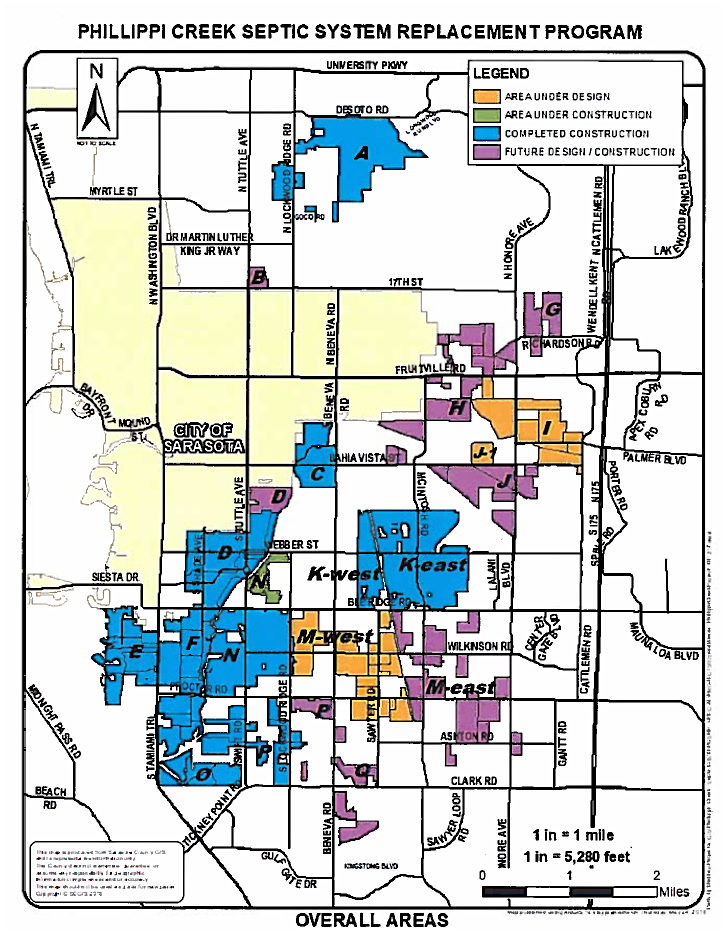
This November 2018 graphic shows the Phillippi Creek Septic Replacement System. Image courtesy Sarasota County
An earlier version of the draft order, which the Sierra Club provided to the News Leader, called for the county to eliminate septic tanks and connect homes to sewer systems in two more areas of the Phillippi Creek Basin — Areas M West and D4. That work would have been in lieu of converting the Bee Ridge plant to an Advanced Wastewater Treatment facility.
In a June 3 letter to FDEP, Cris Costello, organizing manager of the Sierra Club in Osprey, wrote that the county’s discharges between Aug. 16, 2018 and Oct. 22, 2018 “had an average nitrogen concentration of 19.3 mg/L [milligrams per liter], based upon County Discharge Monitoring Reports (DMRs) submitted to FDEP …” That equates, Costello continued, to 33,101 pounds of nitrogen discharged directly to Phillippi Creek. Based on scientific calculations Costello cited, that is more nitrogen than the load produced by all the septic systems the county was proposing to hook up to new sewer lines in the Phillippi Creek watershed, her letter pointed out.
Mylett, the county’s interim director of Public Utilities, told the County Commission in early May that an advanced wastewater treatment system would reduce the nitrogen load to 3 mg per liter.
“Ironically,” Costello pointed out in her letter, “the majority of this direct loading to Phillippi Creek also occurred during the County’s fertilizer ‘restricted period’ of June 1 through September 30, in conflict with the intent of the County’s own fertilizer ordinance to limit nitrogen loads.”
Scientists consistently point to nitrogen as the primary food for the red tide algae. (See the related stories in this issue.)
Costello then noted that the county’s discharge of reclaimed water between Dec. 23, 2018 and March 24 of this year had an average nitrogen concentration of 14.9 mg per liter, based upon the county DMRs submitted to FDEP. Those discharges, she wrote, equated to 28,235 pounds of nitrogen going into Phillippi Creek, which also was greater than the annual loading from all the septic systems the county was proposing to hook up to sewer lines in Areas M West and D4.
This is an exhibit filed with the federal lawsuit. Image courtesy U.S. District Court for the Middle District of Florida
As county staff negotiates with FDEP, county leaders also are in the midst of a federal lawsuit regarding the discharges from the water reclamation plants. That complaint was filed this spring by three nonprofit organizations: the Suncoast Waterkeeper, Our Children’s Earth Foundation and the Ecological Rights Foundation. The nonprofits have alleged county violations of the U.S. Clean Water Act, contending that the county illegally discharged “raw sewage, partially treated sewage and/or treated reclaimed water into Phillippi Creek, Cowpen Slough, Whitaker Bayou, and streams and other waters that are tributaries to Sarasota Bay, Roberts Bay, Dona/Roberts Bay and the Gulf of Mexico in or adjoining Sarasota County.”
Give-and-take of the negotiations
As negotiating has continued over both the short- and long-term solutions, the latest version of the FDEP consent order calls for the county “to cease all unauthorized discharges of treated wastewater from the Bee Ridge Facility” by Aug. 30.
An earlier version of the document cited July 19 as the date and did not specify the Bee Ridge plant.
Additionally, within five days of the effective date of the order, the county is to retain the services of a professional engineer registered in the State of Florida to design the proposed short-term modifications of its wastewater treatment facilities, “effluent disposal systems, and effluent conveyance systems.” The county also would have to complete an engineering report “demonstrating that, after implementation of the [short-term] modifications, the Facilities will not discharge air or water contaminants in sufficient quantity … so as to contribute significantly to the pollution problems within the State.”
Moreover, the latest draft says the county would agree to pay FDEP $2,000 per day in penalties “for each and every day [the county] fails to timely comply with any of the requirements of this Consent Order, other than unauthorized discharges.”
An earlier version put the penalties at $2,500 per day.
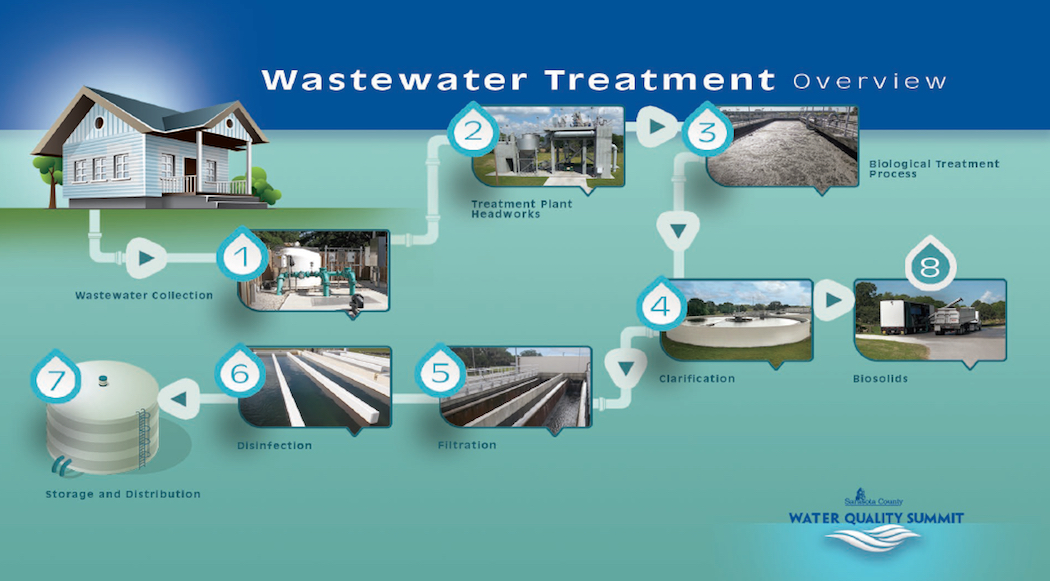
This graphic, presented to county Water Quality Summit attendees, shows how wastewater treatment functions. Image courtesy Sarasota County
A separate section of the latest draft also specifies penalties for unauthorized discharges “from any part of any of the [county’s] wastewater collection and transmission systems, wastewater treatment works, reuse or disposal systems, conveyance or storage systems, and residual management systems,” as follows:
$500 for up to 5,000 gallons.
$1,000 for 5,001 to 10,000 gallons.
$2,500 for 10,001 to 25,000 gallons.
$5,000 for 25,001 to 100,000 gallons.
$10,000 for any discharge in excess of 100,000 gallons.
Further, the draft calls for the county to submit to FDEP a written report every six months containing information about the status of the projects outlined in the order, as well as “any reasons for noncompliance.”
An earlier version required a report every calendar quarter.
A months-long process
In her June 11 email to the News Leader, Miller of FDEP wrote, “In the event of a discharge, our response is threefold: (1) work with the facility to identify any releases and ensure the release is stopped as quickly as possible; (2) gather and analyze information surrounding the circumstances of the reported incident to evaluate it from a regulatory perspective to determine if there were any violations; (3) identify any further corrective actions needed, including solutions to avoid future discharges and possible enforcement.”
Miller continued, “DEP has a number of enforcement tools we are able to use to address any identified violations. The nature of the violation and circumstances surrounding the event are used in the determination of which one is best suited. Along with the possibility of fines and penalties, which is one enforcement tool, enforcement can also be requiring necessary restoration and/or remediation actions through a Compliance Assistance Offer, Consent Order or other enforcement mechanism.”
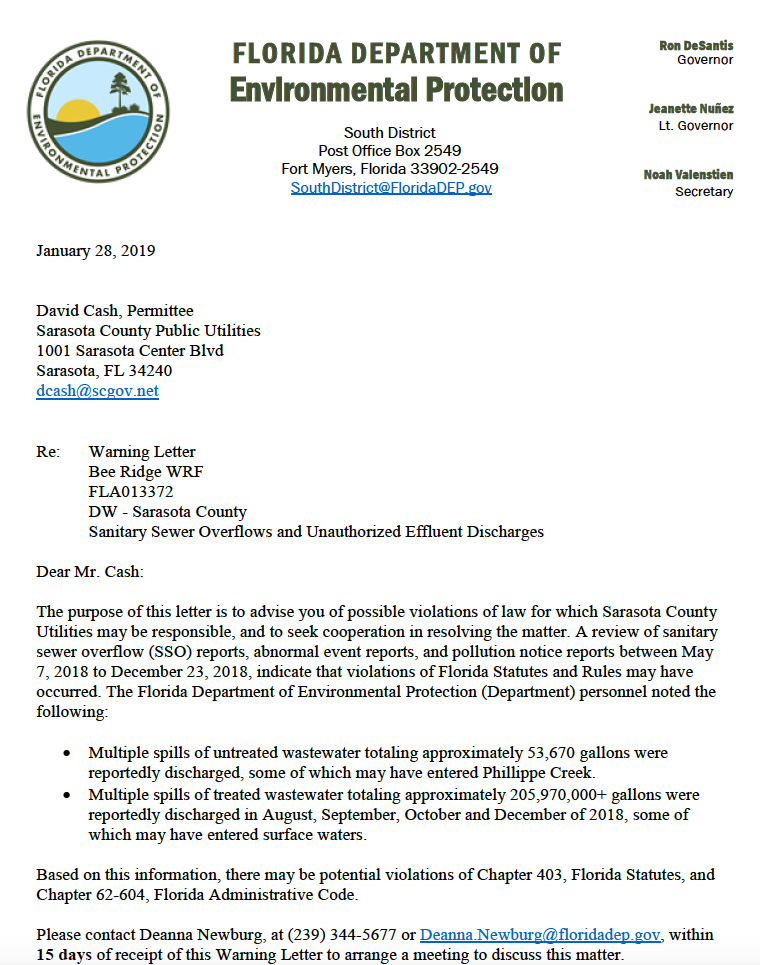
On Jan. 28, Miller wrote, FDEP sent a warning letter to Sarasota County, notifying county leaders “of possible violations of law for which Sarasota County Utilities may be responsible at the county’s Bee Ridge and Central facilities.”
This is a portion of the warning letter FDEP sent the county in January. Image courtesy FDEP
She added that the warning letter required the county to set up a meeting to discuss the matter within 15 days.
“This meeting was held on March 4, 2019,” Miller continued. At that time, [FDDP] staff “made it clear that the county must immediately implement a daily notification protocol during discharge events and that they are to make it their top priority to explore every opportunity to temporarily divert water to reduce or eliminate the discharge and to consider upgrading their plant to advanced waste treatment (AWT) and constructing additional permittable treated wastewater disposal capacity on an accelerated schedule,” Miller explained.
Letter from Sierra Club to FDEP regarding Sarasota County's wastewater treatment failures:
Sierra Club Florida supports the original mitigation in FDEP’s draft consent order requiring that Sarasota County upgrade their wastewater treatment plans to meet advanced wastewater treatment (AWT). We oppose Sarasota County’s (County) counter offer to delete this mitigation requirement in favor of connecting more wastewater flows from onsite sewer treatment and disposal systems (OSTDS). In fact, the state of Sarasota County wastewater management system is in such disarray with excessive discharges, nutrient concentrations, and spills that we would support FDEP limiting any additional flows being accepted from OSTDS or new development until the County has at least committed to upgrade to AWT.
Sarasota County acquired several AWT facilities, shut them down, and diverted that water to its own non-AWT facilities
5. Based upon Sarasota County’s 2001 Bee Ridge Water Reclamation Facility (WRF) WRF Expansion Facilities Plan, the Bee Ridge WWTF was originally AWT but was converted to secondary treatment with filtration. In addition, it is our understanding that Sarasota County has purchased and decommissioned at least four WWTFs (Siesta Key Utilities, South Gate, Gulf Gate, and Aqua Utilities) that were previously meeting AWT standards. This wastewater, formerly treated to AWT standards, has been diverted to the County’s non-AWT plants where the resulting effluent now has significantly higher nutrient concentrations.
ii. The County’s discharge of 205,197,000 gallons of reclaimed water between 8/16/18 and 10/22/18 had an average nitrogen concentration of 19.3 mg/L, based upon County Discharge Monitoring Reports (DMRs) submitted to FDEP, equates to 33,101 pounds of nitrogen discharged directly to Phillippi Creek.
. . . nitrogen levels in Sarasota’s bays have been documented, by Sarasota County, as increasing over the past 20 years. This increase has been accompanied by a documented decrease of seagrass coverage in recent years.
====
Entire Text:
June 3, 2019
Jon Iglehart Director, South District Florida Department of Environmental Protection
2295 Victoria Avenue
Suite 364
Fort Myers, FL 33901
RE: Consent Order to Sarasota County Utilities
Dear Mr. Iglehart:
Please accept this as an interjection in the matter of FDEP’s consent order to Sarasota County Utilities on behalf of Sierra Club Florida. Specifically, Sierra Club Florida supports the original mitigation in FDEP’s draft consent order requiring that Sarasota County upgrade their wastewater treatment plans to meet advanced wastewater treatment (AWT). We oppose Sarasota County’s (County) counter offer to delete this mitigation requirement in favor of connecting more wastewater flows from onsite sewer treatment and disposal systems (OSTDS). In fact, the state of Sarasota County wastewater management system is in such disarray with excessive discharges, nutrient concentrations, and spills that we would support FDEP limiting any additional flows being accepted from OSTDS or new development until the County has at least committed to upgrade to AWT. We present the following in support of this position:
1. A “preliminary planning level” estimate of costs to upgrade to AWT and cap on costs by the end of the year as proffered by the County does not appear to be a good faith effort to address the issue.
2. The County’s proposed mitigation seems counter-productive at this point; the County is not in a position to take on more flows without satisfactorily addressing their disposal capacity and nutrient issues.
3. Since the County seems to want to estimate nitrogen loads regarding OSTDS:
i. Based upon information from the Florida Department of Health cited by Dr. Mary Lusk
with the University of Florida-IFAS Extension (Septic Systems 101), the average gross and net nitrogen loadings for an OSWDTS are 11.2 and 7.8 grams of nitrogen per person per day, respectively. These would equate to gross and net loadings of 19.8 and 13.8 pounds of nitrogen per household per year, respectively, assuming 2.2 people per household. The net 13.8 pounds of nitrogen per household per year is still conservative since it does not consider denitrification, which likely occurs due to the unique hydrogeology of areas like Sarasota County. The County’s 25 pounds reflects the gross nitrogen load, and basically assumes that all of the OSTDS are failing. Therefore the County’s estimated nitrogen load reduction of 35,000 pounds from 14,000 OSTDS should actually be 19,230 pounds, which is still conservative since it does not consider denitrification.
ii. The County’s discharge of 205,197,000 gallons of reclaimed water between 8/16/18 and 10/22/18 had an average nitrogen concentration of 19.3 mg/L, based upon County Discharge Monitoring Reports (DMRs) submitted to FDEP, equates to 33,101 pounds of nitrogen discharged directly to Phillippi Creek. This event loading is greater than the annual loading from all the OSTDS that the County is proposing to hook up as mitigation. Ironically, the majority of this direct loading to Phillippi Creek also occurred during the County’s fertilizer “restricted period” of June 1 through September 30, in conflict with intent of the County’s own fertilizer ordinance to limit nitrogen loads.
iii. The County’s discharge of 227,287,000 gallons of reclaimed water between 12/23/18 and 3/24/19 had an average nitrogen concentration of 14.9 mg/L, based upon County DMRs submitted to FDEP, equates to 28,235 pounds of nitrogen discharged directly to Phillippi Creek. This event loading is also greater than the annual loading from all the OSTDS that County is proposing to hook up as mitigation.
4. Based upon the DMR’s submitted by Sarasota County to FDEP, the average nitrogen concentrations in 2018 from the Bee Ridge, Central County, and Venice Gardens Wastewater Treatment Facilities (WWTFs) were 18.3 mg/L, 7.66 mg/L, and 14.2 mg/L, respectively. These reflect the average nitrogen concentrations of the “treated” wastewater or reclaimed water. This is not just reflective of the nutrients that might be directly (and illegally) discharged, but of those which are being put into the environment to irrigate lawns, landscapes and golf courses. The application of the County’s effluent reclaimed water is resulting in the application of significant and year-round nitrogen in addition to nitrogen fertilizer to the environment. This is in direct conflict with the intent of the Sarasota County’s own fertilizer regulations that bans the application of nitrogen fertilizer between June 1 and September 30; and limits the total nitrogen application to 4 pounds per 10,000 square feet per year. Sierra Club believes that upgrading their WWTFs to meet the AWT for nitrogen of 3 mg/L, or even better the nutrient numeric criteria for freshwater streams of 1.65 mg/L, would put Sarasota County in a position to eliminate nitrogen loads to the extent practical. It is noted that the City of Sarasota’s wastewater is currently meeting the numeric nutrient criteria for both nitrogen and phosphorus, so such a goal is in fact practical and achievable.
5. Based upon Sarasota County’s 2001 Bee Ridge Water Reclamation Facility (WRF) WRF Expansion Facilities Plan, the Bee Ridge WWTF was originally AWT but was converted to secondary treatment with filtration. In addition, it is our understanding that Sarasota County has purchased and decommissioned at least four WWTFs (Siesta Key Utilities, South Gate, Gulf Gate, and Aqua Utilities) that were previously meeting AWT standards. This wastewater, formerly treated to AWT standards, has been diverted to the County’s non-AWT plants where the resulting effluent now has significantly higher nutrient concentrations. Conservatively assuming that the combined flow from these 4 WWTFs was 4.0 million gallons a day (the combined permitted capacity of these 4 WWTFs exceeded 8 mgd) and given the average 2018 nitrogen concentration difference between the Bee Ridge Plant of 18.3 mg/L and the AWT limit of 3 mg/L, equates to an additional annual nitrogen load of 187,000 pounds. This represents not only a huge step backwards but results in an increased nitrogen load to the environment that is almost 10 times greater than that of the County’s proposed but misdirected and inadequate mitigation (19,320 pounds).
6. Finally, nitrogen levels in Sarasota’s bays have been documented, by Sarasota County, as increasing over the past 20 years. This increase has been accompanied by a documented decrease of seagrass coverage in recent years. It is not unreasonable to conclude that the increase in nitrogen is in part due to Sarasota County’s poor wastewater planning and misdirected public investments, resulting in illegal spills and discharges of nitrogen-rich wastewater to the waters of the State as well as to the landscape that drain to state waters. Since the City of Sarasota’s existing WWTF exceeds AWT standards; the Bee Ridge WWTF met AWT prior to being downgraded by Sarasota County; and numerous private WWTFs were meeting AWT prior to being purchased and deactivated by Sarasota County, the technology to meet AWT is both practical and possible. Therefore, it is demonstrated both possible and practical for Sarasota County to convert their WWTFs to AWT and the Sierra Club supports FDEP’s consent order to require such for the Bee Ridge and Central County Plants but also advocates the upgrading of the Venice Gardens WWTF to AWT, given its high nitrogen levels, to mitigate for past, present, and future nutrient loads.
Thank you for considering Sierra Club’s concerns and our position in support of a strong Consent Order that will go further than Sarasota County’s proposed amended Draft to assure future compliance with the law. We would appreciate the opportunity for additional review and comment as the Department’s enforcement action matures towards resolution.
Sincerely,
Cris Costello Organizing Manager Sierra Club 2127 S. Tamiami Trail Osprey, FL 34229 941-914-0421 cris.costello@sierraclub.org
cc: Jennifer Carpenter, Assistant Director of District Management, FDEP