Showing posts with label advanced wastewater. Show all posts

Monday, June 3, 2019

Sierra Florida to FDEP: Sarasota wastewater management system is in disarray

Letter from Sierra Club to FDEP regarding Sarasota County's wastewater treatment failures:

Sierra Club Florida supports the original mitigation in FDEP’s draft consent order requiring that Sarasota County upgrade their wastewater treatment plans to meet advanced wastewater treatment (AWT). We oppose Sarasota County’s (County) counter offer to delete this mitigation requirement in favor of connecting more wastewater flows from onsite sewer treatment and disposal systems (OSTDS). In fact, the state of Sarasota County wastewater management system is in such disarray with excessive discharges, nutrient concentrations, and spills that we would support FDEP limiting any additional flows being accepted from OSTDS or new development until the County has at least committed to upgrade to AWT. 

Full letter from Cris Costello of the Sierra Club here (also below the image)


Among the points made:

Sarasota County acquired several AWT facilities, shut them down, and diverted that water to its own non-AWT facilities

5. Based upon Sarasota County’s 2001 Bee Ridge Water Reclamation Facility (WRF) WRF Expansion Facilities Plan, the Bee Ridge WWTF was originally AWT but was converted to secondary treatment with filtration. In addition, it is our understanding that Sarasota County has purchased and decommissioned at least four WWTFs (Siesta Key Utilities, South Gate, Gulf Gate, and Aqua Utilities) that were previously meeting AWT standards. This wastewater, formerly treated to AWT standards, has been diverted to the County’s non-AWT plants where the resulting effluent now has significantly higher nutrient concentrations. 
ii. The County’s discharge of 205,197,000 gallons of reclaimed water between 8/16/18 and 10/22/18 had an average nitrogen concentration of 19.3 mg/L, based upon County Discharge Monitoring Reports (DMRs) submitted to FDEP, equates to 33,101 pounds of nitrogen discharged directly to Phillippi Creek.
. . . nitrogen levels in Sarasota’s bays have been documented, by Sarasota County, as increasing over the past 20 years. This increase has been accompanied by a documented decrease of seagrass coverage in recent years. 


====


Entire Text:


June 3, 2019
Jon Iglehart Director, South District Florida Department of Environmental Protection
2295 Victoria Avenue
Suite 364
Fort Myers, FL 33901
RE: Consent Order to Sarasota County Utilities

Dear Mr. Iglehart:

Please accept this as an interjection in the matter of FDEP’s consent order to Sarasota County Utilities on behalf of Sierra Club Florida. Specifically, Sierra Club Florida supports the original mitigation in FDEP’s draft consent order requiring that Sarasota County upgrade their wastewater treatment plans to meet advanced wastewater treatment (AWT). We oppose Sarasota County’s (County) counter offer to delete this mitigation requirement in favor of connecting more wastewater flows from onsite sewer treatment and disposal systems (OSTDS). In fact, the state of Sarasota County wastewater management system is in such disarray with excessive discharges, nutrient concentrations, and spills that we would support FDEP limiting any additional flows being accepted from OSTDS or new development until the County has at least committed to upgrade to AWT. We present the following in support of this position:

1. A “preliminary planning level” estimate of costs to upgrade to AWT and cap on costs by the end of the year as proffered by the County does not appear to be a good faith effort to address the issue.

2. The County’s proposed mitigation seems counter-productive at this point; the County is not in a position to take on more flows without satisfactorily addressing their disposal capacity and nutrient issues.

3. Since the County seems to want to estimate nitrogen loads regarding OSTDS:

i. Based upon information from the Florida Department of Health cited by Dr. Mary Lusk
with the University of Florida-IFAS Extension (Septic Systems 101), the average gross and net nitrogen loadings for an OSWDTS are 11.2 and 7.8 grams of nitrogen per person per day, respectively. These would equate to gross and net loadings of 19.8 and 13.8 pounds of nitrogen per household per year, respectively, assuming 2.2 people per household. The net 13.8 pounds of nitrogen per household per year is still conservative since it does not consider denitrification, which likely occurs due to the unique hydrogeology of areas like Sarasota County. The County’s 25 pounds reflects the gross nitrogen load, and basically assumes that all of the OSTDS are failing. Therefore the County’s estimated nitrogen load reduction of 35,000 pounds from 14,000 OSTDS should actually be 19,230 pounds, which is still conservative since it does not consider denitrification.

ii. The County’s discharge of 205,197,000 gallons of reclaimed water between 8/16/18 and 10/22/18 had an average nitrogen concentration of 19.3 mg/L, based upon County Discharge Monitoring Reports (DMRs) submitted to FDEP, equates to 33,101 pounds of nitrogen discharged directly to Phillippi Creek. This event loading is greater than the annual loading from all the OSTDS that the County is proposing to hook up as mitigation. Ironically, the majority of this direct loading to Phillippi Creek also occurred during the County’s fertilizer “restricted period” of June 1 through September 30, in conflict with intent of the County’s own fertilizer ordinance to limit nitrogen loads.

iii. The County’s discharge of 227,287,000 gallons of reclaimed water between 12/23/18 and 3/24/19 had an average nitrogen concentration of 14.9 mg/L, based upon County DMRs submitted to FDEP, equates to 28,235 pounds of nitrogen discharged directly to Phillippi Creek. This event loading is also greater than the annual loading from all the OSTDS that County is proposing to hook up as mitigation.

4. Based upon the DMR’s submitted by Sarasota County to FDEP, the average nitrogen concentrations in 2018 from the Bee Ridge, Central County, and Venice Gardens Wastewater Treatment Facilities (WWTFs) were 18.3 mg/L, 7.66 mg/L, and 14.2 mg/L, respectively. These reflect the average nitrogen concentrations of the “treated” wastewater or reclaimed water. This is not just reflective of the nutrients that might be directly (and illegally) discharged, but of those which are being put into the environment to irrigate lawns, landscapes and golf courses. The application of the County’s effluent reclaimed water is resulting in the application of significant and year-round nitrogen in addition to nitrogen fertilizer to the environment. This is in direct conflict with the intent of the Sarasota County’s own fertilizer regulations that bans the application of nitrogen fertilizer between June 1 and September 30; and limits the total nitrogen application to 4 pounds per 10,000 square feet per year. Sierra Club believes that upgrading their WWTFs to meet the AWT for nitrogen of 3 mg/L, or even better the nutrient numeric criteria for freshwater streams of 1.65 mg/L, would put Sarasota County in a position to eliminate nitrogen loads to the extent practical. It is noted that the City of Sarasota’s wastewater is currently meeting the numeric nutrient criteria for both nitrogen and phosphorus, so such a goal is in fact practical and achievable.

5. Based upon Sarasota County’s 2001 Bee Ridge Water Reclamation Facility (WRF) WRF Expansion Facilities Plan, the Bee Ridge WWTF was originally AWT but was converted to secondary treatment with filtration. In addition, it is our understanding that Sarasota County has purchased and decommissioned at least four WWTFs (Siesta Key Utilities, South Gate, Gulf Gate, and Aqua Utilities) that were previously meeting AWT standards. This wastewater, formerly treated to AWT standards, has been diverted to the County’s non-AWT plants where the resulting effluent now has significantly higher nutrient concentrations. Conservatively assuming that the combined flow from these 4 WWTFs was 4.0 million gallons a day (the combined permitted capacity of these 4 WWTFs exceeded 8 mgd) and given the average 2018 nitrogen concentration difference between the Bee Ridge Plant of 18.3 mg/L and the AWT limit of 3 mg/L, equates to an additional annual nitrogen load of 187,000 pounds. This represents not only a huge step backwards but results in an increased nitrogen load to the environment that is almost 10 times greater than that of the County’s proposed but misdirected and inadequate mitigation (19,320 pounds).

6. Finally, nitrogen levels in Sarasota’s bays have been documented, by Sarasota County, as increasing over the past 20 years. This increase has been accompanied by a documented decrease of seagrass coverage in recent years. It is not unreasonable to conclude that the increase in nitrogen is in part due to Sarasota County’s poor wastewater planning and misdirected public investments, resulting in illegal spills and discharges of nitrogen-rich wastewater to the waters of the State as well as to the landscape that drain to state waters. Since the City of Sarasota’s existing WWTF exceeds AWT standards; the Bee Ridge WWTF met AWT prior to being downgraded by Sarasota County; and numerous private WWTFs were meeting AWT prior to being purchased and deactivated by Sarasota County, the technology to meet AWT is both practical and possible. Therefore, it is demonstrated both possible and practical for Sarasota County to convert their WWTFs to AWT and the Sierra Club supports FDEP’s consent order to require such for the Bee Ridge and Central County Plants but also advocates the upgrading of the Venice Gardens WWTF to AWT, given its high nitrogen levels, to mitigate for past, present, and future nutrient loads.

Thank you for considering Sierra Club’s concerns and our position in support of a strong Consent Order that will go further than Sarasota County’s proposed amended Draft to assure future compliance with the law. We would appreciate the opportunity for additional review and comment as the Department’s enforcement action matures towards resolution.
Sincerely,

Cris Costello Organizing Manager Sierra Club 2127 S. Tamiami Trail Osprey, FL 34229 941-914-0421 cris.costello@sierraclub.org

cc: Jennifer Carpenter, Assistant Director of District Management, FDEP


======


Friday, May 3, 2019

"Reasonably founded fears" - Utilities Director out in wake of alleged Clean Water Act violations

Courtesy of the Sarasota News Leader

Subscribe to the SNL

Director of county’s Public Utilities Department leaves position in early April


Scott Schroyer addresses the County Commission on March 29. News Leader image

Scott N. Schroyer, who had served as director of Sarasota County’s Public Utilities Department since early fall of 2014, has left that position, The Sarasota News Leader has learned.
In response to a News Leader request for information about the situation, county Media Relations Specialist Brianne Grant provided a statement in an April 30 email.
“There has been a change in leadership and focus in the county’s Public Utilities Department,” the statement began. “The relationship with an at-will employee may be terminated any time by either party. As an organization, we recognize that the services provided by our Public Utilities Department [are among] the most vital to our community. Focusing on customer service [and] improving our utilities infrastructure are key factors in moving forward,” the statement added.
Schroyer began his employment as the Public Utilities director on Oct. 6, 2014, Grant wrote. His last day with the county was April 10; his ending salary was $139,588.80, she noted.
Mike Mylett, who has been with Sarasota County for 19 years, has been named the interim director, Grant reported.
The News Leader was unsuccessful in attempts to reach Schroyer.
Mylett appeared before the County Commission last week in his new capacity. However, most of the memos in the agenda packets for Public Utilities Department items for the April 23 and April 24 board meetings listed Schroyer as the director. Mylett was named on only two of them. One pertained to a contract amendment for new pipes and fittings for potable water, reclaimed water and wastewater utilities. The other involved water demand projections from 2020 to 2040, in the context of the county’s contract with the Peace River Manasota Regional Water Supply Authority.
When then-County Administrator Tom Harmer announced Schroyer’s hiring in a Sept. 18, 2014 news release, Harmer said of Schroyer, “His strong management background and his experience in the public works field will be a great asset in serving our residents and utility customers.”
The release noted that Schroyer had more than 30 years of experience in local government. He had worked for the City of Hudson, Ohio, since 1984, the release pointed out, “most recently serving as its assistant city manager beginning in June 2011 and its interim city manager from late 2013 through July 2014.”
Throughout his career, the release continued, Schroyer has specialized in public works/utilities, including the operational management of water, wastewater, stormwater and electric utilities. He also has held licensing in water distribution and wastewater collection systems, the release noted. As the Hudson, Ohio assistant city manager, the release added, his responsibilities included “strategic oversight of the utility system.”
Schroyer’s last formal presentation to the County Commission occurred on March 29, as part of a budget workshop. The board members that day reviewed a list of projects related to county water quality initiatives, as they talked about the devastation of red tide on the environment and tourism last summer and fall.
County Administrator Jonathan Lewis introduced that part of the workshop by explaining that the Florida Legislature would be convening earlier in 2020 — in January instead of March — because next year is an election year. Lewis said staff wanted to ensure the commissioners have an opportunity to tweak water quality priorities with an eye toward applying for state funding assistance.
That day, commissioners criticized Schroyer, Assistant County Administrator Mark Cunningham and County Engineer Spencer Anderson, because slides they trio showed the board lacked detailed information.


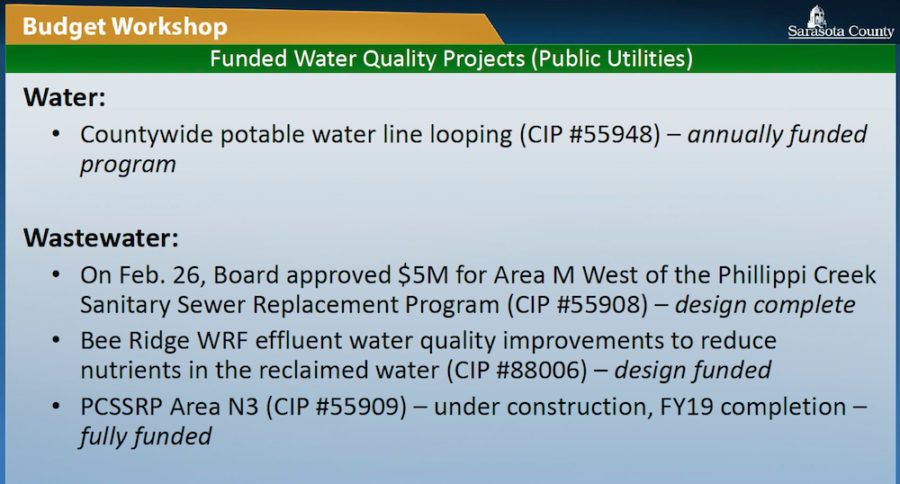
This is one of the slides that drew commission criticism on March 29. Image courtesy Sarasota County

For example, Commissioner Nancy Detert complained to Schroyer that none of the slides had timelines, so she had no idea when a particular project was scheduled for construction — or whether it was on the construction list for the next five years. (The commission each year approves priorities in its Capital Improvement Program — CIP — for five years, though only the projects listed in the first year generally will be pursued; priorities often change year-to-year.)
Additionally, Commissioner Alan Maio called for more details to be included for the public in discussions involving the county’s long-term initiative to eliminate septic tanks in the Phillippi Creek Basin.
The litigation
That March 29 budget workshop was held nine days after the Sarasota Herald-Tribune reported that three nonprofit environmental organizations — the Suncoast Waterkeeper, Our Children’s Earth Foundation and the Ecological Rights Foundation — had filed notice of intent on Feb. 20 that they would bring suit against the county in federal court.
The civil action would be a response to the nonprofits’ allegations of county violations of the U.S. Clean Water Act. They contend that the county illegally discharged “raw sewage, partially treated sewage and/or treated reclaimed water into Phillippi Creek, Cowpen Slough, Whitaker Bayou, and streams and other waters that are tributaries to Sarasota Bay, Roberts Bay, Dona/Roberts Bay and the Gulf of Mexico in or adjoining Sarasota County.”


This is a banner from the Suncoast Waterkeepe’s website. Image courtesy of Suncoast Waterkeeper

The primary focus of the complaint was the county’s Bee Ridge Water Reclamation Facility, located at 5550 Lorraine Road in Sarasota. The nonprofits say in their suit that “treated wastewater effluent that meets public access quality standards is stored on-site” at that facility in a 2-million gallon, above-ground storage tank, as well as in a storage pond encompassing 29.4 acres that is capable of holding 145.2 million gallons. (A county fact sheet says the storage pond has a maximum capacity of 170 million gallons per day.)
The county operates a North Master Reuse System, the complaint continues, “to provide treated effluent from the Been Ridge [facility] … primarily for a golf course and residential irrigation for approximately 5,500 acres of land.”
That reclaimed water “contains high levels of nutrients,” the nonprofits argue, “and [it] is not treated for surface water discharges.”
(During the March 29 budget workshop, Assistant County Administrator Cunningham reported that all three of the county’s water reclamation facilities are “classified as advanced secondary [treatment plants].” He added that FDEP allows 15 to 20 mgs of nitrogen per liter, but the nitrogen count following treatment in those facilities is about 12 to 15 mgs per liter.)
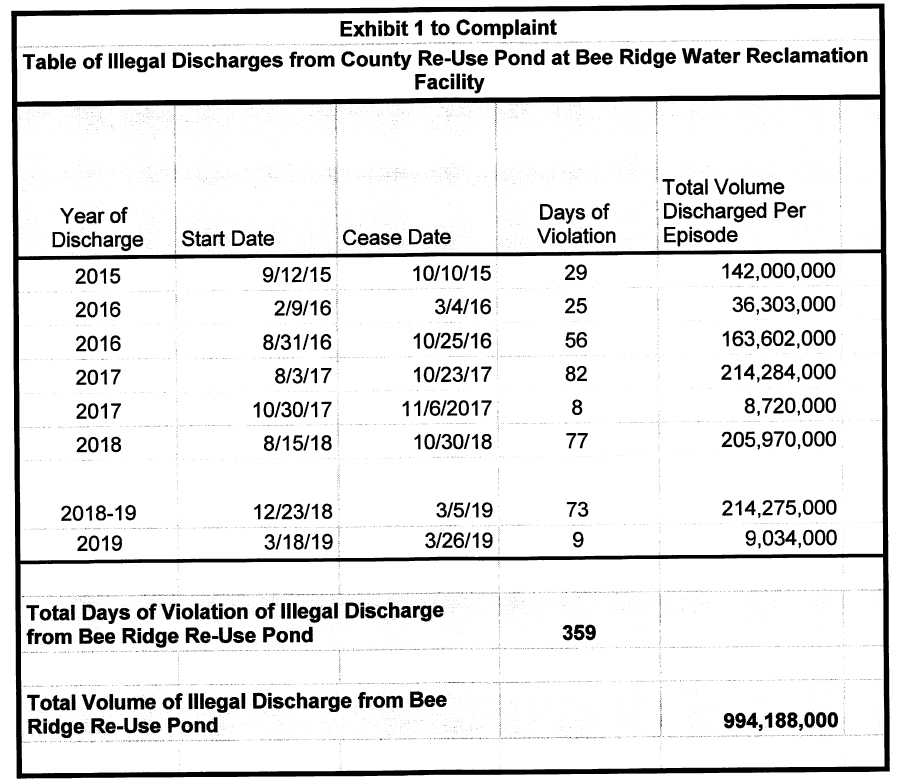
According to an exhibit filed with the lawsuit, the nonprofits contend that the county illegally has discharged close to 1 billion gallons from the Bee Ridge pond since September 2015: 994,188,000 gallons. The highest volume for a continuous period, that exhibit shows, was 214,284,000 gallons from Aug. 3, 2017 to Oct. 23, 2017 — 82 days.

This is an exhibit filed with the federal lawsuit. Image courtesy U.S. District Court for the Middle District of Florida

The suit asks the court to make the county cease the illegal discharges. Additionally, it calls for the assessment of
civil penalties against the county of up to $37,500 per day for each violation on or before Nov. 2, 2015 and $54,833 per day for each violation after Nov. 2, 2015.
Since at least 2013, the complaint continues, the county “has reported numerous discharges of Reclaimed Water from the Bee Ridge storage pond into the stormwater system,” and those discharges “have increased in duration and volume over time, with the knowledge of the County and with no adequate measures taken to prevent or cease these discharges.”
Moreover, the suit contends, “The County has reported numerous overflows of raw sewage from the County’s sewer lines, manholes, pump stations” and various other sections of its overall collection system.
The spills are documented in forms the county had to file with the Florida Department of Environmental Protection (FDEP), the complaint points out.
“The County’s discharges of raw sewage, partially treated sewage and/or treated reclaimed water … degrade water quality and harm aquatic life in [the affected] waters,” the complaint adds.
Members of the Suncoast Waterkeeper in Sarasota and Manatee counties “who reside in the vicinity of the waters affected by Sarasota County’s violations … have reasonably founded fears that the high nutrients contained [n the spills] have contributed to the conditions exacerbating Red Tide,” the complaint points out.


An August 2018 satellite image shows the presence of red tide in area waters. Image courtesy City of Sarasota

The organizations filed suit, they write, because “neither the [Environmental Protection Agency] nor the state of Florida has commenced or is diligently prosecuting an action to redress the violations alleged …”
The Feb. 20 letter the nonprofits sent the county served as the required 60-day notice before the filing of the complaint. The filing occurred on April 22 in the U.S. District Court for the Middle District Court in Tampa.
On April 22, county Media Relations Officer Drew Winchester released the following statement: “Sarasota County is aware of the civil litigation related to reclaimed water storage at the Bee Ridge Water Reclamation Facility. We are committed to improving our utilities infrastructure as water quality is a top priority for the county.”
As a matter of policy, county staff does not comment on litigation.
Commission frustrations
The Herald-Tribune article was the focus of county commissioners’ comments during the March 29 budget workshop.
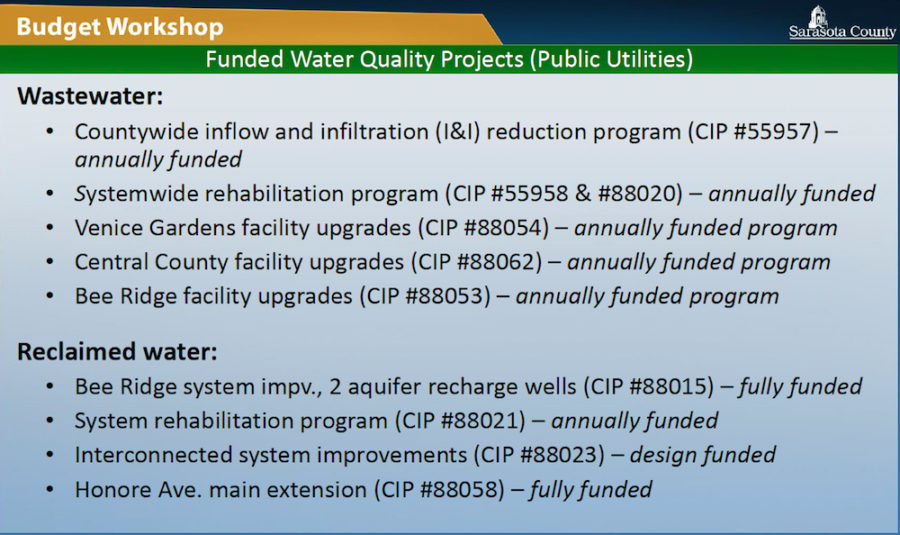
For example, referring to slides about the Bee Ridge plant, Chair Charles Hines told Schroyer that details about staff plans to reduce the level of nutrients in the reclaimed water need to be part of any report Schroyer provides the board.


This is another slide presented on March 29 that drew commission criticism. Image courtesy Sarasota County

Schroyer did point out that staff has been working on a project that will see the construction of two aquifer recharge wells able to handle 18 million gallons per day at the Bee Ridge facility. The estimated $14.2-million initiative is fully funded, he added.
The estimated completion of the new wells is Dec. 31, 2023, according to a county fact sheet issued in April.
Later during the March 29 discussion, Commissioner Maio referenced the board members having been “hit with a lot of emails” after the Herald-Tribune article was published. “We need to get the word out” about the plans for those wells, he stressed. “We do not promote that!”
“Part of your job,” Commissioner Detert told Schroyer, “is to keep us informed as to what the needs are, so we don’t get [an unexpected headline].”
After the federal lawsuit was filed, county Communications staff issued the fact sheet about the Bee Ridge Water Reclamation Facility, noting that the plant is one of three such operations in the county.
In 2018, the fact sheet said, the county treated 5.1 billion gallons of wastewater countywide.
The Bee Ridge plant dates to 1994, the sheet continued. It has the capacity to treat 12 million gallons per day.


Subscribe to the SNL