Showing posts with label lawsuits. Show all posts

Friday, February 15, 2019

Cosentino can join suit on Charter case


Subscribe to the SNL


County and plaintiffs in Charter amendments lawsuit agree Reopen Beach Road can be a party to the case


Reopen Beach Road objects to judge’s proposal to refer the case to a Circuit Court magistrate
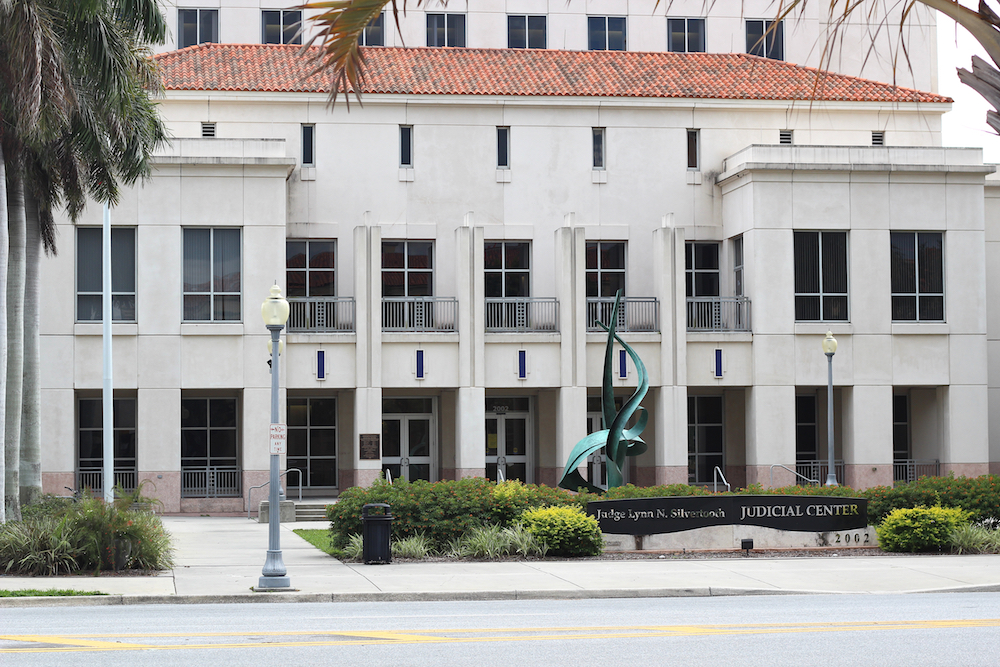

The Silvertooth Judicial Center is located on Ringling Boulevard in downtown Sarasota. File photo

Siesta Key property owners who have challenged the legality of two Sarasota County Charter amendments and the Office of the County Attorney have agreed that the nonprofit organization Reopen Beach Road should be allowed to intervene in a 12th Judicial Circuit Court case focused on the amendments.
Siesta Key resident Michael Cosentino — who established the nonprofit Reopen Beach Road in June 2016 — wrote the two Charter amendments, both of which are related to a May 2016 County Commission vacation of part of North Beach Road. The amendments won voter approval on the Nov. 6, 2018 General Election ballot.
Attorney Ryan Reese of Moore, Bowman & Rix in Tampa, acting on behalf of plaintiff William H. Caflisch, and Assistant County Attorney David M. Pearce signed a stipulation that was filed with the Circuit Court on Feb. 6. It said that it was appropriate for Reopen Beach Road “to intervene in this matter …” They were joined in the stipulation by attorney Fred E. Moore of the Bradenton firm Blalock Walters, acting on behalf of Reopen Beach Road.
The stipulation indicated that the attorneys had prepared an order for Circuit Judge Maria Ruhl to review and then execute, allowing Reopen Beach Road to be a party to the case. However, no order from Ruhl had appeared in the docket as of this writing.


Ryan C. Reese. Photo from the Moore Bowman & Rix website

On Jan. 16, Reopen Beach Road had filed a motion, seeking to intervene in the case that Siesta property owners William and Sheila Caflisch initiated on Oct. 9, 2018. The Caflisches had sought to have the Sarasota County Charter amendments removed from the November 2018 ballot, but the court did not rule on the matter prior to the election. As a result, on Jan. 3, Caflisch attorney Reese filed a Motion for Judgment on the Pleadings, saying that the documents filed in the case “demonstrate no genuine dispute of material fact exists [between the Caflisches and Sarasota County].” Adding that the amendments “offend existing state law, in violation of [Florida Statute 125.01],” he wrote that the court should declare them “void ab initio,” meaning that the amendments were not valid from the time they were proposed.
Statute 125.01 requires county law to be consistent with state law.
A Jan. 30 hearing on that motion for judgment was cancelled.
In a filing in a related case, Assistant County Attorney Pearce wrote, “The constitutionality of the charter amendments is a real issue and not an academic one.”
In that document, Pearce pointed out that the county had challenged the Charter amendments “because they are inconsistent with general law and vague. … [They] interfere with the express authority granted to the [County Commission] to sell and convey property, vacate roads, and make budgetary decisions, as envisioned by [sections of the Florida Statutes]. The County has also alleged the charter amendments are vague because they outline no standard of conduct,” Pearce added.
That document was filed with the court on Nov. 7, 2018, the day after voters approved the amendments.
Reopen Beach Road arguments
In a supplemental memorandum of law filed with the Circuit Court on Jan. 28, Reopen Beach Road pointed out that it “was the sponsor and driving force” behind Charter Amendments 3.9 and 3.10.
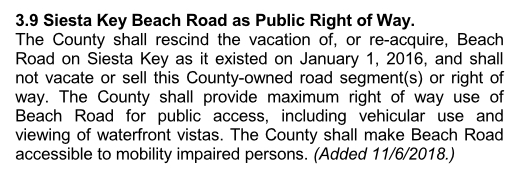

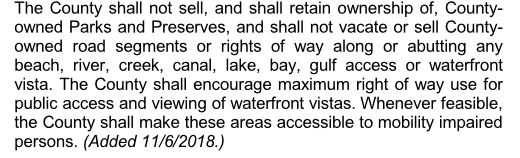
This is Sarasota County Charter Section 3.9, which was approved on Nov. 6, 2018. Image courtesy of the Office of the Sarasota County Clerk of Court and County Comptroller

The former says the county must rescind the vacation of the 373-foot-long segment of North Beach Road that was approved on May 11, 2016, and then the county must re-acquire the right of way. The amendment also indicates the county should repair the road and keep it open to vehicular traffic.
Amendment 3.10 prohibits Sarasota County from vacating or selling any segment of road or right away abutting any area that could be considered to have a “waterfront vista.”In June 2016, Cosentino filed suit against the county, arguing that the County Commission had violated the county’s Comprehensive Plan in vacating the portion of North Beach Road. Although Circuit Court Judge Frederick Mercurio dismissed all the counts against Sarasota County, Cosentino has appealed the final dismissal to the Second District Court of Appeal in Lakeland.

Cosentino’s attorney in that case — Lee Robert Rohe of Big Pine Key — asked that the Appeal Court delay until March 22 the filing of his initial brief with the court. On Jan. 28, the Appeal Court ordered that the initial brief “shall be served within 30 days of the date of this order.”
Cosentino lost an earlier appeal of one of Mercurio’s rulings in favor of the county.
The Jan. 28 supplemental memorandum of law says Reopen Beach Road “was organized and incorporated … for the express purpose of promoting a citizen’s initiative petition drive for placement of the Charter Amendments on the Ballot.”
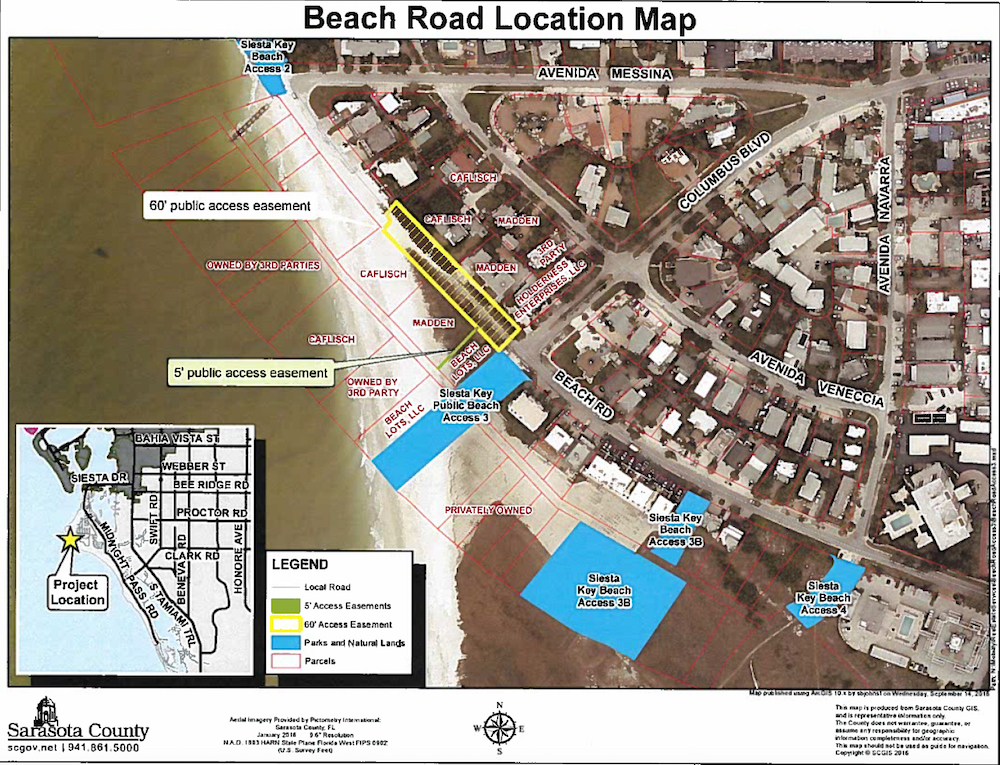

A county graphic shows facets of the area surrounding the North Beach Road vacation site. Image courtesy Sarasota County

It also points to “the County’s continuing alignment with the Plaintiffs (who are condominium developers) …” Further, it says, “It is not beyond the realm of possibility that the Plaintiffs and the County may enter into a settlement agreement, thus leaving [Reopen Beach Road] out in the cold.”
Sarasota News Leader check of Sarasota County Property Appraiser Office records shows William H. Caflisch Sr. and Sheila S. Caflisch — the plaintiffs in the Charter amendment case — own several parcels on Siesta Key, including property at 77 Beach Road and 70 Avenida Veneccia, each of which is the site of a single-family house. They do own two vacant lots on Avenida Veneccia that are zoned for multi-family construction, according to the Property Appraiser’s Office.
The Caflisches were among the three sets of property owners who petitioned for the North Beach Road vacation in 2016, arguing that the segment had been closed to motor vehicles since 1993 because of repeated storm damage. Cosentino has contended the County Commission never should have approved the request because of the road segment’s value as public access to Siesta Beach. He cited a section of the county’s Comprehensive Plan in effect at that time to underscore his argument.
Objection to referral of case to a magistrate


Circuit Judge Maria Ruhl. Image from the 12th Judicial Circuit Court website

Circuit Court Judge Ruhl — who was elected to the bench in November 2018 — has taken over the case from Circuit Court Judge Mercurio. On Feb. 4, she issued an order, referring the matter to 12thJudicial Circuit Court Magistrate Deborah A. Bailey. That order called for Bailey to handle all discovery motions and all motions “directed to the pleadings.”
Bailey was authorized to conduct any hearings, which could include the “taking of evidence,” and then was directed to file a recommended order to Ruhl, “as soon as practicable.”
Nonetheless, the order pointed out, “A referral to a Magistrate requires the consent of all parties.”
On Jan. 31, S. William Moore, another attorney for the Caflisches, had a letter hand-delivered to Ruhl, the court docket shows. Moore wrote that he had conferred “with all counsel” regarding her proposed order of referral to the magistrate. Sarasota County had no objection, he added. However, “Counsel for proposed Intervenor Reopen Beach Road, Inc. … has notified us of its objection to the referral. It is therefore anticipated that a written objection may be filed, pursuant to the Court’s requirements.”
On Feb. 13, Cosentino’s attorney, Rohe, did file a notice of objection of the referral to the magistrate. Among Rohe’s arguments was the fact that part of Cosentino’s suit against the county is on appeal.
The notice added that Reopen Beach Road “believes that, in the interest of justice and to best serve the public, the Court must be directly involved in acquainting itself with the complexities of the case and ruling upon the First Amendment and election law issues arising from this case; instead of relying upon the ‘filter’ of recommended ruling(s).”

Saturday, January 19, 2019

Community sues to halt Siesta Promenade


Courtesy of the Sarasota News Leader

Subscribe to the SNL

Lawsuit filed to try to halt construction of Siesta Promenade at U.S. 41/Stickney Point Road intersection


Siesta resident seeking contributions to pay for litigation

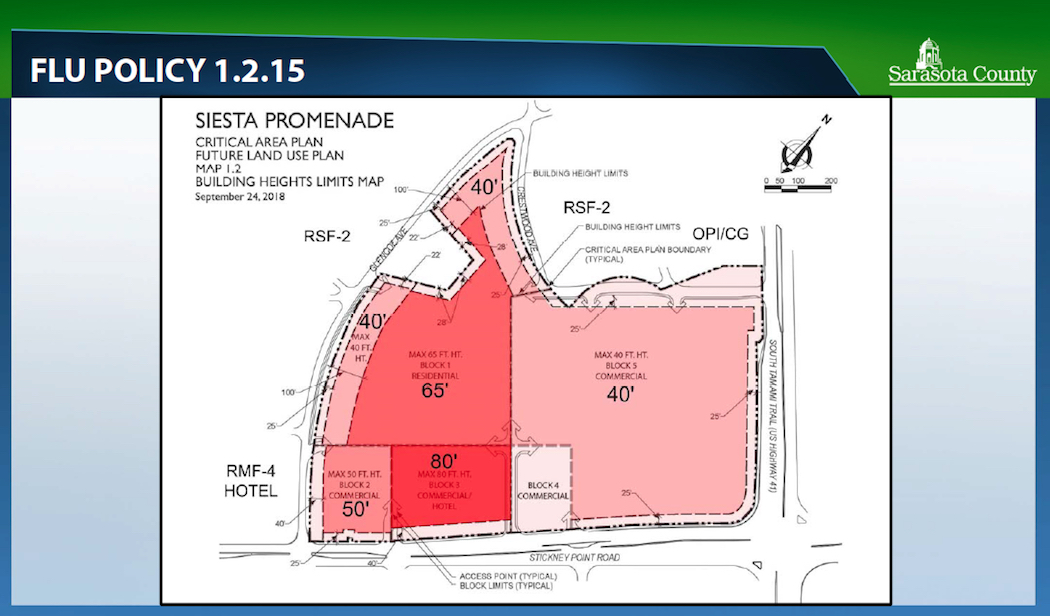
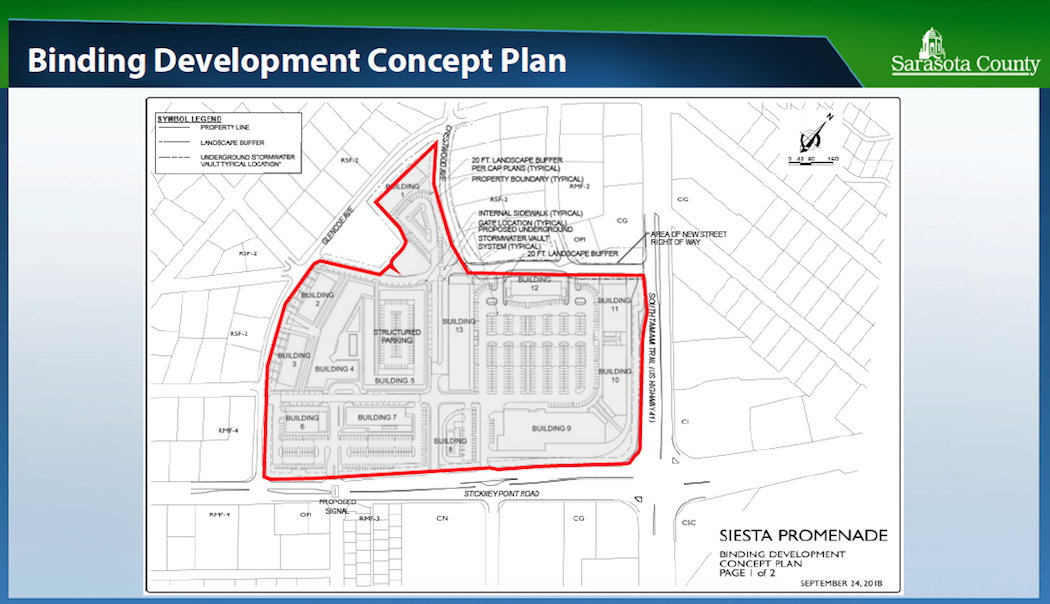
This is the binding development concept plan for Siesta Promenade approved by the county Planning Commission and the County Commission. Image courtesy Sarasota County

A petition filed in the 12th Judicial Circuit Court on Jan. 11 argues that the December 2018 decision of the Sarasota County Commission to allow the construction of the Siesta Promenade mixed-use project was unlawful for a multitude of reasons.
James P. Wallace, a Siesta Key resident since 1964, told members of the Siesta Key Association (SKA) during their regular meeting on Jan. 10 that he was angered by the series of commission votes on Dec. 12, 2018 that figuratively paved the way for the project to proceed.
Only then-Chair Nancy Detert voted against all but one of the motions following a public hearing that lasted approximately seven hours. Commissioner Charles Hines joined her in opposing the motion to rezone most of the 24-acre site in the northwest quadrant of the intersection of U.S. 41 and Stickney Point Road. The only motion Detert voted in favor of allows street vacations of portions of Crestwood Avenue and Brentwood Avenue; the vacation was designed to facilitate the site plan and traffic flow around the property.
Wallace acknowledged to his fellow SKA members on Jan. 10 that he did not get involved in the fight against Siesta Promenade until shortly before the Dec. 12 public hearing. “My wife kept telling me I needed to worry about this thing,” he said, but he was busy with major projects for his work.
(When he testified during the Siesta Promenade public hearing, Wallace told the commissioners he is a systems engineer.)
“The more I got involved,” he said during the SKA meeting, “the madder I got, frankly. … This [commission decision], I think, [is] a really serious problem.”
Wallace added of the lawsuit, “We need to win this. We absolutely need to win it.” He said he would “try [his] best to stop this project by any legal means possible.”

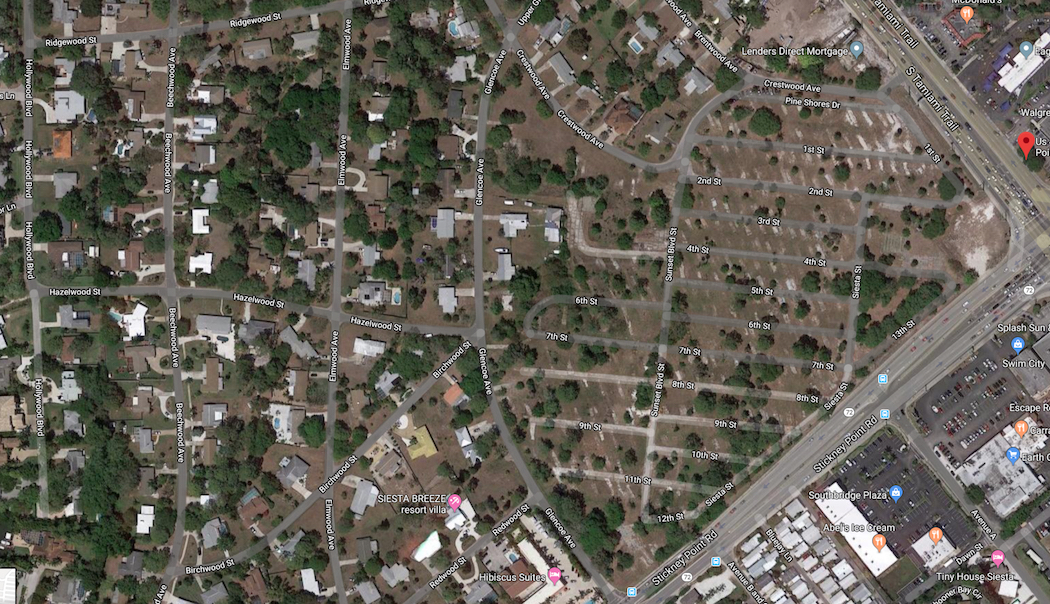
An aerial map shows part of Pine Shores Estates next to the Siesta Promenade site. Image from Google Maps

The complaint has a single plaintiff: Sura Kochman, a resident of the Pine Shores Estates community, which would be the immediate neighbor of Siesta Promenade. Kochman had been a leader of opponents of the project, as it was designed. Her ownership of a home in Pine Shores gives her “standing” in the Petition for Writ of Certiorari, as the legal document explains: “As a direct and proximate result of the [County Commission’s] approval, including the Project’s higher density, [Kochman] will be adversely affected by increased traffic, increased height, increased density and increased intensity and use of the [property].”
Benderson Development also won County Commission approval of a Critical Area Plan (CAP) designation for Siesta Promenade, which allowed the company density as high as 25 units per acre, instead of the 13 units per acre provided for under county regulations for districts zoned Commercial General.
Along with the 80-foot-tall hotel, Benderson plans one condominium/apartment tower that would stand 65 feet high, as well as 40-foot-tall residential buildings. The latter would be closest to Pine Shores residents.
During the Dec. 12 hearing, Commissioner Hines talked of the potential discomfort of Pine Shores residents coming out of their homes to get their morning newspapers and looking up at balconies in that 65-foot-high residential structure in Siesta Promenade.
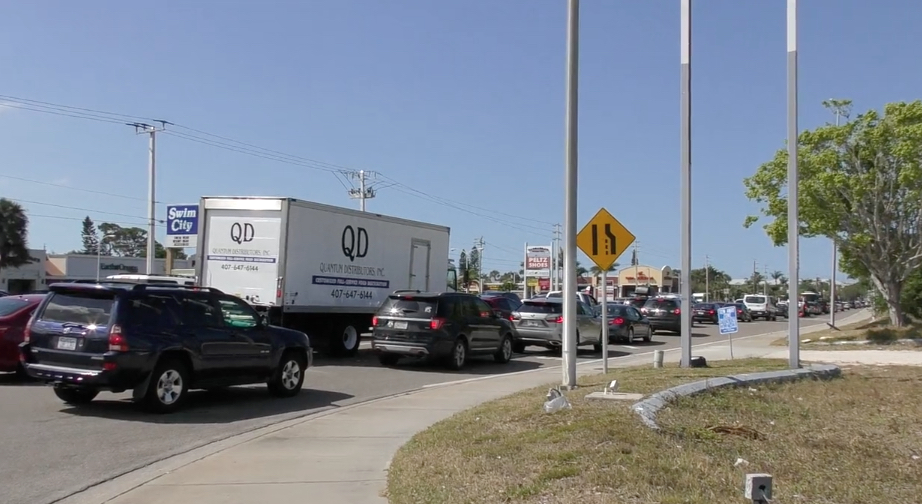
Many of the speakers during the hearing also stressed that traffic at the U.S. 41/Stickney Point Road intersection already is terrible during the height of tourist season, as people try to reach Siesta Public Beach via Stickney Point Road. Sarasota County Sheriff’s Office personnel wrote $166 tickets early this year to drivers who created gridlock at the intersection as they tried to make it through the traffic signals to reach Stickney Point Road.
Additionally, a number of those who testified talked of worries that, with Siesta Promenade on the northwest corner of the intersection — generating even more vehicle trips every day — emergency personnel will encounter long delays reaching people suffering medical emergencies or responding to major structural fires on Siesta Key.

Traffic is at a standstill on April 3, 2018 at the intersection of Stickney Point Road and U.S. 41, where the proposed Siesta Promenade would be built. Contributed photo

The emergency vehicle response issue is one that Wallace focused on during his SKA remarks.
“How could it be that the board would sit there and hear so many excellent legal as well as traffic analyses [and arguments related to planning issues] and just vote to approve [Siesta Promenade]?” he asked.
As he and his wife have lived on Siesta Key for decades, Wallace continued, they have “a pretty good feel for the ramifications of treating [the Siesta Promenade] corner … like any other corner on [U.S.] 41.” Yet, Wallace pointed out, that intersection, “is clearly the primary entrance” to Crescent Beach on Siesta Key.
Crescent Beach is south of Siesta Beach Park.
The attorney handling the complaint is Ralf Brookes of Cape Coral.
The petition indicates that Sarasota attorney Robert Lincoln is representing Benderson Development. The Sarasota News Leader did not get a response from Lincoln to its request for a comment.
The policy of the Office of the County Attorney is not to comment on litigation that is underway, county staff has explained on several occasions to the News Leader.
Paying for the litigation

James P. Wallace addresses Siesta Key Association members on Jan. 10. Rachel Hackney photo

Wallace further pointed out to the SKA members that he has been working to raise money to cover the expense of the lawsuit. The estimate he had received, he said, was $75,000.
Both SKA Vice President Catherine Luckner and the Siesta Key Condominium Council (SKCC) already have sent out email blasts to inform members of their organizations about the legal challenge.
In their Jan. 11 notice, the Condominium Council leaders pointed out that they had opposed Siesta Promenade by sending letters to the County Commission, speaking at the county Planning Commission hearing on the proposal, which was conducted on Nov. 15, 2018, and addressing the County Commission on Dec. 12. “These actions were taken on the belief that the vast majority of the Condo Membership were against the development,” the notice says.
Both Luckner, during the Jan. 10 SKA meeting, and the Condominium Council leadership have explained that if anyone desires to provide financial support for the lawsuit, the person may send a check to the Sarasota law firm of Bentley & Bruning, with the notation that the money is for the Siesta Promenade lawsuit. Wallace explained on Jan. 10 that Bentley & Bruning will compile all the funds in a trust account.
The firm’s address is 783 S. Orange Ave., Suite 300, Sarasota, 34236.
Any money not spent, Wallace stressed, will be returned on a pro-rata basis.
Facets of the complaint
Among the arguments in the petition is that the County Commission did not allow members of the public sufficient time to provide testimony during the public hearing as they addressed facets of Benderson’s proposal. “This was an extremely complex set of four different applications that experts for the opposition opined did not meet requirements of the [county’s] Land Development Code,” the complaint says. Nevertheless, the speakers “were cut off” after only 3 minutes into their presentations “(for all 4 applications together!),” the petition says.
Typically, the County Commission allows 5 minutes per person during a public hearing. However, after then-Chair Detert reported that 90 speaker cards had been turned in before the start of the Siesta Promenade hearing, she asked the audience members whether they would be willing to shorten their statements to 3 minutes each. The majority of them agreed to that, as indicated by a show of hands.
Brookes cites two opinions of the Florida Second District Court of Appeal and one of the Third District Court of Appeal in arguing that more time should have been allowed for the speakers.

A graphic shows how Benderson Development has planned the transition of building height in Siesta Promenade. Image courtesy Sarasota County

For Siesta Promenade, Benderson was seeking not only the rezoning and the Critical Area Plan designation but also a Special Exception for inclusion of the hotel on the site and the approval of the street vacation.
“The denial of a meaningful opportunity to be heard and present expert opinion evidence … violates fundamental procedural due process,” the complaint says.
On another point, the petition contends that county staff and the commission failed to adhere to a county ordinance specifying how a Critical Area Plan (CAP) application should be handled. Brian Lichterman of Sarasota, a consultant who worked for decades as a county planner before opening his own firm, was among those who pointed out to the commissioners that county regulations required their approval of the boundary of the CAP as an initial step in the process. Yet, the CAP approval did not take place until after the Dec. 12, 2018 public hearing had concluded.
Further, the complaint argues that the County Commission did not consider how Siesta Promenade could lead to restricted access to Siesta Key.
The petition also contends that Benderson Development did not provide “any competent substantial evidence” that the project “was compatible with the surrounding neighborhood.” The term “competent substantial evidence” is used in reference to local government hearings that are conducted like trials. An applicant must demonstrate that he or she will be in compliance with all of the affected local government’s land development regulations.
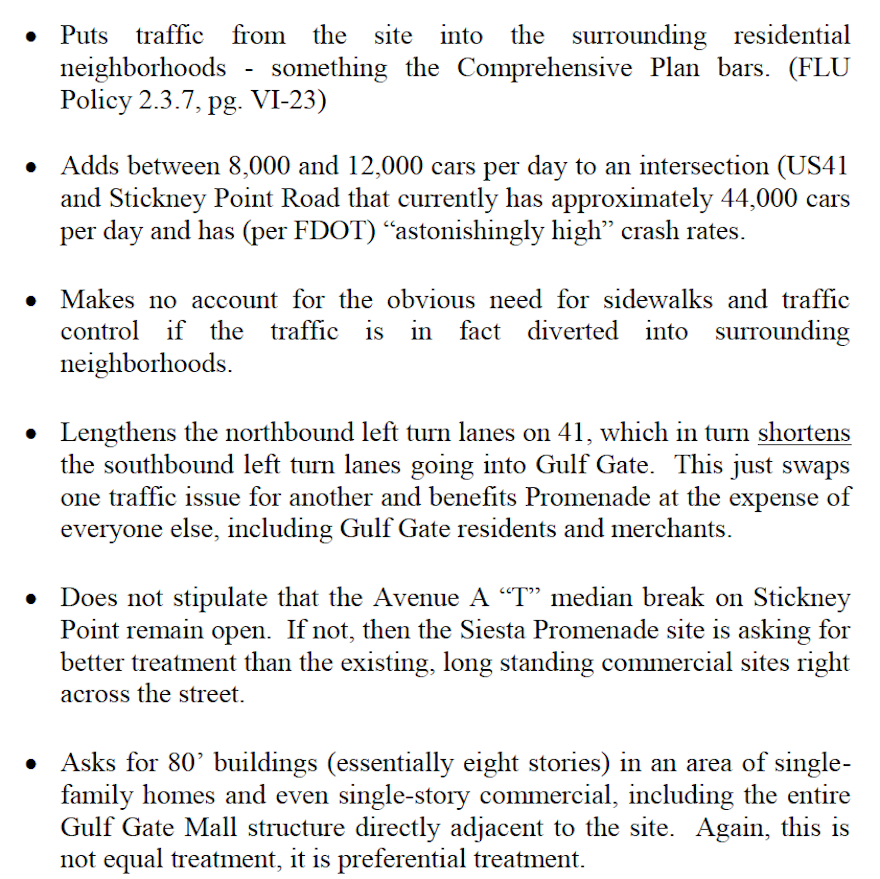
The complaint points out that traffic from Siesta Promenade will travel the roads in “surrounding residential neighborhoods,” which is a violation of a Future Land Use policy in the county’s Comprehensive Plan.

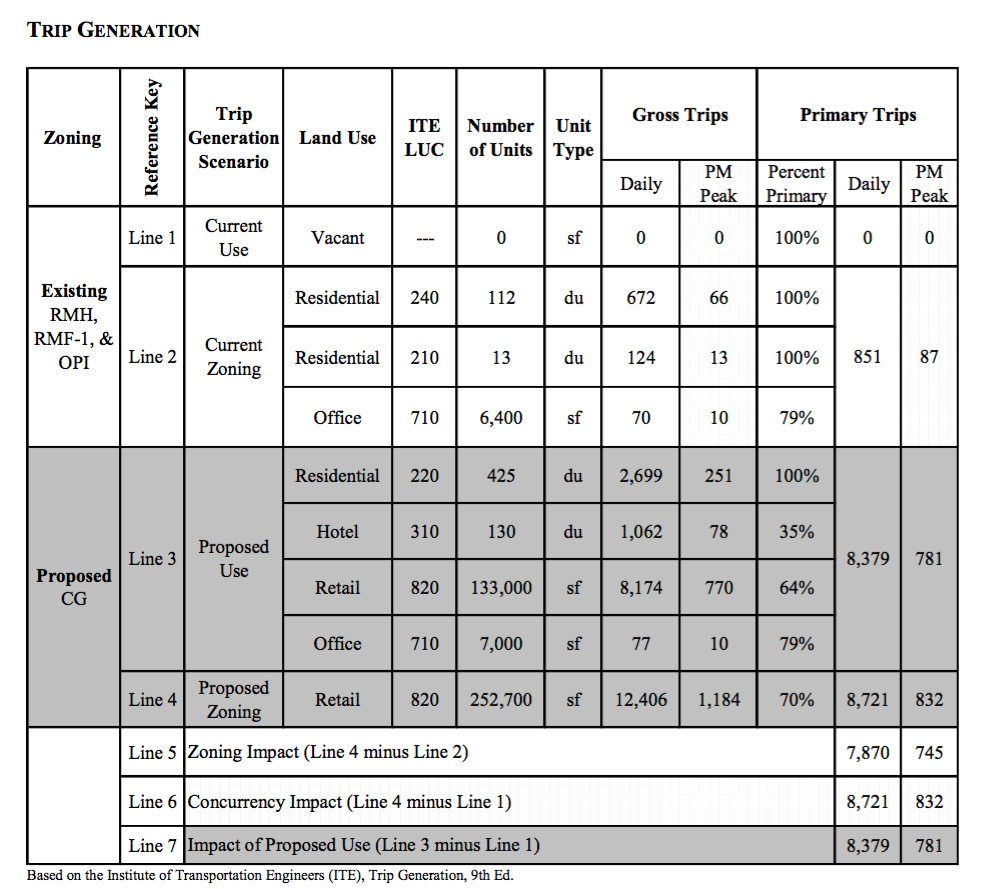
A table in a county staff report offers these details about anticipated traffic generation related to Siesta Promenade. Image courtesy Sarasota County

Additionally, the complaint argues that the County Commission ignored “uncontested testimony and evidence” that the installation of a new traffic signal at the intersection of Stickney Point Road and Avenue B and C “will have a negative effect on emergency access to Siesta Key.”
Benderson Development’s traffic consultant on the project — Kimley-Horn and Associates of Sarasota — recommended the traffic signal as a means of dealing with the thousands of extra vehicle trips anticipated on a daily basis in the area of U.S. 41 and Stickney Point Road after Siesta Promenade has been completed.

These are among the arguments outlined in the Petition for Writ of Certiorari. Image courtesy Sarasota County Clerk of the Circuit Court and County Comptroller

Tuesday, January 15, 2019

Siesta Promenade: Citizens take legal action

Dear All,

A very concerned and motivated resident of Siesta Key has been pursuing an avenue through which the approval of the Siesta Promenade application by the Board of County Commissioners could be overturned.

This resident has, on his own, raised funds which enabled Attorney Ralf Brookes to be  engaged to handle this case with the pro bono assistance of Morgan Bentley.  As most of you may know, Morgan laid the groundwork for an appeal by sending letters to County Attorney Alan Roddy, pointing out the many procedural and other errors that were taking place. To see these letters, please visit the website:


A Petition for a Writ of Certiorari was filed on Friday, 1/11/19 with the 12th Circuit Court of Appeal. 
 
A plaintiff with unquestionable standing and affected status was needed. I was asked, and did agree, to be the plaintiff, as I live within 20' of the Benderson property.

This Writ of Certiorari is a request for an order of the court to quash and remand the decision for failure to afford procedural due process and failure to comply with essential requirements of law.  A link to the Writ will be made available on the website mentioned above, under the "Updates" tab once amendments are finalized.   

To continue go forward with this legal action, we will need additional funding. Morgan Bentley is providing an Attorney Trust account for all donations, without any charge. Having an Attorney Trust account provides a guarantee that all funds will be used correctly and also, returned, pro rata, should they not be fully utilized.

This case is winnable!  Our goal is to ensure that development of the land located at the Stickney Point Road/US-41 intersection is developed in a compatible manner with the surrounding residential neighborhoods and retail establishments. It should not be detrimental to their quality of life, health, safety and welfare, nor cause undue hardship for anyone wishing to access Siesta Key.


Your support is crucial and can be accomplished with a check made out to the following:
Bentley & Bruning, P.A
Re: Siesta Promenade Trust Account
783 South Orange Ave, Suite 300
Sarasota FL 34236

Thank you,

Sura Kochman
Pine Shores Neighborhood Alliance


Friday, August 17, 2018

Opponents of Grand Lake file legal challenges

Update on this process:

Grand Lakes Rezone Hearing oral arguments 
November 14, 2018, 2:30 pm
2002 Ringling Blvd.  Courtroom 7C


Sarasota News Leader


August 16, 2018 by Rachel Brown Hackney, Editor & Publisher

12th Judicial Circuit Court case begun, and petition submitted to Florida Division of Administrative Hearings, saying Sarasota County violated its policies in approving the plans


A graphic shows plans for the two neighborhoods in Grand Lakes. Image courtesy Sarasota County
Even before the Sarasota County Commission voted 4-1 on July 11 to approve the petitions necessary for Neal Communities’ Grand Lakes development to be built, Pat Neal, chair of the company’s executive committee, indicated he was expecting a lawsuit. 


Indeed, not one but two legal initiatives have begun, in an effort to stop Grand Lakes from becoming a reality east of Interstate 75 and south of Clark Road. 
(Plaintiff Press Release)
On Aug. 10, a number of homeowners in the area around the Grand Lakes site filed a Petition for Writ of Certiorari in the 12th Judicial Circuit Court in Sarasota, contending that in approving the Grand Lakes application, the County Commission violated tenets of its Sarasota 2050 process for Villages. The homeowners also filed a Petition for Formal Administrative Hearing with the Florida Division of Administrative Hearings (DOAH). That argues that a county Comprehensive Plan amendment — which the County Commission initially approved in March and formally adopted in July — will enable Neal Communities to eliminate a commercial center from the design of Grand Lakes, even though Grand Lakes will not be contiguous to a Village with such a center. A county staff report on the proposed amendment said, “‘The commercial and service needs of the [Grand Lakes] residents can be met by the Village Center (approved for 300,000 square feet of non-residential uses) in LT Ranch Village, which will be located approximately 2.5 miles to the east,’” the petition points out.
The amendment is inconsistent with other Sarasota 2050 policies, the petitioners contend.


A page in a market study undertaken for Grand Lakes shows details about nearby retail businesses. Image courtesy Sarasota County

During a March 14 public hearing, Grand Lakes project team members told the County Commission that not enough residents would live in Grand Lakes to entice retail businesses — especially a major grocery store chain — to become tenants in a commercial center on the site. They also pointed to the plans for the LT Ranch Village. In the meantime, however, they said enough retail businesses already exist in close proximity to the Grand Lakes site to serve their residents.
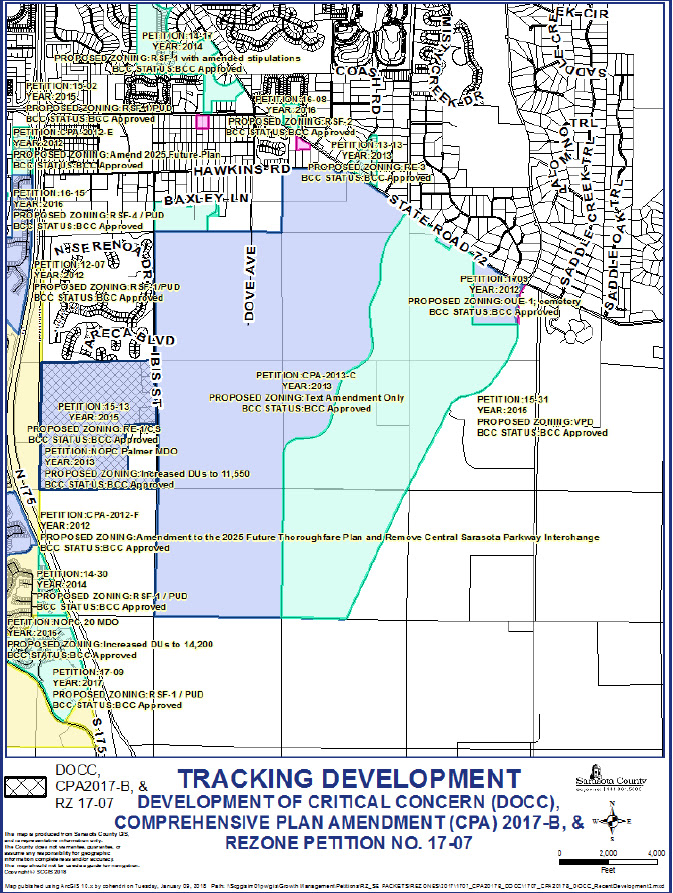
The plans for Grand Lakes that the County Commission approved on July 11 would allow up to 1,097 homes on 533 acres south of Clark Road in an area where other several other 2050 Village developments have been approved or proposed. Another major concern for residents in the Serenoa Lakes and Serenoa communities — which would be the closest neighbors to Grand Lakes — is that Ibis Street is the only immediate access to their homes and the Grand Lakes site.
The DOAH petition asks that the case be assigned to an administrative law judge and that a hearing be conducted to determine whether the Comprehensive Plan amendment complies with Sarasota County policy. Alternatively, the petition calls for the county to withdraw the amendment or otherwise remedy the action taken in July.
David Anderson, president of the Serenoa Lakes Association since 2010, is one of the plaintiffs in both legal challenges.
The Manatee-Sarasota Sierra Club and 1000 Friends of Florida Inc. “are providing financial support and legal assistance” to the plaintiffs, Anderson pointed out to The Sarasota News Leader in an Aug. 13 telephone interview.
The website of 1000 Friends of Florida says it is the “state’s leading not-for-profit smart growth advocacy organization. … We promote vibrant, sustainable, walkable, livable communities which provide residents with affordable housing choices and transportation alternatives.”
Gayle Reynolds, Sarasota conservation chair of the Manatee-Sarasota Sierra Club, told the News Leader this week that that organization has more than 3,400 members.
Along with homeowners who will be near Grand Lakes, Anderson pointed out to the News Leader, people who use the county’s facilities at Twin Lakes Park — which is close to the Grand Lakes property — have voiced concerns about the potential intensification of traffic as a result of the development. Some of them testified about their worries during county public hearings on the proposed project.


Scott McLaren. Image from the Hill, Ward and Henderson website

In response to a News Leader request for comment about the legal challenges, Scott McLaren of the Hill Ward Henderson law firm in Tampa — which represents Neal Communities — wrote in an Aug. 14 email, “Neal Communities applied for and received approval from Sarasota County to develop its property consistent with all regulations, laws, and ordinances, and consistent with its private property rights protected by the U.S. and Florida Constitutions. The County staff thoroughly reviewed every aspect of Neal’s application and concluded that the application complied with all  requirements — and the Board of County Commissioners agreed. These plaintiffs have filed 2 lawsuits against the County alone and strategically chose not to sue Neal Communities, whose property rights are at stake here. The plaintiffs’ efforts to avoid litigating against Neal are futile, because Neal Communities will intervene and vigorously defend against these meritless claims that were obviously interposed solely for purposes of delay.”
As a matter of policy, Sarasota County does not comment on litigation, the Office of the County Attorney has said on multiple occasions.
Hoping for the best
From the beginning of the process with Grand Lakes, Anderson of Serenoa Lakes told the News Leader, “We wanted [the Neal Communities representatives] to know — and the commissioners — that we were very, very organized,” he said of the plaintiffs. “We were very, very fact-based” in opposition to the development, he added, making certain the focus stayed on the facts. Emotions had to be kept in check, he said.
The opponents, he continued, reviewed the Grand Lakes application in the same manner county staff was supposed to have reviewed it. “We paid for a court stenographer to be at all [the public] hearings,” he added. “That was critical.”


Pat Neal. Image from the Neal Communities website

The transcripts enabled members of the group to pore over details provided by county Planning and Development Services staff and the Neal Communities project team.
Before the County Commission vote on July 11, Anderson pointed out, Pat Neal had asked him more than once during the hearings — outside the Commission Chambers — whether people were planning to file a lawsuit. “I said, ‘No,’” Anderson told the News Leader. He gave Neal that answer, he said, because the group wanted to provide the County Commission “every opportunity to vote this down.”
“When we got to the final stage of this [on July 11], it became abundantly clear,” he said, that, in spite of the record of what he contends are multiple problems with the application — which his group had documented — the vote was going to go in Neal’s favor.
In fact, the group’s objections — compiled in a document that Neal told the board on May 23 encompassed about 400 pages — prompted the commission that day to continue the final hearing on Grand Lakes until July 11. That was to allow both the Neal Communities team and the commissioners the opportunity to review the challenges and enable the Neal representatives to respond to them.
During the May 23 public hearing, a Fellow of the American Institute of Certified Planners, Mary Anne Bowie of Sarasota, had spoken for the residents who have become the plaintiffs in the legal challenges filed this week. She gave the 400-page document to the clerk to the board during that session.
The plaintiffs
Along with Anderson, the petitioners in the 12th Judicial Circuit Court case are Keath Cuyler, Mitchell Goldberg, Ronald Newmark, Arthur Cooper, Karie Backman and Douglas Watts. (Cooper, Backman and Watts are not parties in the DOAH challenge, however.) All of them live within close proximity to the proposed site for Grand Lakes, the Circuit Court petition notes. Cooper’s property, for example, is just 120 feet away from it, and Backman’s is only 130 feet away.
The Circuit Court petition explains that Neal Communities sought a rezoning of the Grand Lakes site from Residential, Estate-1/Conservation Subdivision — which allows one dwelling unit per 2 acres — to Village Planned Development. The latter district, it continues, is used in conjunction with Sarasota 2050 projects. The petition explains that the Sarasota 2050 Resource Management Area chapter of the county’s Comprehensive Plan sets the framework for “an incentive-based system that encourages a compact development form; simultaneously implementing a number of public benefits, allowing for continued growth and economic development that preserves environmentally sensitive lands and open space.”


A Sarasota County graphic shows details about Sarasota 2050 Villages and resource management areas east of Interstate 75. Image courtesy Sarasota County

“As a direct and proximate result” of the County Commission’s approval of Grand Lakes, the petition continues, the plaintiffs “will be adversely affected by increased development, including impacts from additional density approved in the rezoning.”
During the telephone interview with the News Leader, Anderson explained that residents living near the property had pointed out many times during the Grand Lakes application process that they “had worked in a very cooperative manner with the Bispham family,” which later sold the land to Neal Communities. The Bisphams had sought an earlier rezoning of the property to allow the construction of 258 houses, Anderson added. In 2015, Anderson said, he pointed out to the County Commission that the Bisphams’ plan was economically feasible and provided for the best use of the land.
Reynolds of the Sierra Club told the News Leader, “The developer knew when he purchased that property that it was going to be very difficult” to make his neighborhoods conform to Sarasota 2050 standards. “He proceeded to change the [2050] plan to fit his site. … That change affects the entire county.”
“Our number remains 258,” Anderson said in the interview with the News Leader.
The Circuit Court case
One of the central contentions of the 12th Judicial Circuit Court case is that Neal Communities did not undertake the required market analysis to determine how much commercial-retail space would be needed in Grand Lakes. The petition says that the Neal project team had to demonstrate that the non-residential needs of the development would be served within the development, as provided for in Sarasota 2050 policy.
No market study accompanied the Grand Lakes application, the petition points out.

Mary Anne Bowie. Image from the American Institute of Certified Planners

Further, the petition argues, Bowie — the expert planner hired by the petitioners for the May 23 public hearing on Grand Lakes — was given only 5 minutes for her testimony. (Five minutes generally is the time limit per speaker during any Sarasota County Commission or Planning Commission public hearing.) That was insufficient time for her to present all the testimony and evidence she had prepared to make her case that Grand Lakes should not be approved, the petition says.
Yet, a Florida 3rdDistrict Court of Appeal decision in 2007 — in Hernandez-Canton v. Miami City Commission — made it clear, the petition continues, that “8 minutes was insufficient and too short a time allotment for [objectors’] expert witnesses to make their presentations in a quasi-judicial hearing …” The petition adds, “The denial of a meaningful opportunity to be heard and present expert opinion evidence before the quasi-judicial [Sarasota County Commission] violates fundamental procedural due process.”
A rezoning is an example of a quasi-judicial hearing.
Additionally, the Petition for Writ of Certiorari says the rezoning violates the county’s requirements for greenways and greenbelts, as required in Sarasota 2050 policy.
In support of part of the argument on those issues, it contends that the Grand Lakes team did not provide county staff updated maps. The petition says, for example, “The decades-old [U.S. Geological Survey] Topographical Map submitted … does not reflect the existing site conditions.”
The DOAH filing


A graphic provided to the County Commission earlier this year shows other planned 2050 villages in the vicinity of the proposed Grand Lakes. Image courtesy Sarasota County

The petition for the DOAH hearing focuses on the Comprehensive Plan amendment the County Commission approved, to enable Grand Lakes to be built without a commercial center. That petition says, “Allowing non-contiguous Villages without a commercial or retail component is … inconsistent with the existing Sarasota County Comprehensive Plan and is not supported by data and analysis [emphasis in the document].” In fact, the petition continues, such a change to the Sarasota 2050 policy was considered before “and was rejected by staff and the County because it was found to be internally inconsistent with the existing Comprehensive Plan in 2014.”
Additionally, the petition notes, county staff members considered the elimination of Village Centers when they were working on the third phase of a revision of Sarasota 2050. Yet, the petition continues, “The County’s analysis on July 24, 2014 importantly found that ‘the provision for non-residential uses through the establishment of mixed use Village and Neighborhood Centers is central to the concept of Villages as an alternative to urban sprawl. … Without the non-residential uses in close proximity and integrated into the residential uses, the Villages resemble other suburban residential development typical of Sarasota County and other communities.”

A graphic included in the Circuit Court petition includes this information about the greenbelts planned for Grand Lakes. Image courtesy David Anderson

In the separate Aug. 13 telephone interview with the News Leader, Reynolds of the Manatee-Sarasota Sierra Club explained that she has spent years following the Sarasota 2050 process. After attending the July 11 public hearing, she added, “I couldn’t recognize Grand Lakes as anything … previously approved.”
The changes the Neal Communities team sought, she said, “should have had more discussion” and more time for public review.
The DOAH petition also notes that Chapter 8 of the Future Land Use Element of the county’s Comprehensive Plan says, “Villages are a collection of Neighborhoods that have been designed so that a majority of the housing units are within a walking distance or [one-quarter] mile radius of a Neighborhood Center. Villages shall be supported by internally designed, mixed-use Village Centers (designed specifically to serve the daily and weekly retail, office, civic, and government use and services needs of Village residents) [emphasis in the petition], and the Village shall be surrounded by large expanses of Open Space …’”
The petition adds that the county staff report justifying the policy change for Grand Lakes “offers nothing to reverse the County’s previous findings that the contiguous Village requirement is necessary to maintain internal consistency [with the Sarasota 2050 policies].”