New county water quality fee proposed as potential revenue source to back bonds
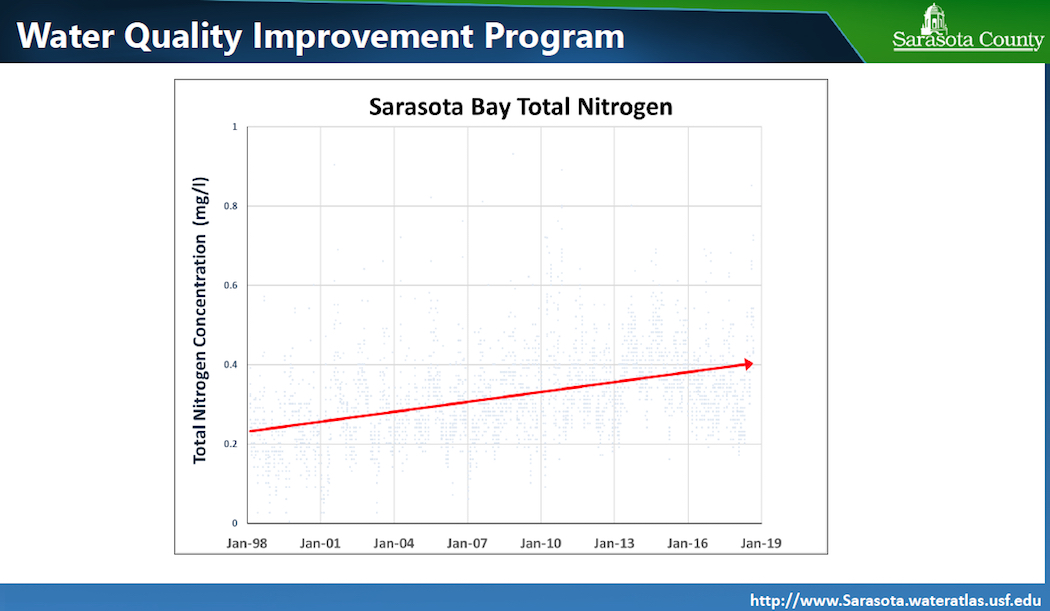
A graph shows the increase in the level of nitrogen in Sarasota Bay over the past two decades. Image courtesy Sarasota County
Given the strong fiscal health of Sarasota County, the majority of the county commissioners this week expressed a willingness to borrow money to put the county’s water quality programs on equally firm footing.
After a comprehensive staff presentation on what has been done and what could be done to reduce the nutrient load going into the county’s waterways — and, ultimately, the Gulf of Mexico — Commissioners Michael Moran and Christian Ziegler indicated a preference for upgrading the county’s three wastewater treatment plants to advanced treatment facilities (AWWTF) at an expense estimated between $70 million and $90 million. The goal would be to reduce the total nitrogen discharge to 3 milligrams (mg) per liter, or less, from the Bee Ridge, Central County and Venice Gardens facilities, Mike Mylett, interim director of the county’s Public Utilities Department, told the board members on May 8.
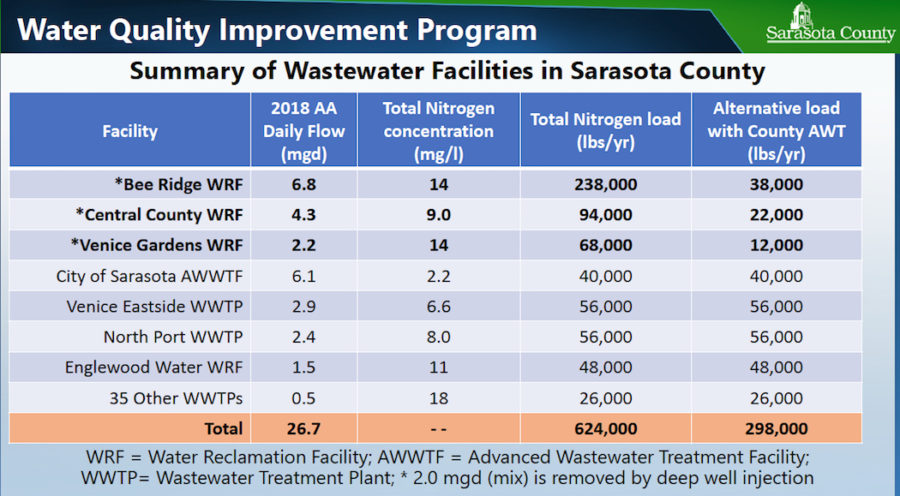
The total nitrogen load for the Bee Ridge facility is 14 mg per liter; for the Central County plant, 9; and for Venice Gardens, 14, according to a slide Mylett showed the commissioners. A note on that slide said that 2 mg per day is removed from the overall nitrogen load produced by each facility, thanks to deep well injections.
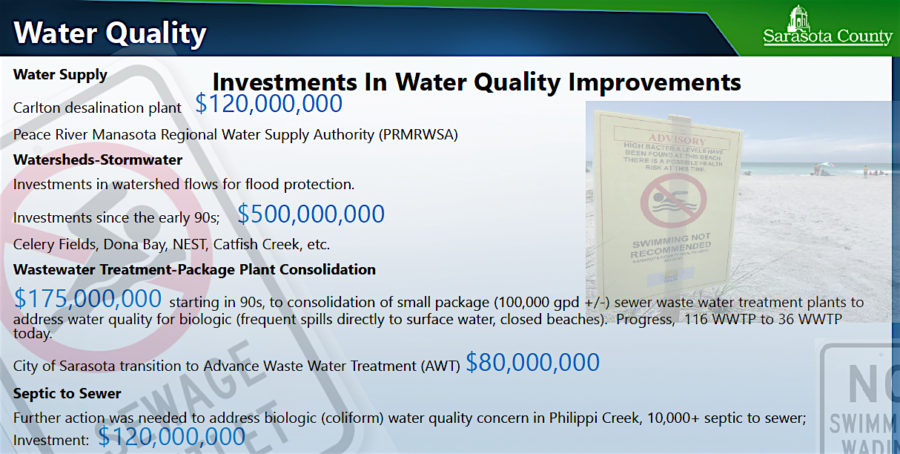
Altogether, the three county wastewater treatment plants, along with facilities in the City of Sarasota, Venice, North Port and Englewood — plus 35 private operations — produce about 624,000 pounds of nitrogen a year, Mylett pointed out, although not all of that goes directly to the bays. (Only the City of Sarasota facility is an AWWTF, according to a chart Mylett showed the board. That initiative cost the city $80 million, he said.)
With the improvements to the county’s three wastewater treatment plants, the slide noted, the total nitrogen load could be reduced to about 298,000 pounds a year.
This graphic shows details about the nitrogen loads from wastewater treatment plants in the county. Image courtesy Sarasota County
Red tide research has shown that nitrogen is the primary feeder for the algae that produces the blooms, Karenia brevis.
All of the commissioners talked of the fact that this would be an opportune time for them to pursue the borrowing of money for major projects.
Altogether, staff said on May 8, a variety of proposals — including the elimination of more septic tanks and improvements to stormwater systems — would cost about $310 million. Extra annual operating expenses — an estimated $20 million — would be necessary, as well.
“To me, after hearing all this,” Commissioner Moran began, “I feel that all roads lead back to us moving our community to [advanced wastewater treatment].” That conversion, he continued, would lead to the biggest return on investment for the taxpayers.
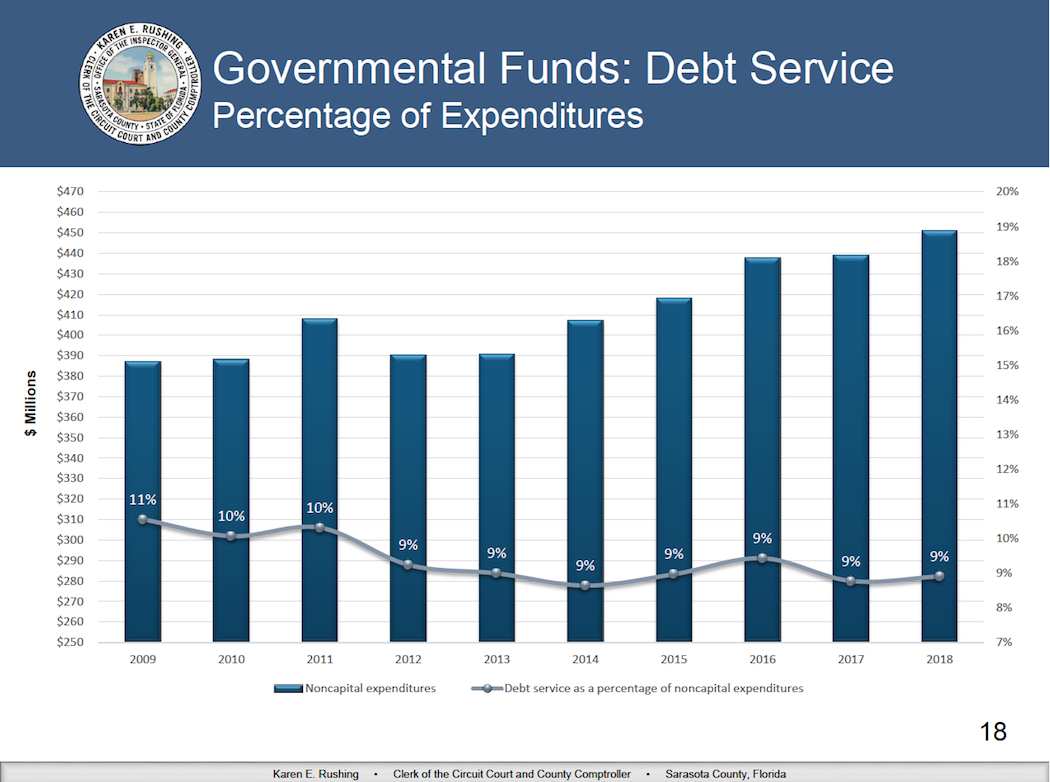
Referencing the Comprehensive Annual Financial Report presentation the board heard on May 7 — provided by the Office of the Sarasota County Clerk of the Circuit Court and County Comptroller — Moran added, “Our debt ratios are incredibly fiscally conservative, [and the county’s bond ratings] are excellent. … Our interest rates are at historic lows. … I want the true solution to this,” he told Chuck Walter, manager of the county’s Stormwater Division, “and then we make the difficult decisions.”
This slide reflects findings in the 2018 Comprehensive Annual Financial Report (CAFR) for Sarasota County. Image courtesy Sarasota County Clerk of the Circuit Court and County Comptroller
“I think Commissioner Moran is right,” Commissioner Ziegler said, adding that he would like for staff to come back to the board with funding options that would lead to the greatest positive results.
Commissioner Alan Maio further pointed to the community pressure on the board to try to prevent a recurrence of the economic devastation of red tide last year, noting “the bludgeoning” businesses took.
As Spencer Anderson, director of the county’s Public Works Department, put it at the outset of the presentation, the red tide bloom that worsened in early August 2018 and persisted for several more months “was crippling, to say the least,” to the county’s economy.
Commissioner Nancy Detert asked staff members for detailed cost estimates — including the potential expenses to homeowners of specific proposals — and information about sources of revenue. “I think we need to put our plan into effect while we can still borrow really cheap.”
In response to a question from Detert, Walter said that over the past six or seven years, the county has received about $50 million from various sources for water quality initiatives. “There’s probably going to be more external money available [in the future],” he added. However, almost all grants require significant local matches, he noted.
Gov. Ron DeSantis has let the Southwest Florida Water Management District (SWFWMD) board and staff know that he wants the district to put a focus on water quality improvements that will benefit the Gulf of Mexico, Chair Charles Hines added.
This graphic shows investments the county already has made in water quality. Image courtesy Sarasota County
The board members further concurred that they will need to make decisions about exactly how they want to proceed as they hold discussions in June during their workshops on the 2020 fiscal year budget.
In response to a question from The Sarasota News Leader, the county Office of Financial Management (OFM) reported in a May 9 email that the commission could not issue bonds totaling more than $23,712,978 if it pursued a general government borrow that would have to be paid off with property tax revenue. Any amount above that tied to ad valorem tax revenue would have to be approved by voters through a referendum, mirroring the process the commission pursued last year to raise money for the North Extension and other connections of The Legacy Trail.
The bonding limitation is laid out in Section 5.2D of the County Charter.
However, the OFM staff pointed out that no limitation exists if the commission were to issue bonds that would be paid back with revenue generated by an “Enterprise fund.” The county Stormwater and Solid Waste divisions, for examples, produce revenue from user fees; thus, those accounts are called “Enterprise funds.”
On May 8, Chair Hines emphasized that the commissioners must make sure the members of the public understand that they can expect higher costs pegged to new county initiatives.
One funding option that Walter, manager of the Stormwater Division, proposed is a county assessment on property owners, with the revenue dedicated to improved water quality. Staff would like to explore that, Walter said. If the county had funds from such an assessment, he explained, “Then we would have a significant bonding component right upfront.”
Walter meant that the county could pledge the revenue from the assessments to debt service for bonds.
The seagrass issue
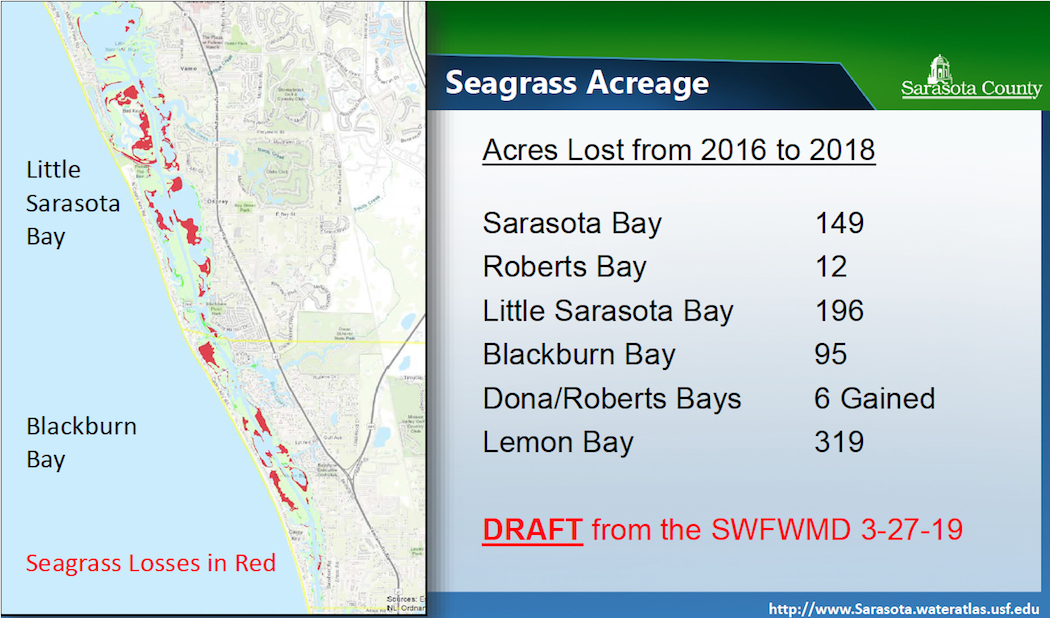
A graphic provides details about seagrass decline over the past two years. Image courtesy Sarasota County
During his part of the presentation, Walter also cautioned the board members that if they do not pursue measures to improve the quality of water in the bays — in the face of demonstrated seagrass loss — then it is likely they will have to contend with state and federal regulatory action dictating the steps they must take to achieve specific goals.
A slide Walter showed the board said that from 2016 to 2018, Lemon Bay lost 319 acres of seagrass; Little Sarasota Bay, 196 acres; Sarasota Bay, 149; Blackburn Bay, 95; and Roberts Bay, 12 acres. Those estimates came from SWFWMD on March 27, the slide noted.
Only Dona Bay has seen an increase in seagrass acreage, thanks to county initiatives over the past years to improve its water quality, staff has explained.
Commissioner Detert talked of her desire for the commission to act on its own before such regulatory oversight might become necessary.
What does the public want?
As they discussed how best to proceed, Chair Hines said he hopes the public will contact the commissioners about preferences for board priorities among those staff had discussed that morning.
Hines referenced the primary areas of focus: the conversion to the advanced wastewater treatment plants; continued removal of septic tanks in the Phillippi Creek Basin, plus a proposal for a new program that would entail pumping out private septic tanks every five years and concurrent tank inspections; and the improvements to stormwater systems.
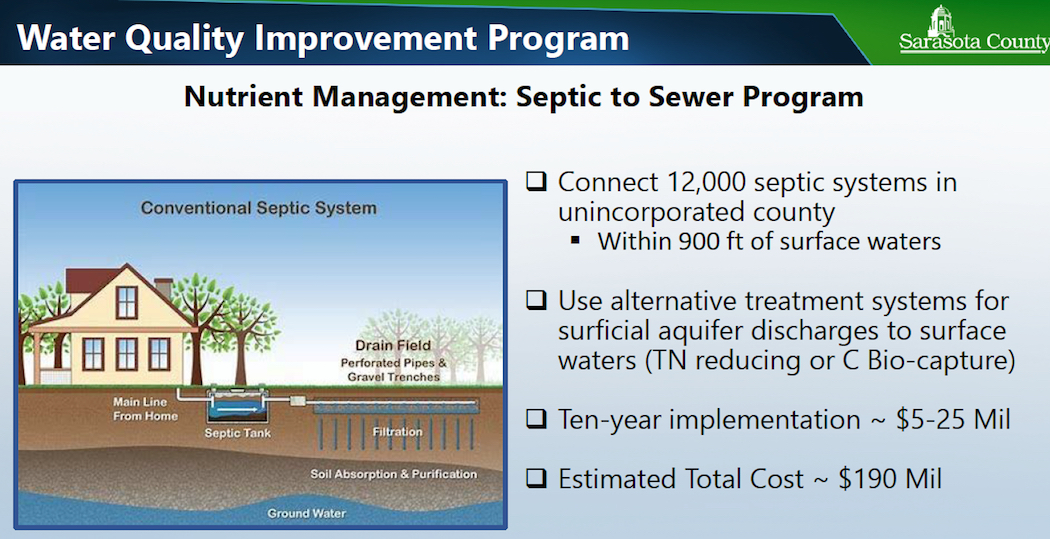
This graphic provides details about a program that would eliminate more septic tanks. Image courtesy Sarasota County
The pump-out/septic tank inspection program would necessitate changes to the County Code, Chuck Henry, director of the county’s Health and Human Services Department, explained. It would be designed for homes in the more rural areas of the county that are distant from sewer connections, he indicated.
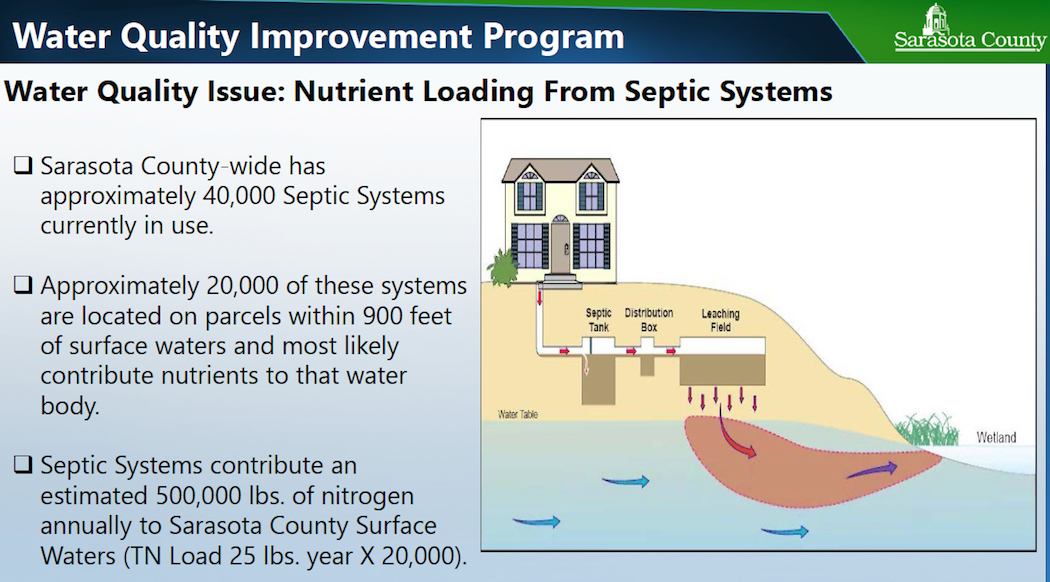
About 20,000 septic systems across the county are within 900 feet of surface waters, Henry said, as determined by a Sarasota Bay Estuary study. The total estimated cost for new sewer systems to eliminate just the 12,000 septic tanks in the unincorporated part of the county is $190 million, Henry pointed out.
Altogether, about 40,000 septic systems remain in operation countywide, Henry said.
Hines talked of his interest in a suggestion Walter, the Stormwater Division manager, had made: working with the City of Sarasota to use city right of way to the eastern part of the county to lay new county pipeline that would divert stormwater from the Whitaker Bayou and Phillippi Creek watersheds. That stormwater then could be used for irrigation or other purposes, Walter explained.
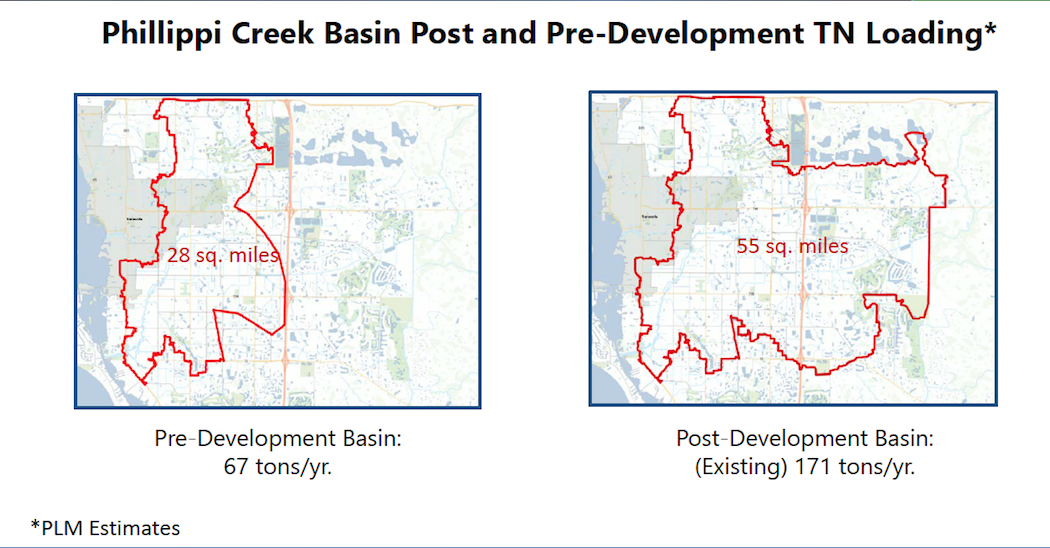
This graphic shows changes in the Phillippi Creek Basin as a result of growth in the county. ‘TN’ refers to the total amount of nitrogen. Image courtesy Sarasota County
The City of Sarasota uses the right of way corridor for its reclaimed water distribution system, Walter noted.
The estimated expense of the county project was put at $40 million, with the goal of removing 20,000 pounds of nitrogen a year from the waterways and reducing flooding in neighborhoods.
“Whitaker Bayou’s been a problem for many, many years,” Hines said.
“We’re really solving multiple issues with a solution like this,” Walter pointed out.
Education and outreach
At various times during the approximately 95-minute discussion, commissioners also stressed the need to educate the public about what the county has done to improve water quality, as well as the benefits of the new proposals.
Both Commissioners Detert and Maio talked of the reluctance of homeowners to pay to convert from septic tanks to sewer systems.
As a Florida legislator prior to becoming a commissioner, Detert noted, she helped win state grants for the conversion to central sewer of most of the approximately 10,000 septic systems in the Phillippi Creek Basin. If the county were able to make the switch to central sewer less expensive, she said, more people would agree to it.
Henry, the Health and Human Services director, acknowledged, “The biggest pushback we always hear is … ‘I’m on a fixed income right now, [and] I pay nothing for my wastewater …’”
“On the other side of that,” Henry said, is the fact that “there’s a cost to the community and the environment.” Every homeowner hooked up to central sewer pays a monthly bill, Henry pointed out, which helps keep the environment clean.
Maio talked about the “absolute uproar” he has heard from residents of subdivisions without sewer systems when he has talked about the county’s efforts to eliminate septic tanks. Yet, Maio continued, those homeowners generally do not think about the necessity of leaving their property vacant around the septic tanks, which means they cannot have detached garages or in-ground swimming pools, for examples. They would have freer use of their land, he pointed out, if they were using a central sewer system.
This graphic provides details about septic systems. ‘TN’ refers to total nitrogen. Image courtesy Sarasota County
Commissioner Ziegler said he had not thought about that. “Being able to get a significant chunk of your property back … is a big selling point.”
Members of the staff of the University of Florida/Institute of Food and Agricultural Sciences Extension Program (UF/IFAS) in the county “will be critical,” Henry said, in helping property owners understand the benefits of eliminating septic systems.
Ziegler also talked of the need for the commissioners and county staff to “get more aggressive” with county communications to the public, noting how much misinformation he hears. “The community wants [the facts]; I don’t think they’re misinformed on purpose.”
Florida Department of Environmental Protection has issued two permits needed for construction but TST Ventures awaiting approval of county applications
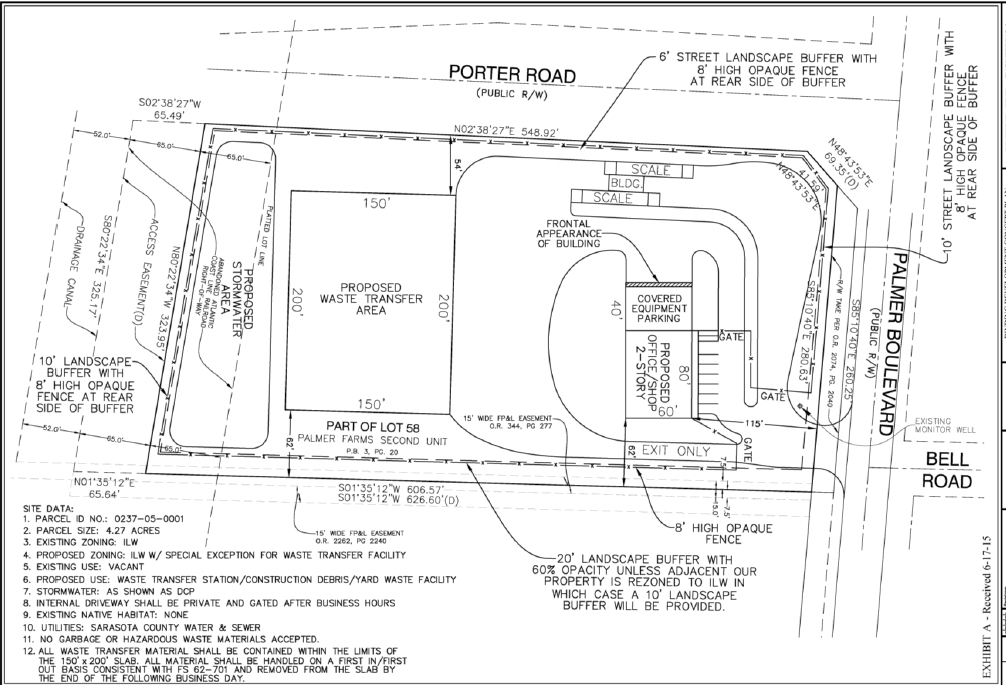
This is the concept plan for the waste transfer station as approved by the County Commission in October 2015. County staff has told the News Leader that TST Ventures has to adhere to the facets of the plan, as required by county land development regulations. Image courtesy Sarasota County
Plans are proceeding for a waste transfer station near the Celery Fields, The Sarasota News Leader learned this week.
The owner of the business — James Gabbert of Sarasota — has received the necessary state permits for the site work.
In an April 30 email, Dee Ann Miller, a spokeswoman for the Florida Department of Environmental Protection (FDEP), told the News Leaderthat the department had issued the Environmental Resource Protection and National Pollutant Discharge Elimination System permits to Gabbert. However, she added, “[N]o application for the solid waste permit has yet been submitted.”
Gabbert is waiting on several permits from county staff.
On April 12, an application was submitted to the county for a commercial office building as part of the Palmer Transfer Station project, Mark Loveridge, the county’s land development manager, wrote in an April 30 email in response to a News Leader inquiry about the status of the TST Ventures plans.
The applicant officially is Rykin Construction Services LLC of Boleyn Road in Sarasota County, according to a News Leader search of county permitting records. “[The application] is under review at this time with comments due on May 24, 2019,” Loveridge added in his email.
The online permitting materials say the value of the construction would be $365,000.
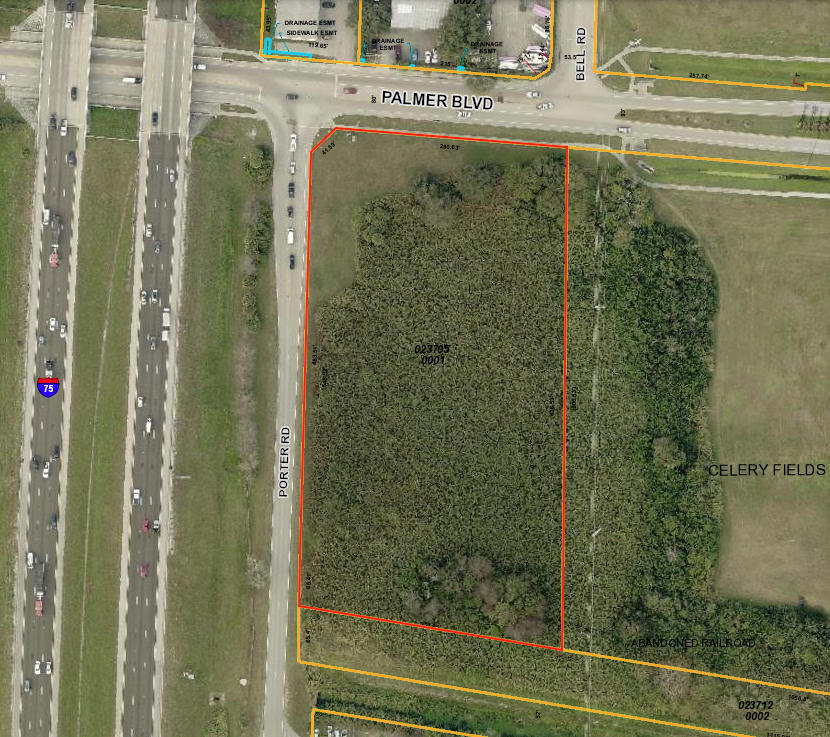
An aerial map shows the proposed location of the waste recycling facility, outlined in red. Image from the Sarasota County Property Appraiser’s Office
Then, on April 30, TST Ventures applied for a permit to install three new “motor truck scales,” noting the value of that project would be $60,000. Those scales would be needed to weigh the trucks carrying the waste materials, based on Gabbert’s testimony prior to his winning County Commission approval for the project in October 2015.
The review of the latter application is due to be completed on June 12, the document says.
Additionally, in its search of county permitting records, the News Leader found that an application was submitted in February for the construction of the 8-foot-tall precast concrete wall around the facility, as detailed in the site plans. The value of that construction was put at $113,600, with Permacast LLC of Bradenton listed as the company that would undertake the work. The most recent notation on that application shows that it failed a staff drainage review.
The staff comment said, “No boundary and topographic survey noted in the permit packet. Survey must be signed and sealed by a Florida Registered Surveyor and Mapper. Please provide a site plan of scale capable to review the wall and post footing locations in relation to any or all easements. Plan has a note the lot drainage is the responsibility of the owner. Drainage is part of the application process for the permit. Please note how lot drainage will be handled, will the wall have a panel gap at the base or scuppers and openings.”
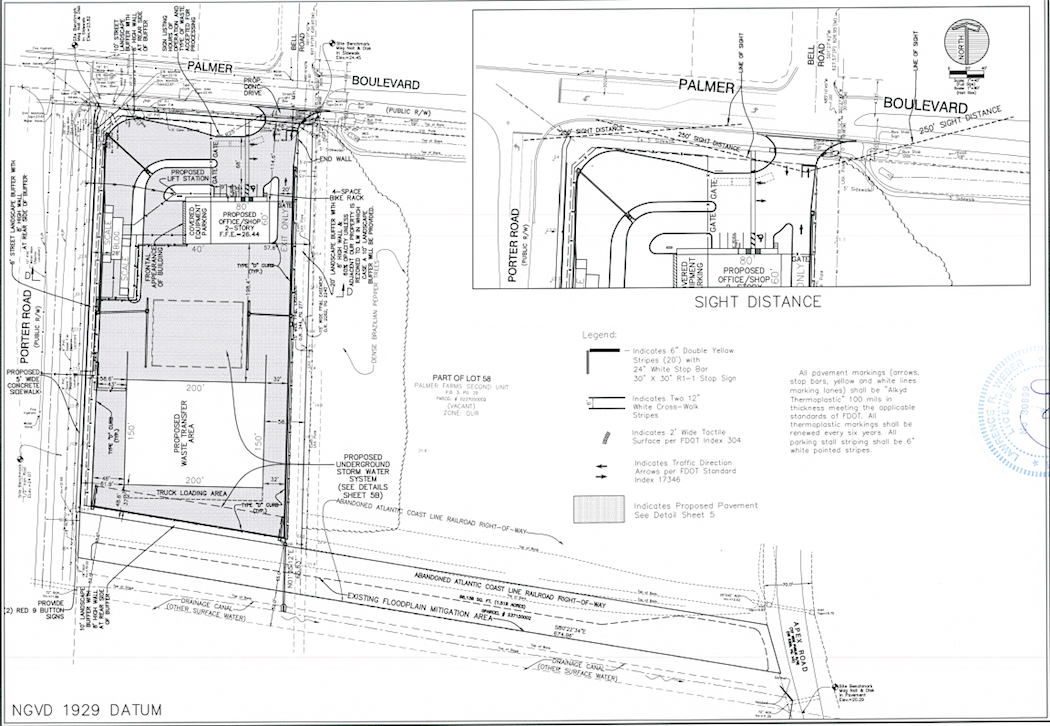
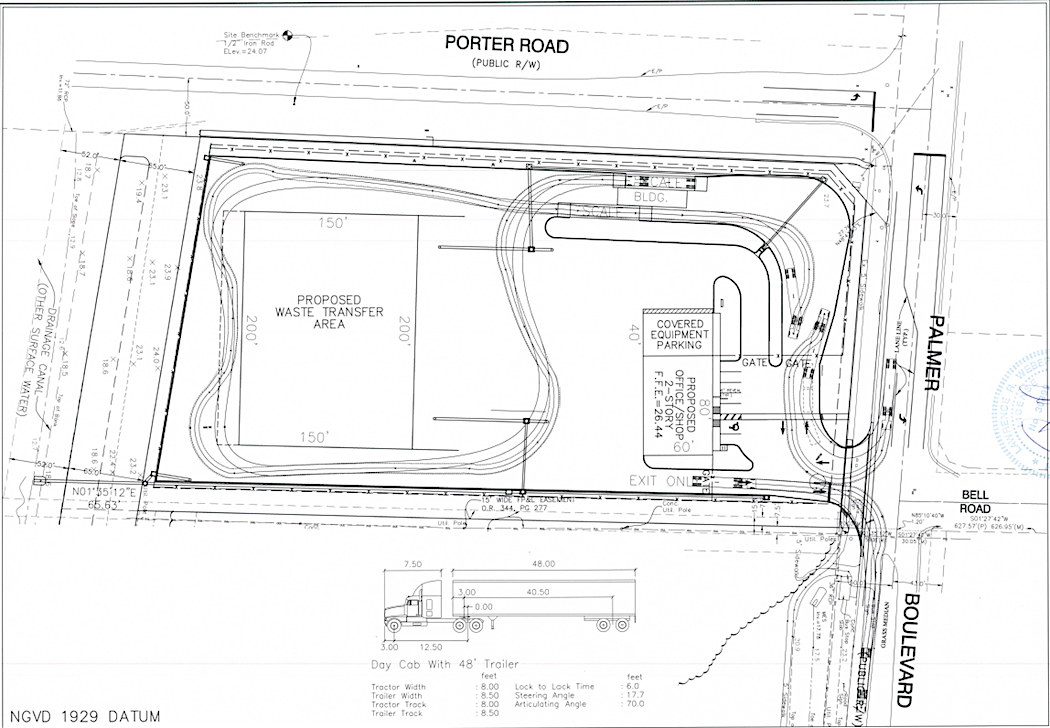
This engineering drawing for the Palmer Transfer Station offers additional details about the plans. Image courtesy Sarasota County
The most recent staff remarks on that application — entered on April 25 — said the prior comments about the survey and the “site plan with scale to determine location in relation to lot lines or easements with dimension to footings, concrete poured or wall panels” still had not been addressed. The notation added, “Corrections Required.”
On April 1, in response to a News Leaderrequest for an update, Media Relations Officer Drew Winchester also reported that, as of that date, TST Ventures had filed for two utility permits — involving fire and water lines — and those also were under review, too.
On Jan. 31, Sarasota County staff issued the primary permit for the Palmer Transfer Station to Weber Engineering and Surveying of Sarasota, agent for Gabbert’s firm, TST Ventures.
The Palmer Transfer Station is slated to be built on property located at 6150 Palmer Blvd., which is next to the county’s “Quads” parcels. Those, in turn, stand adjacent to the Celery Fields, a county stormwater project that has become an internationally known bird-watching park.
The 6150 Palmer Blvd. site comprises about 4.27 acres. It is located at the intersection of Porter Road and Palmer Boulevard, just east of Interstate 75.
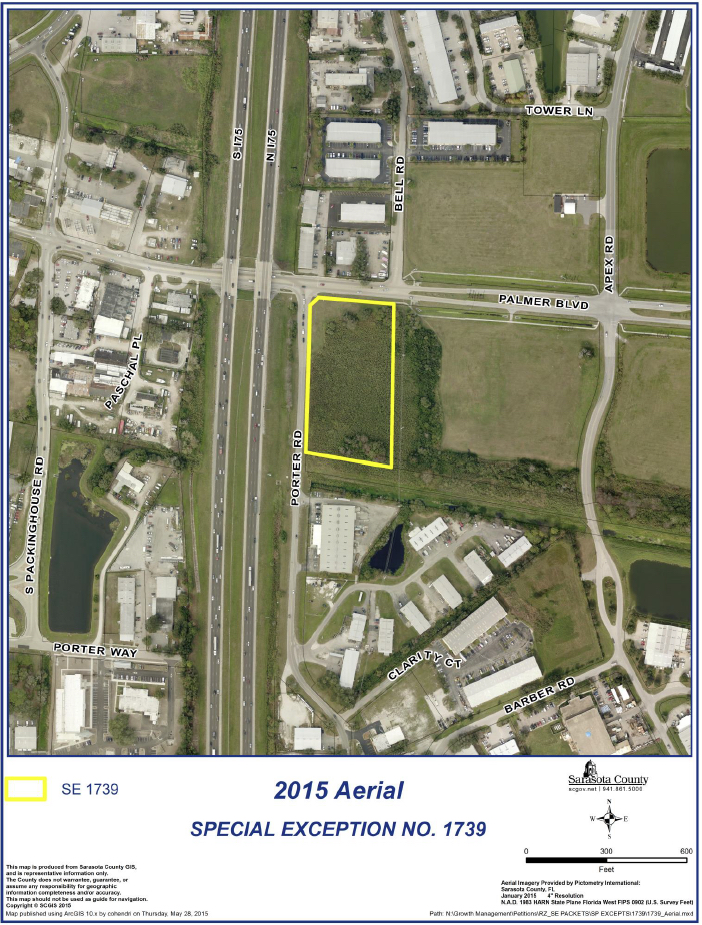
This aerial map shows the proximity of the Gabbert property to the county’s ‘Quads’ parcels. Image courtesy Sarasota County
Gabbert originally planned to combine the waste transfer station project with a construction and yard waste recycling center on the Southwest Quad. However, advocates for the Celery Fields led a series of protests against the recycling facility and urged the county commissioners to deny Gabbert’s petitions for its construction. Gabbert had planned to purchase the Southwest Quad from the county if he won commission approval for the project.
The county’s Planning Commission voted to recommend the County Commission deny the petitions, largely out of concerns related to what members of that board characterized as a road network inadequate to support Gabbert’s plans.
An engineering drawing in the site plans shows these details about trucks that will be coming to the facility and traffic flow. Image courtesy Sarasota County
As for the FDEP permits: On May 28, 2016, TST Ventures received its National Pollutant Discharge Elimination System (NPDES) permit, which the company needed for construction activities on the Palmer Boulevard parcel. That permit will expire on May 27, 2021, a member of FDEP’s NPDES Stormwater Program wrote in a June 2, 2016 letter addressed to Gabbert.
TST Ventures applied for that permit on May 25, 2016, according to another FDEP document. On the form, the box for “Small Construction” was marked, indicating the project would “disturb between 1 and 4.99 acres of land …” On a separate line, the application noted that the “[a]pproximate total area of land disturbance from commencement through completion of construction” would be 2.34 acres.
Gabbert, who signed the application as manager of TST Ventures, indicated the start date of the work would be May 2016, with completion in June 2017.
In regard to the second FDEP permit: On June 5, 2018, the department issued an Environmental Resource Permit (ERP) to TST Ventures for the construction of “a solid waste management facility.” That permit will expire on June 5, 2023, the document says.
The project description explains that the permit covers “the construction and use of stormwater management system consisting of drainage inlets, swales and one dry retention stormwater treatment basin.”
====
CSC Editor's Note: More about Waste Transfer Facilities (WTF) here:
Members call for better education of the public about consequences of measures
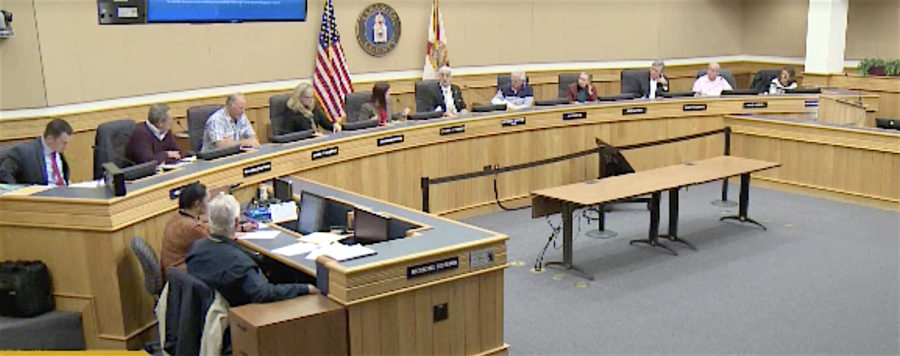
The Charter Review Board members sit in session on Jan. 30 in Venice. News Leader image
On a 6-4 vote, the members of the Sarasota County Charter Review Board have agreed on the appointment of a committee to study how best to handle the vetting of proposed amendments to the Charter as a result of citizen petition drives.
Vice Chair Joe Justice of North Port initially proposed a change to the Charter that would necessitate that any proposed amendment “be fully vetted so all of the pros and cons can be discussed for the public to see,” as he put it in an email to the clerk to the Charter Review Board. However, Justice added that even if the board members felt the amendment would be inappropriate, he believed the person or group seeking the change still could pursue the petition process to put the amendment before voters during a referendum.
After a discussion during the Charter Review Board’s Jan. 30 meeting, Chair Anthony Sawyer of Sarasota appointed five of his colleagues to the study committee: James Gabbert of Sarasota, chair; Justice, vice chair; Donna Barcomb of Sarasota; Deborah Lynne LaPinska of Venice; and Neil Rainford of Sarasota.
They had joined Sawyer in casting the six votes in favor of the committee’s establishment.
Those voting in opposition to the proposal were Richard Dorfman of Sarasota, Pat Wayman of Venice, Joseph Hudgins of Sarasota and David Samuel of Venice.
The issue first arose during the Charter Review Board’s meeting on Oct. 17, 2018. At that time, Sawyer pointed out on Jan. 30, he had asked that any members who had comments they wished the full board to discuss should put those in writing. Justice was the only one to do so, Sawyer noted.
On Jan. 30, Justice explained that, even with the voters in November 2018 having approved changes to the citizen-initiated Charter amendment petition process, anyone who can gather the necessary number of signatures of registered voters on petitions can get a proposed amendment on the ballot.
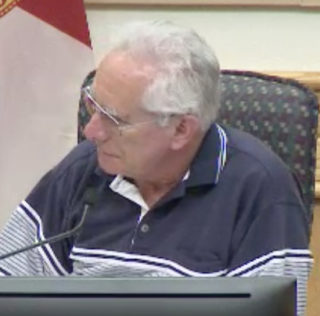
Vice Chair Joe Justice listens to a comment on Jan. 30. News Leader image
“I think [a proposed amendment] should come through us to be completely vetted, so both pros and cons … are available to the public,” he said, referring to his November 2018 email.
“With the petition process,” Justice continued, “you really only hear the side of the petitioner. You’re not really hearing the cons to it.”
Rainford indicated that he wanted a statement on the record about whether the vetting of proposed amendments is required for any of the methods the Charter allows.
Justice then asked Assistant County Attorney Sarah Blackwell, who works with the Charter Review Board, to provide the answer.
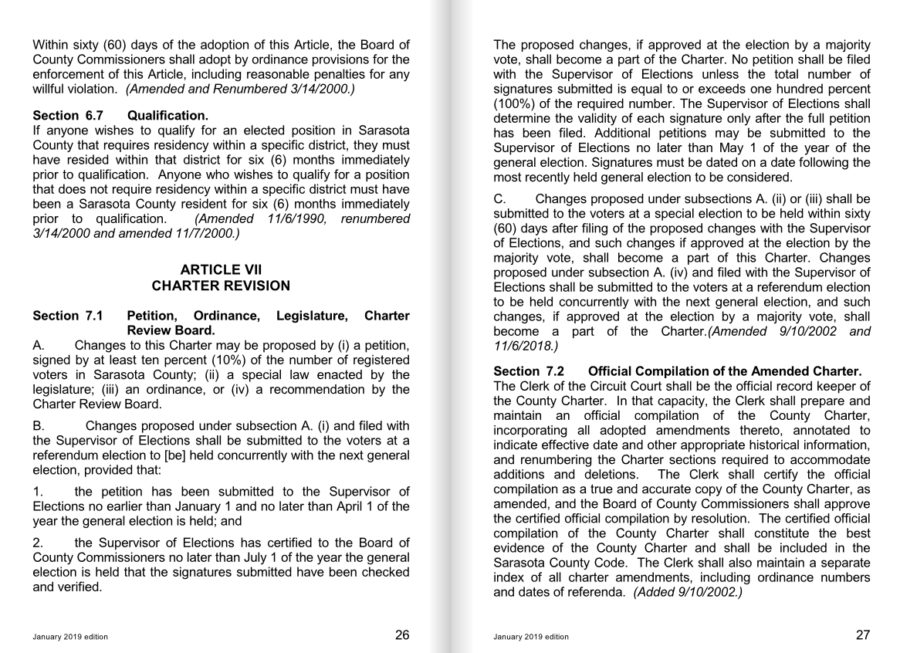
Blackwell referred to Section 7.1 of the Sarasota County Charter, which outlines the four methods through which an amendment can be pursued. A copy of that section was provided to the board members with their agenda packet, she noted.
Along with the citizen petition process, the Charter Review Board itself can propose an amendment; the County Commission can propose an amendment; and the Legislature can propose an amendment.
After explaining those methods, Blackwell said she believed “a certain amount of vetting” takes place in each process except for one involving citizen-initiated amendments.
Pros and cons among the board members
This is Section 7.1 of the Sarasota County Charter, including amendments approved on Nov. 6, 2018. Image courtesy Sarasota County Clerk of the Court and County Comptroller
Sawyer asked each of the board members to offer his or her view on Justice’s proposal.
Dorfman pointed to the lengthy process — 18 to 24 months, he said — to get any issue before the Charter Review Board. Additionally, he continued, “I personally am not in favor of having another layer of process added to the amendment process.”
Gabbert, however, told his colleagues, “I believe we should move forward with the committee … I believe that information that is directed to citizens by paid signature gatherers is slanted and is notin the best interest of the county.”
County commissioners last year voiced criticism of the use of paid signature gatherers in efforts to get citizen-initiated amendments on a ballot.
Barcomb said she agreed that the Charter Review Board needs to review any proposed amendments. Prior to the 2018 General Election, she added, “Constituents of the county were not served by appropriate vetting.”
Donna Barcomb. News Leader image
For example, she continued, she asked the Sarasota County Supervisor of Elections Office last year to provide her with the number of registered voters in each of the five County Commission districts. She sought the information, she indicated, in the context of the proposed Charter amendment — which passed — calling for single-member districts.
The figures she received, Barcomb noted, showed, for example, 57,270 registered voters in District 1 and 73,633 in District 5.
(In response this week to a Sarasota News Leader request for the figures, Rachel Denton, communications and voter outreach manager with the Supervisor of Elections Office, provided these figures of registered voters as of Feb. 5: District 1 — 57,353; District 2 — 61,755; District 3 — 66,030; District 4 — 64,238; and District 5 — 73,769.)
The Single-Member District Charter change will allow voters in each district to vote only for County Commission candidates from that district. Previously, all registered voters were able to vote for commission candidates in each district up for election.
If voters had had the district voter numbers before the Nov. 6, 2018 General Election, Barcomb said on Jan. 30, “They may or may not have voted differently … I feel we might be the board to be able to at least go through the appropriate vetting,” she added, concurring with Justice.
Wayman joined Dorfman in voicing opposition to any potential for lengthening the process for the Charter Review Board to approve a proposed amendment. “I do agree that we should have both sides,” she continued, but she pointed out, “I’m not sure how many people actually listen to what we’re saying anyway.”
Perhaps the board could allocate some of its budget to running an advertisement prior to an election that could explain facets of any amendments that would be on the ballot, Wayman suggested.
“There are paid solicitors … that will stick a piece of paper in front of a lot of people and not fully explain the situation,” Hudgins told his colleagues, referring to paid signature gatherers. Yet, most people, by nature, will say they are open to change, he added. “But then there are situations when [proposed amendments] are never fully vetted, and the ramifications and the consequences are not discussed and weighed.”
He suggested the board invite any group or person with enough voter signatures to get an amendment on the ballot “to come and present [it], and let’s hear both sides of it. … We can at least question them and get dialogue out. … I think it goes in context with our duties.”
“We’re here representing the people,” Chair Sawyer responded, “and we ought to be transparent and all inclusive.” He added, “I’m all for [inviting people to the board’s meetings].”
Samuel told his colleagues, “Anyone who’s opposed to a proposed revision [of the Charter] has the opportunity to come here.”
Chair Anthony Sawyer. News Leader image
LaPinska said she also was opposed to any measure that would lengthen the process for getting a Charter amendment on the ballot, but she agreed that the board should try to educate the public about proposed amendments.
Gabbert pointed out that the board could pursue an amendment to the Charter requiring vetting without lengthening the process.
“I don’t see how it can’t change the length of the process,” Dorfman responded. “I just believe there’s a way to get the information out” without changing the Charter, he added. Perhaps the group or person who pursues a citizen-initiated amendment process should be required to make a formal presentation to the County Commission, Dorfman added, so issues related to the amendment could be explained fully.
Justice said he was thinking perhaps a 15- to 20-minute presentation by the group before the Charter Review Board, so the board could fully vet the proposed amendment.
Sawyer then said he felt it would be best for him to appoint a special committee “to look into this.”
Dorfman suggested, however, that Sawyer seek a vote of the board members on the establishment of the committee.
In response to a question, Blackwell, the assistant county attorney, told Sawyer that he had the power to appoint such a committee. Dorfman continued to insist upon a vote, first, to see if enough members supported that plan. Hudgins agreed with Dorfman.
After the vote tally showed the result was 6-4 in favor of the committee, Sawyer named the members. He would leave it to Gabbert, as chair, he added, to work with the clerk to the board, from the Sarasota County Office of the Clerk of Court and County Comptroller, to make the other committee members aware of the meeting dates and locations.
Blackwell clarified that the clerk would notify the other committee members of the information.