Below: An open letter to the Board regarding the adequacy of online Neighborhood Workshops. The workshop discussed below is scheduled to be on Zoom only, on Tuesday, May 23, at 6 pm.
Re: Workshop for housing proposed next to Celery Fields Wetlands
A proposal for intense single family housing on some 49 acres along Raymond Road has lately come to the attention of the Sarasota community. As the Celery Fields is a beloved environment prized for its nesting and migrating birds -- a unique asset that brings tourists from all over the world, the cumulative impact of 160+ new homes in close proximity to these nesting wetlands raises a host of questions and concerns.
Part of site plan for Raymond Rd
In order to address important community questions that could involve everything from bird and animal life to ecotourism and water quality, neighborhood traffic, flooding, lighting and more, all steps in the planning process deserve to be handled with integrity.
To this end, I and others ask that you require a Neighborhood Workshop that will be held live (an online component could be included for those out of state.) I'm sure you've heard from citizens who have been frustrated when seeking to participate in various workshops via Zoom or Microsoft Teams. Many citizens do not even use tools like Zoom, some do not own computers.
What's more, these online meetings depend on the developer's agent for their timing and informational quality. I can attest that at some online workshops I've attended, the information presented was minimal, the images were small and blurry, sound quality was poor, the question period was brief, and the opportunities for follow-up questions were non-existent.
Given that the birding, hiking, fishing, kayaking and ecotourism at the Celery Fields are activities that mean a great deal to our citizens, the questions surrounding the impacts of this proposal go far beyond the number of homes, parking spaces, and entrances. An online Workshop will not do justice to the complications of this proposal.
A live workshop with stormwater quality experts, environmental and tourism personnel on hand as well as the developer's agent is warranted to address the full range of issues raised by this development.
For the sake of a fair, open process, please require a live workshop with appropriate staff to get the planning process off to a reasonable start. This project is likely to eventually land on your desks -- here's an opportunity to demonstrate that you understand our concerns and are doing what you can to allow the public to examine the potential impacts from this project's intensity and proximity fully and fairly.
As many know, Jon Thaxton and Steve Suau were two of the key people behind the creation of the Celery Fields Water Management facility quite a few years ago.
They're still concerned with water, and will be giving several talks on the results of a year's research on nutrients in our soil, and how they affect our bays and waterways. It's a wake-up call for us all.
Jon and Steve will be at the Robert L. Anderson Administration Center in Venice this Tuesday (March 10) shortly after 1:30 pm presenting to the Board of Sarasota County Commissioners.
Divers did find absence of sponges and dead and stressed corals, likely a result of depleted oxygen levels
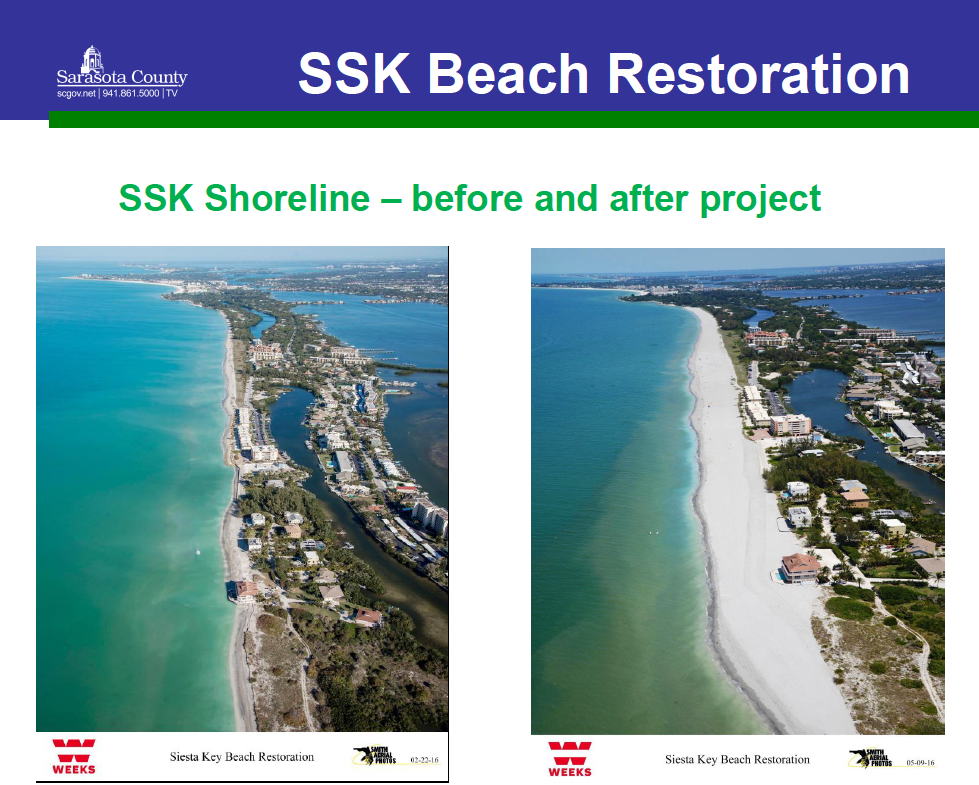
A graphic shows before and after photos of south Siesta Key beach in 2016. Image courtesy Sarasota County
The severity of the red tide bloom that ended early this year significantly hampered the work of a Deerfield Beach consulting firm Sarasota County hired to monitor the impacts of the last South Siesta Renourishment Project, The Sarasota News Leader has learned.
“Conditions at Siesta Key were checked on October 29, 2018 but were not acceptable for underwater work,” the consultant, Coastal Eco-Group, wrote in a report detailing the situation in the nearshore hardbottom area close to the south Siesta shoreline. After late October 2018, further attempts were made to study four areas designated for the monitoring in the second year after the project was completed, the report explains, but each had little success.
Finally, even after the red tide bloom subsided, rough conditions in the Gulf of Mexico dropped visibility levels so low that mapping was not possible, the report says. The survey ultimately was terminated, the report adds.
Nonetheless, limited observations that divers were able to make in November and December 2018 found that “[s]ponges [had] virtually disappeared from the benthic community,” and that that loss “is likely attributed to the prolonged red tide event in 2018.” The report did point out, though, that Hurricane Irma in September 2017 and Hurricane Michael in October 2018 might have dislodged some of the sponges.
Yet, “Harmful algal blooms have been linked to invertebrate die-offs including sponges,” as a result of prolonged periods of low oxygen levels, the report notes.
(The benthic zone is the lowest level of a body of water, including the sediment surface and some subsurface layers, the New World Encyclopedia explains. “Benthic organisms play an important role in food chains, including as food for humans,” the encyclopedia adds, and the “benthic zone provides an area for spawning, foraging, and refuge for various fish species …”)
Dead and stressed and corals that divers were able to observe also most likely were victims of the red tide bloom, the report indicates, as blooms deplete oxygen in the water. One section of the report notes that corals did not appear to have suffered from coverage of sand associated with the renourishment initiative.
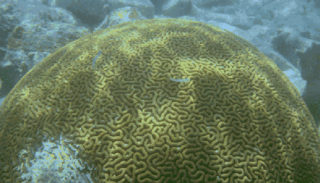
This is an example of scleractinian coral. Image from the University of California at Berkeley
Later, the report references “the losses of large biota (sponges, octocorals and scleractinian corals) observed [during the survey],” adding that the situation appeared “to be related to the effects of the severe red tide and storm dislodgement rather than burial from beach nourishment sand …”
The report focuses on the monitoring attempts for the second year — “Year 2 post-construction,” as it is referred to — following the April 2016 completion of the South Siesta Renourishment initiative. The survey was required by state and federal environmental officials in an effort to determine the effects of the project on sea creatures living offshore of the renourishment area.
The report was submitted to county staff earlier this year and released to the News Leader, at the publication’s request, after the county staff review was completed late last month.
In October 2015, the report points out, pre-construction surveys of three areas were completed, to serve as a baseline for the monitoring.
The Florida Department of Environmental Protection (FDEP) requires monitoring of nearshore hardbottom after renourishment projects because of the importance of hardbottom as an ecological resource.
It serves as a shelter and food resource for more than 1,000 recorded species of algae, invertebrates and vertebrates.
It provides nursery areas.
It provides spawning sites for more than 100 species of invertebrates and fish.
It provides recreational opportunities — boating, fishing and diving.
It dissipates wave energy that otherwise could cause erosion.
FDEP strives to protect nearshore hardbottom resources because of those reasons, the materials point out.
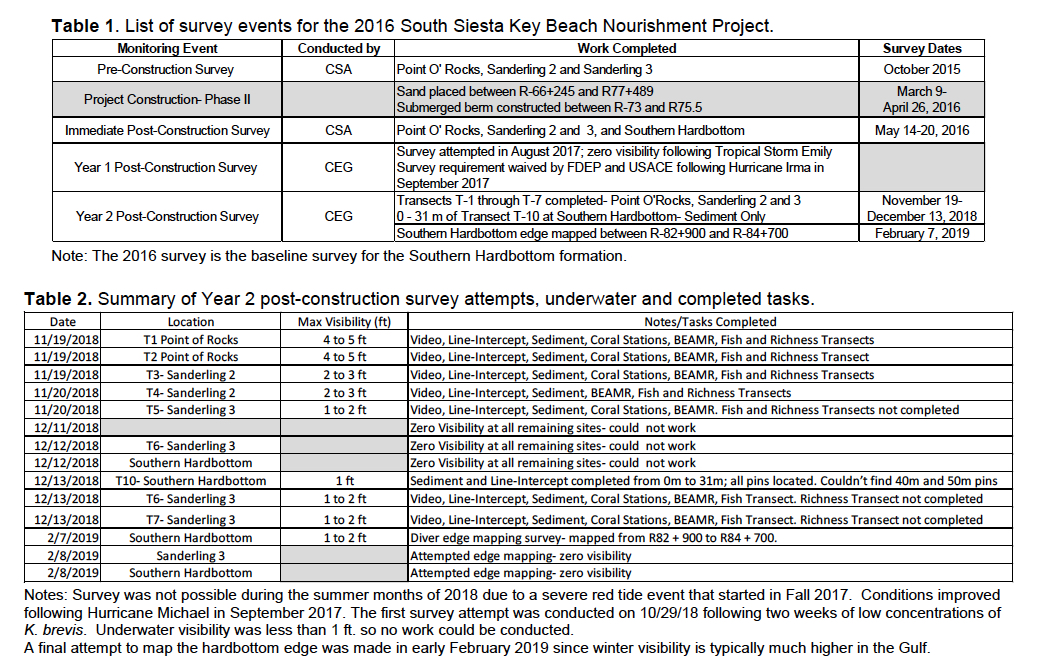
This chart details the survey efforts for the Year 2 post-construction monitoring of the South Siesta Renourishment Project. Image courtesy Sarasota County
The Coastal Eco-Group report concludes that, based on the observations and results of the Year 2 post-construction survey, “it is unlikely that the current hardbottom monitoring program will be able to detect project-related effects” from the 2016 South Siesta Renourishment Project.
Still, the report says, the “Year 3 post-construction survey will provide valuable data on recovery of benthic communities, particularly sponges, octocorals, and scleractinian corals, following the red tide event and an overall status/condition report of benthic communities adjacent to the beach nourishment project area.”
Monitoring plans
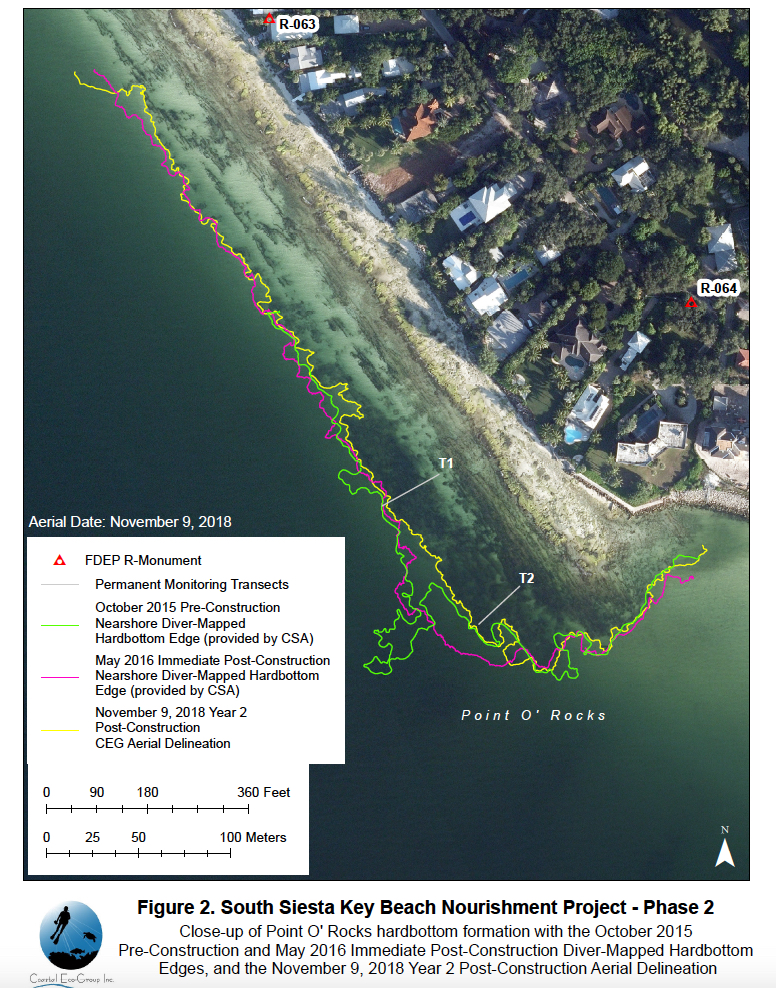
A graphic included in the report shows details about the monitoring efforts regarding the Point of Rocks nearshore hardbottom area. Image courtesy Sarasota County
The Coastal Echo-Group report explains that the Biological Monitoring Plan for the South Siesta Renourishment Project required annual surveys of hardbottom habitats updrift and downdrift of the area where approximately 749,238 cubic yards of sand was placed on the beach, between March 9 and April 2016. The sand was dredged from three offshore borrow areas, the report points out.
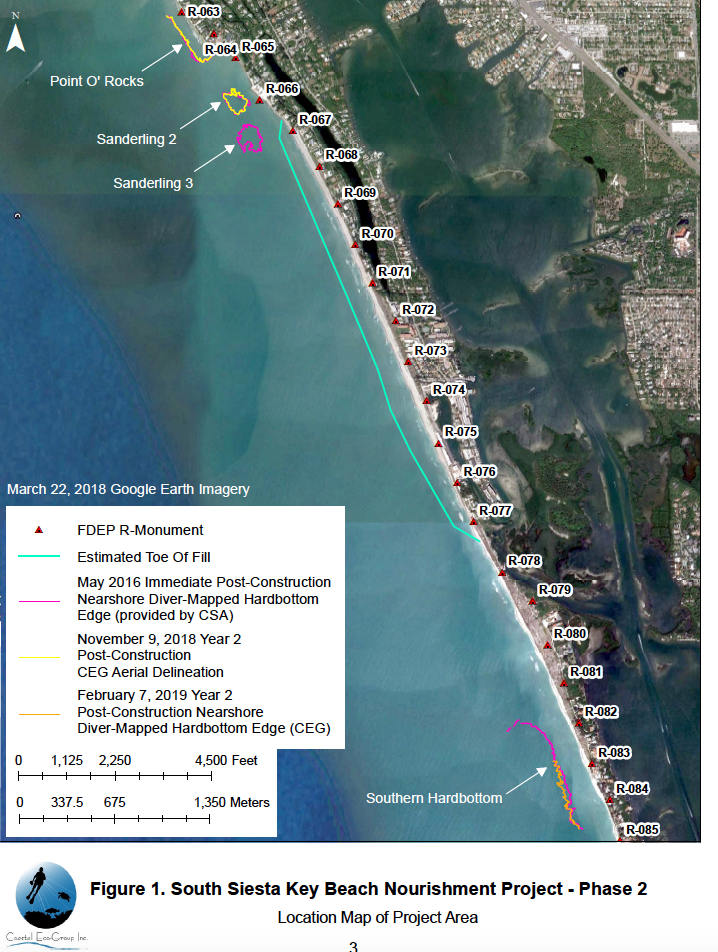
The project area extended from a rock revetment about 3,000 feet south of Point of Rocks to the southernmost house on Siesta Key, according to county staff. The area is approximately 2 miles in length.
For monitoring purposes, the plan designated three hardbottom areas: Point of Rocks, “Sanderling 2” and “Sanderling 3,” the report notes.
Additionally, the plan encompassed a fourth formation, referred to as Southern Hardbottom, which is located about 0.8 miles south of the southern limit of the renourishment project and approximately 500 feet offshore.
Point of Rocks is located about half-a-mile north of the project boundary, while Sanderling 2 is about 150 feet offshore, between Point of Rocks and Sanderling 3, the report says. Sanderling 3 is located approximately 350 feet offshore at the northern end of the beach fill area.
“The Immediate post-construction survey of all four hardbottom formations was completed … during the summer following project construction in May 2016,” the report notes.
A graphic shows all of the monitoring areas for the project. Image courtesy Sarasota County
The Biological Monitoring Plan called for three annual surveys, the report continues — during the first, second and third years after construction ended.
In August 2017, when the first annual survey was attempted, the report continues, Tropical Storm Emily’s passage, with heavy rainfall, led to zero visibility in the water. Those conditions persisted until Hurricane Irma passed over Florida in September 2017, the report adds.
The first annual survey requirement was waived by FDEP and the U.S. Army Corps of Engineers, the report says, “due to persistently poor in-water conditions following Hurricane Irma.”
Then, the report continues, “A severe red tide event began in southwest Florida in October 2017. The red tide persisted through the Summer of 2018 such that in-water surveys were not possible.”
After Hurricane Michael passed through the Gulf of Mexico in October 2018, the report points out, “red tide levels started to slowly decline in the waters of Sarasota County.”
The Year 2 post-construction survey effort began in late October 2018 “following two weeks of FWC [Florida Fish and Wildlife Conservation Commission] reports of background to low concentrations of Karenia brevis,” the report notes, referring to the red tide algae.
Following problems encountered on the first attempt in October 2018, the report says, a second attempt was made on Nov. 19, 2018. However, visibility at Point of Rocks was only about 4 feet that morning, the report continues, and it decreased in the afternoon to 2 to 3 feet at Sanderling 2. On Nov. 20, 2018, visibility was only 1 to 2 feet at Sanderling 2, the report notes.
Additionally, the report says, “Mild respiratory irritation was reported by … divers during the November 2018 survey attempts; and there were reports of blooms of K. brevis just offshore of Siesta and Longboat Keys during the field survey days.”
The third attempt was made between Dec. 11 and Dec. 14, 2018, the report notes, “during a short period of calm seas. Visibility was absolute zero (blackout)” on Dec. 12 for all the areas scheduled for observation on the Southern Hardbottom and at Sanderling 3, the report adds.
Rough seas again prevented any work on Dec. 14, 2018, the report points out.
“Underwater visibility in the southwest Gulf of Mexico is typically much higher during winter months due to drought conditions,” the report explains. Visibility of 8 to 10 feet “is not uncommon from January through March.”
Therefore, the report continues, the final attempt to map the nearshore hardbottom was planned for early January of this year. “[H]owever, rough conditions following multiple cold fronts pushed the survey attempt to the first week of February. The final survey effort was conducted on February 7 and 8, 2019,” the report says. With visibility “so poor, the nearshore hardbottom edge survey progressed slowly.”
Finally, the post-construction survey was terminated, the report points out.
New county water quality fee proposed as potential revenue source to back bonds
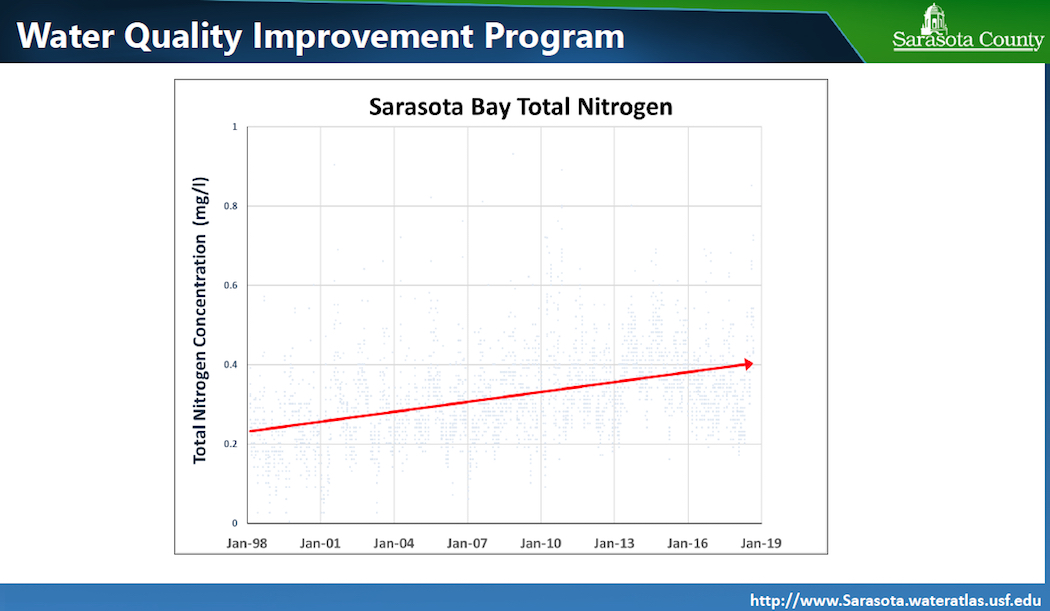
A graph shows the increase in the level of nitrogen in Sarasota Bay over the past two decades. Image courtesy Sarasota County
Given the strong fiscal health of Sarasota County, the majority of the county commissioners this week expressed a willingness to borrow money to put the county’s water quality programs on equally firm footing.
After a comprehensive staff presentation on what has been done and what could be done to reduce the nutrient load going into the county’s waterways — and, ultimately, the Gulf of Mexico — Commissioners Michael Moran and Christian Ziegler indicated a preference for upgrading the county’s three wastewater treatment plants to advanced treatment facilities (AWWTF) at an expense estimated between $70 million and $90 million. The goal would be to reduce the total nitrogen discharge to 3 milligrams (mg) per liter, or less, from the Bee Ridge, Central County and Venice Gardens facilities, Mike Mylett, interim director of the county’s Public Utilities Department, told the board members on May 8.
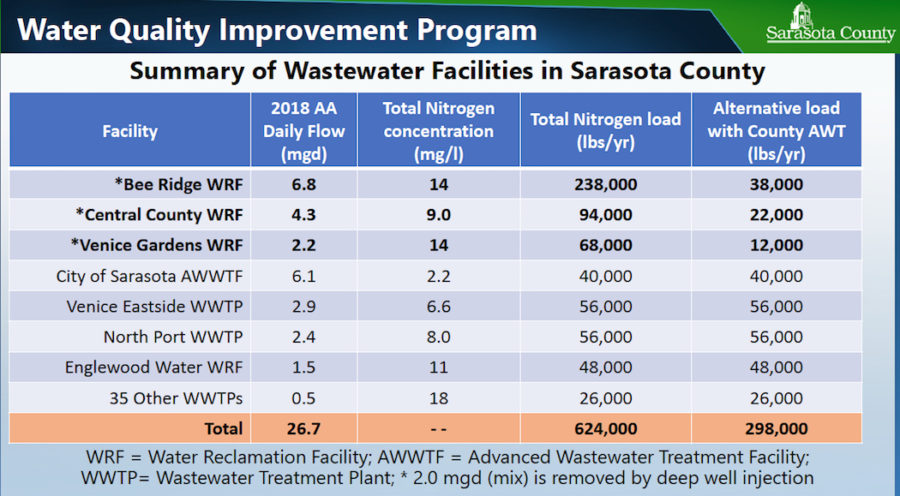
The total nitrogen load for the Bee Ridge facility is 14 mg per liter; for the Central County plant, 9; and for Venice Gardens, 14, according to a slide Mylett showed the commissioners. A note on that slide said that 2 mg per day is removed from the overall nitrogen load produced by each facility, thanks to deep well injections.
Altogether, the three county wastewater treatment plants, along with facilities in the City of Sarasota, Venice, North Port and Englewood — plus 35 private operations — produce about 624,000 pounds of nitrogen a year, Mylett pointed out, although not all of that goes directly to the bays. (Only the City of Sarasota facility is an AWWTF, according to a chart Mylett showed the board. That initiative cost the city $80 million, he said.)
With the improvements to the county’s three wastewater treatment plants, the slide noted, the total nitrogen load could be reduced to about 298,000 pounds a year.
This graphic shows details about the nitrogen loads from wastewater treatment plants in the county. Image courtesy Sarasota County
Red tide research has shown that nitrogen is the primary feeder for the algae that produces the blooms, Karenia brevis.
All of the commissioners talked of the fact that this would be an opportune time for them to pursue the borrowing of money for major projects.
Altogether, staff said on May 8, a variety of proposals — including the elimination of more septic tanks and improvements to stormwater systems — would cost about $310 million. Extra annual operating expenses — an estimated $20 million — would be necessary, as well.
“To me, after hearing all this,” Commissioner Moran began, “I feel that all roads lead back to us moving our community to [advanced wastewater treatment].” That conversion, he continued, would lead to the biggest return on investment for the taxpayers.
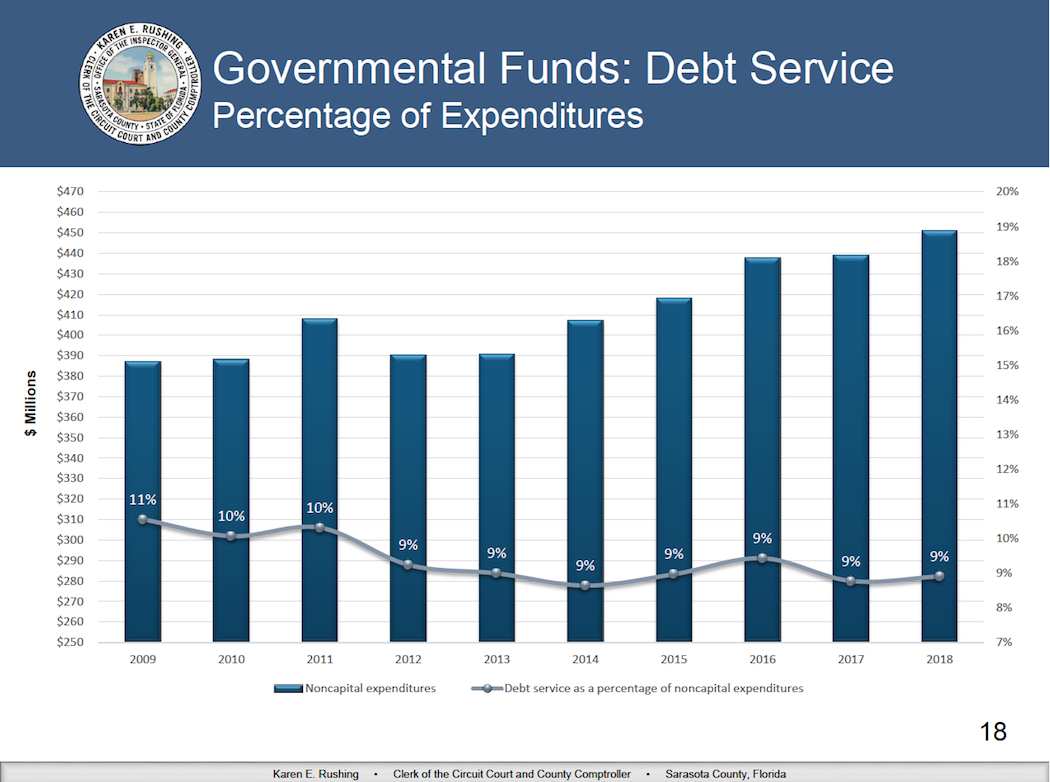
Referencing the Comprehensive Annual Financial Report presentation the board heard on May 7 — provided by the Office of the Sarasota County Clerk of the Circuit Court and County Comptroller — Moran added, “Our debt ratios are incredibly fiscally conservative, [and the county’s bond ratings] are excellent. … Our interest rates are at historic lows. … I want the true solution to this,” he told Chuck Walter, manager of the county’s Stormwater Division, “and then we make the difficult decisions.”
This slide reflects findings in the 2018 Comprehensive Annual Financial Report (CAFR) for Sarasota County. Image courtesy Sarasota County Clerk of the Circuit Court and County Comptroller
“I think Commissioner Moran is right,” Commissioner Ziegler said, adding that he would like for staff to come back to the board with funding options that would lead to the greatest positive results.
Commissioner Alan Maio further pointed to the community pressure on the board to try to prevent a recurrence of the economic devastation of red tide last year, noting “the bludgeoning” businesses took.
As Spencer Anderson, director of the county’s Public Works Department, put it at the outset of the presentation, the red tide bloom that worsened in early August 2018 and persisted for several more months “was crippling, to say the least,” to the county’s economy.
Commissioner Nancy Detert asked staff members for detailed cost estimates — including the potential expenses to homeowners of specific proposals — and information about sources of revenue. “I think we need to put our plan into effect while we can still borrow really cheap.”
In response to a question from Detert, Walter said that over the past six or seven years, the county has received about $50 million from various sources for water quality initiatives. “There’s probably going to be more external money available [in the future],” he added. However, almost all grants require significant local matches, he noted.
Gov. Ron DeSantis has let the Southwest Florida Water Management District (SWFWMD) board and staff know that he wants the district to put a focus on water quality improvements that will benefit the Gulf of Mexico, Chair Charles Hines added.
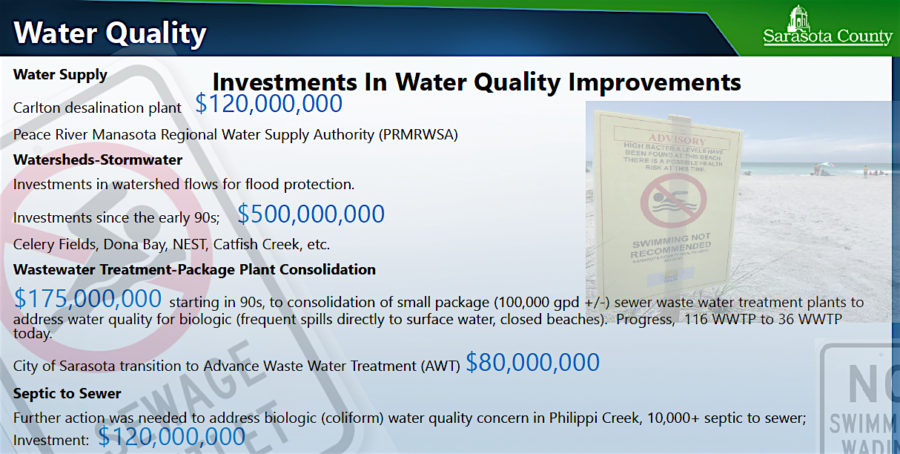
This graphic shows investments the county already has made in water quality. Image courtesy Sarasota County
The board members further concurred that they will need to make decisions about exactly how they want to proceed as they hold discussions in June during their workshops on the 2020 fiscal year budget.
In response to a question from The Sarasota News Leader, the county Office of Financial Management (OFM) reported in a May 9 email that the commission could not issue bonds totaling more than $23,712,978 if it pursued a general government borrow that would have to be paid off with property tax revenue. Any amount above that tied to ad valorem tax revenue would have to be approved by voters through a referendum, mirroring the process the commission pursued last year to raise money for the North Extension and other connections of The Legacy Trail.
The bonding limitation is laid out in Section 5.2D of the County Charter.
However, the OFM staff pointed out that no limitation exists if the commission were to issue bonds that would be paid back with revenue generated by an “Enterprise fund.” The county Stormwater and Solid Waste divisions, for examples, produce revenue from user fees; thus, those accounts are called “Enterprise funds.”
On May 8, Chair Hines emphasized that the commissioners must make sure the members of the public understand that they can expect higher costs pegged to new county initiatives.
One funding option that Walter, manager of the Stormwater Division, proposed is a county assessment on property owners, with the revenue dedicated to improved water quality. Staff would like to explore that, Walter said. If the county had funds from such an assessment, he explained, “Then we would have a significant bonding component right upfront.”
Walter meant that the county could pledge the revenue from the assessments to debt service for bonds.
The seagrass issue
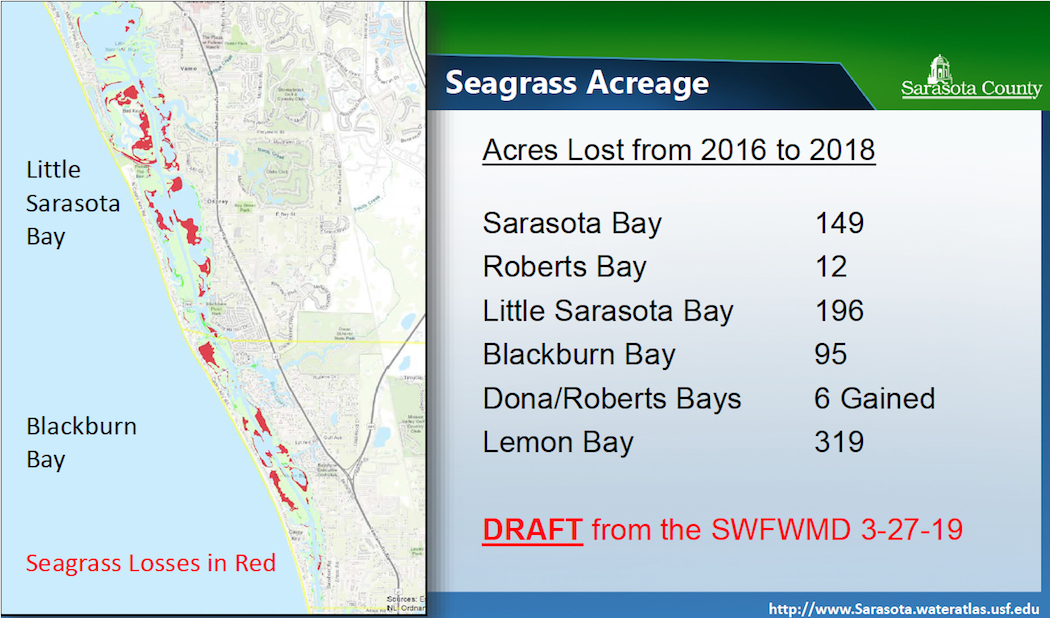
A graphic provides details about seagrass decline over the past two years. Image courtesy Sarasota County
During his part of the presentation, Walter also cautioned the board members that if they do not pursue measures to improve the quality of water in the bays — in the face of demonstrated seagrass loss — then it is likely they will have to contend with state and federal regulatory action dictating the steps they must take to achieve specific goals.
A slide Walter showed the board said that from 2016 to 2018, Lemon Bay lost 319 acres of seagrass; Little Sarasota Bay, 196 acres; Sarasota Bay, 149; Blackburn Bay, 95; and Roberts Bay, 12 acres. Those estimates came from SWFWMD on March 27, the slide noted.
Only Dona Bay has seen an increase in seagrass acreage, thanks to county initiatives over the past years to improve its water quality, staff has explained.
Commissioner Detert talked of her desire for the commission to act on its own before such regulatory oversight might become necessary.
What does the public want?
As they discussed how best to proceed, Chair Hines said he hopes the public will contact the commissioners about preferences for board priorities among those staff had discussed that morning.
Hines referenced the primary areas of focus: the conversion to the advanced wastewater treatment plants; continued removal of septic tanks in the Phillippi Creek Basin, plus a proposal for a new program that would entail pumping out private septic tanks every five years and concurrent tank inspections; and the improvements to stormwater systems.
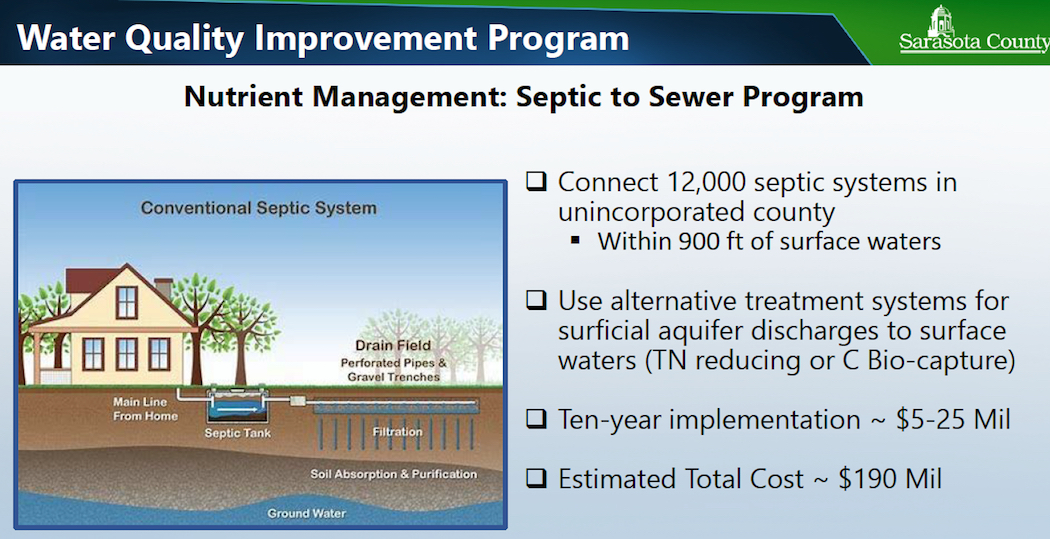
This graphic provides details about a program that would eliminate more septic tanks. Image courtesy Sarasota County
The pump-out/septic tank inspection program would necessitate changes to the County Code, Chuck Henry, director of the county’s Health and Human Services Department, explained. It would be designed for homes in the more rural areas of the county that are distant from sewer connections, he indicated.
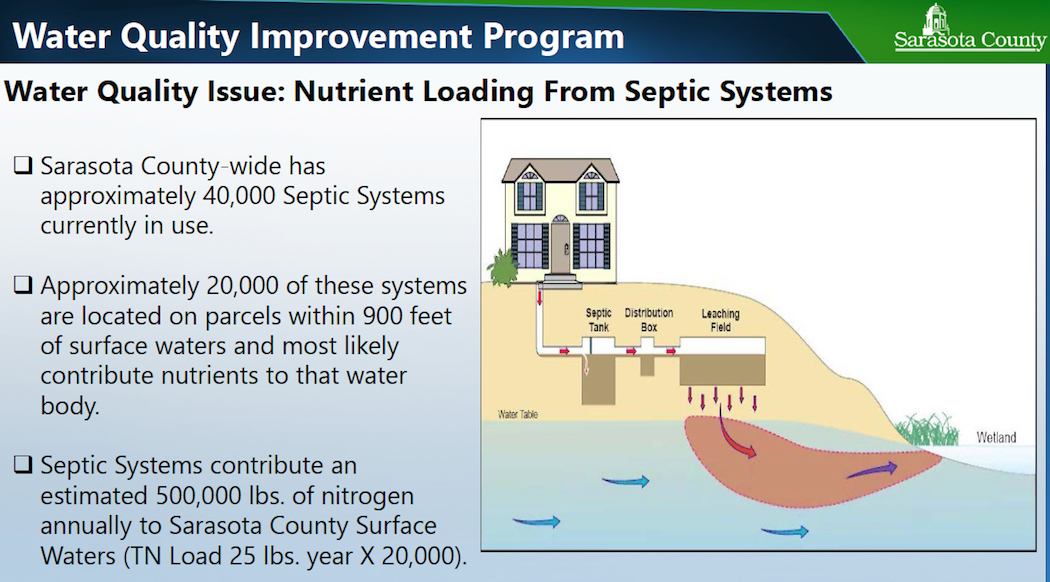
About 20,000 septic systems across the county are within 900 feet of surface waters, Henry said, as determined by a Sarasota Bay Estuary study. The total estimated cost for new sewer systems to eliminate just the 12,000 septic tanks in the unincorporated part of the county is $190 million, Henry pointed out.
Altogether, about 40,000 septic systems remain in operation countywide, Henry said.
Hines talked of his interest in a suggestion Walter, the Stormwater Division manager, had made: working with the City of Sarasota to use city right of way to the eastern part of the county to lay new county pipeline that would divert stormwater from the Whitaker Bayou and Phillippi Creek watersheds. That stormwater then could be used for irrigation or other purposes, Walter explained.
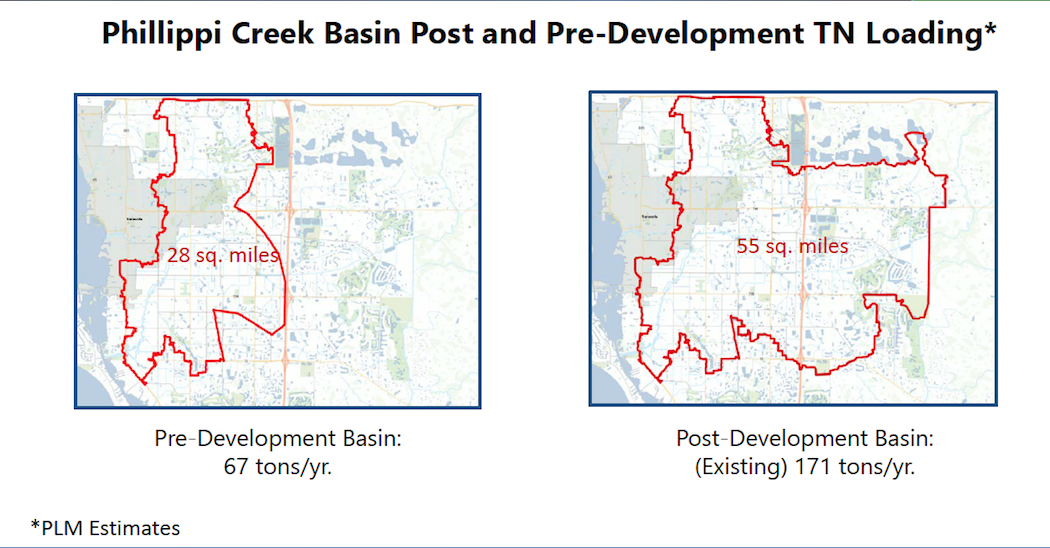
This graphic shows changes in the Phillippi Creek Basin as a result of growth in the county. ‘TN’ refers to the total amount of nitrogen. Image courtesy Sarasota County
The City of Sarasota uses the right of way corridor for its reclaimed water distribution system, Walter noted.
The estimated expense of the county project was put at $40 million, with the goal of removing 20,000 pounds of nitrogen a year from the waterways and reducing flooding in neighborhoods.
“Whitaker Bayou’s been a problem for many, many years,” Hines said.
“We’re really solving multiple issues with a solution like this,” Walter pointed out.
Education and outreach
At various times during the approximately 95-minute discussion, commissioners also stressed the need to educate the public about what the county has done to improve water quality, as well as the benefits of the new proposals.
Both Commissioners Detert and Maio talked of the reluctance of homeowners to pay to convert from septic tanks to sewer systems.
As a Florida legislator prior to becoming a commissioner, Detert noted, she helped win state grants for the conversion to central sewer of most of the approximately 10,000 septic systems in the Phillippi Creek Basin. If the county were able to make the switch to central sewer less expensive, she said, more people would agree to it.
Henry, the Health and Human Services director, acknowledged, “The biggest pushback we always hear is … ‘I’m on a fixed income right now, [and] I pay nothing for my wastewater …’”
“On the other side of that,” Henry said, is the fact that “there’s a cost to the community and the environment.” Every homeowner hooked up to central sewer pays a monthly bill, Henry pointed out, which helps keep the environment clean.
Maio talked about the “absolute uproar” he has heard from residents of subdivisions without sewer systems when he has talked about the county’s efforts to eliminate septic tanks. Yet, Maio continued, those homeowners generally do not think about the necessity of leaving their property vacant around the septic tanks, which means they cannot have detached garages or in-ground swimming pools, for examples. They would have freer use of their land, he pointed out, if they were using a central sewer system.
This graphic provides details about septic systems. ‘TN’ refers to total nitrogen. Image courtesy Sarasota County
Commissioner Ziegler said he had not thought about that. “Being able to get a significant chunk of your property back … is a big selling point.”
Members of the staff of the University of Florida/Institute of Food and Agricultural Sciences Extension Program (UF/IFAS) in the county “will be critical,” Henry said, in helping property owners understand the benefits of eliminating septic systems.
Ziegler also talked of the need for the commissioners and county staff to “get more aggressive” with county communications to the public, noting how much misinformation he hears. “The community wants [the facts]; I don’t think they’re misinformed on purpose.”
This editorial appeared in Sarasota's Herald Tribune on July 7:
On the day before the 4th of July, traditionally one of the biggest beach days of the year here, the state Department of Health sent out an advisory warning that four of the state’s beaches posed health hazards for visitors due to high fecal levels. Three of those beaches, where the levels of bacteria ranked “poor,” were in Sarasota County.. . .
There seems to be a consistent disconnect between our high priority of promoting Sarasota Bay for recreation and our low priority of insuring its waters remain usable. Somehow, we can make a commitment to invest in a multi-million-dollar project like The Bay, but when it comes to an advanced water treatment plant or more septic conversions, the price tag is always too high. Carrie Seidman - Swim at your own risk:
Carrie Seidman is describing the incongruence of marketing and reality in the city of Sarasota. The same discontinuity applies with more force to Sarasota County.
Take for example the handling of planning wizardry such as Comprehensive Plan Amendments and Special Exceptions.
According to our Section 124-43(b) of the Sarasota County Unified Development Code:
a. A special exceptionis a use that would not be appropriate generally or without restriction throughout a zoning division or district but which, if controlled as to number, area, location or relation to the neighborhood, would promote the public health, safety, welfare, morals, order, comfort, convenience, appearance, prosperity or the general welfare.
Gabbert
Developers regularly ask for Special Exceptions when the code stands in the way of their plans. James Gabbert was granted an exception to build and operate a waste transfer station on thin, failing roads next to public lands at the Celery Fields, in full view of the highway.*
The area's largest local developer and local campaign contributor wished to build 1,100 homes on a cul de sac where the land use rules allowed 258. Pat Neal asked to amend the county's 2050 Comp Plan, which requires plans defined as "Villages" to have contiguous commerce enhance walkability and reduce traffic. Neal thought his Grand Lake "Village" could do without the contiguity rule, and the Board was pleased to grant his amendment. "The County thinks this is a good product," said one County planner. Neighbors sued to no avail.
Such "investments" in our publicly planned space never seem to cover the costs they impose on taxpayers -- a fact documented nearly two decades ago by the Tischler report. (See also Jon Thaxton on balanced growth).
Last month, an East Sarasota County advocate proposed a public comprehensive plan amendment at the Planning Commission. Anticipating a proposal for large-scale housing project in East County, Old Miakka neighborhood leader Becky Ayech cited the rural heritage designation of the area, whose character, history and rural land uses date back decades.
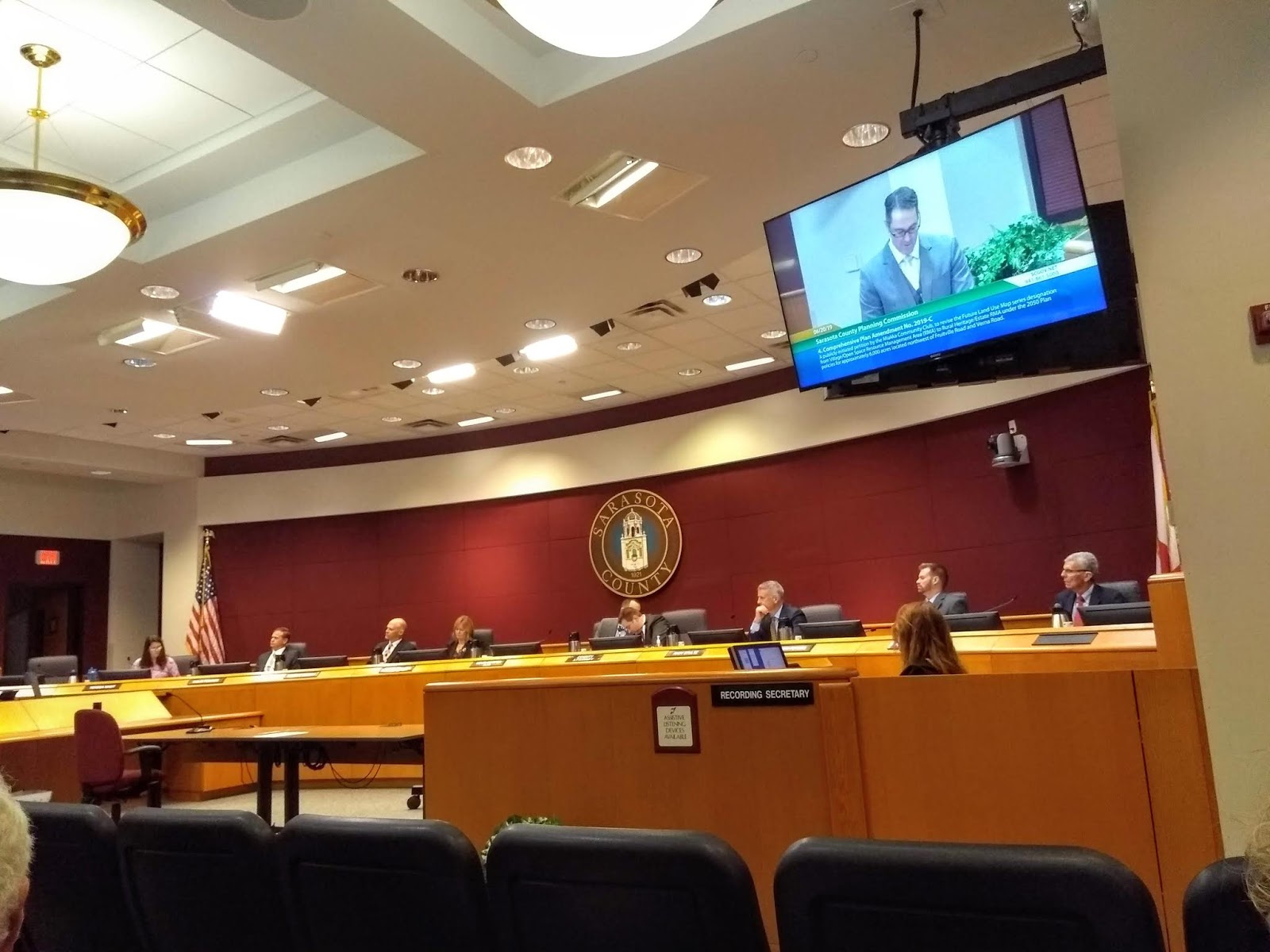
The Sarasota County Planning Commission
Ayech isn't asking the County to deny the developer's proposal. Instead she and a substantial number of other voters want County Planning to look at the long-range viability of a rural sector of East County. Such a Comp Plan Amendment from a resident was a first for the county, which is used to seeing and approving amendments from developers seeking to increase density and intensity. ***
Becky Ayech
According to land use experts, the development pattern of five and ten-acre parcels that Ayech’s proposal would protect is one of the few land use patterns that generate surplus tax revenue to the County’s General Fund. That is, these properties pay more in taxes than they consume in services. In June, the Planning Commission unanimously recommended denial of Ayech's initiative. They saw no reason to allow residents to consider changes to our comprehensive plan that might help avert massive urban sprawl or other degrading impacts on their property. In September, the Board of Sarasota County Commissioners (BCC) will decide whether to allow Ayech's amendment process to go forward. The Planning Commission is an advisory board, made up largely of Realtors, builders, marketers and insurers appointed by the BCC. There is no citizen advocate seat on the Commission. Recently Jon Thaxton, a former County Commissioner who probably knows more about development regulation than anyone else in Sarasota, was denied a seat on the Planning Commission.
The Planning Commission is also the sacred ladder leading from hoi polloi to the County Commission. Their every move is scrutinized by developers, attorneys, builders and business leaders. Anyone who speaks out of tune with the Official Growth Doctrine of the Builders and Contractors industry groups, Matt Walsh, the Argus Foundation. etc., can expect his/her upward path to power and glory go up in smoke.
The pattern of providing concierge service to high-powered developers such as Benderson, Neal, Carlos Beruff and others within this tight governing coterie is unmistakable -- click here for several examples.
Developers ignore public goods - open space, road safety, environmental health -- because their business models see no profit in them. Their petitions come with no plans or funding to improve road capacity – so traffic issues will multiply exponentially.
While our officials grant new building permits, amendments and special exceptions, the costs on the other side of the ledger -- the expense to taxpayers -- is huge.
These expenses of indifference and neglect include:
diminution of quality of life;
higher costs of living;
reduced market values for existing housing;
reduced public services and staff;
higher costs for roads, fire, police, and sanitation;
reduced attention to parks, emergency shelters and evacuation routes.
These privations amount to a "tax" upon all voters who put these officials in office. Residents who have no voice on the Boards that oversee the policy and needs of the people.
While our public wastewater infrastructure has been crumbling, developers are going full speed ahead with vast new developments in East County: LT Ranch (Turner family), Waterside (Rex Jensen of Lakewood Ranch), Grand Lake (Pat Neal). Giant Hi Hat Ranch (Turner family) is now speeding toward approval, and if Ayech's effort fails, Rod Krebs and Don Neu will be building thousands of homes in Old Miakka.
The consistent pattern of our elected officials' decisions raises some important questions:
Where was their attention when county data showed eight years of rising nitrogen levels of our bays and waterways?
How did they fail to discern major policy and environmental concerns looming on the public horizon while granting plan amendments and special exceptions to one developer after another?
How do those special exceptions square with the UDC criteria: public health, safety, welfare, morals, order, comfort, convenience, appearance, prosperity or the general welfare?
Should officials in receipt of more than $10,000 in campaign contributions from developers recuse themselves from voting on large developments or Comprehensive Plan amendments from developers?
Information Bubble
It's the county's job to watch out for us. Do they? In fact, the county has already approved more than 250% of the housing units that state standards call for.
When a government is so subservient to wealth and business interests, it is no longer for the people. Sarasota's elected officials -- from the same tiny ideological gene pool for the last 50 years -- appear little more than a shadow private sector pretending to be the public sector.
Note: This is not about party. The problem is not which party is in power for 50 years, it's that 50 years of any small entrenched group is bound to create a self-serving bubble. Its spectrum of ideas contracts, outreach to diverse elements of the commonweal ceases.
Perspectives outside a narrow, self-serving spectrum simply do not exist. Ideas such as:
using public lands for public benefit, rather than selling them to private developers; or,
doing the actual job of government to maintain aging infrastructure, rather than risking public health and damage to our tourism market; or,
encouraging a diversity of views, values and expertise on our advisory boards.
Unlike Mr. Neal, Sarasota's voters will receive no special exceptions. We'll pay, and pay, and pay to fix what's wrong.
But we can redistribute the power.
In 2020, we have single member district voting. We have the power to bring back open, accountable, fair government to Sarasota County.
Sarasota 2020: Government for the People
______
Notes:
*For details on how the County Commission changed the Comp Plan to enable Gabbert to build a giant open air waste plant, see this timeline.
**Ayech and her neighbors have assembled a great deal of information regarding their proposal. It can be found here.
***See this planning memo in which Ayech's key statements receive thoughtful comments from a respected county planner: