Monday, October 8, 2018

Gabbert to proceed with waste facility at Palmer and Porter


TST Ventures submits revised site plans to answer county staff concerns about April documents regarding waste transfer station near the Celery Fields


On Oct. 10, County Commission scheduled to consider consultant’s report recommending rezoning of county’s ‘Northwest Quad’ parcel near the Celery Fields
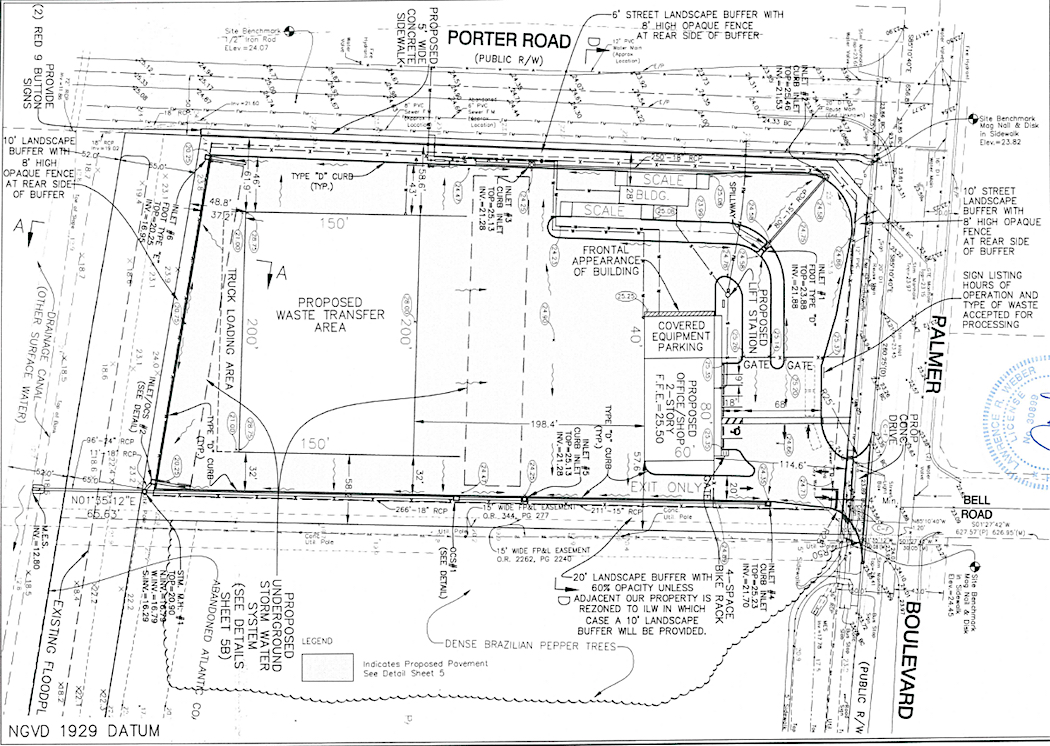
A revised document submitted to the county in late August shows details about the plans for the waste transfer station. Image courtesy Sarasota County

With the Sarasota County Commission preparing to consider next week the rezoning of one of the four parcels the county owns next to the Celery Fields, county staff is reviewing the latest documents filed for the construction of a waste transfer station on property next to those “Quads,” The Sarasota News Leader has learned.
On Aug. 24, Weber Engineering & Surveying Inc. of Sarasota submitted revised site plan documents showing details about the waste transfer station, which would be located on property owned by TST Ventures at 6150 Palmer Blvd.
Lawrence R. Weber, president of his eponymous firm and a professional engineer, also provided responses on Aug. 24 to comments county staff issued in mid-June, deeming the project plans Weber submitted on April 25 to be insufficient.
During its regular meeting on Oct. 10, the County Commission is scheduled to discuss a report completed by a Miami firm hired to analyze the potential rezoning of what is called the “Northwest Quad.” That parcel is south of the site planned for the waste transfer station.
The October 10 session will be held at the County Administration Center on Ringling Boulevard in downtown Sarasota. The agenda was not available prior to the News Leader’s publication this week.
As part of a Nov. 28, 2017 discussion, the commissioners agreed to have an outside consultant analyze the Northwest Quad in preparation for their plans to sell it. At the time, the commissioners were working with county administrative staff on a number of options to plug a multi-million-dollar budget gap for the 2019 fiscal year — which began on Oct. 1 — as well as deficits expected in future fiscal years.
Using a technical term, the report prepared by Lambert Advisory LLC of Miami said the “highest and best use” of the land would be industrial development.
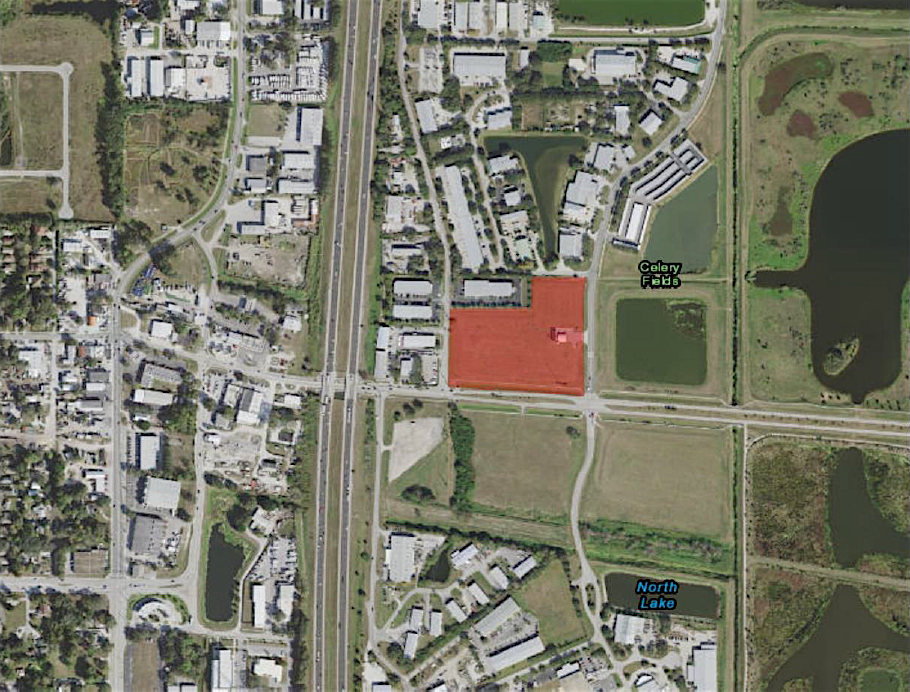

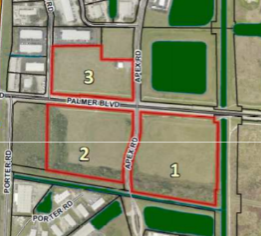
The Lambert Advisory report includes this graphic showing the Northwest Quad, in red. Image courtesy Sarasota County

As for the waste transfer station proposed in the same area: In an Oct. 1 email response to News Leader questions, Ashley Lusby, the county’s Emergency Services media relations officer, wrote, “[T]he project is not authorized at this time.” She added that staff review of Weber’s comments was still underway.
In a June 15 letter deeming the April TST Ventures site plan materials insufficient, Kristen Hellman of the county Zoning Division pointed to several concerns. Among them, she wrote, “The proposed slab for the waste transfer area has been re-oriented. Please demonstrate how this is consistent with the Binding Development Concept Plan associated with Special Exception 1739.”
On Oct. 14, 2015, the County Commission voted unanimously to approve that special exception petition to enable the owner of TST Ventures — James Gabbert — to build the waste transfer facility on about 4.28 acres located at the intersection of Porter Road and Palmer Boulevard, east of Interstate 75. With that decision, the board also affirmed the proposed site plan.
“After reconsideration of the operation of the facility,” Weber wrote in his Aug. 24 responses, “the slab for the waste transfer area was revised to the original orientation as shown on the Binding Development [Concept] Plan.”
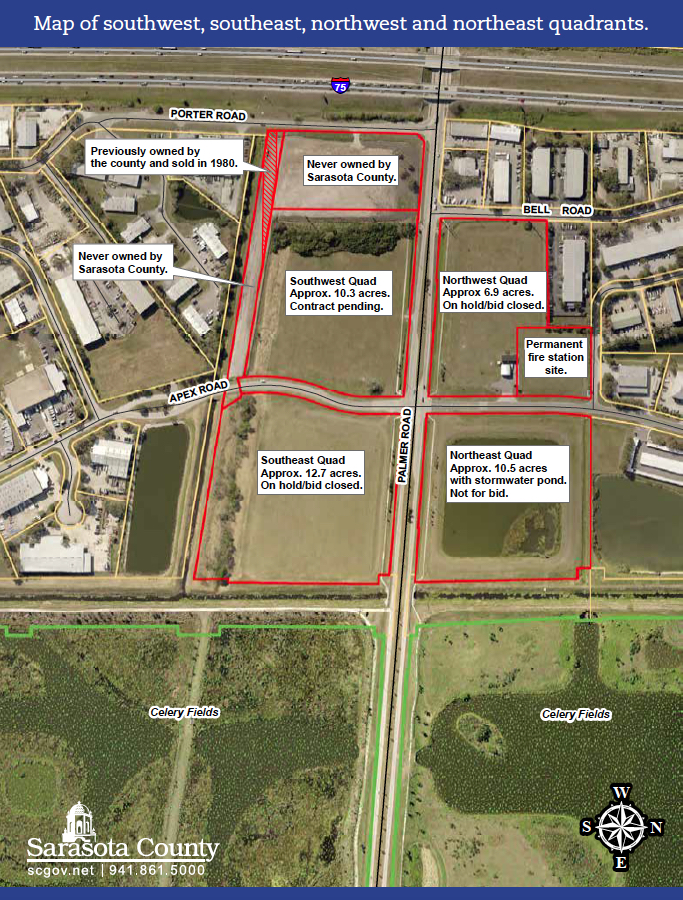
An August 2017 county graphic explains the ‘Quads’ parcels. Image courtesy Sarasota County

The waste transfer station would be built next to a 10.3-acre county parcel known as the “Southwest Quad.” In August 2017, Gabbert failed to win County Commission approval for a construction and yard waste recycling facility on that property, on which he had placed an option for purchase. Following the 3-2 denial vote, he decided not to buy the land.
He had planned to combine the Southwest Quad with the property already slated for the waste transfer station, for a more expansive operation.
Commissioners Nancy Detert, Paul Caragiulo and Charles Hines cited a number of issues in denying Gabbert’s rezoning petition for the Southwest Quad, including the inability of the adjacent road network to support traffic the recycling facility would generate, as well as the growing national and international popularity of the county’s Celery Fields stormwater site among bird-watchers and other aficionados of ecotourism. Commissioners Alan Maio and Michael Moran voted in favor of Gabbert’s project.
Other staff concerns addressed
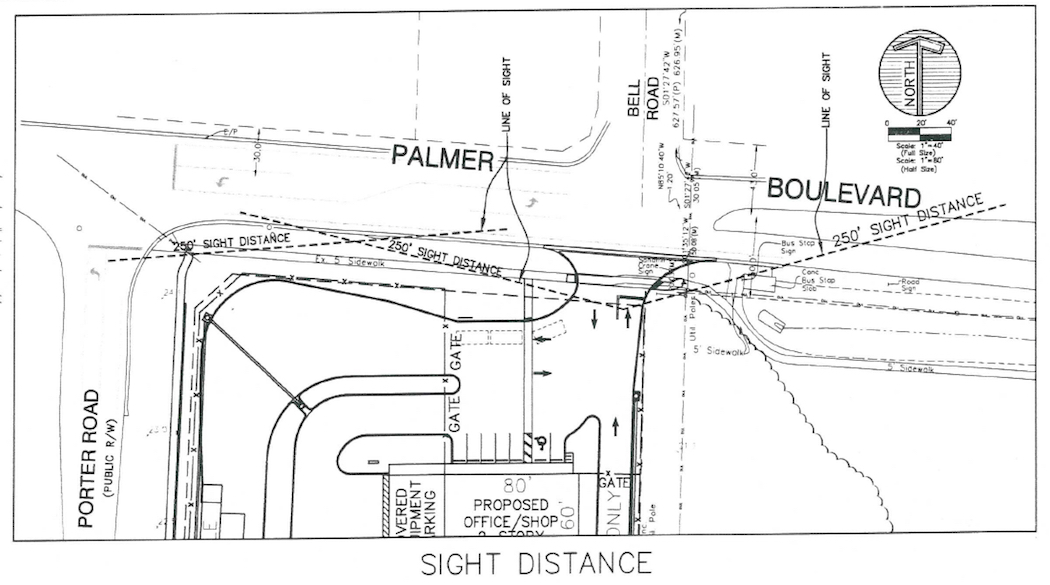
A diagram in the Aug. 24 materials responds to a county staff comment calling for more detail about line-of-sight issues. Image courtesy Sarasota County

Along with addressing the county staff concern about the orientation of the slab, Weber provided comments on 17 other issues in his Aug. 24 letter. Among them, he acknowledged notice from the Planning Services staff about a potential insufficiency in regard to the zoning comments on the materials submitted in April. “If deemed more than a minor modification from the Special Exception Development Concept Plan, an amended special exception will be required,” the staff comment said.
Both the April 25 site plan materials and the revised set submitted in August note that the zoning of the property is Industrial Light and Warehousing (ILW) with Special Exception.
The April 25 materials also said that the total area of the project would be 252,743 square feet and that the proposed impervious area after construction would encompass 145,878 square feet.
At that time, the project was scheduled for two phases. An initial building would cover 30,840 square feet, the document said; a second — to be built in Phase 2 — would entail 9,600 square feet of coverage. One of the April documents listed a covered equipment parking area, next to the proposed office/shop, as “Phase 2.”
The revised materials submitted in August pointed out that the total project area would take up 186,605 square feet, with 148,409 of that to be impervious. One proposed building would cover 7,200 square feet, the document said.
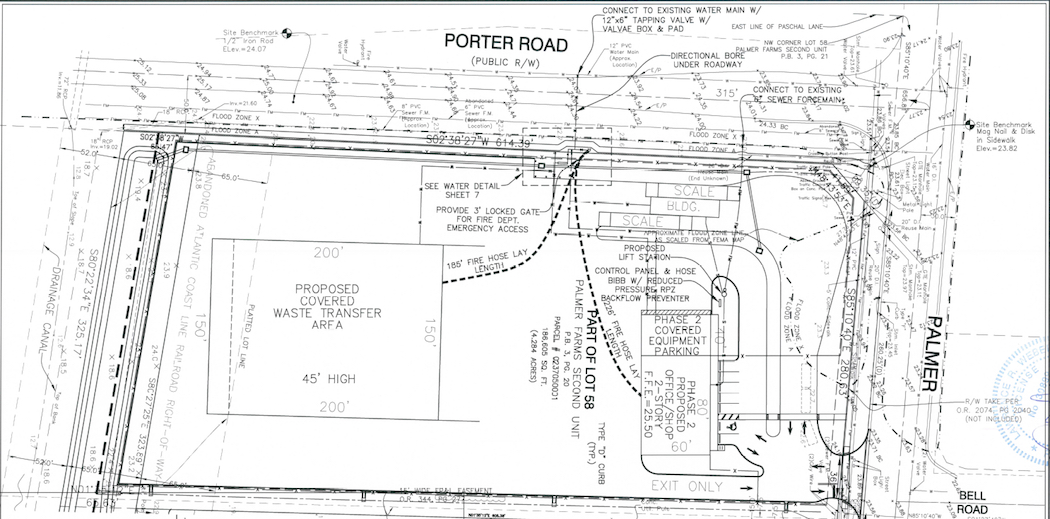
This is one of the engineering drawings for the waste transfer station submitted to county staff in April. It shows a Phase 2 building. Image courtesy Sarasota County

Weber further noted in the Aug. 24 responses that the second building had been removed from the plan. “All improvement will be constructed in a single phase,” he added.
Yet another staff comment in the June document called for demonstration of “how line-of-site compliance for vehicular traffic will be achieved at the northeast corner of the site.”
Weber noted in the Aug. 24 letter that a diagram had been included in the revised materials. Additionally — responding to a related staff comment — Weber wrote that a “revised turning template” had been included in the updated materials to show how vehicles entering the site from the east — “especially larger vehicles” — would not encroach into turn lanes or any other lanes.
In response to another comment, Weber explained in the Aug. 24 letter that the materials brought to the site for transfer would be loaded into truck beds “on a continuous basis in order to provide sufficient room for the operation of the facility. It is necessary to [move the material offsite],” he added, “to provide for in-coming material and maneuverability on the site. All material must be handled on a first in/first out basis consistent [with a state statute] and removed accordingly.”
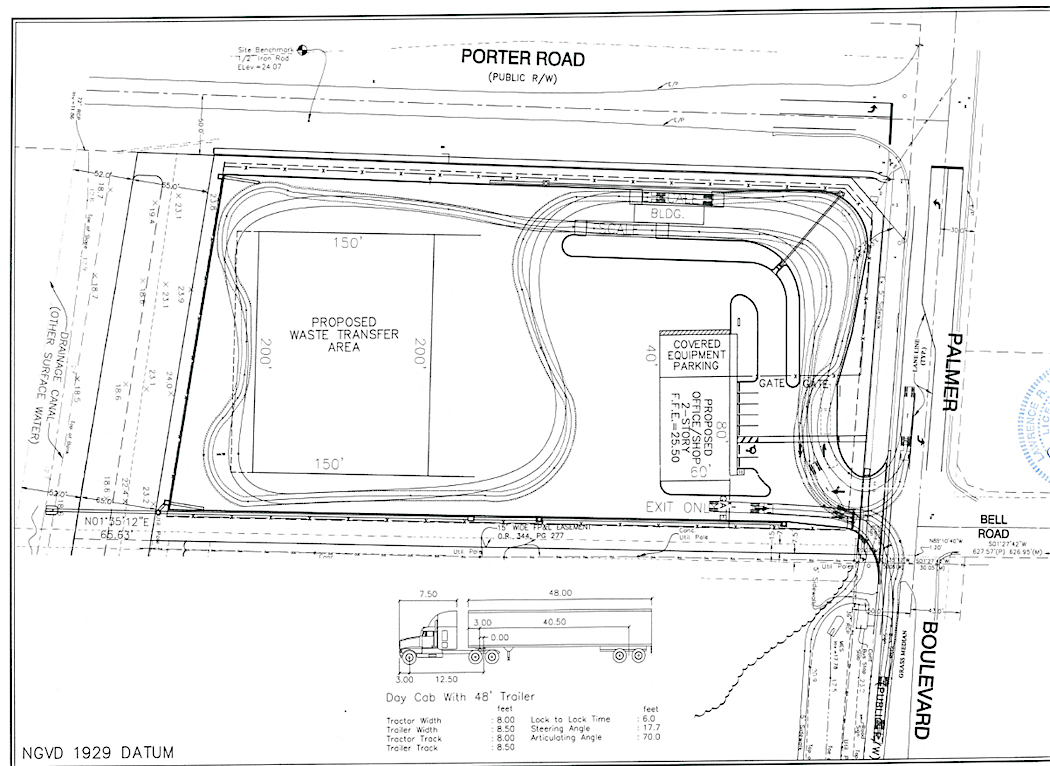
This diagram in the materials submitted in August offers details about the traffic pattern for the facility. Image courtesy Sarasota County

Additionally, he pointed out that signs would be posted at the entrance of the station to alert customers about the materials that would be accepted. Such signage had been added to the plans, Weber wrote, referencing one of the updated documents.
Further, he continued, the “gate to the facility will close at 5 pm’; a sign at the entrance also would list the hours of operation.
One staff comment in June pointed out that the plans submitted in April showed that the stormwater area for the site had been relocated into an Open Use Rural zoning district, “which is not shown on the Special Exception plan. The Zoning Code prohibits a stormwater facility in a different zone district than the principal use,” the staff comment continued. “The stormwater retention area is required to be on the ILW portion of the site consistent with the approved plan.”
Weber responded in August that the plan had been changed to reflect that.


Friday, October 5, 2018

Don't let Board muzzle citizens

Update: See this panel discussion hosted by the Herald Tribune at Holley Hall for further discussion of Single Member Voting.


Guest Column to the Herald Tribune

Muntz: Don’t make petition drives harder

By Kindra Muntz, Guest Columnist
Posted Aug 27, 2018 at 5:15 AM


Don’t let the Sarasota County commissioners silence your voice: They propose to muzzle the voters by making it practically impossible for citizens to get county charter amendments on the ballot by petition initiative.

For over two years, voters of all political parties, as well as independents, have signed petitions to put a Sarasota County charter amendment on the ballot to change County Commission elections to single-member districts. Voter approval would result in commissioners being elected by the voters in the district they seek to represent, not by voters all over the county. [For more info, see SingleMemberDistricts.com]

Passage would, according to some estimates, cut campaign costs by 80 percent (there are five districts) and empower neighborhoods. That will give grass-roots candidates a chance against the candidates chosen and bankrolled by big development interests in expensive countywide campaigns. (Do you think it’s cheap to pack everyone’s mailboxes with all those glossy flyers?)

On June 22, the Sarasota Alliance for Fair Elections submitted the last of the 15,096 petitions needed to put single-member districts to a vote this November. That’s 5 percent of registered voters at the last general election, as required by the county charter. On Wednesday, the County Commission will conduct a public hearing to put it on the ballot.

But wait! The commissioners are not happy that voters have achieved this milestone. They don’t like this referendum, because some of them might not be re-elected if the voters in their district have their way.

Commissioners also opposed previous initiatives when voters found a need to make an end-run around the politicians. Charter amendments placed on the ballot by petitions brought mandatory recycling to Sarasota County when the commission refused to do so; instituted paper ballots in county elections (to be able to confirm machine counts, in an initiative by Sarasota Alliance for Fair Elections that led to adoption of paper ballots statewide); required that any comprehensive plan amendment to increase land-use density or intensity be made by a vote of no fewer than four of the five commissioners.

On Wednesday, the county commissioners will consider their own charter amendments that would severely restrict the ability of voters to again petition for needed changes to protect the public’s rights and interests.

What would their amendments, if approved by voters, do? Double the petition requirement for any citizens’ initiatives in the future to 10 percent of voters. Instead of the 15,096 petitions voters we had to gather for the single-member district amendment, we would have to collect more than 31,000 petitions! (And more as our population grows.)

That would make it nearly impossible for volunteers to meet the requirement and too expensive even for paid petition help for all but the very wealthy, such as big developers.

They would also restrict the time to gather petitions to 1½ years, limit when voters can submit them, and more.

Only seven of Florida’s 20 charter counties have a 10 percent petition requirement.

We encourage all concerned voters in Sarasota County to attend the public hearing at 1:30 p.m. Wednesday, August 29, at 1660 Ringling Boulevard in Sarasota, to support our single-member district amendment and oppose the County Commission’s amendments to double petition requirements. Wear a red shirt if you can, so the commissioners can clearly see our supporters.

Don’t let them make it more difficult to petition your government. Don’t let them silence your voice.

Be ready to vote in November and say “yes” for single-member districts and, unless commissioners abandon their amendments, “no” to doubling petition requirements for citizens’ initiatives.

Kindra Muntz is president of the Sarasota Alliance for Fair Elections (SAFE) and Single Member Districts.

Thursday, October 4, 2018

Groundhog Day: Why the Rush to Rezone Parcel #3?


When James Gabbert proposed building heavy industrial waste operation last year on a parcel of public land near the Celery Fields, the Board got a bellyful from the people. No industry, they said. It’s wrong on so many levels -- bad for the roads, for the birds, for the entire eco-system, for property values, for the future development of the area.

Since then, instead of taking a fresh look at the area and seeking alternatives to industry, the Board hired a Miami consultant to rezone one of the “Quad Parcels” at Apex and Palmer Blvd. -- parcel #3. And lo and behold, the consultant has returned a recommendation that the county allow an 80,0000-square-foot industrial facility on this parcel. 


On October 10, the Board will listen to the consultant, and if it likes what it hears, it can initiate the public process to rezone parcel #3 for industrial use. The parcel is currently zoned OUR - Open Use Rural. To rezone for industry, having no actual client or developer, the Board would send the Lambert recommendation with staff notes to a Neighborhood Workshop, then a Planning Commission hearing, then a final Board hearing. 


On our public lands, it's Groundhog Day all over again.


Parcel #3 is the smallest of the Quad parcels - nine acres in all, but two acres are reserved for a permanent fire station. The remaining seven acres are what the consultant, Lambert Advisory LLC of Miami, was asked to rezone for sale.

Lambert began work in June and completed its “assessment” of parcel 3 in mid-August.

Below are some of the questions and concerns raised by this rush to rezone.
  • We have yet to hear of a publicly beneficial reason why the County wants to sell this public parcel to a private developer. When the idea was originally presented by Commissioner Al Maio last November, the motive was to sell public lands to reduce a budget shortfall. Mr. Maio has since stated that the county is in excellent fiscal condition (3 1/2 min. audio), and that "there is no shortfall" (17 sec. audio) facing the County in the near future. Mr. Maio has also never explained why he wants to sell all three Quad parcels. He simply has said he wants to.
  • Note: “Highest and best use” (HBU) is land-use code for “ignore every consideration except sale price.” Rather than consider uses beneficial to the community for parcel 3 -- uses which certainly exist -- the Board is seeking to sell to the highest bidder. An HBU assessment looks only at sales price. The tactic allows the consultant to ignore virtually everything residents consider important to their quality of life:
    1. Environment - bird sanctuary, water, air
    2. Roads - traffic, large trucks (already to be augmented by James Gabbert's six-acre Waste Transfer Station at Porter and Palmer).
    3. Community - homes, schools, amenities on Palmer Blvd. and Cattlemen
    4. Economic potential - eco-tourism at the Celery Fields, retail along West Palmer.
    5. Macro-trends - moving toward residential, recreational gateway features (visibility from highway).
    6. Future possibility - a citizens group has offered a wide variety of uses and synergies for the the four quad parcels, supported by the community: everything from athletic resources to a history archive to shops, affordable housing, a cafe, a market, the educational potential of a YMCA with programs tied in with Audubon’s nature center. 
Lambert submitted its recommendation for industry in a 49-page report. It recommends industry, arguing that this would bring a markedly higher sale price than office, commercial, or residential uses. An 80,000-square-foot industrial facility could be an example of highest and best use, the report states.

Restaurant Depot, Tampa

The recommendation raises additional questions:
  • If “industry” would assure the highest value, why is no one coming to the nearby Fruitville Initiative to buy land there to use for Industry? The Initiative’s parcels lie just to the north, along Apex Rd., which turns into Coburn Rd., near I-75. All 200 acres are designated MEC, just like parcel #3. At the Fruitville Initiative, it's another story:
    • The landowners are not getting inquiries from developers about industrial uses.
    • They’re mainly receiving proposals for multi-family residential with some interest in office and commercial uses. 
    Can Lambert or our Planning Dept. or the Board explain this contradiction between Lambert’s finding and actual market activity?

  • A citizens group working to find alternative uses for the public quad parcels ("Fresh Start") sought to communicate with Lambert Advisory, but was told by County staff not to attempt to contact the Lambert group. Staff responded to Fresh Start on July 3, 2018:
Out of an abundance of caution to the process, I would not be comfortable with a private group directly communicating with a consultant on an item that will culminate in a quasi-hearing on a Board directive that was decidedly different from your own.  The consultant has been made aware of the efforts of Fresh Start and the dynamics and sensitivities of the area, but because we have reached out to an independent expert on this matter, it is best to limit the influences on the data. 
  • The task given to Lambert came with scoping instructions -- a to-do list -- from the County:
Scope of Consultant Task #4
How did preventing communication with the community facilitate the task of developing “a general understanding of the community and its residents”?
  • Fresh Start asked why Lambert Advisory’s assessment of parcel #3 contained no reference to the traffic and road constraints, which weighed heavily in hearings of the Planning Commission and the Board last year on the Gabbert Waste Processing Proposal. Residents were emphasized the fragility of Palmer Blvd. and Apex Road, and the poor Level of Service. 

  • Here is the Consultant’s response, forwarded by county staff:
By definition (Appraisal Institute), highest and best use represents the reasonably probable and legal use of vacant land or an improved property that is physically possible, appropriately supported, financially feasible and that results in the highest value.  It takes into consideration any known constraints to development such as environmental or traffic/roadway capacity issues (documented through an applicable public agency). At the time of the study, we were not aware of  any documented issues related to development constraints, including roadway capacity. (emphasis added)
Road conditions were a hugely important determining factor at the Gabbert hearings. Would the County not have been advised to address the roads before hiring a consultant for $61,209 to recommend industry at the Quads?
  • In preparing a briefing paper for Commissioners on the Lambert Report, staff originally seemed willing to accept the Lambert recommendation. But now it does not support it:
  • Given the astonishing pace of approved housing development in the area, why would the Board go full speed ahead with rezoning this parcel for industry?
The Board has been happy to rapidly approve several developers' proposals for new residential communities in the area:
1,080 new homes within walking distance, and
2,390 more homes within a few minutes' drive from this intersection
____
3,470 new nearby homes
Where's the logic:  Do the Commissioners have some way to reconcile their multiple approvals of residential development on the one hand with zoning that burdens these essential roads with industrial uses and truck traffic on the other? We'd love to hear it

How can the Board rezone to industrial use on the basis of a "study" that in fact did not:
  • Consider the impact of a large industrial facility upon the ecology, the community, the economy, and property values?
  • Look at the existing and trending uses of the area by residents and tourist visitors who walk, jog, hike, bird, kayak and fish at and around the Celery Fields?
  • Have any county transportation data on the road and traffic conditions at Apex and Palmer?

Groundhog Day

In short, the hiring of a Consultant who has brought in a recommendation to industrialize parcel #3 brings us back to February 2017, when Restaurant Depot sought to put a giant warehouse sales operation on the same parcel, and encountered strong opposition. Again, roads and large trucks were the main issue.

For ten months -- from December 2017 to September 2018 -- the Fresh Start group attempted a dialog with the Board, but as of yet, it's still waiting for responses to its proposals and answers to its many questions.

Perhaps it's time for the Board to respond to the public. They might start with answering these questions: 
  1. There is no budget crunch, no shortfall. What's the benefit to the community in selling any of our public lands here? 
  2. Why pay a consultant to rezone to Industry before addressing the roads? 
  3. Why withhold from the consultant the basic known facts and studies of the roads?


Image from the Fresh Start presentation of 9.12.18, courtesy of the Fresh Start Initiative.


On Oct. 10, sometime about 9:30 a.m. or a little after, the Board will discuss the Lambert Advisory recommendation. Let's be there, to remind them we're still here, and we still care.
Commission Chamber Ground Floor
1660 Ringling Blvd.

Wednesday, October 3, 2018

Vote NO! Sarasota County Commission Ordinance Could Muzzle Citizens' Voices

To Sarasota County voters:

"We, the People of Sarasota County, hereby . . . adopt this Home Rule Charter."
These words appear at the beginning of the County Charter, our local constitution.

But if our County Commissioners prevail on Nov. 6th, the voices of "We the People" may be muzzled.

Beware the "Trojan Horse" on the General Election ballot! It was written to look harmless, but it's anything but.  

Our County Charter has been amended over time. Amendments can be proposed in several ways, including by County Commission ordinance and by citizen-initiated petition efforts. Voters ultimately determine the merits of Charter amendments by county-wide referendum. For example, Sarasota County has used paper ballots since 2007 because citizens collected enough valid voter signatures to put the issue on the ballot in the 2006 General Election.  County voters overwhelmingly approved paper ballots despite a failed legal challenge by our County Commission to keep the referendum from reaching county voters. The State of Florida switched to "paper" shortly thereafter.

Now our County Commission is at it again---determined to render the process of amending the Charter by "citizen petition initiative" virtually unattainable. In late August, with little public discussion and by a unanimous 5-0 decision--our Commissioners put the "Citizen Petition" ordinance on the November ballot.

Currently petitioners must gather valid signatures from 5% of county voters (approx. 15,000 petitions) for an amendment to reach the voters. The current 5% valid voter signature requirement has generally taken about two years to achieve---through much perseverance and toil, not by a "voice vote" in County Commission Chambers.   

The County Commission's ballot amendment could greatly harm Home Rule by:
     Doubling the number of valid petitions required to place an amendment on the ballot from 5% to 10% (from about 15,000 valid voter signatures to more than 30,000).
     Greatly reducing the time allowed to gather petitions (a maximum 18-month window between general election cycles).
     Requiring all petitions to be submitted by May 1st of the general election year, although the Elections Office isn't required to  complete the signature verification process until July 1st, or two months after the deadline to submit petitions. 
     Eliminating a rarely used special election option for citizen-petition initiatives while the County Commission would retain its right to hold a special election after approving an ordinance.

See the ballot question below. The wording is vague and potentially misleading. An increase from 5% to 10% seems insignificant without knowing that Sarasota County has over 300,000 registered voters. The ballot wording creates an impression that citizens have two years (or a general election cycle) to reach their petition goal. The "set general election cycle timeframe" is actually a maximum of 18 months, but who would know? All 30,000+ petition signatures would have to be submitted six months before the next general election is held.   
_________________________________________________________________________

                     County Charter Amendment by Sarasota County Commission ordinance 
Ballot Question: 
PROCESS FOR CITIZEN INITIATED PETITIONS FOR CHARTER AMENDMENTS TO BE PLACED ON THE GENERAL ELECTION 
Shall Sarasota County Charter Section 7.1 be amended to place citizen-initiated Charter amendments on the next general election ballot upon receiving signatures from 10% of registered voters, provided that signatures are gathered within a set general election cycle timeframe, instead of having an unlimited time to obtain signatures of 5% of registered voters for placement of citizen-initiated amendments on a special election ballot that is held 60 days after certification of the signatures? 
_____YES, for the Charter amendment 
_____NO, against the Charter amendment
________________________________________________________________________

For the sake of self-governance in Sarasota County: Vote NO! on this toxic "citizen petition" question.  
(Please forward to other Sarasota County voters with a reminder that County-level ballot questions are listed at the end of this year's long election ballot.)

Sunday, September 30, 2018

Stadium deal could devastate Sarasota's tourism marketing


Courtesy of the Sarasota News Leader


Subscribe to the SNL


Tourist Development Council members say promotional funding critical for county’s tourism agency to fight widespread negative publicity over red tide


County Commission to have final say about how to pay for needed repairs to Ed Smith Stadium
(Editor’s note: This article was updated late in the morning of Sept. 21 to make it clear that the $97 million figure for the Baltimore Orioles’ economic impact on Sarasota County is the latest annual figure, based on research undertaken for Sarasota County.)

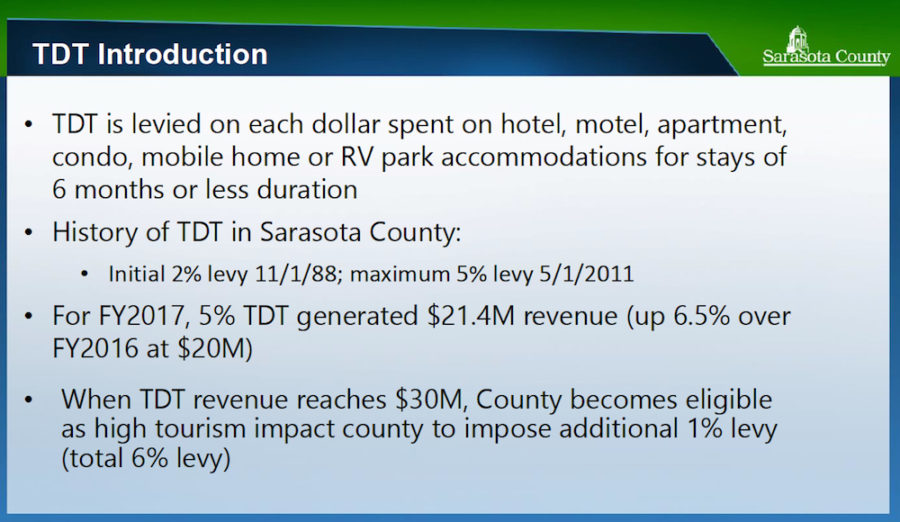
A county fact sheet offers details about the Tourist Development Tax. Image courtesy Sarasota County

Given the significant downturn in business and resulting employee layoffs since early August because of red tide, the members of Sarasota County’s Tourist Development Council (TDC) this week voted to recommend the County Commission not reduce the marketing budget in coming years for Visit Sarasota County.
As she had during the commission’s Aug. 22 budget workshop, Carolyn N. Brown, director of the county’s Parks, Recreation and Natural Resources Department, explained to the TDC members on Sept. 17 that staff had considered a variety of options to pay for repairs the county is obligated to make to Ed Smith Stadium in Sarasota within the next five years. A decrease in promotional funding for the county’s tourism agency budget was deemed the best of those, Brown added.
An independent assessment — completed in July — of the county-owned stadium and Buck O’Neil Baseball Complex at Twin Lakes Park on Clark Road showed that about $16.5 million will be needed over the next 10 years for the repairs and improvements, Brown said. The county’s General Fund — which covers the operations of most county departments and those of the majority of the county’s constitutional officers — is too constrained to handle the expenses, she added.
The Baltimore Orioles use both facilities; they have been conducting Spring Training at Ed Smith Stadium since 2010.
Brown also noted that the county is obligated, under the terms of a Memorandum of Understanding with the Orioles, to keep Ed Smith Stadium “at a Major League Baseball standard.” The agreement calls for periodic assessments of the facilities, she explained.

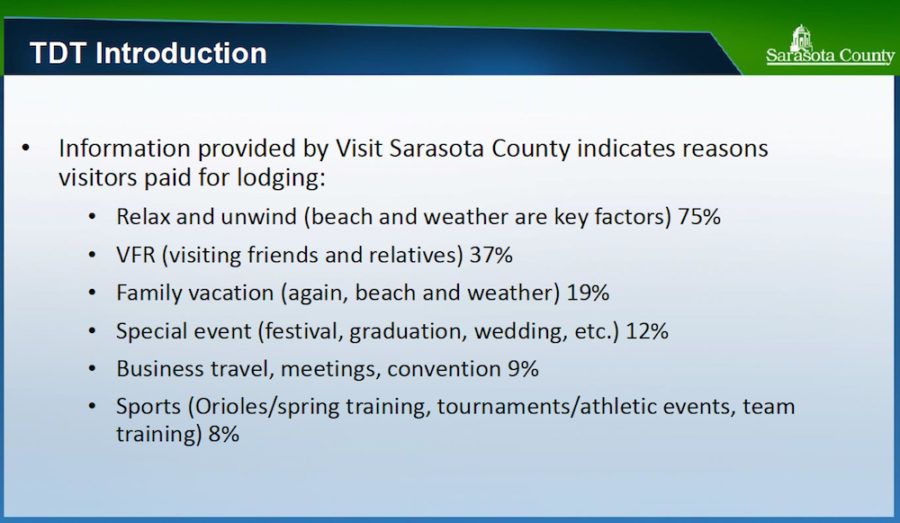
These are the top reasons people visit Sarasota County, according to research undertaken for Visit Sarasota County. Image courtesy Sarasota County

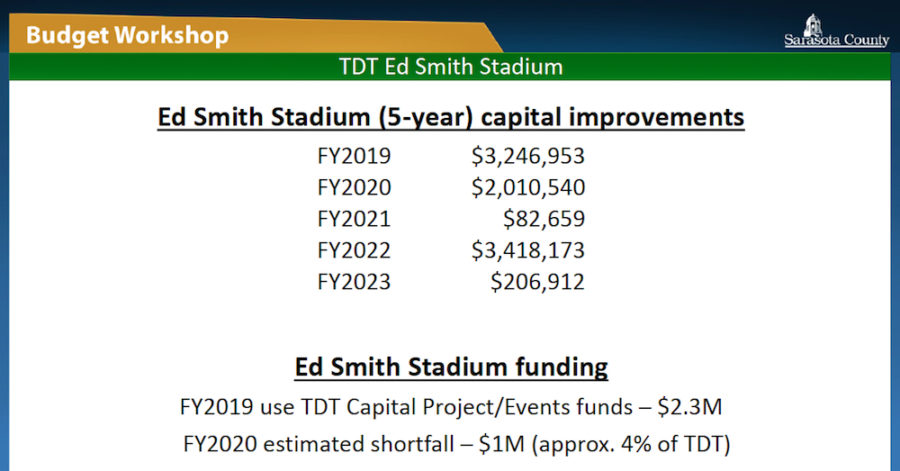
The county has sufficient revenue in the Tourist Development Tax (TDT) reserve fund for Capital Projects/Events to cover $2.3 million of the approximately $3.3 million the county will have to spend at Ed Smith in the 2019 fiscal year, Brown said. The extra $1 million will come out of TDT revenue allocated for sports stadiums. However, staff does not anticipate having enough TDT money for the projects planned for the 2020 and 2022 fiscal years, she continued. Therefore, staff recommended reducing the money allocated to VSC for promotional purposes by about 5% in those two fiscal years, Brown pointed out, to cover the stadium expenses.
During the County Commission’s Aug. 22 budget workshop, the board members concurred with the staff recommendation. However, Commissioner Charles Hines, who chairs the TDC, noted that that advisory council would have an opportunity to review the issue and offer its opinion.
Hines did not vote at the conclusion of the presentations and discussion during the Sept. 17 TDC meeting. He abstained, he said, as he would be participating later in a formal vote as a member of the County Commission.
Media Relations Officer Drew Winchester told The Sarasota News Leader this week that the commission is scheduled to vote during its Oct. 9 regular meeting on whether to authorize a public hearing on staff’s proposed change to the TDT ordinance to shift funds from the promotional efforts for VSC to the stadium account. If the commission approves holding the hearing, Winchester added, that would be conducted on Oct. 23.
Vice Chair Norman Schimmel initially said he wanted to abstain from the vote, as well. Schimmel added that he first wanted to see a presentation Visit Sarasota County (VSC) President Virginia Haley plans for the TDC in October, showing how her staff would be modifying its business plan for the 2019 fiscal year to try to counter all the negative national publicity about red tide.
After Hines said he did not believe the TDC’s governing rules would allow Schimmel to abstain, Schimmel decided to join his advisory council colleagues in unanimously opposing any reduction in the VSC marketing funds.

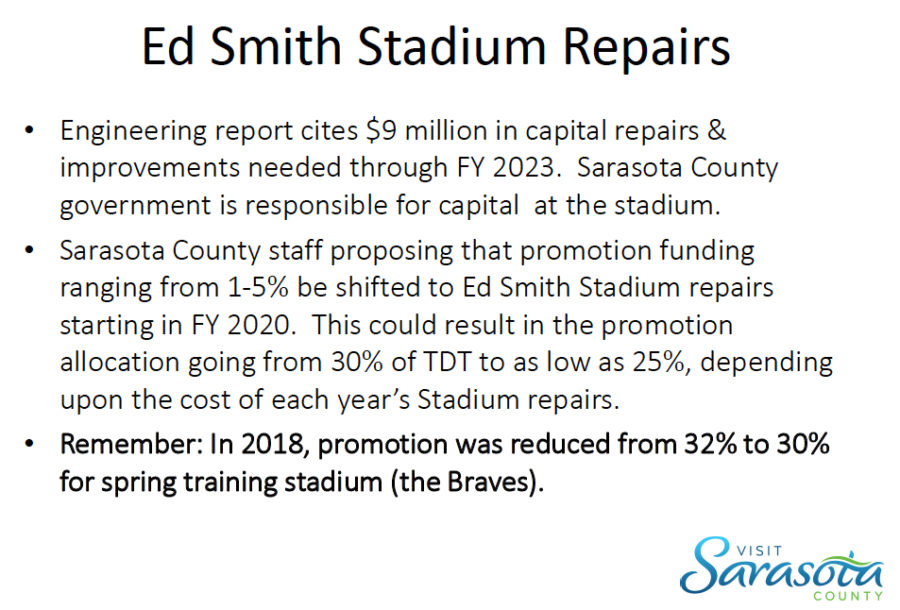
This Visit Sarasota County graphic argues against the change in allocation of revenue to promotional initiatives. Image courtesy Sarasota County

“It is devastating,” TDC member Bob Daniels, who serves on the Venice City Council, said of the loss of tourism business — and worker layoffs — because of red tide. “It’s a shame we have to put the Orioles on the same table” as promotional funding.
Nine representatives of tourism-related businesses implored the TDC members not to take money from VSC.
“I can’t believe that this group is even considering cutting the marketing [money] for Visit Sarasota!” Paul Parr, who owns 12 vacation rental condominiums on Siesta Key, told the council.
Before red tide began plaguing the shoreline, Parr said, his August bookings were 30% ahead of the number for August 2017. “We ended up closing out August 30% behind last year.”
All of his September guests cancelled, he added. “I got the last two today. So my numbers are 30% down for August and 100% down for September …”
John Tanner, general manager of Innisfree Hotels, which manages the Indigo and the Embassy Suites in downtown Sarasota, told the TDC members, “It’s imperative now” to ensure Visit Sarasota County has sufficient marketing funds.

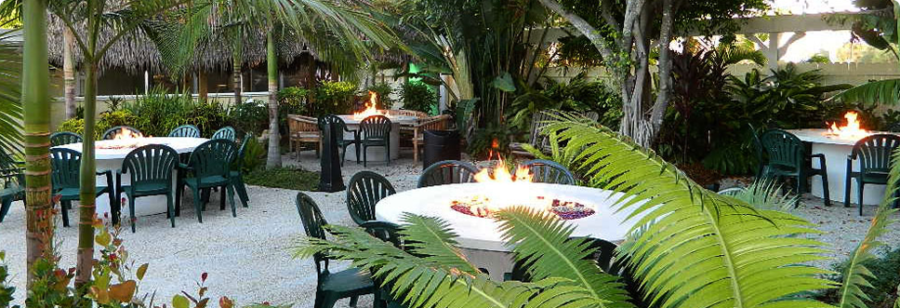
This is one of the dining areas at Pop’s Sunset Grill on the Intracoastal Waterway in Nokomis. Photo from the restaurant website

Joe Farrell, owner of Pop’s Sunset Grill on the Intracoastal Waterway (ICW) in Nokomis, said, “We’re down 60% in the last nine weeks.”
TDC member Erin Silk, CEO of Venice MainStreet, reported that that nonprofit had undertaken a survey since red tide had worsened. Of the 134 businesses that responded, she said, 72% were located within 3 miles of the beach or the ICW. Two “outliers” reported losses of $1 million and $3 million, Silk continued. Without them, the average loss for each of the other businesses was about $15,800.
Altogether, she continued, 10% said their revenue was down more than 50% for the month of August; 30% said business was down from 25% up to 50%; and 36% had had to cut employees.
“It is our duty to protect our local businesses,” Silk added.
Yet, David Rovine, vice president for the Orioles in Sarasota, pointed out that the team has provided more than $10 million to Visit Sarasota County for promotional efforts over the past nine years. “This investment is not mandated by our contract with the county,” he added. “It’s a commitment from the Orioles … that is unmatched in Major League Baseball and possibly in professional sports.”
Rovine noted that since the team began Spring Training in Sarasota, the number of annual visitors to Sarasota County from the Mid-Atlantic States during the first quarter of each year had grown 300%.

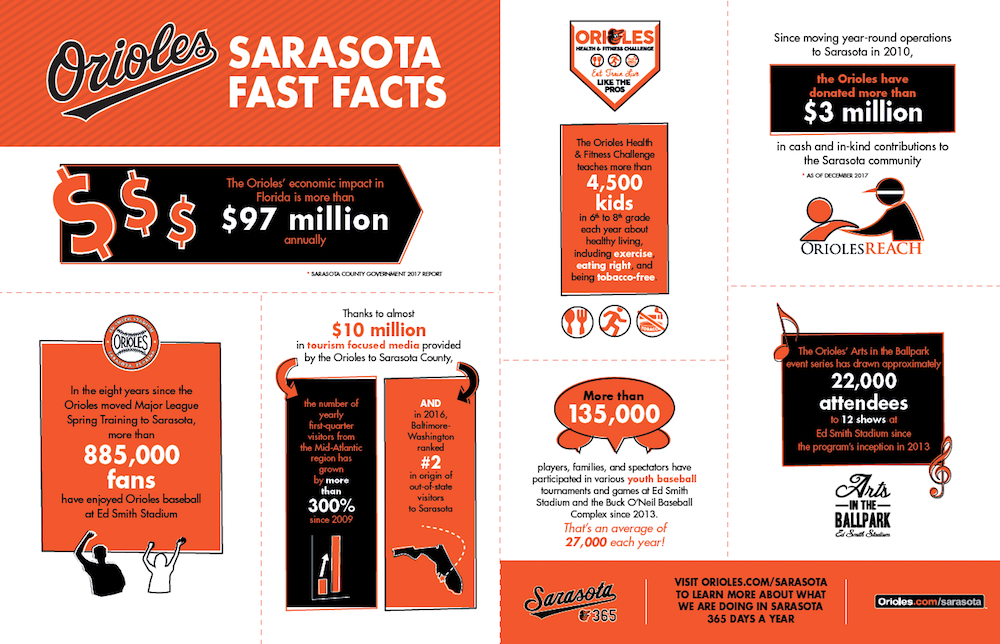
A graphic provides details about the Baltimore Orioles’ impact on Sarasota County’s economy. Image courtesy Sarasota County

The Orioles do not just conduct Spring Training, he stressed. They also host events throughout the year, including Fall Instructional League games and youth baseball tournaments, which generate hotel stays.
Moreover, Rovine said, the team elected not to construct dormitories for players, as many other teams have done in areas where they hold Spring Training. Instead, Rovine pointed out, the Orioles have spent more than $15 million on hotel room nights in the county for players and staff.
Brown of the Parks, Recreation and Natural Resources Department also pointed out that the Orioles contribute about $97 million a year to the county’s economy, based on research undertaken for the county.
“This is probably one of the hardest debates and discussions I’ve had,” Commissioner Hines said, since he became the TDC chair in late 2014.
The stadium issues and the money

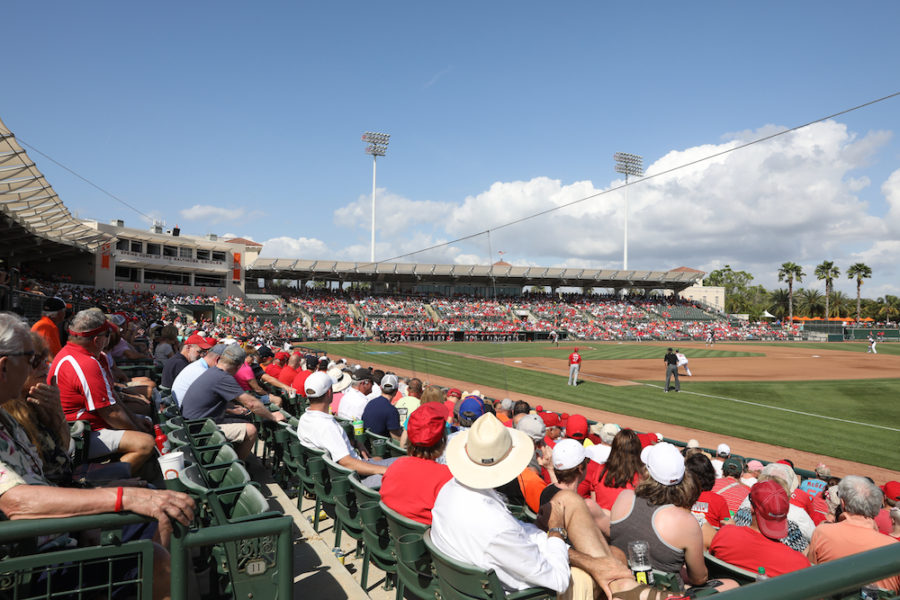
Fans watch a game on Feb. 28 at Ed Smith Stadium. Image copyright by the Baltimore Orioles

During her Sept. 17 presentation, Brown explained that the comprehensive facilities assessment for Ed Smith Stadium and the Buck O’Neil Baseball Complex determined a number of issues that needed to be addressed over the next decade.
The projects planned for the 2019 fiscal year, she continued, will include renovations of practice fields 2 and 3 and the main field at the stadium; replacement of the remaining parts of the irrigation system installed in 1989; replacement of the top coat on the flooring in various areas; and the installation of equipment for lightning protection.
The biggest estimated expense listed in the report for FY19 is $1.5 million to raise the outfields to the infield level on practice fields 1, 2 and 3 and laser-grading of the fields. That work would cost $500,000 per field, the report said.
Brown noted that the study was undertaken by an Orlando firm called ZHA, which focuses on professional sports facilities.
The county and the Orioles each contribute $150,000 per year to a “CAPX” — capital expenditures — fund, she said, but that revenue cannot begin to cover the expenses outlined in the study.

A chart shows the funds needed over the next five years for repairs and renovations at Ed Smith Stadium. Image courtesy Sarasota County

In response to a question, Kim Radtke, director of the county’s Office of Financial Management, explained that if the county were to borrow the $8 million for five years to cover the repairs and renovations, the debt service would be $1.7 million per year, plus the county would incur expenses for issuing the bonds. VSC staff had suggested the bond issue as an alternative.
Brown also noted that staff had considered other ways of reapportioning the TDT revenue, but she stressed the need for continued beach maintenance and renourishment, as well keeping intact the funding dedicated to the arts in the community and to Nathan Benderson Park, which hosts national and international rowing events, among other activities.
The Visit Sarasota County perspective

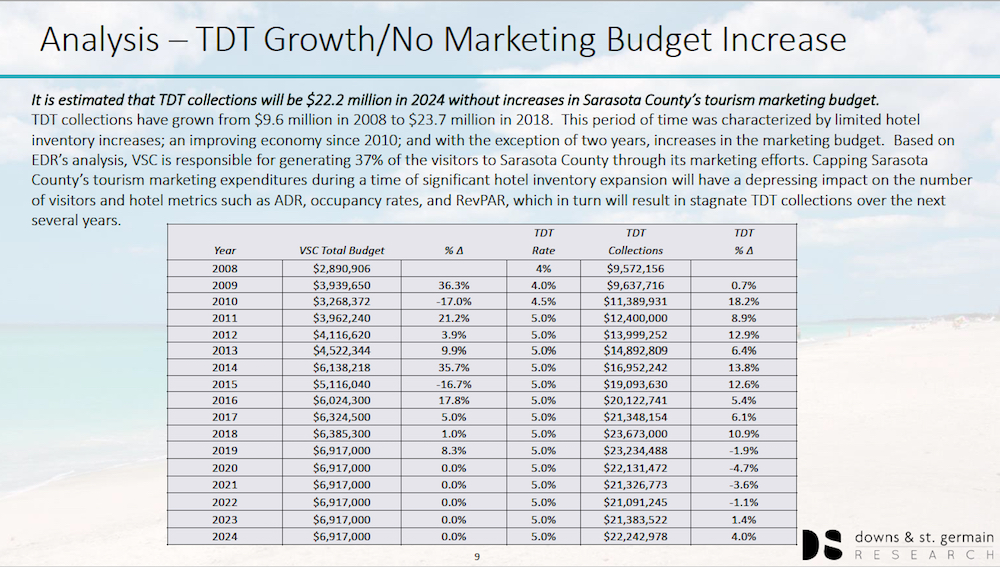
A chart prepared for Visit Sarasota County by Downs & St. Germain Research offers the tourism agency’s perspective on anticipated growth in TDT revenue. Image courtesy Sarasota County

During her portion of the presentation, Haley, the president of Visit Sarasota County (VSC), pointed out, as she had earlier this year to the TDC, that the county will see an addition of 1,177 hotel rooms by the end of this year. That represents a 23% increase, she said.
To maintain the current occupancy levels, she continued, 225,000 more room nights would have to be sold in FY19, which would mean drawing 10% more visitors. “We are averaging 2 to 3% a year,” she said of the growth in the number of tourists.
The less demand for rooms, Haley stressed, the lower the room rates hotels can charge. The lower the rates, she continued, the less Tourist Development Tax revenue is produced, as the tax is 5% on accommodations rented for less than six months a year.
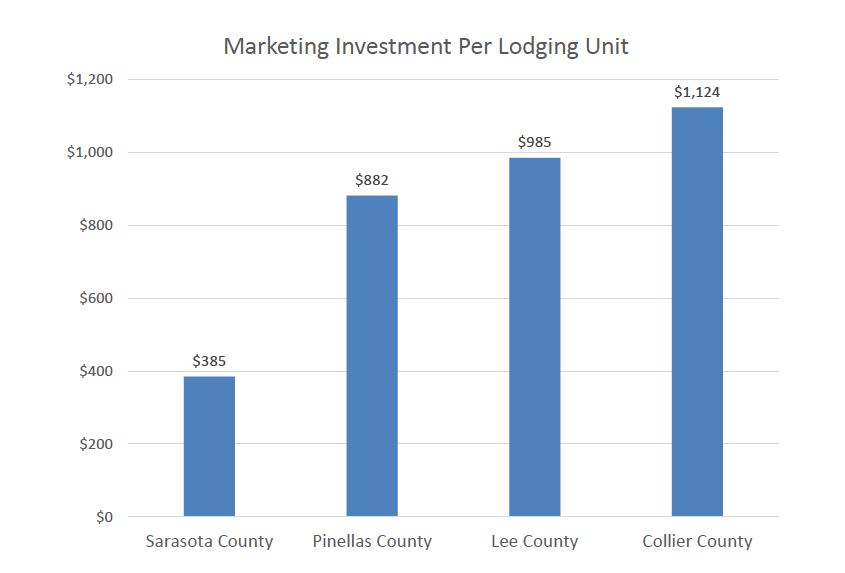
She showed the council a slide that said the county’s tourism promotion investment per lodging unit is $385. Through June of this year, the slide noted, the revenue per available room averaged $134.43, a 2.5% drop from the figure for the same period of the 2017 fiscal year.

A bar graph compares promotional investments of Sarasota County and neighboring counties. Image courtesy Sarasota County

In Pinellas County, the slide said, the revenue per available room had grown 2.9% for this fiscal year, through June. Pinellas invests $882 per lodging unit, the slide noted.
Sarasota County has lagged behind its competitor counties in terms of tourism promotional spending for the past 25 years, Haley said. “It’s just gotten worse over time.”
“We’re warning you,” she added: “Continual nibbling away of tourism marketing dollars” will continue to lead to negative consequences for TDT revenue.