Showing posts with label budget. Show all posts

Wednesday, May 23, 2018

Bringing an umbrella to a hurricane: Update

On Friday May 25, 2018, the Board of Sarasota County Commissioners will hold a fiscal workshop in the "Think Tank" on the third floor of the County Administration building. The workshop is open to the public, begins at 9 a.m., and will examine all facets of the Sarasota County budget, including a recent inventory of all public lands. The Board will consider selling public lands as one strategy to offset budget shortfalls.*

Updates:
A detailed article from the Sarasota News Leader: Plans call for about 200 surplus Sarasota County parcels to be turned over to one or more brokers in July for sale as soon as possible 
The Board identified more than 200 parcels of public land that could be sold immediately. Observer

The Board's review comes in the wake of prior Board decisions to take key revenue options off the table.

On June 22, 2017, the Board voted against raising millage rates for 2018.
That decision was predicated on the understanding that the Board had a better solution: A public service tax of up to 8% on electricity, natural gas, liquid petroleum and water.
On September 21, 2017, the Board voted against instituting a public service tax.
That decision was predicated on the understanding that the Board would use $5.4 million from its Economic Uncertainty Fund to balance the budget. The Board agreed it could later find ways to pare expenses, making cuts in services if necessary. 
Despite improving tourist taxes and other added revenue from new construction, and despite $5.4 million in recurring budget cuts, the County is not off the hook.

Two new state revenue referenda on the November ballot virtually guarantee that the County will be looking at large budget shortfalls in the near future. The Sarasota News Leader states:
If those pass — the result commissioners have indicated they expect — then the board would be looking at finding money to eliminate a shortfall of $8,970,406 in its FY20 budget and an even larger hole — about $10.3 million — in the FY21 budget.
One referendum increases the homestead exemption from $50,000 to $75,000, which is estimated will cost Broward County $32 million in annual revenue. The other referendum makes permanent a cap on increases on non-homestead property assessments. Both involve amending the state Constitution, so both are on the ballot.

As property values have risen, the county's ad valorem revenues have risen as well:

Graphic courtesy of the Sarasota News Leader

Despite the ad valorem increase and the cuts made to parks, libraries, other public services, Friday's workshop focus is on selling public lands. This is like opening an umbrella before a hurricane.

The county needs a realistic strategy, given the extraordinary shortfalls looming:


The Board is facing a new fiscal reality, yet it appears not to have begun to address it. It is looking to sell public lands -- a one-time, market-sensitive, relatively small-revenue option -- rather than examining systemic, recurring revenue options such as millage or impact fee increases, or through a public service fee.

At a public talk he gave recently, former Commissioner Jon Thaxton said that the sale of public lands is not the first thing a Board does -- indeed it should be the last. The bar in the public interest should be "extraordinarily high" before public land should be sold, he added.

Now might be a good time for our officials to close their cocktail umbrellas and take an honest look at current growth patterns and what's coming down the road. With the state's egregious electoral giveaway, local governments are looking at serious budget pain. Examine realistic provisions now and bite the bullet.
*Note: Friday's workshop is a review of all public lands with an eye toward selling those which staff identifies as neither necessary nor significant for possible future use. So far, the public lands known as "the Quads" near the Celery Fields are not part of this review. They are on hold as a citizens group (The Fresh Start Initiative) works with the County on constructive, community-friendly proposals for at least two of those parcels.
The Think Tank Workshop should be available for viewing online.

All accessible links to the Sarasota News Leader courtesy of the publisher.

Friday, May 18, 2018

County’s ‘bed tax’ revenue up close to $1.5 million for first six months of fiscal year


County’s ‘bed tax’ revenue up close to $1.5 million for first six months of fiscal year
March collections came close to the $4-million mark, Sarasota County Tax Collector’s Office reports
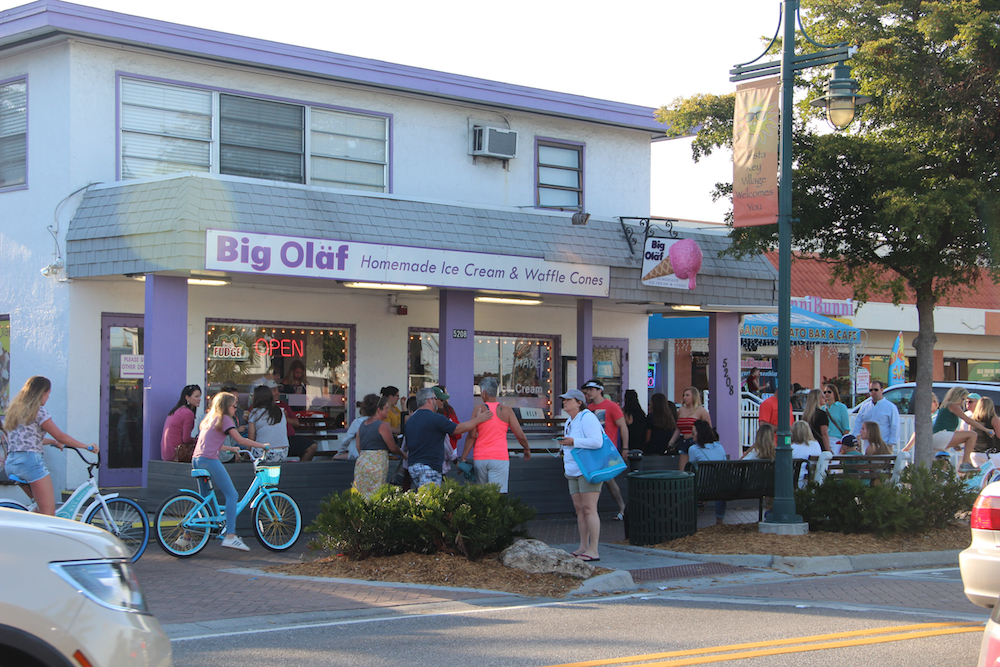
Visitors make their way by Big Olaf’s in Siesta Village. Rachel Hackney photo

Through February, the county’s Tourist Development Tax (TDT) revenue was up more than $1 million year-over-year. Thanks to the traditional big boost in March, the total “bed tax” collections so far this fiscal year are almost $1.5 million higher than they were by the end of March 2017, the latest figures show.

March typically is the month during which collections exceed the $3-million mark, Tax Collector Barbara Ford-Coates and her staff have told members of Sarasota County’s Tourist Development Council. This year, the March figure came its closest yet to the $4-million mark.

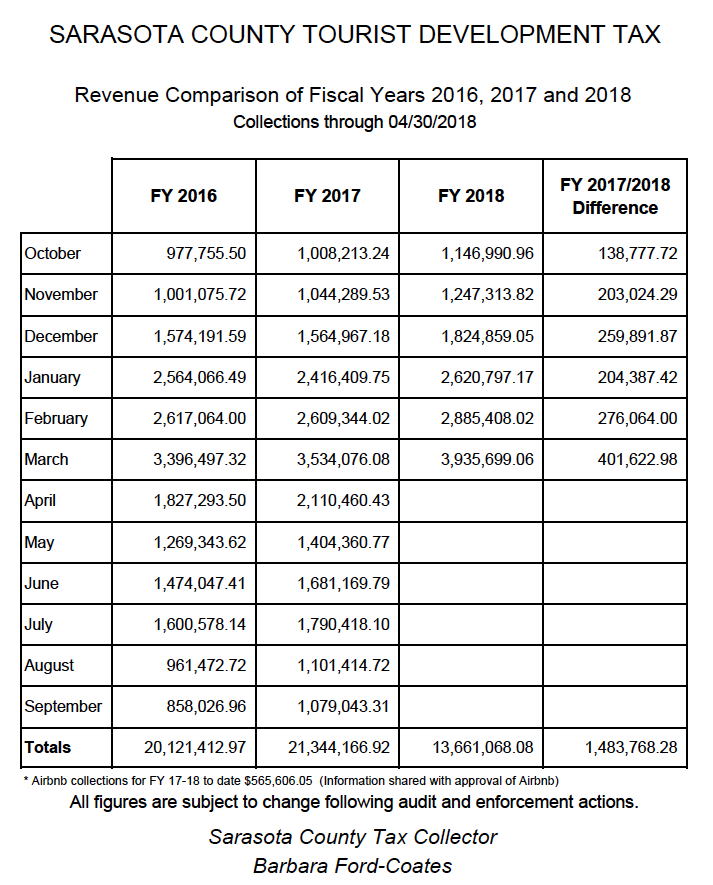
The entities that report the revenue to the Sarasota County Tax Collector’s Office collected $3,935,699.06 in March, the Tax Collector’s Office has announced. That was an increase of $401,622.98 compared to the March 2017 TDT figure, the report says.

Overall, through the first six months of this fiscal year, bed tax revenue is up $1,483,768.28, the Tax Collector’s Office data show.

Audits and other revisions of the figures can lead to refined numbers Ford-Coates and her staff also have cautioned. Generally, over the past several years, those changes have been reflected in slight upticks of figures. For example, the numbers for TDT revenue for November and December 2017, as well as for January and February, are higher in the latest report from the Tax Collector’s Office. The February number rose from $249,363,85, as shown in the data reported through March 31, to $276,064, as noted in the report dated April 30.

Yet, the October 2017 number has dipped slightly in the most recent report. Last month, it was listed as $138,779.87. The latest data show it to be $138,777.72.

Oct. 1 marks the start of each county fiscal year.
A chart compares the latest TDT revenue figures to those for preceding fiscal years. Image courtesy Sarasota County Tax Collector’s Office

Overall, the county has collected $13,661,068.08 in TDT revenue so far this fiscal year. Of that total, $565,606.05 was reported by residents who rent accommodations through the Airbnb internet service, the Tax Collector’s Office pointed out.

The previous two fiscal years, the county set records in the amount of TDT it collected. The funds are used for a variety of projects, including beach maintenance and renourishment, as well as to cover the debt service on bonds the county issued to assist with the construction of the new Atlanta Braves Spring Training complex in the West Villages community outside North Port.

The March report also shows Siesta Key passing the city of Sarasota as the location for the highest total of collections. Siesta Key entities that collect the bed tax contributed 30.08% of the total thus far this fiscal year, compared to 28.49% for the city of Sarasota. Siesta typically wins recognition for the highest amount of TDT revenue hosts report each year in specific areas of the county.

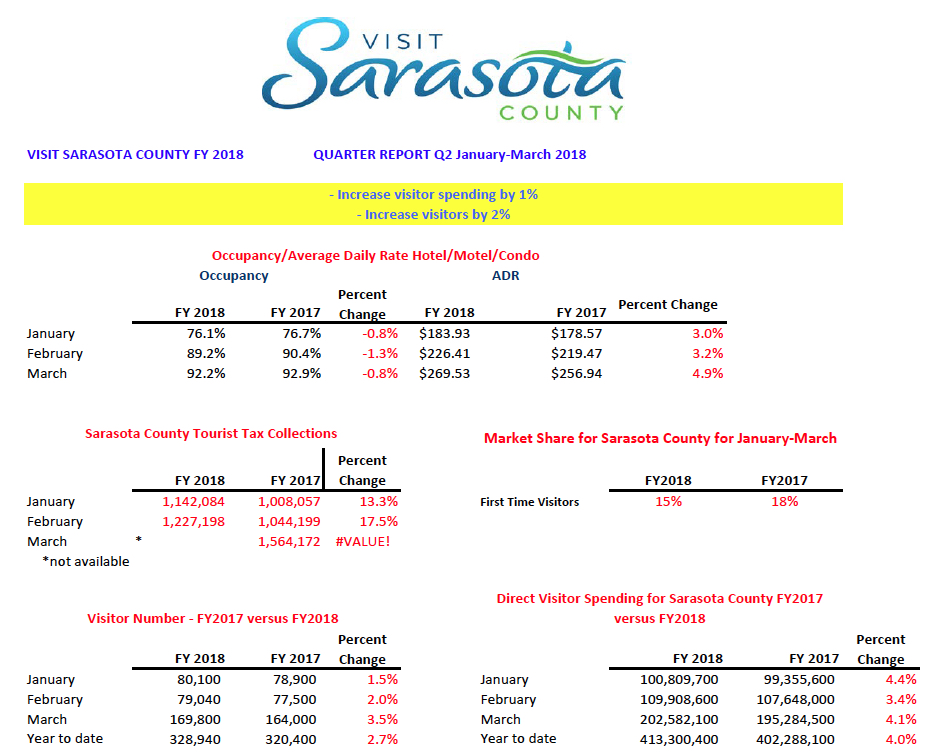
In its report on the second quarter of the 2018 fiscal year — provided for the Tourist Development Council meeting scheduled for May 17 — Visit Sarasota County noted that the number of tourists visiting the county from January through March was up 2.7% compared to the same three months of 2017. The March figure was 3.5% higher than the figure for March 2017, the report said, with a total of 169,800.

Moreover, those visitors’ direct spending increased 4% for that quarter, compared to the second quarter of the 2017 fiscal year, the figures showed. The total for the three months, based on research undertaken for Visit Sarasota County, was $413,300,400, the report noted.

January saw the highest year-over-year change: 4.4%, followed by March with 4.1% and February with 3.4%. Direct spending in January was $100,809,700.


A Visit Sarasota County report shows data from the second quarter of the fiscal year. Image courtesy Visit Sarasota County

However, the occupancy rate for hotels/motels/condominiums was down 1.3% for February and 0.8% for both January and March, compared to the figures for the same months in 2017, the report said. The average daily rate charged was up 4.9% in March to $256.94; in February, it was higher by 3.2% year-over-year, at $219.47. For January, the increase was 3%, compared to the figure for January 2017. The figure for this January was $178.57, the report said.

Friday, April 27, 2018

SNL: Bed Tax revenue up in County

‘Bed tax’ revenue up more than $1 million in the county year-over-year through February

Each month has seen an increase since fiscal year began on Oct. 1, 2017
While some visitors make their way toward the parking lot, many others gather at Siesta Public Beach for sunset in late February. Rachel Hackney photo
During a March presentation to the Sarasota County Tourist Development Council, Assistant Sarasota County Tax Collector Sherri Smith remarked that the latest Tourist Development Tax (TDT) revenue report showed collections already “up almost $750,000” compared to the figure for the same period of the 2017 fiscal year.
Make that a difference of more than $1 million in “bed tax” money year-over-year, according to the most recent Tax Collector’s Office report.
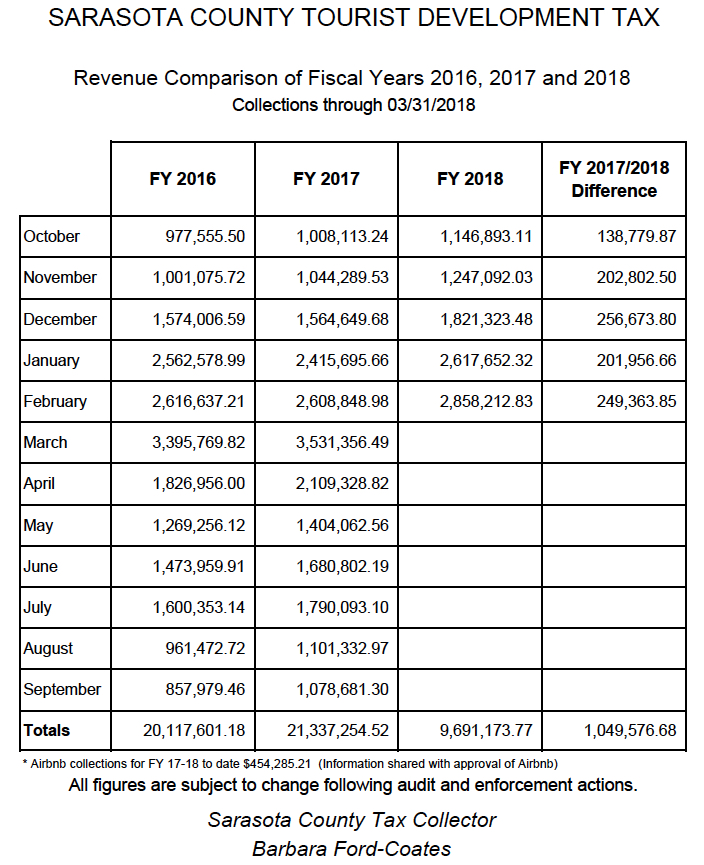
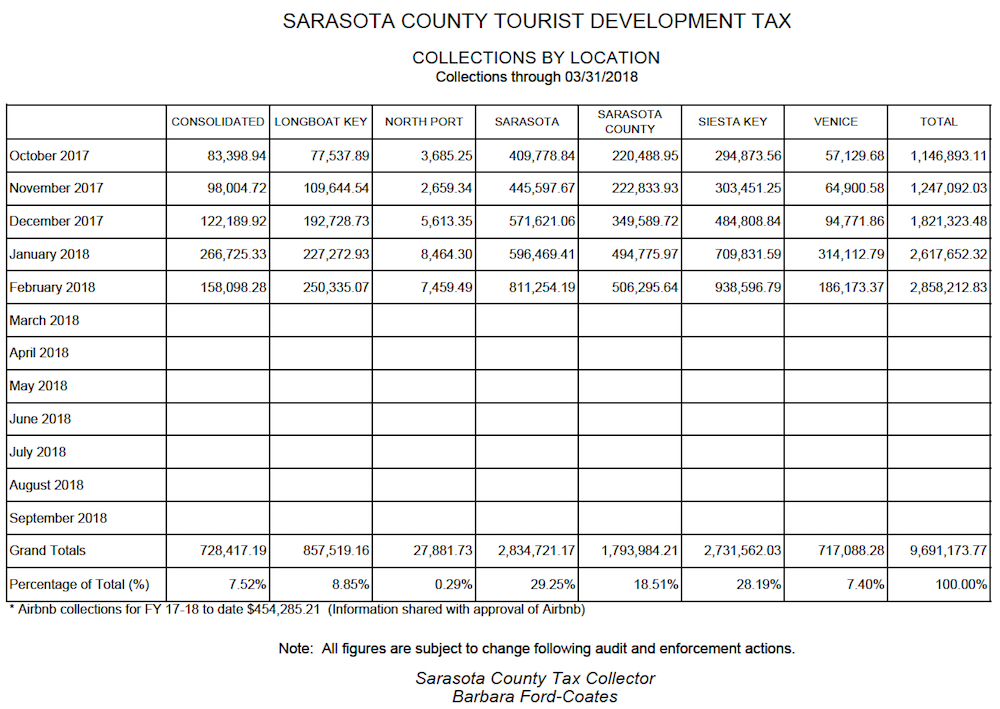
Through February, collections marked an increase of $1,049,576.68, compared to the revenue reported from October 2016 through February 2017. The February total of $2,858,212.83 was the highest thus far of the current fiscal year, which began on Oct. 1, 2017. Each month during the period reflected in the report has seen a higher figure than the previous month.
The past two years, the county set records for the total amount of bed tax it collected. The money is divided among a number of “pots,” with revenue going to cover initiatives such as beach maintenance and renourishment, as well as debt service on the bonds the county issued to help pay for the Atlanta Braves’ new Spring Training complex underway in the West Villages near North Port.
And the numbers could change. Audits and other revisions of the figures submitted to the Tax Collector’s Office each month by the entities that collect the tax can produce changes, Tax Collector Barbara Ford-Coates has explained.
In fact, the latest report shows an increase of more than $39,000 for the January TDT figure. The numbers released last month showed total revenue was $163,499.19. However, the new report puts the figure at $201,956.66.
Conversely, the figure for October 2017 dropped a bit, from $139,379.87 in the report issued at the end of February to $138,779.87 in the March Tax Collector’s Office report.
Overall, TDT revenue totals $9,691,173.77 for the first five months of this fiscal year.
A chart shows Tourist Development Tax collections through February. Image courtesy Sarasota County Tax Collector’s Office
The location with the accommodations that have collected the highest percentage of that amount through the end of February is the city of Sarasota, with 29.25%. Siesta Key was in second place with 28.19%.
Included in the figures are Airbnb collections from hosts who work through the internet-based accommodations service. The March 31 Tax Collector’s report says that, for current fiscal year, Airbnb revenue totals $454,285.21.
In an April 3 press release, Airbnb announced that all of its hosts in the 12 Florida cities with teams in Major League Baseball’s Grapefruit League saw “significant spikes in Airbnb guest arrivals during the preseason baseball training as compared to the prior 5-week stretch.” For this year, that Spring Training period ran from Feb. 21 through March 27, the release pointed out.
Among the data for specific cities, the release noted, Sarasota saw a “100% spike” in the number of Airbnb guests, compared to the figure for the 2017 period.
A chart shows TDT revenue collections by location through February. Image courtesy Sarasota County Tax Collector’s Office
The press release added that Sarasota Airbnb hosts welcomed 12,000 guests for Spring Training and earned $1.1 million from them.
The Baltimore Orioles conduct Spring Training in Sarasota.
Fifteen Major League Baseball teams hold Spring Training games in 12 Florida cities, primarily in Central and Southwest Florida, the release added.

News Leader 4.26.18: County Budget in good shape


County budget in good shape at midpoint of fiscal year


Major revenues up 9.1% compared to same period of 2017 fiscal year and expenditures staying in check

A chart shows the status of specific Sarasota County revenue sources at the midpoint of the current fiscal year. Image courtesy Sarasota County

Major Sarasota County revenues were up 9.1% compared to staff’s projection for the midpoint of the current fiscal year, and overall expenditures were at the 37% mark, county staff reported to the County Commission this week.
Those numbers were part of a review of the status of the budget for the fiscal year that began on Oct. 1, 2017.
“We’re glad we’re in the black and doing better than we expected,” Chair Nancy Detert said.
During their regular meeting on April 25, the board also approved an amendment to their 2018 fiscal year budget to reflect spending reductions they approved on Jan. 31. Formally, those changes will save the county $1,974,885 for the remaining six months of the current fiscal year.
Altogether, the Jan. 31 decisions represented $5.3 million in annual recurring expenses that will be reflected in the 2019 and subsequent fiscal year budgets, County Administrator Jonathan Lewis reminded the board members on April 25. Those included plans to leave vacant positions unfilled.
Among specific funds Kim Radtke, director of the county’s Office of Financial Management, reviewed this week, she noted that revenue from the county’s 1-cent sales tax — approved by voter referendum in 2009 for infrastructure projects — was 8.9% higher than expected; revenue from the county’s five separate gas taxes was up 8.8% compared to the budget projection; and the combined county utility revenues were 8.1% higher.
Revenue from the 5% Tourist Development Tax (TDT) — the “bed tax” — was 17% above the staff projection for the midpoint, Radtke said.
However, the figure staff used for its April 25 presentation did not encompass the latest report from the Sarasota County Tax Collector’s Office, which reflected revenue collected through the end of February. That report showed the TDT revenue was up $1,049,576.68 compared to the same period of the 2017 fiscal year. (See the related article in this issue.)

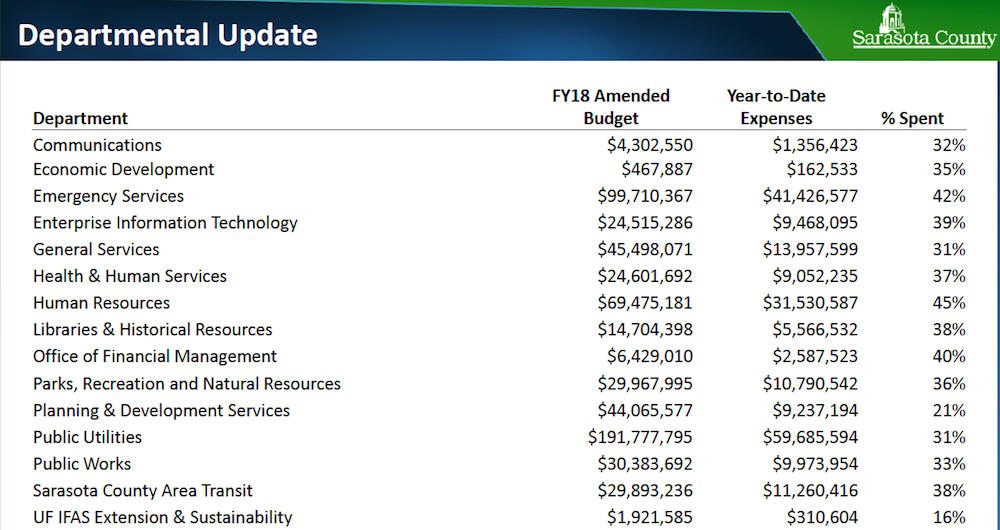
A chart shows the status of expenditures by Sarasota County departments at the midpoint of the fiscal year. Image courtesy Sarasota County
No department operating under the aegis of the County Commission had spent 50% of its budget by the midpoint, Radtke added. Twelve of them were more than 10% below the 50% level, she pointed out. “County staff did a really good job of being conservative,” she said, before the County Commission took measures during its Jan. 31 budget workshop.
In regard to other facets of the midyear budget, Radtke noted that the Sarasota County Fire Department/EMS fund had spent 42% of its projected expenses for the 2018 fiscal year; and the Medical Benefits Fund had paid out 47% of its projected expenses.
The General Fund expenses were at the 44% level.
The Solid Waste Fund had the smallest outlay of any major county fund at the midpoint of the fiscal year, according to a chart provided to the board: 27%. The Utilities Fund was at the 29% mark.
Among other trends worth noting, County Administrator Lewis pointed out that the number of building permits the county had issued by the middle of the fiscal year was up 18% compared to the same point in the prior fiscal year. The total was 19,273, he said. “I think that’s a significant number …”
The count of commercial permits was 78% higher than the figure at the midpoint of the 2017 fiscal year, he added, with 64 having been approved.


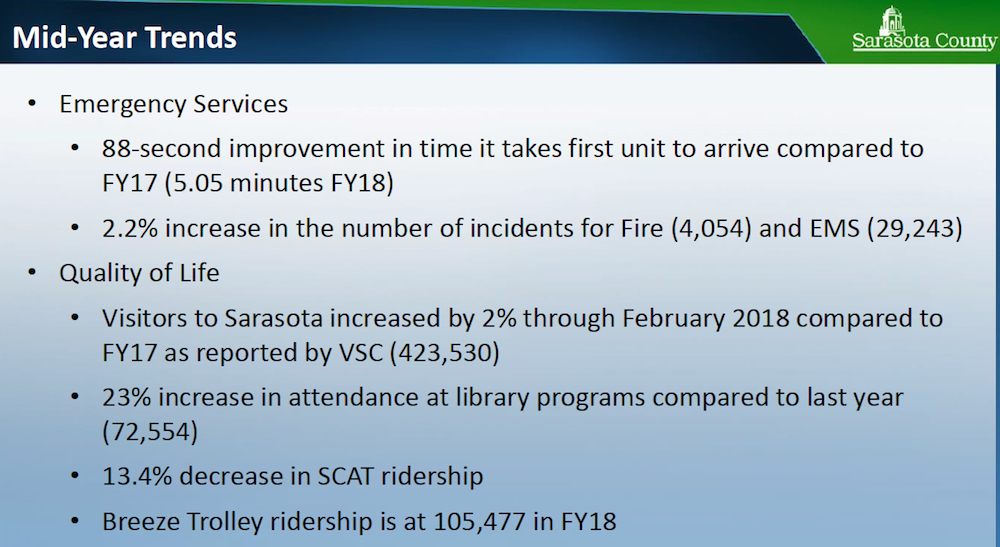
A chart provides county statistics for the midpoint of the current fiscal year. Image courtesy Sarasota County

For single-family residential construction, a 4% decrease had been recorded through March, compared to the figure as of the end of March 2017, according to a chart Lewis showed the commission. Of those permits, 54% were issued in North County; the remaining 46%, in South County.
However, the total number of permits for multi-family units was up 62% through the midpoint of the current fiscal year, compared to the figure for the midpoint of FY17.
Yet another statistic Lewis cited was the 3% increase in calls to the county’s Contact Center as of the middle of the current fiscal year. That total was 90,724, a chart said. “That’s a huge volume,” he told the board.
Residents call the center for a variety of reasons, he explained. For example, some need general information, he said, while others check on the status of work permits.
Social media contacts also are on the rise on a monthly basis, he pointed out. So far this fiscal year, county government’s Facebook page has seen the number of “likes” rise each month, reflecting a 10.5% uptick compared to the same period of the 2017 fiscal year.

Wednesday, November 18, 2015

A letter of concern about Florida parks

The following email from a three-decade veteran of DNR/DEP explores three of the threats posed to Myakka River State Park. The committee meeting he refers to (tomorrow) is taking place today NOV 18.

-----------------

Dear Chairman Dean and other Committee Members:

I am unable to attend tomorrow's committee meeting because of an important medical appointment, and am resorting to emailing you as a group.  I hope that you will give some consideration to what I am writing.  I am a little over one month retired from the Florida Park Service where I served for 29+ years, mostly in the central office.  In my positions, including supervision of the management of the park's natural and cultural resource management programs, I participated to some degree in all the discussions and decisions of the upper management team.

I regret to inform you that by all evidence at hand, the current and immediate past DEP leadership intends to change the basic mission of the Florida State Parks for the worse.  Over the last few years, DEP has already removed from the state parks' own division much of the central office oversight of the day-to-day responsibilities of managing the state park system.  These responsibilities include finance and accounting, planning interpretive services for the public, managing park concessionaires, design and construction of park facilities, and even managing the day-to-day operations of parks.  I can tell you that the state park staff saw all this transfer of responsibility no less than a deliberate dismantling of the state park system.  The actions were especially confusing because Florida State Parks were arguably the nation's best state park system and no accusations of impropriety or dysfunction were ever made.  The changes were only said to be made for "efficiency" and all happened completely under the state legislature's radar.  The state park staff are quite disheartened at the recent manipulations by DEP leadership, although no current employee will be able to say so, because loyalty to top DEP administrators is strictly required and enforced with aggressive firing practices.

Your committee will consider three important proposals tomorrow.

The first issue of concern is the confirmation of Secretary Steverson.  Before my retirement, we in the central office of the Florida Park Service followed his every request to arrange policies and contracts for more aggressive timbering, cattle grazing in natural communities (not just improved pastures), to allow hunting for the first time in state parks, and to open all state parks to multiple uses for private profit for the first time.  No current staff are able to speak out against these new policies, but you probably have noticed an outcry from all the former state park directors and a multitude of former staff.  There are also citizen petitions and action groups that have formed to oppose these radical changes to the state parks as we have always known them.  All these new policies are counter to the clear intention for the state parks in both statute and rule.  I urge you to review this statutory guidance and determine for yourselves that the current direction proposed by Secretary Steverson is contrary to the longstanding legislative intent.  I am not a vindictive person, but I have no hesitancy in predicting that Secretary Steverson will do great harm to the Florida State Parks if confirmed, and I recommend that you find a way with the power vested in your committee to not confirm him.

The second issue is the proposal by DEP to manage its own divisions more autonomously (SB 400).  The bill currently assures the continuity of the Division of State Lands.  I urge you to amend the bill to also assure the continuity of the Division of Recreation and Parks.  The division has a long and honored tradition within Florida government as the administrator of Florida State Parks and is specifically listed as a partner agency with the Department of State's Division of Historic Resources in managing the state's most important archaeological and historic sites.  I am very worried that DEP leadership has plans (certainly secret so far) to further manipulate the state park system with authority provided with this bill.  If no such plans are afoot, there should be no objection by DEP to ensuring the continuity of the Division of Recreation and Parks in an amendment to this bill.

The third issue of concern is the free day admission to the state parks (SB 570).  Over my entire career within the leadership of the state park system, we discussed park fees countless times.  There are a couple of "take-aways" that I would like to share with you.  The first is that private recreational businesses near state parks always resented that our fees were so low that they could not compete on a level playing field. Consequently, they always wanted us to raise our fees to be closer to market value.  Independently, we also wanted to raise fees a little bit at a time over the years, because we wanted to achieve more financial self-sufficiency and also because it was very clear that we were under-valued. Unfortunately, we were usually denied by the Governor's Office or DEP, including again recently.  So be forewarned that even though free admission might seem as though it would increase attendance and benefit the financially disadvantaged, in reality what it will do is to further compromise private recreational providers.  Also importantly, it would also leave a gaping hole in the state parks' budget.  Replacing the budget from another source opens the door to those who would further change the financial structure of the state park system.  You probably will also hear that this would be a problem for many parks that are already at capacity.  This is absolutely true.  I recommend that you not approve this bill as it will do far more harm than good.

Thank you for your consideration of these points.  I will close by testifying that our state park system is being undermined on many fronts without justification.  I have seen it happen over the last few years and the current threats are the worst so far.  Your committee is faced with an important opportunity to preserve America's best state park system and honor the legislatures before you that thoughtfully declared what it should be.   


Mr. Dana C. Bryan
Tallahassee, FL

------------------------------------------------

COMMITTEE MEMBERSHIP

Chair: Senator Charles S. "Charlie" Dean, Sr.
850-487-5005 dean.charles.web@flsenate.gov
Vice Chair: Senator Wilton Simpson
850-487-5018 simpson.wilton.web@flsenate.gov
Other Committee Members:
Senator Thad Altman
850-487-5016 altman.thad.web@flsenate.gov
Senator Christopher L. Smith
850-487-5031 smith.chris.web@flsenate.gov