| ||
|
Showing posts with label impact fees. Show all posts
Monday, February 8, 2021
"We are concerned with excessive growth"
Wednesday, March 4, 2020
UPDATE: Lobeck to Gruters: Stop this train wreck in its tracks
Update following changes made to Florida SB 1077 after communication from attorney Dan Lobeck to Sen. Joe Gruters. The original Feb. 26, 2020 post is below this update.
Gone from the bill are measures to limit what impact fees can be charged for – prohibiting impact fees for many purposes now levied by Sarasota County such as libraries, courts and jails, and a requirement that local governments load their impact fee committees with members biased towards development interests. Also gone is a measure to remove the right of local governments to decide what roads and other facilities may be built by a developer to get an impact fee credit.
A very bad companion bill - in some ways worse than Gruters’ original bill (partly because of the powers it would give to the biased committee) remains pending in the Florida House. With the Senate and the House now on opposite tracks, the fate of the legislation remains uncertain. It seems unlikely to pass unless House and Senate leaders agree on the wording and it becomes a priority to the leader of either chamber. The legislation was initially drafted by the Florida Homebuilders Association, which prefers that the taxpaying public, rather than builders and developers, pay for the facilities needed to serve new growth.
The amended Senate bill.
Dan Lobeck
President, Control Growth Now
www.controlgrowthnow.org
==================
Senator Gruters:
This is to urge that you either pull your SB 1066 regarding impact fees or at least have it amended to correct serious flaws.
As it now stands, it is a very bad bill. The House companion, in the form of its current Committee Substitute (pending second reading in the House) is in some ways even worse.
![]() |
| Dan Lobeck |
As you know, this is a Homebuilders Association bill. Certainly, any attempt to tie the hands of local governments on impact fees paid by those homebuilders should be suspect as to whether it serves the public interest or instead serves that special interest contrary to the public interest.
Also, this is one in a long line of legislation in recent years (and before) which would subvert home rule, substituting state strictures for control of commissions closer to the communities they are elected to serve.
Your bill is up for consideration by the Appropriations Committee tomorrow morning at 9. That would be a good time – among others – to stop this train wreck in its tracks. I am copying the members of that Committee for their consideration.
Others have pointed out problems with the legislation, including with regard to the transfer of impact fee credits; limiting the discretion of School Boards and their professional consultants in formulating impact fee methodologies; and removing the right of local governments whether to agree to “contributions” (such as construction of a road) for which a developer will get an impact fee credit.
![]() |
| Joe Gruters |
This is to focus on two severe problems in the bills.
Eliminating Impact Fees for Some Public Facilities
Both bills limit impact fees to certain public facilities listed in what is now s.163.3164(39), Florida Statutes, that is “major capital improvements, including transportation, sanitary sewer, solid waste, drainage, potable water, educational, parks and recreational facilities” and certain others. Those others in the Senate bill are “any fire and law enforcement facility.” The House bill adds “public libraries, parks” and “emergency medical services.”
Sarasota County, and perhaps other jurisdictions, levy impact fees for public facilities not on that list. In Sarasota County it is judicial facilities and public administration buildings.
For both of those purposes, Sarasota County has a severe funding shortfall, for both current and future needs. As such, both impact fees were recognized as inadequate and were increased.
The word “including” and “includes”, without the phrase “but not limited to” may be construed as words of limitation rather than of example.
As such, if your bill becomes law as now drafted, or in its House companion, it may be cited to eliminate Sarasota County’s impact fees for judicial facilities and public administration and (but for the House language) libraries and emergency medical services.
Other Counties and Cities will be similarly limited, for no good reason.
Two other problems with the wording in both bills: what is a “major capital improvement” is ambiguous and as such may be unduly limiting, and “fire and law enforcement facility” should be “fire or law enforcement facility.”
A Biased Impact Fee Committee
Both bills would require each County and City to form an Impact Fee Committee with a mandatory composition guaranteed to be biased towards the builders and developers who pay impact fees.
The Homebuilders Association knew what they were doing when they drafted this. By serving their special interest, it guarantees that the interests of the taxpayers – on whose backs the cost of public facilities to serve new growth will fall if growth is not made to pay its own way – that is the public interest, will be given short shrift.
The Senate bill states that the Committee shall consist of two persons “who represent the business community” (such as Chamber of Commerce representatives, who in my experience typically ally with builders) and two “local licensed general or residential contractors” (e.g. builders), together with one “at large member.”
The House Bill adds to the Committee two members employed by the County or City which levies the impact fee, one of which must be a School Board employee if there is a school impact fee.
The Senate bill has been amended to allow a local government to instead “use an existing committee which contains representation from the building or development community and reviews building or development projects.” Not only is that option oddly limited (for no apparent reason) to “existing” committees, the killer is the final clause: “and reviews building or development projects.” That eliminates any existing impact fee advisory committee which does not also perform that secondary function. As those are two different functions, it is unlikely that any committee does both. In Sarasota County for example, the Public Facilities Financing Advisory Board advises on impact fees but it does not review building or development projects. So that committee, whose members are selected to represent not only business interests but also civic organizations, would be replaced by the biased committee mandated by this new law.
In the Senate Bill, the Impact Fee Committee reviews and recommends not only the impact fee methodology but also the impact fee consultant, studies, calculation changes and expenditures – all of the significant determinations of the County or City on impact fees
The House bill goes even further. It would vest the power to “establish a policy and methodology for determining impact fees on new developments” in the Impact Fee Committee. Not “recommend” but “establish”, thereby stripping that important power from the local elected officials and instead giving it to a committee which is guaranteed to be biased in favor of those who pay impact fees. Also, the House bill would require that the Impact Fee Committee submit a recommendation to the governing body of the county or city each time that an impact fee on a “new development” will be discussed and voted upon (whatever that means).
An Albatross
This terrible legislation will be an albatross around the neck of any Senator or Representative who votes for it – providing clear and demonstrable evidence that person serves development interests contrary to the interests of this or her constituents, who will face higher taxes or inadequate public facilities (or both) when impact fees are too low to make growth pay its own way.
Please change course before it is too late, and kill or at least dramatically modify this very bad bill.
Thank you for your considerations.
Dan Lobeck, Esq.
Florida Bar Board Certified in
Condominium and Planned Development Law
Law Offices of Lobeck & Hanson, P.A.
2033 Main Street, Suite 403
Sarasota, FL 34237
Telephone: (941) 955-5622
Facsimile: (941) 951-1469
Questions regarding the wording of the bill were raised earlier by Mr. Lobeck and were posted here.
ReplyReply allForward
|
Thursday, February 6, 2020
Questions raised about legislation revising impact fees
Letter to State Rep.Margaret Good from Sarasota citizens regarding a new bill revising how impact fees are defined and administered. One of the bill's sponsors is State Sen. Joe Gruters of Sarasota. In part it would require counties to create a new bureaucracy to administer, review, and approve such fees on developers. Text of the bill which is still pending.
To: The Honorable Margaret Good;
From: Dan Lobeck, Glenna Blomquist
Date: 02/05/20
Dan Lobeck and I have reviewed this pending legislature (related to HB 637 and SB 1066). Following please find relevant comments:
One problem is that it limits impact fees to “public facilities” defined (by reference to another statute) as “major capital improvements, including transportation, sanitary sewer, solid waste, drainage, potable water, educational, parks and recreational facilities.”
While the bills then add, “and includes any fire and law enforcement facility”, it is not clear if the word “including” in the referenced statute is meant as a limitation or as providing for examples. If the former, Sarasota County’s impact fees for libraries, courts and administration facilities would be rendered illegal. (Case law would need to be researched on statutory construction of the word “including” in the absence of “but not limited to”).
Also potentially problematic is that impact fees would be limited to “infrastructure,” that is the “construction, reconstruction, or improvement of a public facility …” and (again under the above referenced statute) “major capital improvements,” thereby potentially preventing impact fees from being spent on school buses or mass transit, as they are today.
The requirement that impact fees be based on local data gathered within the past 36 months (apparently on a rolling basis) imposes a burden on local governments to gather that date every three years. However, if done right that is not an entirely bad idea, as Sarasota County has long based its transportation impact fees on outdated national data from the last recession (which the County then seeks to apply through a methodology to local conditions) which understates trip length and frequency.
Truly local data, if done correctly, may be more reliable, although that could be subject to manipulation to keep the fees artificially low.
The composition of the local committees is unfairly loaded to those favoring lower impact fees, with most seats reserved for contractors and other business representatives and only one for the general public. (In Sarasota County, this would not much change the makeup of the Public Facilities Financing Advisory Board, which mainly advises on impact fees, as it is typically loaded with development interests and their allies).
===
News about the bills from Joe Gruters (Sarasota) and Nick DiCelglie (Pinellas):
Florida House panel OKs bill overhauling local government impact fee levies
Tighter restrictions on impact fees are one step closer to House passage
To: The Honorable Margaret Good;
From: Dan Lobeck, Glenna Blomquist
Date: 02/05/20
Dan Lobeck and I have reviewed this pending legislature (related to HB 637 and SB 1066). Following please find relevant comments:
One problem is that it limits impact fees to “public facilities” defined (by reference to another statute) as “major capital improvements, including transportation, sanitary sewer, solid waste, drainage, potable water, educational, parks and recreational facilities.”
While the bills then add, “and includes any fire and law enforcement facility”, it is not clear if the word “including” in the referenced statute is meant as a limitation or as providing for examples. If the former, Sarasota County’s impact fees for libraries, courts and administration facilities would be rendered illegal. (Case law would need to be researched on statutory construction of the word “including” in the absence of “but not limited to”).
Also potentially problematic is that impact fees would be limited to “infrastructure,” that is the “construction, reconstruction, or improvement of a public facility …” and (again under the above referenced statute) “major capital improvements,” thereby potentially preventing impact fees from being spent on school buses or mass transit, as they are today.
The requirement that impact fees be based on local data gathered within the past 36 months (apparently on a rolling basis) imposes a burden on local governments to gather that date every three years. However, if done right that is not an entirely bad idea, as Sarasota County has long based its transportation impact fees on outdated national data from the last recession (which the County then seeks to apply through a methodology to local conditions) which understates trip length and frequency.
Truly local data, if done correctly, may be more reliable, although that could be subject to manipulation to keep the fees artificially low.
The composition of the local committees is unfairly loaded to those favoring lower impact fees, with most seats reserved for contractors and other business representatives and only one for the general public. (In Sarasota County, this would not much change the makeup of the Public Facilities Financing Advisory Board, which mainly advises on impact fees, as it is typically loaded with development interests and their allies).
===
News about the bills from Joe Gruters (Sarasota) and Nick DiCelglie (Pinellas):
Florida House panel OKs bill overhauling local government impact fee levies
The bill would require local governments segregate impact fee revenues into accounts for each improvement category, calculate impact fees with data no older than 36 months, create seven-member committees to review how fees are allocated and exclude costs from fees that don’t meet a revised definition of infrastructure.
Tighter restrictions on impact fees are one step closer to House passage
Some lawmakers expressed reservations about the current language and cautioned they may vote it down if it makes it to the House floor if some concerns aren’t addressed. That includes fears about the fiscal impact to local governments as they are faced with additional administrative burden when levying fees.
Monday, August 26, 2019
"Nobody told us" say Sarasota's elected leaders
"Hear no evil" was the refrain at Sarasota County's budget workshop the other day.
When the issue of the degraded condition of Sarasota's wastewater facilities came up, Sarasota's elected officials bravely faced the fact that their public duty requires them to invest $150 million in the facility in order to meet state DEP standards.
They then concluded the workshop by covering their posteriors (around 2 hr 31 min):
Well now. Instead of indiscriminately throwing staff under the bus, our commissioners might have taken another tack: ordering an independent investigation to find out what persons, what assumptions, what mechanisms, what puppeteers are concealing significant information from public view.
When he ran for reelection in 2018, Commissioner Al Maio claimed he'd kept Sarasota property taxes low for 20 years, but, somehow, this came at no cost to the environment or infrastructural conditions, to parks and other services, or to long range planning and development. Maio was reelected by voters who apparently are drawn to magical thinking.
It may be past time for citizens of Sarasota to buy a clue for our elected officials -- to say something like:
If you don't know how come you're not apprised of key data relating to our economy, environment, and infrastructure, don't you think it might be a good idea to find out how and why that is?
How does critically important information for the people of Sarasota get suppressed? At whose bidding? How long has this been going on?
Are Commissioners Moran and Detert going to run on a platform of "nobody told me" in the 2020 election?
Perhaps it's all too clear, Commissioners. You know the trail would lead right back to you and your friends, whose ambitious large-scale activities have long contributed to the rise in nitrates feeding Red Tide in our waters. (At your morning session on Affordable Housing, developer Pat Neal thanked you for lower impact fees here than in Manatee County.)
If you choose not to investigate, what does this say about the value you place upon "hard truths"?
![]() |
| Top to bottom: Sarasota Commissioners Al Maio, Mike Moran, Christian Ziegler, Charles Hines, Nancy Detert Bottom right: 20 years of county data indicating rising nitrates in Sarasota waterways |
They then concluded the workshop by covering their posteriors (around 2 hr 31 min):
“Were we asleep at the wheel?” Commissioner Christian Ziegler asked, referencing Detert’s earlier remarks.. . . He remembered asking [County Administrator Jonathan] Lewis, Ziegler continued, about comments he had heard in the community about wastewater spills. Lewis’ response, Ziegler said, was that the county generally had no problems except during hurricanes and other heavy rain periods.
Then just a few days later, Ziegler added, he heard about the federal lawsuit.
“I talked to previous commissioners,” asking if they were aware of the problems, Ziegler pointed out. “Nobody had any idea, I think.” Sarasota News LeaderIf Sarasota's elected officials now believe that crucial, economically significant information was systematically withheld from them, why not get to the bottom of this mystery?
“I can’t remember anybody ever coming to me, privately or publicly,” [Commissioner Charles Hines] added, to suggest the need for the upgrade of the Bee Ridge facility.
The reason the commissioners were told nothing about the water treatment plant problems, [Commissioner Mike] Moran indicated — based on what he had heard — was that previous staff members felt the commissioners never would consider paying a high price to resolve the issues. (SNL)
Well now. Instead of indiscriminately throwing staff under the bus, our commissioners might have taken another tack: ordering an independent investigation to find out what persons, what assumptions, what mechanisms, what puppeteers are concealing significant information from public view.
When he ran for reelection in 2018, Commissioner Al Maio claimed he'd kept Sarasota property taxes low for 20 years, but, somehow, this came at no cost to the environment or infrastructural conditions, to parks and other services, or to long range planning and development. Maio was reelected by voters who apparently are drawn to magical thinking.
It may be past time for citizens of Sarasota to buy a clue for our elected officials -- to say something like:
If you don't know how come you're not apprised of key data relating to our economy, environment, and infrastructure, don't you think it might be a good idea to find out how and why that is?
How does critically important information for the people of Sarasota get suppressed? At whose bidding? How long has this been going on?
Are Commissioners Moran and Detert going to run on a platform of "nobody told me" in the 2020 election?
Perhaps it's all too clear, Commissioners. You know the trail would lead right back to you and your friends, whose ambitious large-scale activities have long contributed to the rise in nitrates feeding Red Tide in our waters. (At your morning session on Affordable Housing, developer Pat Neal thanked you for lower impact fees here than in Manatee County.)If you choose not to investigate, what does this say about the value you place upon "hard truths"?
Tuesday, July 24, 2018
UPDATE: Four housing tracts will overrun east Sarasota County without a public long range plan
Updated as of July 24, 2018:
If you live in Sarasota east of the Interstate, or if you like to experience the country roads of rural Florida, prepare for the shock of large-scale development. Several super-sized housing tracts are coming to East Sarasota. Four projects alone will add nearly 28,000 housing units on 20,705 acres.
Major developable swaths of east Sarasota County are either already underway or set to be approved before the inevitable next crash in the Sunshine State's housing cycle.
One of the four largest, Lakewood Ranch (LWR), ranks #5 among the "fastest growing suburbs in the US":
The four largest are Waterside at Lakewood Ranch (Rex Jensen), Hi Hat (Turner), LT Ranch (Turner) and Grand Lakes (Pat Neal). Stretching from University down to 681 near Venice in East Sarasota, these ambitious projects will replace East Sarasota's rural ranchlands and open space with huge tracts of housing.
And more gated housing projects are coming, including Lindvest, Lakepark Estates, Worthington, Palmer Place, Sylvan Lea, Hidden Creek, Rivo Lakes and more.
While quickly granting concessions to private developers, Sarasota County's elected Board displays no evident awareness of its civic responsibility to gauge cumulative impacts, nor, as the public steward of the land, to integrate these impacts within a larger vision of intrinsic tradition and commitment to public uses. One looks in vain for a discussion of bringing greenways or waterways into alignment to create walking paths, wildlife corridors, kayakable sloughs and riding trails that could offer the people of Sarasota public recreation North to South, and East to West.
During a public discussion of a County proposal to reduce open space requirements for developers, one resident put it this way: "If we make changes like this, it changes the character of Sarasota County that was the reason many of us came here."
Add: 12,000-13,000 units, 10,000 acres
==
Turner Family: LT Ranch
This former ranch is approved and underway. It will start with 3,450 units.
UPDATE: Apparently this wasn't "massive" enough, because the Sarasota County Board in 2014 deviated from the Comp Plan to allow a more ambitious development:
Skye Ranch + 3H Ranch together will add some 10,026 units on 4,672 acres.
==
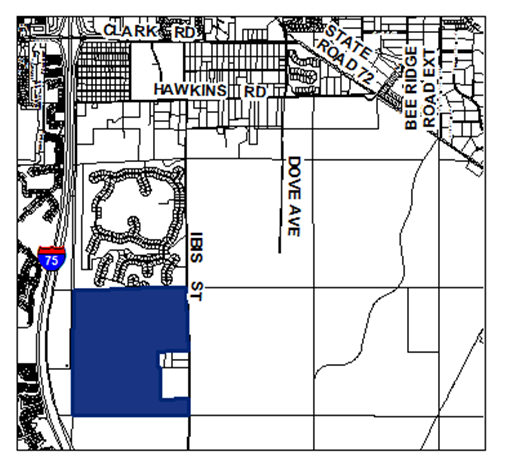
West of LT Ranch, Pat Neal's "Grand Lakes" proposes to put 1,000 homes on 533 acres south of Clark Road at Ibis. The number of Pat Neal dwellings all told in Sarasota County will soon approach 10,000 units.
Hearing continued to July 11, 1:30 pm at Commission Chambers.
UPDATE: Board Action: Neal's Grand Lakes approved despite one-road access* was approved. The action raised a potential public safety issue for this giant cul de sac -- an issue acknowledged, but not addressed, by the Commissioners. Neighbors are considering options for an appeal, and say the Board ruling could open the way to sprawl across East Sarasota County.
See also the Letter to the Editor titled "Something is suspicious in Neal project approval":
Here, for example, is a map of East County, with athletic fields open to the public. For those living east of the highway, one must drive 9-10 miles to the west or south.
If you live in Sarasota east of the Interstate, or if you like to experience the country roads of rural Florida, prepare for the shock of large-scale development. Several super-sized housing tracts are coming to East Sarasota. Four projects alone will add nearly 28,000 housing units on 20,705 acres.Major developable swaths of east Sarasota County are either already underway or set to be approved before the inevitable next crash in the Sunshine State's housing cycle.
![]() |
| Sarasota County Map of developments to the East of I-75, north of Palmer Boulevard |
![]() |
| Sprawl: Fastest burbs in the US: LWR = #5 |
And more gated housing projects are coming, including Lindvest, Lakepark Estates, Worthington, Palmer Place, Sylvan Lea, Hidden Creek, Rivo Lakes and more.
While quickly granting concessions to private developers, Sarasota County's elected Board displays no evident awareness of its civic responsibility to gauge cumulative impacts, nor, as the public steward of the land, to integrate these impacts within a larger vision of intrinsic tradition and commitment to public uses. One looks in vain for a discussion of bringing greenways or waterways into alignment to create walking paths, wildlife corridors, kayakable sloughs and riding trails that could offer the people of Sarasota public recreation North to South, and East to West.
During a public discussion of a County proposal to reduce open space requirements for developers, one resident put it this way: "If we make changes like this, it changes the character of Sarasota County that was the reason many of us came here."
Here's a brief overview of the four largest developments that are either underway or whose plans have received approval:
Rex Jensen's Waterside at Lakewood Ranch
It’s the first project coming to fruition in Schroeder-Manatee Ranch’s Waterside at Lakewood Ranch, a 5,144-home, 5,500-acre development in Sarasota County set around a series of seven large lakes left over from SMR’s aggregate mining operations.
The Waterside project generally runs from Interstate 75 to east of Lorraine Road and between University Parkway and Fruitville Road. It is located south of the Sarasota Polo Club and the Lakewood Ranch Corporate Park.
![]() |
| "Waterside" |
"Waterside" will add 5,144 units, 5,500 acres
=
Turner Family: Hi Hat Ranch
Stretching from Fruitville Road to Clark Road, this 10,000-acre mega-development of a former ranch will add an estimated 12,000 homes.
Hearing July 11, 9 a.m. County Commission Chambers.
UPDATE: Board Action: Hi Hat Petition Approved July 11.
Add: 12,000-13,000 units, 10,000 acres
==
Turner Family: LT Ranch
This former ranch is approved and underway. It will start with 3,450 units.
". . . the 1,725-acre property owned by the Turner family will break ground in the “2050 South Village” mixed-use development plan for the largely rural stretch leading out to the Myakka River State Park.
LT Ranch
"The massive project includes up to 3,450 residential units throughout the neighborhoods, up to 300,000 square feet of commercial space at the corner of Clark Road and Bee Ridge Extension, and a host of environmental and road improvements throughout the area, according to the plans." Herald Tribune 11.9.2016
UPDATE: Apparently this wasn't "massive" enough, because the Sarasota County Board in 2014 deviated from the Comp Plan to allow a more ambitious development:
Property owners planning to add a village on 4,672 acres near Clark Road and Interstate 75 got a lot more leeway Wednesday on how and when they build.
County commissioners decided to amend the county’s 2050 growth plan to allow the owners, 3H Ranch LLC and LT Partners LLLP, to create 9,344 homes on the land, roughly 5,500 to 6,300 more than the guidelines permit. Herald Tribune 3.5.2014
Update June 2024: Pat Neal's 3H Ranch proposal plans to construct 6,576 units.
Skye Ranch + 3H Ranch together will add some 10,026 units on 4,672 acres.
==
West of LT Ranch, Pat Neal's "Grand Lakes" proposes to put 1,000 homes on 533 acres south of Clark Road at Ibis. The number of Pat Neal dwellings all told in Sarasota County will soon approach 10,000 units.Hearing continued to July 11, 1:30 pm at Commission Chambers.
UPDATE: Board Action: Neal's Grand Lakes approved despite one-road access* was approved. The action raised a potential public safety issue for this giant cul de sac -- an issue acknowledged, but not addressed, by the Commissioners. Neighbors are considering options for an appeal, and say the Board ruling could open the way to sprawl across East Sarasota County.
See also the Letter to the Editor titled "Something is suspicious in Neal project approval":
All of the 300 current homeowners on Ibis were confined to their property earlier this year when a fire closed the road for hours. Now the county approves 1,100 additional homes, nearly a 400 percent increase, without fixing the egress issue on a dead-end street.
![]() |
| Grand Lakes |
Add: 1,000 units, 533 acres
==
If all these tracts are approved as planned, they'll add more than 27,600 units to 20,705 acres of a rural area sparsely connected by two-lane country roads, which has no commercial, park or recreational areas. More are on the drawing boards -- including the 450-acre Lindvest tract at Fruitville and Dog Kennel Road, with 900 units. Changes to the 2050 Comprehensive Plan have helped Lindvest progress. Is Sarasota County going to answer these private developments with a balancing vision of public uses -- open spaces, trails, adequate roads and and recreational areas available to all?
Here's a December 2017 Sarasota County map of developments between Fruitville Road and University Parkway:
![]() |
| Developments in NE Sarasota County: Source: Sarasota County |
======
It's time to ask our elected officials: What are you thinking? Are you even thinking? What is this Board, as our representative, doing in response to this appetite for rampant growth?
Will our elected commissioners address the need for public planning and adjust impact fees to prepare for the coming demand for roads, trails, amenities, commerce, arts and recreation, or will they abdicate responsible governance, do nothing, and have us all go hang?
*Sarasota News Leader story made available through kind permission of the publisher.
Labels:
cumulative impacts,
grand lake,
hi hat ranch,
impact fees,
Jim Turner,
lindvest,
long range planning,
LT Ranch,
parks,
pat neal,
Rex Jensen,
roads,
sprawl,
stewardship,
traffic,
Turner,
turner family,
vision,
waterside
Monday, March 26, 2018
Concierge service for developers, bum's rush for taxpayers
Big Development Wins ... Again
Dennis Maley•
Sunday, Mar 25, 2018
|
On Tuesday, Manatee County residents were twice reminded who really runs this community: developers.
Tuesday's Manatee County Commission meeting included plenty of plot twists but the story ended the same way it always seem[s] to. First, we were told that Commissioner Stephen Jonsson would not be voting on whether or not to give developers a 10 percent subsidy on impact fees that are supposed to be paid in order to cover the cost of new growth. It turns out Jonsson’s son, an attorney, had just gone to work as in-house counsel for politically-connected developer Carlos Beruff.
That’s the same Carlos Beruff who, after enjoying a long and fruitful relationship with Jonsson, a banker, went on to bankroll his 2016 county commission campaign, in which he defeated smart growth advocate and recently dismissed member of the Manatee Planning Commission (yes, those two things are related) Matt Bower.
As unseemly as this may appear, it actually seemed to bode well for the matter at hand. Since the item was a vote on scrapping a long-delayed return to collecting the impact fees at their prescribed rate, that meant that a possible 3-3 deadlock would kill the issue and they’d finally return to 100 percent next month, as scheduled. Since three commissioners—DiSabatino, Trace and Smith—had already balked at making the discount permanent, it seemed as though the public might win for once. More on that in a moment.
During public comment on impact fees, the board had to break for a time-certain item: the matter of whether or not to purchase 33 acres of woodlands from politically-connected developer Pat Neal for the exorbitant price of $3 million—nearly twice what he paid for it in December of 2016. A scheme to set up a Municipal Service Taxing Unit and force surrounding neighbors to pay back that $3 million over 30 years went askew when roughly half of them threw a fit, some of whom even filed a lawsuit seeking to prevent it.
Not to worry, Neal was getting his money one way or another. Commissioner Betsy Benac quickly suggested the county just buy the property and figure out some way to pay for it from somewhere else over the summer budget process. Suddenly, the board’s most pro-development commissioner, who had also had her seat sponsored by Mr. Beruff, just couldn’t live with the idea of missing out on the chance to preserve 33 acres of green space, no matter how much we had to pay Mr. Neal.
County Administrator Ed Hunzeker, who developers like so much they made sure he stuck around (at significant taxpayer expense) even after he completed the state’s five-year Deferred Retirement Option Program, indicated that this was a feasible plan, despite his long-time penchant for telling commissioners that the funding for so many more important things like ambulances or competitive EMS and law enforcement pay just can’t be found during these economic times.
That led to a mild uproar from Commissioner Charles Smith who demanded to know why the Palmetto community has been told for 50 years that putting a county-operated public swimming pool north of the river was just too cost prohibitive if a couple of million bucks were so easy to find. Surely the merit of teaching underprivileged black children how to swim in a state where the skill comes in more handy than most had to rank up there with sparing a mere 33 acres (much of which would have remained woods had it been developed), especially in a county that's usually so eager to clear land for new construction. Smith said that "anyone who knows anything about building pools has told me you can’t build one like that for $3 million" and was worried that if costs grew, the people in his district would be given yet another excuse as to why there was still no pool.
Unable to come to a conclusion by lunch, the commissioners recessed with neither item having been voted on. When they came back, the mood was much more congenial. Support for the east county preserve purchase had suddenly materialized. Smith, having been assured by Hunzeker that the pool was a done deal, already budgeted for, and would be built as scheduled, grew more comfortable and joined Benac, Commissioner Baugh (another developer-supported commissioner whose district includes the site in question) and Commissioner Priscilla Trace, to flip the vote to 4-2.
So, in the end, the 33 acres will be spared, and we’ll all pay Neal his $3 million. You can read about that in more depth here.
That led us to the impact fee vote. Once again, those in attendance had to go through the excruciating dog and pony show of developers pleading with the board to relinquish them from this unfair burden and save the mythical middle-class homeowners who would be forced from this community in droves if the oppressive fees were allowed to increase.
Then we sat and listened as advocates like Bower, planning commissioner Al Horrigan, impact fee activist Ed Goff, and Federation of Manatee County Community Associations President Sandy Marshall shoot their arguments full of enough holes to bury nearly every single one of the $4.5 million that were stuffed into the pockets of local developers in FY 2016-17 alone by way of not paying the fees. Fees that were prescribed, by the way, in an expensive taxpayer-funded study the county commissioned from reputable consulting firm Tischler Bise.
Prices are market driven. Houses sell for what the market will bear. They don’t reduce a $350,000 house to $349,000 if you eliminate the fee. Your expressed fear of a lawsuit from developers is unfounded, as Tischler Bise has never ever had their prescribed impact fees successfully challenged in court. If everyone is so concerned about the middle class, why are new home sale prices growing faster in Manatee County than almost anywhere in the country?
Then we had to listen to the commissioners explain that these people don’t really understand impact fees, what they can be used for, how if they are sued it could ultimately cost more than the extra 10 percent to defend, how they are for jobs and middle-class home buyers. If you have an old house and didn’t pay impact fees,how can you say that someone building a new one should? Blotty blue, blotty blah.
Commissioner Benac gave perhaps the most artistic performance. She reminded those in attendance that the county only collected about two thirds of the maximum millage on property taxes and suggested that maybe if we wanted the developers to pay 100 percent, so should we. Benac admitted that sure, we could probably find things to do with the money from the fees, but government can always find a way to tax someone and spend the money. Perhaps Benac missed Mr. Goff’s informative treatise on the difference between a "tax" and a "fee" during public comments.
Benac then posited that the reason there seemed to be a perception that the public was overwhelmingly in favor of collecting full impact fees was owed to the fact that they're only a burden on people who've not yet arrived. Who will be the voice of those taxpayers who've yet to make the decision to come to Manatee County in the first place, the commissioner wanted to know. It seemed she was intent to be the champion of all (future) Manatee County residents. The commissioner, whose voice often drips with condescension when forced to answer those who would question the board publicly, then gave yet another soliloquy on the public's failure to grasp the nuts and bolts of the process and how frustrating it can be to hear their misinformed complaints and how they contradict what impact fees can be used for.
|
| District 2 | District 3 | District 4 |
District 5 | At Large | At Large |
It's true that many citizens are unaware of every spending limitation attached to the funds. However, that doesn't mean that the ones who understand them more fully don't have very valid arguments. To wit, some additional irony came by way of an earlier proclamation that National Library Week would be scheduled from April 8-14. The board took great effort to fawn over their support of libraries in general and our county’s hard working and talented library staff in particular. Yet, when was the last time we used the impact fees we apparently don’t need to build a library that we demonstrably do? Despite massive population growth in Lakewood Ranch and eastward, there is still not a library east of I-75 and south of the river. For LWR residents, the only option is the small Braden River branch, quite a ways down the traffic-riddled SR70 corridor, which is closed two days a week and only stays open until 8 p.m. on two others.
During the recession, the county cut library staff and operation hours, and despite increased usage and budgetary growth have not found the money to put them back, let alone build new facilities to keep up with population growth. Impact fees can only be used for capital expenses, not operational costs such as staff, as commissioners are quick to point out, but I’ve never heard anyone say, hey let’s restore all of the libraries to their regular hours and put adequate programming staff in place and then find the money during the summer budget process. My guess is that unless Pat Neal and Carlos Beruff get into the business of building libraries, we won’t.
When it came time to vote, everyone knew that three votes were in the bag. Commissioners Benac, Baugh and Whitmore would vote for capping the fees at the reduced rate. Commissioner Robin DiSabatino held firm once again, as did Commissioner Trace, which put the decision on whether we collect the fees at 100 percent or give up around $10 million over the next three years on Commissioner Smith.
Smith, who is up for reelection in November, had showed signs of wavering during the public hearing, arguing that all the fees in Lakewood Ranch and Ellenton couldn’t pay for projects in his district anyway. Without much explanation, Smith once again grew more comfortable, pitching in the fourth vote to give developers another win. His mood would improve further after the next item when it was decided to move the Washington Park environmental preserve in his district to a list of projects funded by the half-cent sales tax voters approved in 2016.
DiSabatino was livid. "It was the people of this county who lost today,” she told me afterward. "It’s disgusting. You have a developer (Neal) gouging the county on the price for land, pitting neighbor against neighbor over who’s gotta pay for it. That must be the new business model. Why build the development when you can just get the county to pay you twice what it cost for the land? And the commissioners just stand there and vote for it. It makes me sick. Then they vote for capping the fees, when everyone knows the reasons are all phony. It’s a rigged game. You try and do what’s right and represent what’s best for the people of the county, but you just can’t win. This is a dark day in Manatee County."
It is indeed, and DiSabatino’s had her fill. She’s already announced that she won’t be seeking another term. You can’t blame her for having grown tired of fighting the good fight, maybe getting another commissioner or two to join her on a good cause once in a while, but never seeming to be able to flip the board in favor of the people when it counts. She knows that until more people also run for the right reasons and survive the developer-sponsored attacks to actually get into office, nothing will change, and she’ll be left to continue to bang her head against the wall.
Of course voters have the power to change all that by paying closer attention and then holding public officials accountable for their allegiances. But as many as 130,000 people will vote in a countywide commission race, and you’d be hard pressed to find 10 percent of that number who have any real grasp of issues like this one or even have any idea of the sort of power developers wield in our local government and how it affects them personally. Instead, most just look at whether there’s a D or an R next to the name and vote accordingly.
Developers know this, of course, which is why they funnel hundreds of thousands of dollars into the races to ensure there’s always at least four friendly votes who can send much more dough their way once they’ve gotten a seat at the dais. In 1949, George Orwell wrote in his seminal novel 1984 that all the power was with the proletarians, if they could only ever figure out how to use it. Seven decades later, it’s clear we haven’t.
related:
Sunday, March 4, 2018
Maley: New Growth + low impact fees = infrastructure meltdown?
Same Old Story,
Same Old Song and Dance
Dennis Maley•
|
On Thursday, the Manatee County Commission held a public hearing on the idea of giving developers a multi-million dollar freebie by capping impact fees at a rate lower than what the board had previously passed, based on what had been prescribed in a taxpayer-funded study. As is always the case when this subject comes before the BOCC, I felt like my head was going to explode through much of the meeting.
The most painful part of these engagements is sitting through the litany of tired and misinformed rhetoric about the subject. Impact fees hurt young families, they put people in the industry out of work, they send developers and home buyers elsewhere. None of this is true, of course, but you have to remind yourself that the truth doesn’t matter in such proceedings. The practiced baloney is simply window dressing for a truth that most commissioners find acceptable to practice, if unacceptable to utter: lowering impact fees puts money into the pockets of the developers who get and keep us elected.
Three of the seven commissioners on the board—Baugh, Benac and Jonsson—were installed directly by developers who poured vast sums of money into their campaigns. For their efforts, they have enjoyed votes that reflect the allegiance they’ve expected. Commissioner Whitmore, the longest serving commissioner currently on the board, has gotten the mountains of campaign cash which have kept her in office from a much broader array of interests, but has nonetheless been reliably pro-growth, even if she’s occasionally given to some inconvenient hemming and hawing before casting a vote.
As such, they’re gonna get their four votes, and in most cases five or six, partly because the others know when it’s wise and unwise to go up against them. Nonetheless, such measures require a public hearing, so we had to go through the exercise on Tuesday for the sake of checking the block. In fact, the people showing up to demand that commissioners represent the interests of the taxpayers instead of their campaign sponsors knew more than most that it was just a dog and pony show. On March 20, the board will vote to cap the impact fees at 90 percent of what the consulting firm that conducted the study recommended. They’ll do so because the developers told them to. It's that simple.
Its futility notwithstanding, the hearing was not without entertainment. The commissioners reminded me of an aging rock band on tour without a new album, playing an easily-guessed set list of greatest hits over a painfully predictable 90 minutes. We’re afraid we’ll get sued. That’ll cost us more than the extra 10 percent will yield. We can’t spend it on the things we need. Maybe we should be looking at a "mobility fee” like Hillsborough County has. Maybe we should look at a fee on all real estate transactions not just new homes, blah, blah, blue.
That last one has been the favored complaint of the builders for years. Only one in eight home sales is new construction they tell us. Why shouldn’t the costs be spread out among all people who buy a house here? The people who move to the county and buy existing homes are getting a free ride. Impact fees don’t help the poorest communities where no new development is occurring, because they can’t be spent there.
If you read my column regularly, you’ve heard me debunk all of the arguments used by commissioners and builders ad nauseum. Briefly for those who are new: impact fees are the primary means by which we pay for the infrastructure needed to support new growth. Moving to our county and buying a home that already has the required infrastructure connected to and surrounding it does not create the costs that putting a few thousand homes on a formerly rural parcel without the required infrastructure does. On some levels, we are all forced to pay for the new growth. Impact fees just help make it at least somewhat more equitable.
New growth simply does not pay for itself. It costs about $1.25 in services for every $1 in money it brings in. Impact fees are one of the ways we help to offset that. With somewhere around 10,000 vacant homes in the county, we should be doing everything we can to encourage people who come here to purchase existing property supported by existing infrastructure. Conversely, we should want to discourage our rural hamlets from becoming new development, requiring new infrastructure that must not only be created but maintained. Subsidizing the cost of new construction by waiving and reducing fees is the opposite of that. It doesn’t make sense, but it does make dollars—for developers.
As for discouraging people from moving here or hurting the economy, there's simply no basis in fact whatsoever for such arguments. Indeed, a report issued by Moody Analytics just this week has our area's population as the 10th fasted growing in the entire nation in 2017, with a projection to move up to 9th next year. The same report had us first in job growth. Clearly, we should be much more worried about the long-term effects of our lack of EMS and policing resources (including capital expenses like patrol cars and ambulances), libraries, adequate roadways and other services that impact fees help pay for eventually dissuading current and potential residents than a fee on new construction that would be charged in the sale price anyway, were it not collected.
One of the more interesting aspects of Thursday’s meeting was the public comment, which was perhaps more intellectually organized than usual. Al Horrigan, who spent four decades as a developer out west before retiring to Florida, serves on the Manatee Planning Commission. In his role as the head of an east-county neighborhood association, Horrigan gave commissioners extended comment.
Horrigan asked if a developer who has established the price point for a house at $350,000 isn’t going to build it because of $1,000 fee, or whether, in the history of development, one has lowered the price of a home from $350,000 to $349,000 because such a fee was reduced. No, they sell their homes for what the market will bear. Reducing such costs, simply increases profits.
Horrigan chastised commissioners for recently asking the public for more money via a half-cent infrastructure sales tax that amounts to more annually from everyone than they would be saving just the purchasers of newly constructed homes when amortized over their mortgages. "Did you suddenly realize you now have too much money for infrastructure and the only way you can get rid of it is to give it away to developers?” he asked, pointedly.
Commissioner Vanessa Baugh went on at length about the perils of impact fees, painting a dark picture in which they could leave the entire county economy in a state of ruin. Baugh said that during the development recession that occured after the mortgage crisis in 2009 people "couldn't live here” and "couldn't work here.” She said, "We were basically running them out of town.”
Baugh said that, sure, now the economy was good and building was booming but that we all know there’s a recession on the horizon, and that "we need to prepare for that day and be ready” .... by, you guessed it, capping impact fees. Baugh echoed the fear of legal challenges and stressed that impact fees were paid for by homeowners, including poor and middle class ones, not developers. She’s never been in favor of them, she added, and said that because the county has now begun mentioning mobility fees, that was somehow more reason to cap fees.
Matt Bower, who commissioners recently kicked off the planning commission—presumably for making their tribute votes to developers more embarrassing by politely pointing out the obvious—clearly relished his new role as regular citizen, telling the board when he came up to give public comment that getting rid of him was a double edged sword, as he no longer felt compelled to bite his tongue on public policy issues.
Bower brought the whole developers buy your commission seats issue right out into the public forum and then took down Baugh’s defense of her vote point by point. Bower reiterated that houses will continue to be driven by market demand, that we clearly aren’t hurting to attract both developers and buyers, and that lower fees mean little more than reduced ability to provide needed services—for the sake of increased developer profits. He also pointed out the absurdity of using a mythical coming recession to justify keeping fees lower than they should be while times were admittedly booming.
Bower said that since we’ve routinely lowered them when development was down, it was only common sense that you would collect them fully when development was up. As for the threat of a lawsuit, he echoed Horrigan’s advice: let them sue. Bower said that to his knowledge, the firm that did Manatee’s study has never lost a legal challenge when the fees were collected at 100 percent of what they prescribed. As for the mobility fees, Bower said it was irresponsible to use something that hasn’t even begun to be studied or considered as a reason to alter the current prescribed course, especially because commissioners have no idea whatsoever how or when they would be implemented or what impact on need they would provide.
Ernest "Sandy” Marshall, representing the Federation of Manatee Community Associations, has also been a solid provider of common sense every time this issue comes up. Marshall said the Federation strongly supported collecting 100 percent of the prescribed fees and that they very clearly have not slowed growth in Manatee and Sarasota counties where transplants continue to pour in year after year. He also pointed out that even if new homes are slightly more expensive, that lifts the price of existing properties, leading to growth in revenues from ad valorem taxes.
Glen Gibellina, a citizen activist who has long championed a focus on affordable housing while deriding proposed developments that don’t include it (especially when they seek density increases), said that if we want to look at impact fees, let’s only look at the ones on affordable units. Gibellina suggested we collect 100 percent on every new home with a sale price over $100,000, and then waive them completely for houses under that amount. "People buying a $350,000 house can afford those fees,” argued Gibellina. "When you’re collecting $20,000 in fees on an $80,000 house, that’s gonna be a fifth of that person’s mortgage.”
Commissioner Betsy Benac pointed out that by state law they cannot waive impact fees for any class of homes but said that there was a bill in the legislature that sought to give local governments that latitude. She said she agreed they needed to "look at” affordable housing and the 600 sq ft minimum unit size that Gibellina also lampooned.
However, the point is, the board doesn’t look at those things, because they are of no interest to the developers who put and keep them in office. Developers like minimum square footage, they hate affordable housing requirements, and they hate impact fees. Consider that and then consider the way our meetings are run and which issues are given the most consideration and you’ll see quite clearly who really runs this county.
Commissioner Robin DiSabatino was the only enthusiastic voice for collecting the fees at 100 percent, reasoning that since it’s only become more expensive to build needed infrastructure since the study was done in 2015, the idea that we needed less than the experts told us we needed then didn’t hold water. "I don’t even understand why we’re here talking about this,” DiSabatino said rhetorically, though some of the commissioners seemed to take it literally.
Not coincidentally, DiSabatino announced this week that she will not be seeking reelection in November. Having tried to fight the good fight for almost eight years, she too feels as though her head might spontaneously combust at any moment and has decided that floating on a sailboat in the Bahamas with a margarita in her hand is a better way to spend her golden years. Who can blame her? Things won’t change until more people wake up and take notice, stop casting uninformed, straight-ticket votes and make commissioners fear voter accountability more than developer disloyalty.
Being a commissioner in Manatee County is a good way to feel important, take home a six-figure compensation package for a part-time job with superb benefits, and pad your retirement for a decade or so. It’s not at the moment, however, a good way to fight corruption, improve the quality of life for regular citizens, and be a responsible steward for future generations. Far too many powerful interests find the latter much too inconvenient to abide. So long as the voters and commissioners allow that to be the case, nothing will change.
Subscribe to:
Posts (Atom)