As many know, Jon Thaxton and Steve Suau were two of the key people behind the creation of the Celery Fields Water Management facility quite a few years ago.
They're still concerned with water, and will be giving several talks on the results of a year's research on nutrients in our soil, and how they affect our bays and waterways. It's a wake-up call for us all.
Jon and Steve will be at the Robert L. Anderson Administration Center in Venice this Tuesday (March 10) shortly after 1:30 pm presenting to the Board of Sarasota County Commissioners.
"Hear no evil" was the refrain at Sarasota County's budget workshop the other day.
Top to bottom: Sarasota
Commissioners Al Maio, Mike Moran, Christian Ziegler, Charles Hines, Nancy Detert
Bottom right: 20 years of county data indicating rising nitrates in Sarasota waterways
When the issue of the degraded condition of Sarasota's wastewater facilities came up, Sarasota's elected officials bravely faced the fact that their public duty requires them to invest $150 million in the facility in order to meet state DEP standards.
They then concluded the workshop by covering their posteriors (around 2 hr 31 min):
“Were we asleep at the wheel?” Commissioner Christian Ziegler asked, referencing Detert’s earlier remarks.. . . He remembered asking [County Administrator Jonathan] Lewis, Ziegler continued, about comments he had heard in the community about wastewater spills. Lewis’ response, Ziegler said, was that the county generally had no problems except during hurricanes and other heavy rain periods.
Then just a few days later, Ziegler added, he heard about the federal lawsuit.
“I talked to previous commissioners,” asking if they were aware of the problems, Ziegler pointed out. “Nobody had any idea, I think.” Sarasota News Leader
If Sarasota's elected officials now believe that crucial, economically significant information was systematically withheld from them, why not get to the bottom of this mystery?
“I can’t remember anybody ever coming to me, privately or publicly,” [Commissioner Charles Hines] added, to suggest the need for the upgrade of the Bee Ridge facility.
The reason the commissioners were told nothing about the water treatment plant problems, [Commissioner Mike] Moran indicated — based on what he had heard — was that previous staff members felt the commissioners never would consider paying a high price to resolve the issues. (SNL)
Mike Mylett, left, was only appointed head of wastewater in April, Commissioner Nancy Detert tried to blame him for not telling the Board last year about problems at the facility. Administrator Jonathan Lewis on the right.
Well now. Instead of indiscriminately throwing staff under the bus, our commissioners might have taken another tack: ordering an independent investigation to find out what persons, what assumptions, what mechanisms, what puppeteers are concealing significant information from public view.
When he ran for reelection in 2018, Commissioner Al Maio claimed he'd kept Sarasota property taxes low for 20 years, but, somehow, this came at no cost to the environment or infrastructural conditions, to parks and other services, or to long range planning and development. Maio was reelected by voters who apparently are drawn to magical thinking.
It may be past time for citizens of Sarasota to buy a clue for our elected officials -- to say something like:
If you don't know how come you're not apprised of key data relating to our economy, environment, and infrastructure, don't you think it might be a good idea to find out how and why that is?
How does critically important information for the people of Sarasota get suppressed? At whose bidding? How long has this been going on?
Are Commissioners Moran and Detert going to run on a platform of "nobody told me" in the 2020 election?
Perhaps it's all too clear, Commissioners. You know the trail would lead right back to you and your friends, whose ambitious large-scale activities have long contributed to the rise in nitrates feeding Red Tide in our waters. (At your morning session on Affordable Housing, developer Pat Neal thanked you for lower impact fees here than in Manatee County.)
If you choose not to investigate, what does this say about the value you place upon "hard truths"?
Over the past three years, the county’s utility has spilled more than 800-million gallons of wastewater into Cowpen Slough, Phillippi Creek, Roberts Bay and Sarasota Bay. The water comes from the county’s storage tank and storing pond adjacent to the Bee Ridge Reclamation Facility. County officials admit they are aware of the discharges. They’ve known they needed to increase wastewater treatment capacity since 2013, but have failed to do so. They could face fines up to $55,000 per day. -- Fix Florida's Wastewater Infrastructure - Caroline Smith, guest column, Herald Tribune
More on the overflows, spills, and failure of Sarasota's wastewater treatment facilities and on the science of Red Tide and blue-green algae here and here.
WGCU - the NPR station in Fort Myers - has a special report on possible connections between Blue-Green Algae and neurodegenerative disorders. Listen to the report here.
Nutrient pollution from agricultural and urban runoff, as well as from leaky septic tanks and sewer lines, causes the majority of freshwater cyanobacteria blooms, according to the Florida Fish and Wildlife Conservation Commission. TBT
For an editorial on the systemic neglect of public infrastructure, go here.
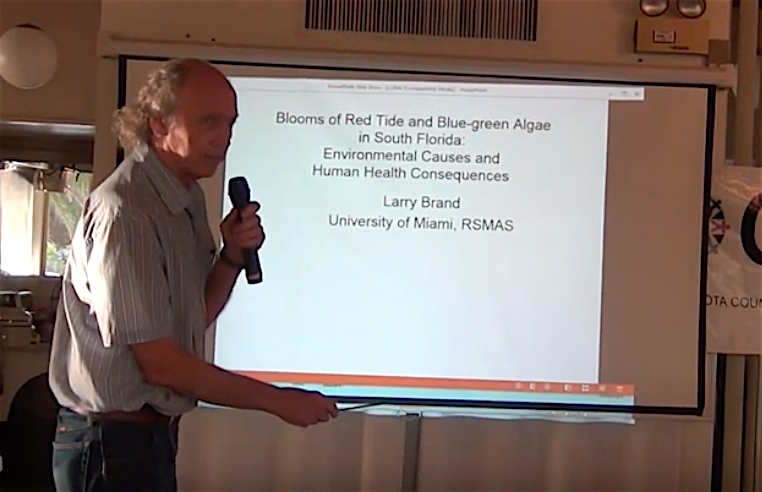
Larry Brand acknowledges that his theories about red tide and blue-green algae have proven controversial
Larry Brand addresses the CONA audience on June 10 in Sarasota. Image courtesy of CONA
Data analysis clearly shows that the more development Florida has seen — and the higher the population has climbed — the more abundant the red tide algae has become in the Gulf of Mexico off the Southwest coast of Florida.
That is just one controversial observation for which Larry Brand, a professor in the Marine Biology and Ecology Department in the University of Miami’s Rosenstiel School of Marine and Atmospheric Science, has been criticized, Brand told the audience during a June 10 presentation for the Sarasota County Council of Neighborhood Associations (CONA).
From 1954 to 1963, Brand explained, data shows that the number of red tide cells in blooms in the Gulf was about 2.5 million per liter. From 1994 to 2002, he continued, that level had increased about 15-fold — to 34.7 million cells per liter. “It’s getting worse.”
For that dramatic an increase to occur, he pointed out, the red tide algae — Karenia brevis— needed 15 times more nutrients.
“I can’t think of any natural nutrient sources that have increased 15-fold over the last 15 years,” he told the audience.
Then where did those nutrients come from? “Basically us,” he said, from agricultural operations and sewage, among other examples.
“A lot of people are not happy about my conclusions,” Brand acknowledged.
Nonetheless, he noted, “I used the raw data.”
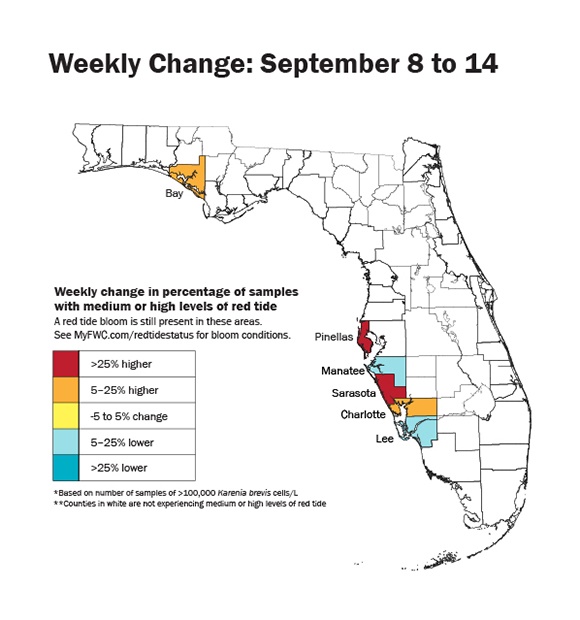
A Florida Fish and Wildlife Conservation Commission shows changes in red tide concentrations between Sept. 8 and Sept. 14, 2018. Image courtesy FWC
Sediment cores taken from Charlotte Harbor from the 1800s on into this century, he said, have demonstrated that the increase in nutrients in that body of water is comparable to the rise in population in Florida.
He also showed the audience several graphs depicting the increase in red tide algae cells in the Gulf during the wet seasons over the past decades, as more runoff flows from inland waterways into that big body of water.
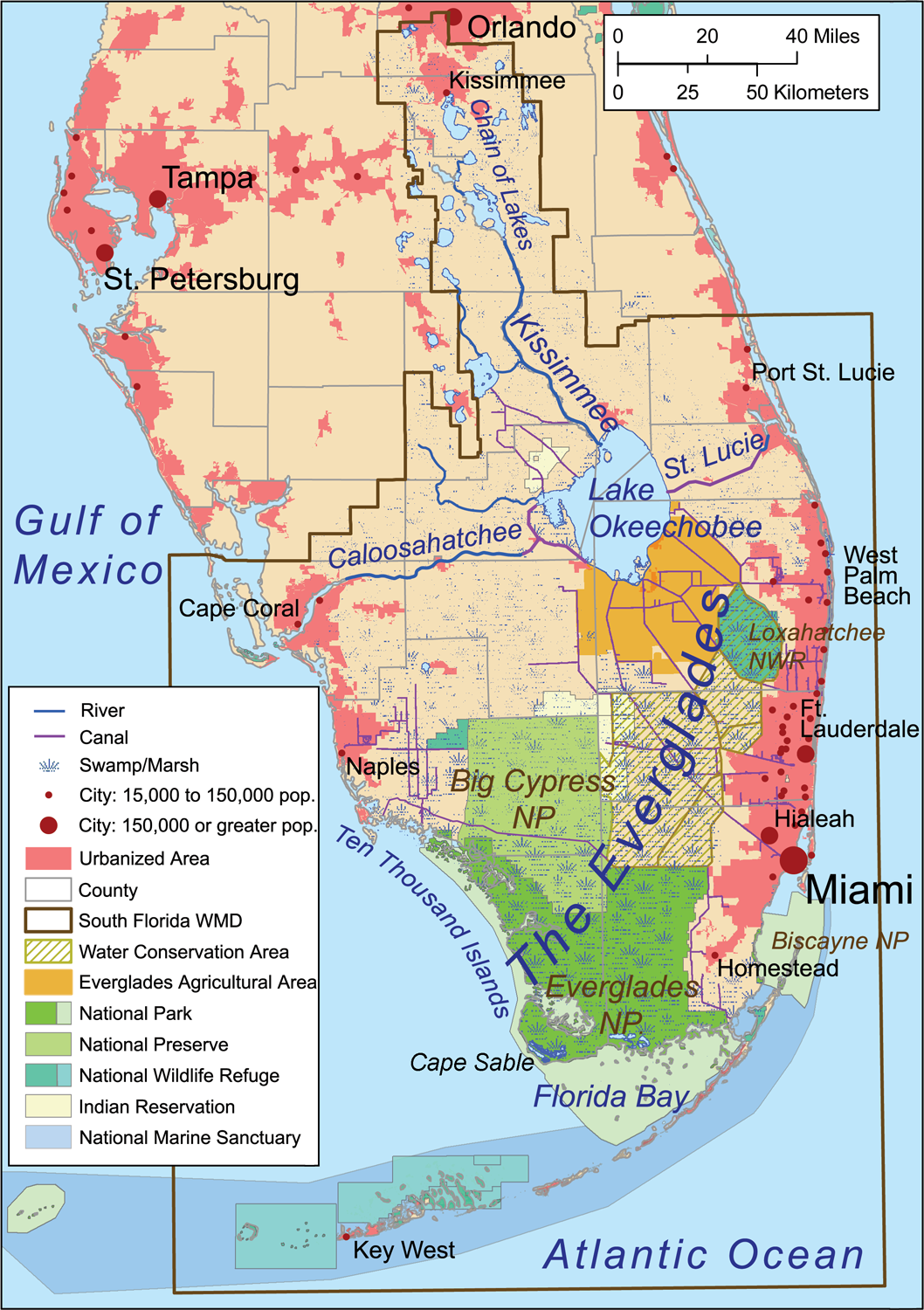
“A lot more nutrients are coming down the Caloosahatchee River,” he added, noting that the U.S. Army Corps of Engineers (USACE) “greatly enlarged” a connection from the river to Lake Okeechobee about 1960.
Initially, Brand pointed out, the lake’s watershed was much smaller. However, over the years, it was enlarged fourfold, to include the sugar cane fields to the south, the Kissimmee River Basin and the Everglades.
“A lot more nutrients are coming down the Caloosahatchee River,” he said, which flows west to the Gulf of Mexico.
A map shows the Everglades and the Caloosahatchee River. Image by Kmusser via Wikimedia
As the News-Press explains, the releases are designed “to protect thousands of lives south of the lake, as well as large agriculture operations and drinking water sources for millions of Floridians.”
The nutrients also flow to the southwest coast in the Peace River, Brand told the CONA audience.
Whenever he goes on a cruise, he continued, he always sees “a higher amount of algae near the mouth of [the Caloosahatchee].”
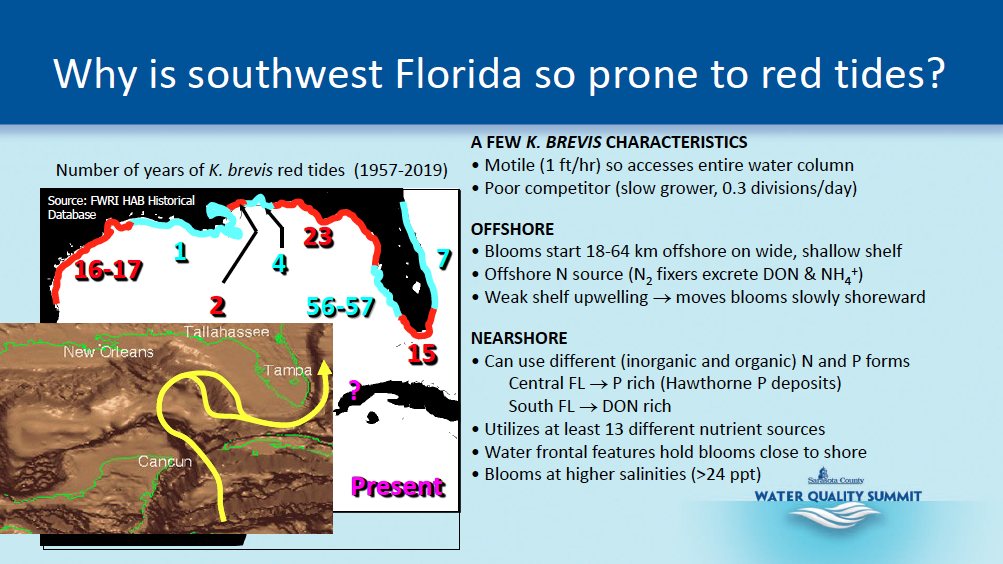
Brand also talked — as red tide researchers with Mote Marine Laboratory have — about the fact that the flow of the Loop Current in the Gulf of Mexico has an effect on red tide blooms. “We never get a red tide when the Loop Current is in the southern position.”
A graphic shows details about the loop current and the continental shelf off the west coast of Florida, both factors in red tide blooms, scientists say. Image courtesy Sarasota County
Brand further concurred with other red tide researchers in explaining that nitrogen is the biggest source of food for Karenia brevis.
The health concerns
During his presentation, Brand also devoted time to the health concerns related to the toxin — called brevetoxin — produced by the red tide algae.
The primary effect, he noted, is respiratory irritation. During the height of blooms, he said, hospital records show that 50% of patient visits were for respiratory distress.
A review of the records also found a 56% rise in cases of bronchitis; a 44% increase in asthma; and a 31% increase in pneumonia, according to a slide he showed the audience.
When the amount of red tide algae in the water reaches the level of 100,000 cells per liter or higher, he added, that is when fish begin dying and people get sick. The discoloration of the water is evident at that level, he noted.
However, periods when the algae is present at levels below 100,000 cells per liter also have increased “quite a bit” in frequency, Brand said.
Thus, even when fish are not dying, he stressed, the algae is present in the Gulf.
About 30 different species of fish absorb the brevetoxin, he continued. Research has shown that those species “all have sub-lethal concentrations of the brevetoxin in them.”
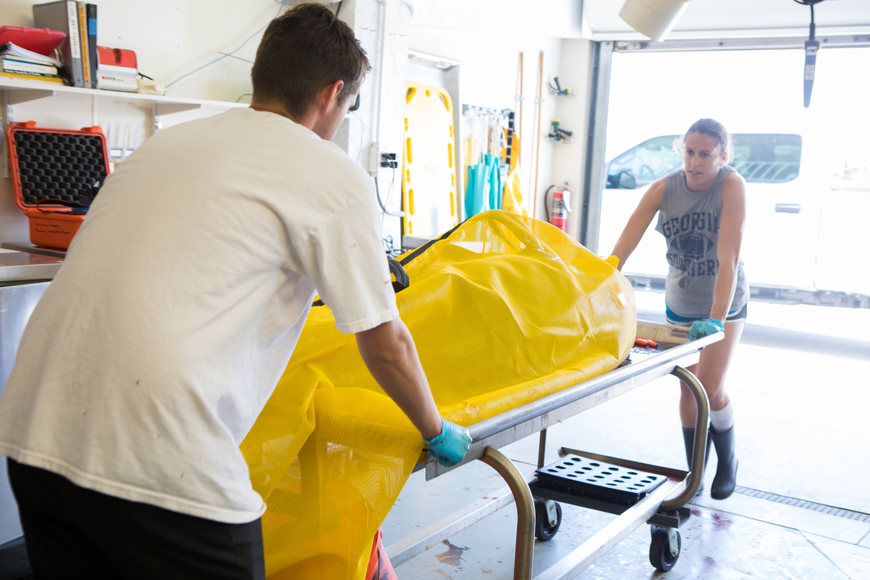
Mote Marine Laboratory staff members bring a deceased dolphin into Mote’s facilities on City Island in August 2018, so a necropsy can be performed to determine if red tide exposure caused the death. Photo by Connor Goulding of Mote Marine
Necropsies performed on dolphins that have died in the Gulf, Brand pointed out, also have provided evidence that the mammals were “packed full of brevetoxin.”
He said he believes those deaths were linked to the amount of fish the dolphins had eaten.
Additionally, Brand told the audience, he suspects that a documented, 40% increase in gastrointestinal problems in humans during red tide blooms is linked to people eating fish that have accumulated the brevetoxin.
The history and the science
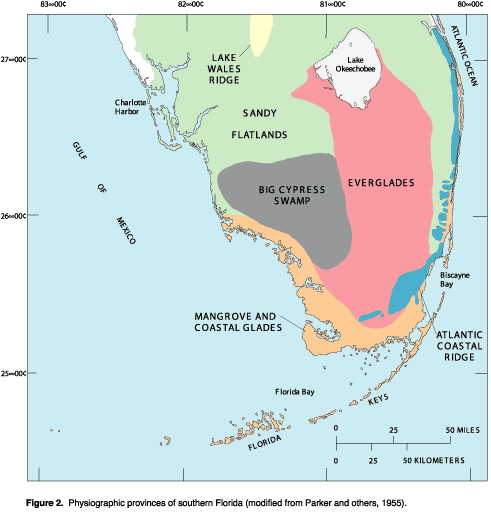
Brand used more graphics as he talked about the geology of Florida, showing how water came to be channeled between two ridges — the Lake Wales Ridge and the Atlantic Coastal Ridge on the eastern side of the state. That water flowed as though it were in a trough, through the basins in that part of the state, as it made its way south to Florida Bay, Brand said.
After the last Ice Age, as the sea level rose and Florida became more humid and experienced more rainfall, he noted, the trough became a wetlands. The Everglades, which is about 5,000 years old, he added, is part of that wetlands.
Over time, he pointed out, all of the organic materials from plants built up into organic peat in that trough, which was “extremely rich in nitrogen.”
A map shows the Lake Wales Ridge, the Atlantic Coastal Ridge and other features of south Florida. Image from the U.S. Geological Survey Archive
Wetlands naturally trap the nitrogen and store it, he said.
When humans drained the wetlands — as they did with the northern third of the Everglades — that organic peat was exposed to the air, he continued; bacteria began attacking it and decomposing it. The nitrogen then was released.
Before the Everglades was drained, Brand said, the organic peat was up to 15 feet deep. “All that nitrogen just ran downstream.”
In 1959, Brand pointed out, as the Cuban Revolution was underway, the United States Government seemed unable to find a way to unseat Fidel Castro as the new leader, so the U.S. began focusing on how it could destroy the Cuban economy. That economy, he emphasized, was based largely on the cultivation of sugar cane.
The U.S. Government began subsidizing the sugar cane industry in South Florida, he said, which led to about a tenfold increase in the size of the crop.
Yet, even though the “huge drainage” of the Everglades occurred in the 1960s, Brand noted, the algal blooms did not start until the 1980s. “What happened? … To keep the sugar cane fields dry, you’ve got to pump out the water, just like The Netherlands.”
The U.S. Army Corps of Engineers (USACE) installed giant pumps and reversed the flow of water into Lake Okeechobee, Brand explained. Instead of water heading south, the water flowed from the lake into the Caloosahatchee and St. Lucie rivers.
However, the filing of lawsuits around 1980 forced the USACE to stop most of the back pumping, he said, leading to a “huge increase of water heading south.”
By the late 1980s, he said, the blue-green algal blooms began in Florida Bay.
The FDEP (Florida Dept. of Environmental Protection) has issued a Consent Order to Sarasota County. It requires Sarasota to move to Advanced Water Treatment, to rid our canals and bays of nitrogen-rich discharges that feed Karenia Brevis -- Red Tide.
The upcoming planning workshop about the future of our public lands near the Celery Fields (the Quads) is open to new ideas -- alternatives to heavy industry included -- but don't plan to propose them at the workshop -- Send them in advance, says lead planner Steve Kirk.
Sarasota County is under fire for the massive amount of treated wastewater that has spilled from its Bee Ridge treatment facility into local waterways. Three nonprofits have told the county they plan to sue if it cannot figure out how to stop the spillage.
The issue, said Suncoast Waterkeeper founder and executive director, Justin Bloom, is much more complicated than just an overflow of wastewater.
Sarasota County’s issues are two-fold, he said.
"Part one is the collection system, which is in disrepair and spills sewage, particularly when it rains a lot,” he explained. “Part two is the reuse system. It’s not a problem with their capacity to treat gallons of sewage. They’re able to treat the sewage the way the treatment facility is designed. The problem is there’s not a lot of demand for the treated wastewater.”
Mike Mylett, division manager for water and wastewater for Sarasota County public utilities, said demand for reclaimed water is down because of a wet winter season.
“People aren’t irrigating as much as they normally do so there’s more reclaimed water (left over).”
Bloom, however, argues that the reason demand is down is more complicated than that.
“There’s so much nitrogen in this partially treated wastewater that the end users don’t want it,” he said
Weir where excess water from Bee Ridge Water Treatment Plant is discharged
He added that documentation shows Sarasota County’s treated wastewater has 18 or 19 milligrams per liter of nitrogen. He used other plants like the city of Sarasota's and Bradenton's as a comparison, both of which have three or less miligrams per liter of nitrogen in their treated wastewater.
Rich plantlife in overflow pond beyond Water Treatment Plant Weir
“It is acknowledged throughout the scientific community that human sources of nitrogen significantly fuels red tide,” Bloom said. “So I'm making a connection between these failing sewage systems in Sarasota and throughout the region and increased nitrogen in our local waterways which fuels red tide."
This isn't the first time an area city has dealt with wastewater spillage into major waterways. In 2016 and 2017, the City of St. Petersburg was under scrutiny for the hundreds of millions of treated sewage waters that flowed into local waterways.
Stopping the Sarsota County spillage is an issue that needs to be addressed immediately, said Bloom.
He claims, currently, the Bee Ridge treatment facility is spilling multiple gallons of treated wastewater on a daily basis into a wetland that leads to Phillippi Creek.
A long-term solution is already underway, according to Mylett. He said the county is working with the Florida Department of Environmental Protection to install two aquifer recharge wells to hold excess water.
The wells will cost about $14.2 million, and Mylett said funds are already secured.
“It’s part of the utility rates. That’s a normal capital improved project budgeted item.”
As far as addressing how the wastewater is treated and the amount of nitrogen in it, Sarasota County has not made any public statements about if they will be making changes.
Bloom said the county would benefit from upgrading the treatment system sooner rather than later. Coastal areas like Sarasota, he explained, must get in front of water pollution in whatever way they can.
“We know how to keep this out of our streams and creeks and estuaries. It's expensive, but the technology is there. We're learning more and more about how (wastewater) contributes a significant amount - more than I think was originally realized - of pollution, particularly nitrogen pollution in our estuaries.," he said. "We know how to fix it and the municipalities needs to step up and fix their systems.”
Sarasota County has repeatedly discharged excess reclaimed water from the Bee Ridge Wastewater Treatment Facility to surface waters in the Phillippi Creek watershed since at least 2013, according to the Sarasota Herald Tribune (Wed. 3.20.19).
"These spills have sent raw sewage streaming into streets, storm drains and/or adjacent surface waters, posing serious public health threats and creating a severe nuisance in exposing substantial numbers of people to raw sewage,” the letter states. “These spills have been caused by a variety of poor or inadequate system maintenance, operation, repair, replacement and rehabilitation practices."
According to the County’s own information, this direct discharge has occurred continuously since Dec. 12, 2018 at an average rate of between 2.5 million and 3 million gallons each day, with an average nitrogen concentration of 17.9 milligrams per Liter. That concentration is more than ten times the state's maximum acceptable limit of 1.65 mg per Liter.
Dead fish on Sarasota beaches in 2018-19
The resulting nitrogen load from this extended “event” is over 33,000 pounds -- virtually the same magnitude as the County's 2016 estimate for all of the septic systems in the Phillippi Creek watershed for an entire year.
According to stormwater experts, this is a serious matter, and does real damage to the County’s reputation and credibility. Given the scientific evidence that nitrogen is a key fuel source for red tide, it is not acceptable that this has been occurring since 2013. While all the while Sarasota County Government has touted to the public its commitment to water quality. Someone needs to be held accountable.
The Suncoast Waterkeeper has identified this long term and blatant violation and sent a Notice of Intent to File Suit under the Clean Water Act to Sarasota County on Feb. 20, 2019. We fully support their efforts as someone needs to be looking out for the best interest of the County’s residents.
Brand is a professor of Marine Biology and Ecology at the Rosenstiel School of Marine and Atmospheric Science at UM.
Larry Brand - photo: Tiffany Tomkins Bradenton Herald
In 2007, he published research with colleague Angela Compton that attributes a long-term increase in red tide severity directly to human activity. The study made use of date collected by the Florida Fish and Wildlife Research Institute from 1994 to 2002.
Brand and Compton’s conclusions are in direct contrast with other prominent red tide researchers in the state of Florida, including Mote Marine Laboratory and the Florida Fish and Wildlife Commission.
Both Mote Marine Lab and FWC claim that there is no direct evidence linking nutrient pollution with the frequency or start of red tide blooms.
Brand disagrees with how they are interpreting the data.
The culprit behind intense harmful algal blooms, Brand says, is nutrient overload in state waters due to human activity. Brand says that the nutrients that cause extreme red tide blooms are carried to Florida’s west coast from Lake Okeechobee via the Caloosahatchee River.
Harmful algal blooms aren’t just a Florida problem. The issue is popping up all over the world.
“We’re having to feed seven and half billion people on this planet now,” Brand said. “That takes a lot of food. That takes a lot of nutrients. The two major nutrients you need are nitrogen and phosphorous.”
Those same nutrients will feed algal blooms when out of proportion, Brand explained.
“When you fertilize your crops, you’re not 100 percent efficient. Basically the algae need the same exact nutrients as the higher plants do on land. So you have this runoff of these nutrients and you generate algal blooms.”
Florida’s natural geology also comes into play.
Phosphate deposits on the west coast enrich waters with phosphorous, while limestone-dominated east coast waters are richer in nitrogen. The balance is thrown further out of whack by the extra nutrients, allowing harmful algal blooms to thrive.
In addition to runoff from farmlands, Brand says that the drainage and rerouting of Florida’s waterways has caused natural nutrient deposits buried over thousands of years to become exposed.
Nutrient pollution and subsequent harmful algal blooms have dramatically increased since the government started subsidizing the sugar industry in the 1950s, Brand says.
"We need to try to move towards science-based and common sense water policy,” said Andy Mele with Suncoast Waterkeeper.
Replacement of septic tanks and upgraded stormwater systems also would make big impact, Jon Thaxton tells Siesta Key Association members
Former County Commissioner Jon Thaxton addresses Siesta Key Association members on Oct. 4. Rachel Hackney photo
Education is perhaps the biggest key to mitigating red tide blooms, former Sarasota County Commissioner Jon Thaxton told about 45 people at the Oct. 4 Siesta Key Association (SKA) meeting.
“I think ignorance is probably our greatest enemy in this fight,” he said.
Thaxton acknowledged that he was one of the primary proponents of the county’s ban on nitrogen-based fertilizer use during the rainy season each year, as well as the force behind creation of the county’s Stormwater Utility, which was the first in the state.
The nitrogen human beings add to the environment is one of the major feeders of the algae that causes red tide, Karenia brevis, he pointed out.
In response to questions from audience members, Thaxton suggested that county staff could put notices in utility bills to remind customers each year of the nitrogen fertilizer ban from June through September. He called that a “really, really simple way to get the messaging out.”
When one audience member questioned whether law care company employees adhere to the county’s ordinance, Thaxton replied, “I have less of a concern with the professionals than I do with the non-professionals.”
People who are in the law care business have to take a course that explains the facets of the county’s regulations, he pointed out.
Then he invited the audience members to visit a store such as Lowe’s or Home Depot and look at “these mountainous stacks of fertilizer.” If they went back four days later, all of it would be gone, he added, with homeowners primarily having been the purchasers.
Thaxton said people think using more fertilizer is better, likening that to the rationale a person who feels poorly often utilizes: If one aspirin will help, “two pills will make me feel great.”
Yet, Thaxton explained, “Over-fertilizing actually harms the lawns.”
Much better enforcement of county regulations would help with red tide, too, he continued. However, he cautioned that enforcement without education angers people and makes them even less likely to follow the rules.
“Today, you will hear no state or local elected official looking to compromise the integrity of any rule, law or ordinance that protects our waterways,” he pointed out. Yet, when the Gulf of Mexico once again is clear, he added, efforts will resume to reduce pollution prevention.
“As a community,” Thaxton said, “we need to remember the suffering that we have now. … This is a systemic, land-use created issue.”
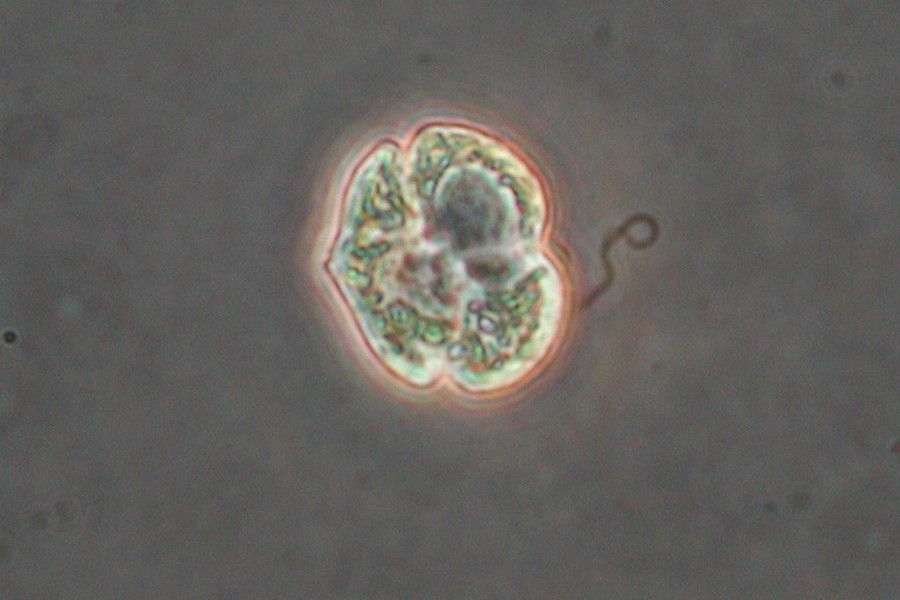
This is a Karenia brevis cell. Image courtesy of Mote Marine Laboratory
As a senior vice president for community investments with the Gulf Coast Community Foundation, Thaxton reported, “We are already starting to see evictions and children missing school” because of the downturn in business resulting from national publicity about the current red tide bloom, which worsened this summer. In another 30 to 60 days, he added, he believes more families will lose their homes, as many people working in service industry jobs have lost income.
“You have yet to see the economic impact of this red tide,” Thaxton said. If the current bloom subsides, and the area experiences no problems for the next three to four years, he predicted it would take that long for the economy to recover.
The feeding of the algae
“Red tide is always in the Gulf of Mexico,” Thaxton explained. “The blooms come and go.” What makes them worse — such as the one Southwest Florida and the Panhandle and Palm Beach County have experienced, he continued — is the nitrogen-rich water the algae feeds on as it comes near the shoreline.
“If you have this toxic organism and you are now actually feeding it,” he said, the bloom “is now going to be significantly more intense” and cover a larger area of the coast.
Some researchers believe that nitrogen from the decomposing fish killed by Karenia brevisalso has been feeding the algae, Thaxton noted.
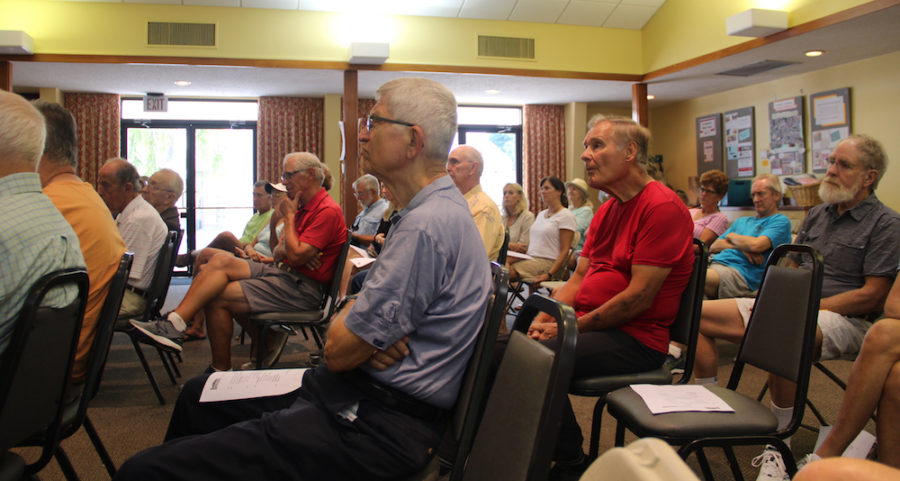
SKA members listen to Jon Thaxton’s remarks on Oct. 4. Rachel Hackney photo
Leaking septic tanks are a source of the nitrogen along with fertilizers, he pointed out.
Robert Luckner, a member of the SKA’s Environmental Committee, noted that when the county won voter support in 2009 for the most recent penny tax to support a variety of infrastructure projects, about $20 million of the resulting revenue was to have been put toward new sewer systems to replace septic tanks. Yet, Luckner said, based on research he has undertaken, less than one-quarter of that money has been spent on that initiative since 2009.
(In the 2019 fiscal year budget, which the County Commission adopted on Sept. 27, $32.5 million has been allocated to a variety of wastewater projects, including more septic tank replacements. In an update provided to the board during a May 25 budget workshop, staff proposed slightly less than $2.5 million just for the septic tank replacement program, with the funds coming out of surtax revenue and income from utility payments. The county has budgeted another $2,390,000 for stormwater projects. The fiscal year began on Oct. 1.)
Unfortunately, Thaxton told Luckner, in the 1960s and 1970s, the county paid the “lion’s share” of the expense for new developments. It was cheaper to put in septic tanks, he continued, than to build sewer systems. Although the federal government began providing funds in the 1970s for central sewer systems, Thaxton added, county leaders waited until the 1990s to “really aggressively begin removing septic tanks,” and by that time, the federal assistance had ceased.
Thus, Thaxton said, county taxpayers and residents with septic tanks have had to bear most of the cost for the conversions to central sewer systems.
County Commission Chair Nancy Detert recently told him, he said, that the allocation for such conversions in the county will end around 2020 or 2022, “and we still have a lotof septic tanks that are in the water table, which is really a shame.”
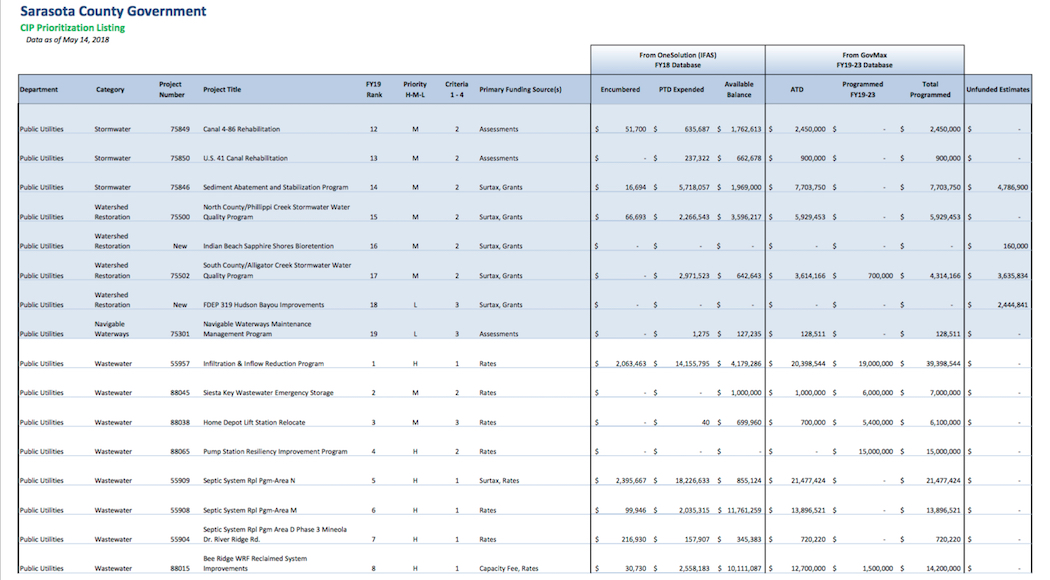
This section of the updated Sarasota County Capital Improvement Program proposed for 2019, as of May, lists septic tank replacement initiatives, among others. Image courtesy Sarasota County
In response to another question, Thaxton said that replacing the oldest septic tanks with central sewer systems would have “a huge impact. … All the barrier islands should be a priority area” for the endeavor, he added.
Other efforts that would be very helpful, Thaxton continued, would be the updating of stormwater runoff regulations and a review of land development regulations to determine other potential mitigation measures.
Stormwater systems remove only 40% of the nitrogen and phosphorous before the water makes it to the bays and the Gulf, he explained. If improved systems could increase that to 60%, he pointed out, that would have a significant impact.
“I believe all of this can happen without impeding any of the economic development, growth, commerce that we have. … It’s just about doing something a little bit better.”
Yet another recommendation Thaxton offered is making the collection of data a priority. Then scientists would be able to show the most cost-effective ways to keep the largest portion of man-made nitrogen out of the waterways. “Right now, there’s no focus on that at all; there’s just not.”
One audience member noted that he recently had learned that scientists have developed methods for identifying specific sources of nitrogen in the water.
“I don’t like pointing fingers,” Thaxton replied.
However, Thaxton continued, the City of Venice is looking at using meters at its eight major stormwater outfalls into the Gulf of Mexico, so city staff members can record water quality and water quantity data in real time. They could use the information to detect how much nitrogen is going into the Gulf, he added, as well as the types of nitrogen.
Not all of the approximately nine different types, he said, serve as food for the red tide algae.