Tomorrow, January 18, 2023, you will be asked to approve a change to the interconnectivity element of the Fruitville Initiative Ordinance - an element that until now has remained in force despite other developers within the Initiative having requested to be excused from it. The entire premise of the Initiative, as put forth at charrettes held by Stefanos Polyzoides in 2010, invoked a model of a walkable mixed-use community. The Interconnectivity component was the core enabling element that guaranteed a grid of streets to render walkability possible.
Original Plan for Interconnectivity:
Revised Plan removing interconnectivity from the County Administration site (lower, far-right parcel):
Bottom right parcel without street grid
Having held all the other developers to this component, Sarasota County is now coming before itself - that is, this Board - to ask your permission to not be held to this core standard, with regard to the construction of the new Administration Building on a site known as parcel F7.
In its documentation, the applicant (Sarasota County) presents no site plan or other information explaining why this exemption is necessary. It would seem reasonable to ask the applicant for a detailed rendering of its plan, if such exists, or at the very least, some clear and sufficient explanation of why it is seeking this dispensation that has been denied to all other Initiative stakeholders.
This seems even more significant when it's understood that this plan to flout the core value of walkability is for the county's Administration Center -- the tax-funded building serving as the County seat. Surely the public deserves a look at what architectural design the county has in mind, and an understanding of why the plan for the new symbol of Sarasota governance has to undermine the organizing principle of its own forward-looking Fruitville Initiative ordinance.
Consider that when this Board was asked to allow a completely incompatible plan presented by Benderson Development in 2015, it unanimously voted to deny that request. The vision of the Initiative was intact then, and deserves not to be ignored in 2023.
Please take this item from the Consent Agenda and request a public hearing that would give you and the public a first look at a project that can and should embody the values and vision of the people of Sarasota.
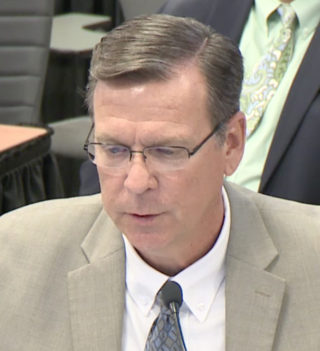
Scott Schroyer addresses the County Commission on March 29. News Leader image
Scott N. Schroyer, who had served as director of Sarasota County’s Public Utilities Department since early fall of 2014, has left that position, The Sarasota News Leader has learned.
In response to a News Leader request for information about the situation, county Media Relations Specialist Brianne Grant provided a statement in an April 30 email.
“There has been a change in leadership and focus in the county’s Public Utilities Department,” the statement began. “The relationship with an at-will employee may be terminated any time by either party. As an organization, we recognize that the services provided by our Public Utilities Department [are among] the most vital to our community. Focusing on customer service [and] improving our utilities infrastructure are key factors in moving forward,” the statement added.
Schroyer began his employment as the Public Utilities director on Oct. 6, 2014, Grant wrote. His last day with the county was April 10; his ending salary was $139,588.80, she noted.
Mike Mylett, who has been with Sarasota County for 19 years, has been named the interim director, Grant reported.
The News Leader was unsuccessful in attempts to reach Schroyer.
Mylett appeared before the County Commission last week in his new capacity. However, most of the memos in the agenda packets for Public Utilities Department items for the April 23 and April 24 board meetings listed Schroyer as the director. Mylett was named on only two of them. One pertained to a contract amendment for new pipes and fittings for potable water, reclaimed water and wastewater utilities. The other involved water demand projections from 2020 to 2040, in the context of the county’s contract with the Peace River Manasota Regional Water Supply Authority.
When then-County Administrator Tom Harmer announced Schroyer’s hiring in a Sept. 18, 2014 news release, Harmer said of Schroyer, “His strong management background and his experience in the public works field will be a great asset in serving our residents and utility customers.”
The release noted that Schroyer had more than 30 years of experience in local government. He had worked for the City of Hudson, Ohio, since 1984, the release pointed out, “most recently serving as its assistant city manager beginning in June 2011 and its interim city manager from late 2013 through July 2014.”
Throughout his career, the release continued, Schroyer has specialized in public works/utilities, including the operational management of water, wastewater, stormwater and electric utilities. He also has held licensing in water distribution and wastewater collection systems, the release noted. As the Hudson, Ohio assistant city manager, the release added, his responsibilities included “strategic oversight of the utility system.”
County Administrator Jonathan Lewis introduced that part of the workshop by explaining that the Florida Legislature would be convening earlier in 2020 — in January instead of March — because next year is an election year. Lewis said staff wanted to ensure the commissioners have an opportunity to tweak water quality priorities with an eye toward applying for state funding assistance.
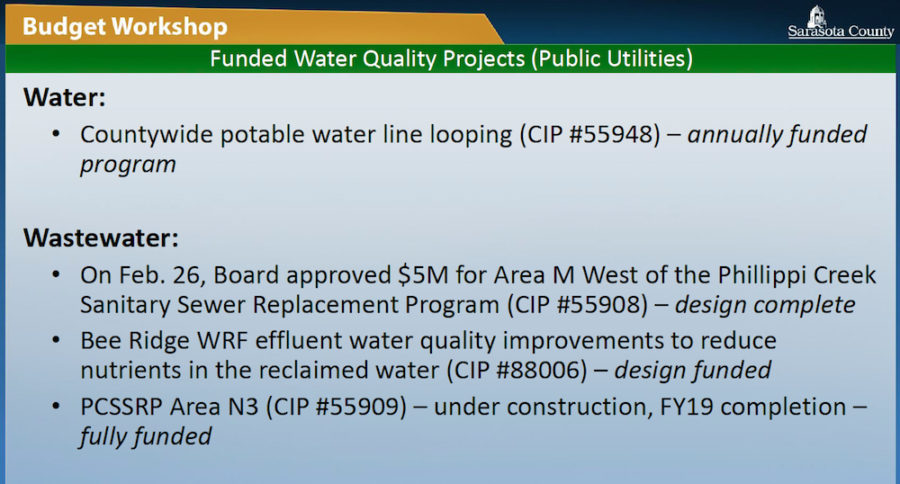
That day, commissioners criticized Schroyer, Assistant County Administrator Mark Cunningham and County Engineer Spencer Anderson, because slides they trio showed the board lacked detailed information.
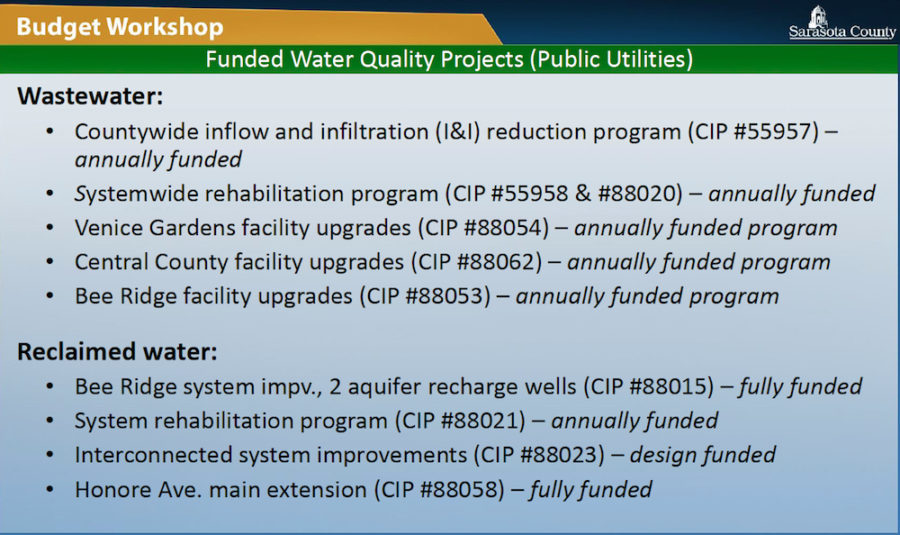
This is one of the slides that drew commission criticism on March 29. Image courtesy Sarasota County
For example, Commissioner Nancy Detert complained to Schroyer that none of the slides had timelines, so she had no idea when a particular project was scheduled for construction — or whether it was on the construction list for the next five years. (The commission each year approves priorities in its Capital Improvement Program — CIP — for five years, though only the projects listed in the first year generally will be pursued; priorities often change year-to-year.)
Additionally, Commissioner Alan Maio called for more details to be included for the public in discussions involving the county’s long-term initiative to eliminate septic tanks in the Phillippi Creek Basin.
The litigation
That March 29 budget workshop was held nine days after the Sarasota Herald-Tribune reported that three nonprofit environmental organizations — the Suncoast Waterkeeper, Our Children’s Earth Foundation and the Ecological Rights Foundation — had filed notice of intent on Feb. 20 that they would bring suit against the county in federal court.
The civil action would be a response to the nonprofits’ allegations of county violations of the U.S. Clean Water Act. They contend that the county illegally discharged “raw sewage, partially treated sewage and/or treated reclaimed water into Phillippi Creek, Cowpen Slough, Whitaker Bayou, and streams and other waters that are tributaries to Sarasota Bay, Roberts Bay, Dona/Roberts Bay and the Gulf of Mexico in or adjoining Sarasota County.”
This is a banner from the Suncoast Waterkeepe’s website. Image courtesy of Suncoast Waterkeeper
The primary focus of the complaint was the county’s Bee Ridge Water Reclamation Facility, located at 5550 Lorraine Road in Sarasota. The nonprofits say in their suit that “treated wastewater effluent that meets public access quality standards is stored on-site” at that facility in a 2-million gallon, above-ground storage tank, as well as in a storage pond encompassing 29.4 acres that is capable of holding 145.2 million gallons. (A county fact sheet says the storage pond has a maximum capacity of 170 million gallons per day.)
The county operates a North Master Reuse System, the complaint continues, “to provide treated effluent from the Been Ridge [facility] … primarily for a golf course and residential irrigation for approximately 5,500 acres of land.”
That reclaimed water “contains high levels of nutrients,” the nonprofits argue, “and [it] is not treated for surface water discharges.”
(During the March 29 budget workshop, Assistant County Administrator Cunningham reported that all three of the county’s water reclamation facilities are “classified as advanced secondary [treatment plants].” He added that FDEP allows 15 to 20 mgs of nitrogen per liter, but the nitrogen count following treatment in those facilities is about 12 to 15 mgs per liter.)
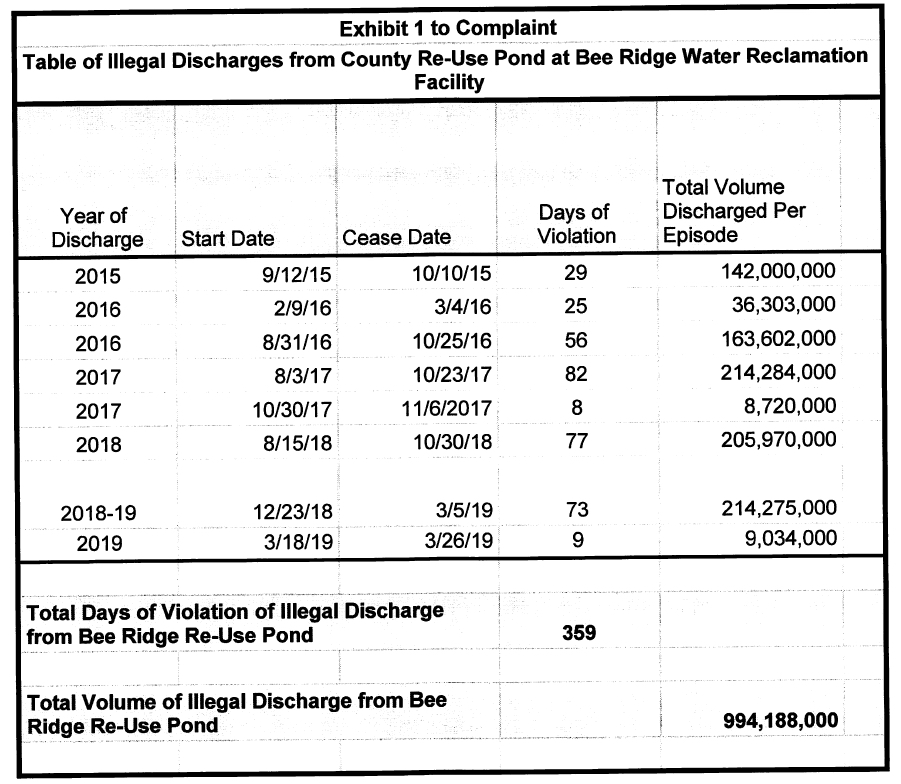
According to an exhibit filed with the lawsuit, the nonprofits contend that the county illegally has discharged close to 1 billion gallons from the Bee Ridge pond since September 2015: 994,188,000 gallons. The highest volume for a continuous period, that exhibit shows, was 214,284,000 gallons from Aug. 3, 2017 to Oct. 23, 2017 — 82 days.
This is an exhibit filed with the federal lawsuit. Image courtesy U.S. District Court for the Middle District of Florida
The suit asks the court to make the county cease the illegal discharges. Additionally, it calls for the assessment of
civil penalties against the county of up to $37,500 per day for each violation on or before Nov. 2, 2015 and $54,833 per day for each violation after Nov. 2, 2015.
Since at least 2013, the complaint continues, the county “has reported numerous discharges of Reclaimed Water from the Bee Ridge storage pond into the stormwater system,” and those discharges “have increased in duration and volume over time, with the knowledge of the County and with no adequate measures taken to prevent or cease these discharges.”
Moreover, the suit contends, “The County has reported numerous overflows of raw sewage from the County’s sewer lines, manholes, pump stations” and various other sections of its overall collection system.
The spills are documented in forms the county had to file with the Florida Department of Environmental Protection (FDEP), the complaint points out.
“The County’s discharges of raw sewage, partially treated sewage and/or treated reclaimed water … degrade water quality and harm aquatic life in [the affected] waters,” the complaint adds.
Members of the Suncoast Waterkeeper in Sarasota and Manatee counties “who reside in the vicinity of the waters affected by Sarasota County’s violations … have reasonably founded fears that the high nutrients contained [n the spills] have contributed to the conditions exacerbating Red Tide,” the complaint points out.
An August 2018 satellite image shows the presence of red tide in area waters. Image courtesy City of Sarasota
The organizations filed suit, they write, because “neither the [Environmental Protection Agency] nor the state of Florida has commenced or is diligently prosecuting an action to redress the violations alleged …”
The Feb. 20 letter the nonprofits sent the county served as the required 60-day notice before the filing of the complaint. The filing occurred on April 22 in the U.S. District Court for the Middle District Court in Tampa.
On April 22, county Media Relations Officer Drew Winchester released the following statement: “Sarasota County is aware of the civil litigation related to reclaimed water storage at the Bee Ridge Water Reclamation Facility. We are committed to improving our utilities infrastructure as water quality is a top priority for the county.”
As a matter of policy, county staff does not comment on litigation.
Commission frustrations
The Herald-Tribune article was the focus of county commissioners’ comments during the March 29 budget workshop.
For example, referring to slides about the Bee Ridge plant, Chair Charles Hines told Schroyer that details about staff plans to reduce the level of nutrients in the reclaimed water need to be part of any report Schroyer provides the board.
This is another slide presented on March 29 that drew commission criticism. Image courtesy Sarasota County
Schroyer did point out that staff has been working on a project that will see the construction of two aquifer recharge wells able to handle 18 million gallons per day at the Bee Ridge facility. The estimated $14.2-million initiative is fully funded, he added.
The estimated completion of the new wells is Dec. 31, 2023, according to a county fact sheet issued in April.
Later during the March 29 discussion, Commissioner Maio referenced the board members having been “hit with a lot of emails” after the Herald-Tribune article was published. “We need to get the word out” about the plans for those wells, he stressed. “We do not promote that!”
“Part of your job,” Commissioner Detert told Schroyer, “is to keep us informed as to what the needs are, so we don’t get [an unexpected headline].”
After the federal lawsuit was filed, county Communications staff issued the fact sheet about the Bee Ridge Water Reclamation Facility, noting that the plant is one of three such operations in the county.
In 2018, the fact sheet said, the county treated 5.1 billion gallons of wastewater countywide.
The Bee Ridge plant dates to 1994, the sheet continued. It has the capacity to treat 12 million gallons per day.
The Sarasota County Commission is currently assessing the need to redistrict our county in 2019---which could change the boundaries of our five voting districts BEFORE the scheduled 2020 US Census. If you think that citizens should play an active role in this process, contact our County Commissioners now!
Last November, voters in Sarasota County sent our County Commission a clear message. In all five Districts, voters overwhelmingly approved more direct and accountable representation from our County Commission. Starting in 2020, each Commissioner will be elected solely by the voters in his/her Voting District -- a major change from the past countywide voting system.
But in the meantime, our current County Commission is considering making changes to our Voting District boundaries this year--starting in early May. Commissioners (including two up for re-election--Mike Moran/Dist. 1, Nancy Detert/Dist. 3, and one departing due to term limits--Charles Hines/Dist. 5) would orchestrate this process themselves rather than taking the course recommended by the League of Women Voters/Sarasota County: Empanel an independent, expert committee of citizens who are not seeking public office.
The LWV also stated that when "diverse stakeholders are left out of the redistricting process, it’s more likely that elected officials will choose their voters than voters will be empowered to choose their elected officials." Link
At minimum, any County-level redistricting process must be fully transparent and should include input and feedback from county residents from start to finish.In advance of Commission discussions or decisions, residents should know key background information--including:
·What universal criteria determine the need to redistrict---FL Statutes, etc?
· Which standardized data sources will be used to determine current population (US Census, other?)
·What methods and software will be used to "balance" each district?
Such questions have been posed to Sarasota County, but not answered. Waiting until County staff delivers a report to the Commission in early May is not adequate or appropriate. Residents and voters should not be passive bystanders in this process. We need answers to key questions beforethe May meeting, preferably at a public, interactive workshop.
A news report on the County Commission meeting on April 9th indicated that Commissioner Detert proposes that Commissioners "make this the most open, transparent and, frankly, televised exercise that the county's ever been through." "...Additionally, Detert said, “I think we all need to work on restoring the average person’s faith in their own government."
Please act now. Words and promises alone mean little. Send a message to our five Commissioners athttps://www.scgov.net/government/county-commission-bcc. We the People must play a key and active role in the County redistricting process. Your vote is your voice.
Kindra Muntz, President, Sarasota Alliance for Fair Elections
Bill Zoller, Past President, Sarasota County Council of Neighborhood Assoc. (CONA/Sarasota)
Pat Rounds, Past Sec'y, Sarasota Alliance for Fair Elections
The Quads -- four parcels near the Celery Fields -- are public lands. We own them, but we could lose them to James Gabbert's trucks or Bob Waechter's warehouses.
Here is the objective set in the I-75 Corridor Study, a forward-looking plan done by County Planning in 1989.
Here is James Gabbert's planned Waste Transfer Facility (WTF), approved to be built on six acres at Porter and Palmer -- on broken roads, in clear view of the highway, with the Celery Fields in the background for highway drivers to see:
WTF indeed.
Feb. 28, 2019: Two citizens met with the lead planner for the county's new process, revising the Critical Area Plan for the Quads. The planner assured us that they are willing to speak with anyone who wishes to provide input. Also, they intend to have a public meeting open to all - not yet scheduled, but likely to be set for mid-May.
Anyone wishing to be added to the notification list can send an email to planner@scgov.net or to skirk@scgov.net. Be sure to reference this Critical Area Plan process - say something like: "CAP for the Quads near the Celery Fields" and ask to be notified of all meetings and actions.