This email today from Justin Bloom, attorney for Suncoast Waterkeeper and additional plaintiffs whose wastewater lawsuit will bring advanced wastewater treatment to Sarasota County.
Bloom wrote:
Today the Federal Judge approved our settlement and dismissed the case, while retaining jurisdiction to allow us to ensure that the County follows through on the many commitments made within the settlement. In 14 days, they start facing stipulated penalties for new spills - and failures to follow-through on all the commitment (injunctive relief) items set forth in the settlement.
On behalf of Suncoast Waterkeeper, our co-plaintiffs Ecological Rights Foundation, Our Children's Earth Foundation, our stellar lead counsel, Kaki Schmidt, I thank you for your time and your willingness to step up and help fight to protect our waterways. It is a big win.
Below is the title page followed by the key rulings and the key monitoring of the upgrade to the county's wastewater system at Bee Ridge Extension, which is due for completion by 2025.
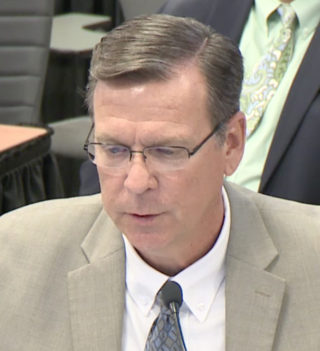
Scott Schroyer addresses the County Commission on March 29. News Leader image
Scott N. Schroyer, who had served as director of Sarasota County’s Public Utilities Department since early fall of 2014, has left that position, The Sarasota News Leader has learned.
In response to a News Leader request for information about the situation, county Media Relations Specialist Brianne Grant provided a statement in an April 30 email.
“There has been a change in leadership and focus in the county’s Public Utilities Department,” the statement began. “The relationship with an at-will employee may be terminated any time by either party. As an organization, we recognize that the services provided by our Public Utilities Department [are among] the most vital to our community. Focusing on customer service [and] improving our utilities infrastructure are key factors in moving forward,” the statement added.
Schroyer began his employment as the Public Utilities director on Oct. 6, 2014, Grant wrote. His last day with the county was April 10; his ending salary was $139,588.80, she noted.
Mike Mylett, who has been with Sarasota County for 19 years, has been named the interim director, Grant reported.
The News Leader was unsuccessful in attempts to reach Schroyer.
Mylett appeared before the County Commission last week in his new capacity. However, most of the memos in the agenda packets for Public Utilities Department items for the April 23 and April 24 board meetings listed Schroyer as the director. Mylett was named on only two of them. One pertained to a contract amendment for new pipes and fittings for potable water, reclaimed water and wastewater utilities. The other involved water demand projections from 2020 to 2040, in the context of the county’s contract with the Peace River Manasota Regional Water Supply Authority.
When then-County Administrator Tom Harmer announced Schroyer’s hiring in a Sept. 18, 2014 news release, Harmer said of Schroyer, “His strong management background and his experience in the public works field will be a great asset in serving our residents and utility customers.”
The release noted that Schroyer had more than 30 years of experience in local government. He had worked for the City of Hudson, Ohio, since 1984, the release pointed out, “most recently serving as its assistant city manager beginning in June 2011 and its interim city manager from late 2013 through July 2014.”
Throughout his career, the release continued, Schroyer has specialized in public works/utilities, including the operational management of water, wastewater, stormwater and electric utilities. He also has held licensing in water distribution and wastewater collection systems, the release noted. As the Hudson, Ohio assistant city manager, the release added, his responsibilities included “strategic oversight of the utility system.”
County Administrator Jonathan Lewis introduced that part of the workshop by explaining that the Florida Legislature would be convening earlier in 2020 — in January instead of March — because next year is an election year. Lewis said staff wanted to ensure the commissioners have an opportunity to tweak water quality priorities with an eye toward applying for state funding assistance.
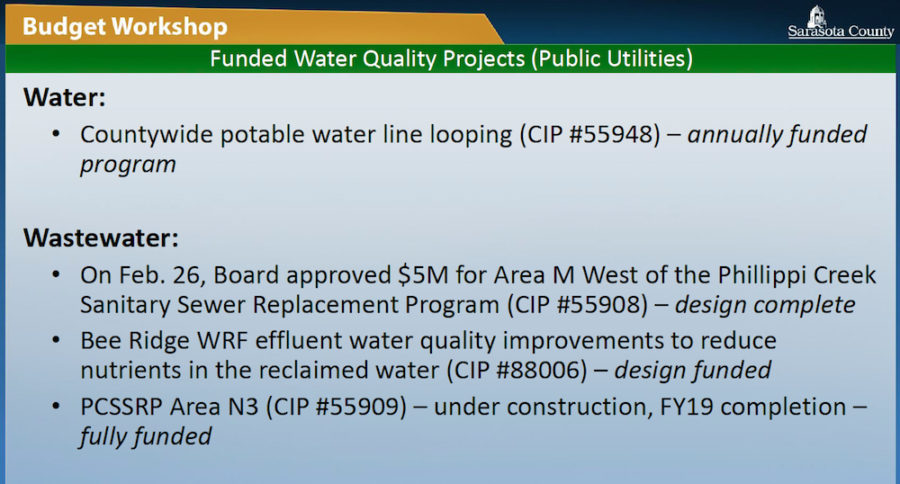
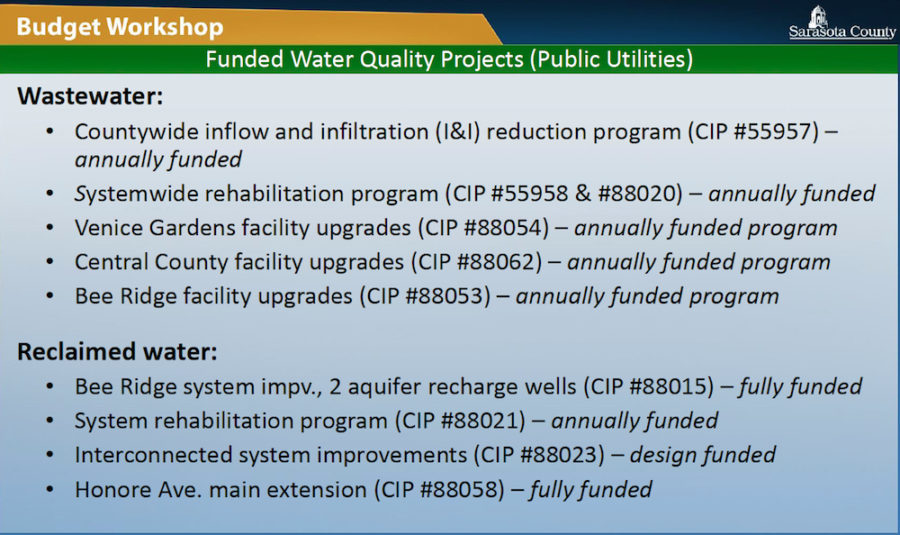
That day, commissioners criticized Schroyer, Assistant County Administrator Mark Cunningham and County Engineer Spencer Anderson, because slides they trio showed the board lacked detailed information.
This is one of the slides that drew commission criticism on March 29. Image courtesy Sarasota County
For example, Commissioner Nancy Detert complained to Schroyer that none of the slides had timelines, so she had no idea when a particular project was scheduled for construction — or whether it was on the construction list for the next five years. (The commission each year approves priorities in its Capital Improvement Program — CIP — for five years, though only the projects listed in the first year generally will be pursued; priorities often change year-to-year.)
Additionally, Commissioner Alan Maio called for more details to be included for the public in discussions involving the county’s long-term initiative to eliminate septic tanks in the Phillippi Creek Basin.
The litigation
That March 29 budget workshop was held nine days after the Sarasota Herald-Tribune reported that three nonprofit environmental organizations — the Suncoast Waterkeeper, Our Children’s Earth Foundation and the Ecological Rights Foundation — had filed notice of intent on Feb. 20 that they would bring suit against the county in federal court.
The civil action would be a response to the nonprofits’ allegations of county violations of the U.S. Clean Water Act. They contend that the county illegally discharged “raw sewage, partially treated sewage and/or treated reclaimed water into Phillippi Creek, Cowpen Slough, Whitaker Bayou, and streams and other waters that are tributaries to Sarasota Bay, Roberts Bay, Dona/Roberts Bay and the Gulf of Mexico in or adjoining Sarasota County.”
This is a banner from the Suncoast Waterkeepe’s website. Image courtesy of Suncoast Waterkeeper
The primary focus of the complaint was the county’s Bee Ridge Water Reclamation Facility, located at 5550 Lorraine Road in Sarasota. The nonprofits say in their suit that “treated wastewater effluent that meets public access quality standards is stored on-site” at that facility in a 2-million gallon, above-ground storage tank, as well as in a storage pond encompassing 29.4 acres that is capable of holding 145.2 million gallons. (A county fact sheet says the storage pond has a maximum capacity of 170 million gallons per day.)
The county operates a North Master Reuse System, the complaint continues, “to provide treated effluent from the Been Ridge [facility] … primarily for a golf course and residential irrigation for approximately 5,500 acres of land.”
That reclaimed water “contains high levels of nutrients,” the nonprofits argue, “and [it] is not treated for surface water discharges.”
(During the March 29 budget workshop, Assistant County Administrator Cunningham reported that all three of the county’s water reclamation facilities are “classified as advanced secondary [treatment plants].” He added that FDEP allows 15 to 20 mgs of nitrogen per liter, but the nitrogen count following treatment in those facilities is about 12 to 15 mgs per liter.)
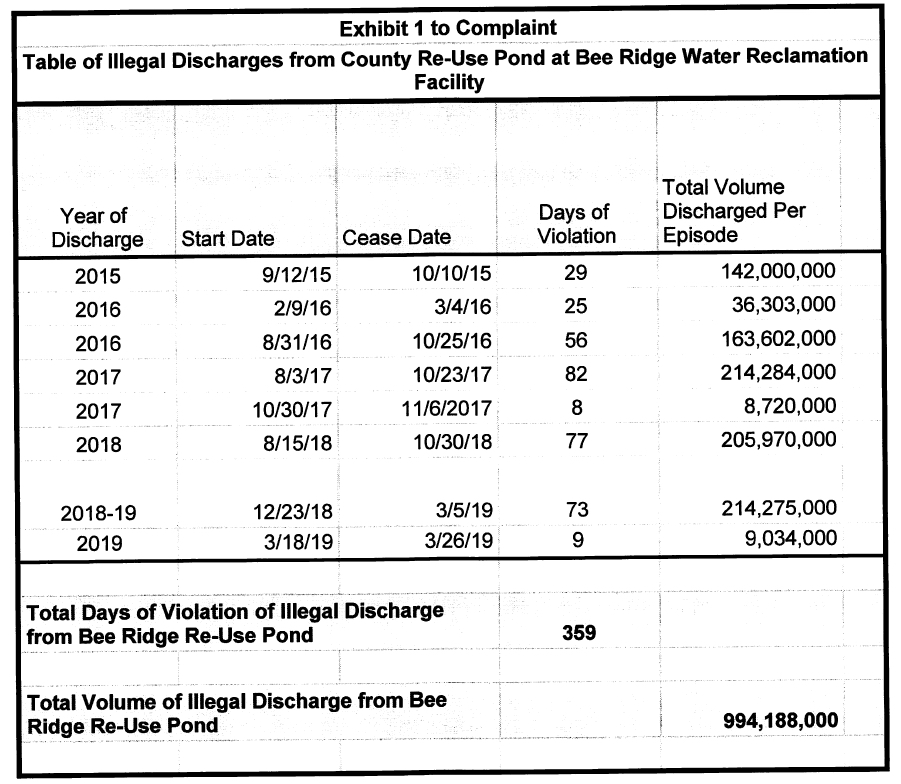
According to an exhibit filed with the lawsuit, the nonprofits contend that the county illegally has discharged close to 1 billion gallons from the Bee Ridge pond since September 2015: 994,188,000 gallons. The highest volume for a continuous period, that exhibit shows, was 214,284,000 gallons from Aug. 3, 2017 to Oct. 23, 2017 — 82 days.
This is an exhibit filed with the federal lawsuit. Image courtesy U.S. District Court for the Middle District of Florida
The suit asks the court to make the county cease the illegal discharges. Additionally, it calls for the assessment of
civil penalties against the county of up to $37,500 per day for each violation on or before Nov. 2, 2015 and $54,833 per day for each violation after Nov. 2, 2015.
Since at least 2013, the complaint continues, the county “has reported numerous discharges of Reclaimed Water from the Bee Ridge storage pond into the stormwater system,” and those discharges “have increased in duration and volume over time, with the knowledge of the County and with no adequate measures taken to prevent or cease these discharges.”
Moreover, the suit contends, “The County has reported numerous overflows of raw sewage from the County’s sewer lines, manholes, pump stations” and various other sections of its overall collection system.
The spills are documented in forms the county had to file with the Florida Department of Environmental Protection (FDEP), the complaint points out.
“The County’s discharges of raw sewage, partially treated sewage and/or treated reclaimed water … degrade water quality and harm aquatic life in [the affected] waters,” the complaint adds.
Members of the Suncoast Waterkeeper in Sarasota and Manatee counties “who reside in the vicinity of the waters affected by Sarasota County’s violations … have reasonably founded fears that the high nutrients contained [n the spills] have contributed to the conditions exacerbating Red Tide,” the complaint points out.
An August 2018 satellite image shows the presence of red tide in area waters. Image courtesy City of Sarasota
The organizations filed suit, they write, because “neither the [Environmental Protection Agency] nor the state of Florida has commenced or is diligently prosecuting an action to redress the violations alleged …”
The Feb. 20 letter the nonprofits sent the county served as the required 60-day notice before the filing of the complaint. The filing occurred on April 22 in the U.S. District Court for the Middle District Court in Tampa.
On April 22, county Media Relations Officer Drew Winchester released the following statement: “Sarasota County is aware of the civil litigation related to reclaimed water storage at the Bee Ridge Water Reclamation Facility. We are committed to improving our utilities infrastructure as water quality is a top priority for the county.”
As a matter of policy, county staff does not comment on litigation.
Commission frustrations
The Herald-Tribune article was the focus of county commissioners’ comments during the March 29 budget workshop.
For example, referring to slides about the Bee Ridge plant, Chair Charles Hines told Schroyer that details about staff plans to reduce the level of nutrients in the reclaimed water need to be part of any report Schroyer provides the board.
This is another slide presented on March 29 that drew commission criticism. Image courtesy Sarasota County
Schroyer did point out that staff has been working on a project that will see the construction of two aquifer recharge wells able to handle 18 million gallons per day at the Bee Ridge facility. The estimated $14.2-million initiative is fully funded, he added.
The estimated completion of the new wells is Dec. 31, 2023, according to a county fact sheet issued in April.
Later during the March 29 discussion, Commissioner Maio referenced the board members having been “hit with a lot of emails” after the Herald-Tribune article was published. “We need to get the word out” about the plans for those wells, he stressed. “We do not promote that!”
“Part of your job,” Commissioner Detert told Schroyer, “is to keep us informed as to what the needs are, so we don’t get [an unexpected headline].”
After the federal lawsuit was filed, county Communications staff issued the fact sheet about the Bee Ridge Water Reclamation Facility, noting that the plant is one of three such operations in the county.
In 2018, the fact sheet said, the county treated 5.1 billion gallons of wastewater countywide.
The Bee Ridge plant dates to 1994, the sheet continued. It has the capacity to treat 12 million gallons per day.
Sarasota County is under fire for the massive amount of treated wastewater that has spilled from its Bee Ridge treatment facility into local waterways. Three nonprofits have told the county they plan to sue if it cannot figure out how to stop the spillage.
The issue, said Suncoast Waterkeeper founder and executive director, Justin Bloom, is much more complicated than just an overflow of wastewater.
Sarasota County’s issues are two-fold, he said.
"Part one is the collection system, which is in disrepair and spills sewage, particularly when it rains a lot,” he explained. “Part two is the reuse system. It’s not a problem with their capacity to treat gallons of sewage. They’re able to treat the sewage the way the treatment facility is designed. The problem is there’s not a lot of demand for the treated wastewater.”
Mike Mylett, division manager for water and wastewater for Sarasota County public utilities, said demand for reclaimed water is down because of a wet winter season.
“People aren’t irrigating as much as they normally do so there’s more reclaimed water (left over).”
Bloom, however, argues that the reason demand is down is more complicated than that.
“There’s so much nitrogen in this partially treated wastewater that the end users don’t want it,” he said
Weir where excess water from Bee Ridge Water Treatment Plant is discharged
He added that documentation shows Sarasota County’s treated wastewater has 18 or 19 milligrams per liter of nitrogen. He used other plants like the city of Sarasota's and Bradenton's as a comparison, both of which have three or less miligrams per liter of nitrogen in their treated wastewater.
Rich plantlife in overflow pond beyond Water Treatment Plant Weir
“It is acknowledged throughout the scientific community that human sources of nitrogen significantly fuels red tide,” Bloom said. “So I'm making a connection between these failing sewage systems in Sarasota and throughout the region and increased nitrogen in our local waterways which fuels red tide."
This isn't the first time an area city has dealt with wastewater spillage into major waterways. In 2016 and 2017, the City of St. Petersburg was under scrutiny for the hundreds of millions of treated sewage waters that flowed into local waterways.
Stopping the Sarsota County spillage is an issue that needs to be addressed immediately, said Bloom.
He claims, currently, the Bee Ridge treatment facility is spilling multiple gallons of treated wastewater on a daily basis into a wetland that leads to Phillippi Creek.
A long-term solution is already underway, according to Mylett. He said the county is working with the Florida Department of Environmental Protection to install two aquifer recharge wells to hold excess water.
The wells will cost about $14.2 million, and Mylett said funds are already secured.
“It’s part of the utility rates. That’s a normal capital improved project budgeted item.”
As far as addressing how the wastewater is treated and the amount of nitrogen in it, Sarasota County has not made any public statements about if they will be making changes.
Bloom said the county would benefit from upgrading the treatment system sooner rather than later. Coastal areas like Sarasota, he explained, must get in front of water pollution in whatever way they can.
“We know how to keep this out of our streams and creeks and estuaries. It's expensive, but the technology is there. We're learning more and more about how (wastewater) contributes a significant amount - more than I think was originally realized - of pollution, particularly nitrogen pollution in our estuaries.," he said. "We know how to fix it and the municipalities needs to step up and fix their systems.”





9(MDAyMTYyMTU5MDEyOTc4NzE4ODNmYWEwYQ004))