4. Location: South Gate Community Center, 3145 South Gate Circle, Sarasota, FL 34239(Capacity: 140)
5. Stormwater Decision Makers Panel:
a. Sarasota County (SC) District 2, Commissioner Mark Smith,
(1) South Gate is in Commissioner Smith's District 2.
(2) Our SC District 4 Commissioner is Chair Joe Neunder.
b. Director of Stormwater Department, Mr. Ben Quartermaine, and
c. Watershed Management Consultant to Sarasota County, Mr. Stephen Suau.
6. Format:
a. Each panelist will have 15 minutes to address their role, vision and/or plans for this critical topic.
b. Following the 3 presentations, the audience will have the opportunity to submit questions via index cards which will be collected and shared with the panelists.
c. Media will have time following the presentations to independently interview the panelists.
7. Hosted by: The Phillippi Creek Coalition (PCC), representing hundreds of homes and thousands of residents along Philippi Creek, comprised of:
a. Forest Lakes HOA (with liaison to Pinecraft),
b. South Gate Community Association, and
c. Supporters of Action Now on Dredging (SAND - River Forest, Admiral Place, Phillippi Cove and Phillippi Gardens/Terra Bea/Monticello).
8. Invitees: We trust you can attend. Seating is limited. Come early!
a. Residents of all PCC neighborhoods and
b. Sarasota Citizens for Action Network (SCAN)
c. Media
Phillippi Creek
STORMWATER PANELISTS
Commissioner Mark Smith-District 2
Mark Smith was elected to the Sarasota County Commission in November 2022. Smith is a long-time Sarasota resident. Born in Detroit, he moved to Sarasota in 1963 and graduated from Riverview High School in 1973. Smith earned bachelor and master degrees from the Georgia Institute of Technology before returning to Sarasota with his family in 1990. In 1994, he started his own architectural firm, Smith Architects, P.A.
Commissioner Smith has been a leader regarding stormwater issues at the Commission table and has played a major role in the establishment of the new Stormwater Department as well as the hiring of both Mr. Suau as Consultant and Mr. Quartermaine, as the new Director.
Director Stormwater Department-Mr. Ben Quartermaine, P.E.
A Sarasota native and lifelong Floridian who grew up on Phillippi Creek, Quartermaine credits the Creek as the place he learned to swim, fish, boat, waterski and scuba.
A professional engineer and former Sarasota County employee, he has worked for the past eight years as a stormwater project manager with the Stantec consulting firm in Sarasota.
Quartermaine brings nearly 30 years of experience in stormwater infrastructure and civil design across Florida to his role with the County. Including his position as lead engineer in the design of the Celery Field Regional Stormwater Facility, (CFRSF), Phase III.
His extensive technical knowledge and experience, as well his passion for water resource conservation and previous experience with the county, make him the clear candidate for resetting the Stormwater Department on a solid path.
Mr. Quartermaine assumed his position as Director of the County Stormwater Department, August 11, 2025.
Watershed Management Planning Consultant to the County-Mr. Stephen Suau, P.E.
Hydrologist, Soil Biologist at Carbon Life and professional engineer, Mr. Suau’s experience in watershed restoration, stormwater quality and floodplain management, spans decades.
He has been involved in all facets of civil engineering design permitting and implementation with both the private and public sectors. This includes having previously served as Executive Director of Sarasota County’s Planning and Development Services Business Center and Stormwater Program Director.
Following the design and installation of the Master Stormwater System for the Palmer Ranch, Mr. Suau oversaw Sarasota County’s initial floodplain modeling and mapping program between 1998 and 2001, as well as the implementation of the Celery Fields and Dona Bay projects.
Mr. Suau volunteered his expertise to investigate the 2024 flooding from Tropical Storm Debby and provided recommendations to Sarasota County. In the summer of 2025, Sarasota County hired Mr. Suau as an independent Consultant to advise the County with its creation of the newly established Stormwater Department, as well as assist with the transition from its previous location as a division under Public Works.
Sarasota County Drainage Project Protects Celery Fields
SARASOTA, FL – Sightseers in northeastern Sarasota County enjoy a natural bird habitat, walking trails, and scenic overviews in an area once flourishing with stalks of celery. An old machine that used to harvest celery and a series of canals remain as reminders of what local residents still call the celery fields. Even evidence of the annual flooding is gone.
Farmers designed the fields to retain water and nourish the celery crops, but development to the south continually flooded as new building subdivisions increased runoff and decreased the ability of the ground to absorb water. The slight southern slope of the land and the loss of natural turf, due to development, caused flooding when heavy rains fell.
The situation became critical in 1992 when 22 inches of rain fell over three days, and the resulting runoff inundated more than 200 homes in the former celery fields.
According to Kirk Bagley, Sarasota County drainage operations manager, the county not only wanted to find a way to safely reroute the water from the inhabited areas, but also ensuring that when flood waters were moved, they did not flood other homes.
Engineers analyzed the area’s flooding patterns and north-south water flows, and then developed a plan to control the water through a series of canals, ponds and mechanical flow devices. They created computer simulations with various flooding conditions and, upon review of the data, the design appeared to stop the damage without flooding other areas.
The county purchased the remaining former celery fields – more than 300 acres of property cut with ditches and framed by a series of canals. The design incorporated the canal infrastructure and added diversion gates, outflow pipes and controls.
After three years of construction on the first two phases of the project, the test came in November and December 1997 when two 100-year events (a level of flooding that has a 1% chance of occurring in any given year) deluged the flood-prone area. The design worked. Nearby homes were spared from flooding.
The county installed automated monitoring stations that allowed staff to watch the water levels remotely. Because of this remote operation, Bagley and his staff can track the amount of water in the canals, measure accrued rainfall, graph results and make appropriate decisions about holding and releasing runoff from the facility and control flow into the system.
To pay for the project, Sarasota County put into place a funding plan often used by cities: the county’s water division localized assessments. This way only those residents who benefited from the project paid for it, instead of taxing all county residents.
“We couldn’t do what we’ve done without the basin assessments,” Bagley said. “With them we don’t have to compete for the county’s general fund dollars.”
The county supplemented assessments for the $27 million project with a grant from the Southwest Florida Water Management District and funds from the state of Florida.
The celery fields project contained a hidden bonus for the county. The grass marsh created on the site lured many birds to nest in its high grasses and weeds. People drove for miles to watch the migrations.
A partnership between the county and the Audubon Society developed to enhance the natural bird habitat. Plans for a third phase will increase walking trails, picnic areas, park amenities and natural landscaping. Visitors will find signs that identify birds and plantings amid the pines, salt myrtles, and wax myrtles.
Water brought new life to the celery fields. What started as nourishment for agricultural land became aggravation for flooded homesteads, returned as a natural habitat for birds and became a great place for people to visit and enjoy the view.
Scott Schroyer addresses the County Commission on March 29. News Leader image
Scott N. Schroyer, who had served as director of Sarasota County’s Public Utilities Department since early fall of 2014, has left that position, The Sarasota News Leader has learned.
In response to a News Leader request for information about the situation, county Media Relations Specialist Brianne Grant provided a statement in an April 30 email.
“There has been a change in leadership and focus in the county’s Public Utilities Department,” the statement began. “The relationship with an at-will employee may be terminated any time by either party. As an organization, we recognize that the services provided by our Public Utilities Department [are among] the most vital to our community. Focusing on customer service [and] improving our utilities infrastructure are key factors in moving forward,” the statement added.
Schroyer began his employment as the Public Utilities director on Oct. 6, 2014, Grant wrote. His last day with the county was April 10; his ending salary was $139,588.80, she noted.
Mike Mylett, who has been with Sarasota County for 19 years, has been named the interim director, Grant reported.
The News Leader was unsuccessful in attempts to reach Schroyer.
Mylett appeared before the County Commission last week in his new capacity. However, most of the memos in the agenda packets for Public Utilities Department items for the April 23 and April 24 board meetings listed Schroyer as the director. Mylett was named on only two of them. One pertained to a contract amendment for new pipes and fittings for potable water, reclaimed water and wastewater utilities. The other involved water demand projections from 2020 to 2040, in the context of the county’s contract with the Peace River Manasota Regional Water Supply Authority.
When then-County Administrator Tom Harmer announced Schroyer’s hiring in a Sept. 18, 2014 news release, Harmer said of Schroyer, “His strong management background and his experience in the public works field will be a great asset in serving our residents and utility customers.”
The release noted that Schroyer had more than 30 years of experience in local government. He had worked for the City of Hudson, Ohio, since 1984, the release pointed out, “most recently serving as its assistant city manager beginning in June 2011 and its interim city manager from late 2013 through July 2014.”
Throughout his career, the release continued, Schroyer has specialized in public works/utilities, including the operational management of water, wastewater, stormwater and electric utilities. He also has held licensing in water distribution and wastewater collection systems, the release noted. As the Hudson, Ohio assistant city manager, the release added, his responsibilities included “strategic oversight of the utility system.”
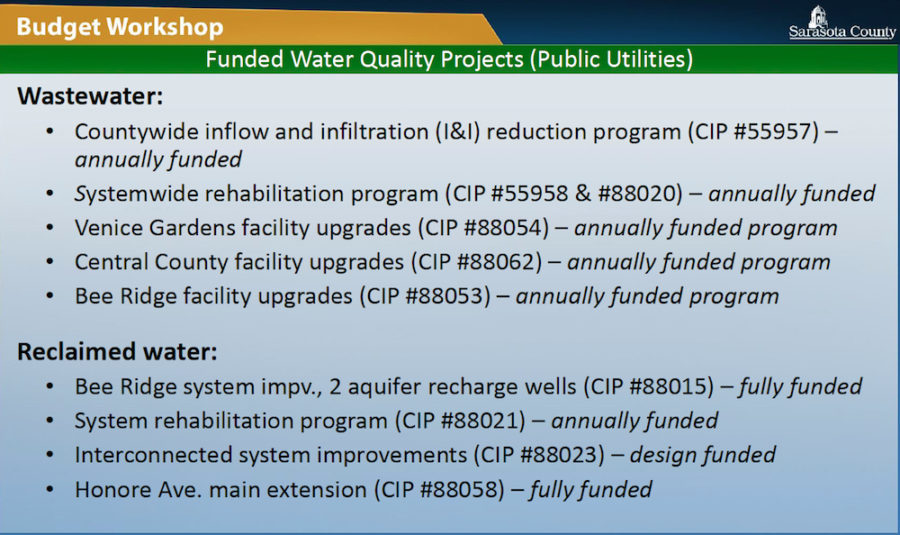
County Administrator Jonathan Lewis introduced that part of the workshop by explaining that the Florida Legislature would be convening earlier in 2020 — in January instead of March — because next year is an election year. Lewis said staff wanted to ensure the commissioners have an opportunity to tweak water quality priorities with an eye toward applying for state funding assistance.
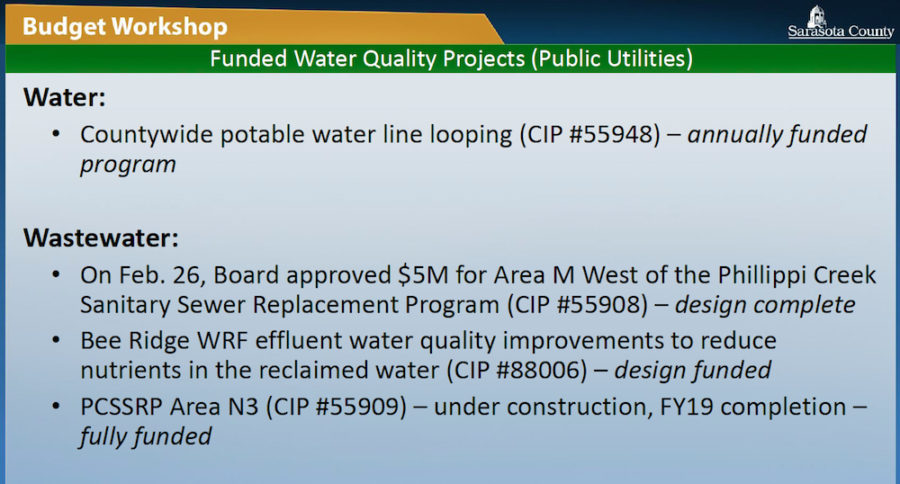
That day, commissioners criticized Schroyer, Assistant County Administrator Mark Cunningham and County Engineer Spencer Anderson, because slides they trio showed the board lacked detailed information.
This is one of the slides that drew commission criticism on March 29. Image courtesy Sarasota County
For example, Commissioner Nancy Detert complained to Schroyer that none of the slides had timelines, so she had no idea when a particular project was scheduled for construction — or whether it was on the construction list for the next five years. (The commission each year approves priorities in its Capital Improvement Program — CIP — for five years, though only the projects listed in the first year generally will be pursued; priorities often change year-to-year.)
Additionally, Commissioner Alan Maio called for more details to be included for the public in discussions involving the county’s long-term initiative to eliminate septic tanks in the Phillippi Creek Basin.
The litigation
That March 29 budget workshop was held nine days after the Sarasota Herald-Tribune reported that three nonprofit environmental organizations — the Suncoast Waterkeeper, Our Children’s Earth Foundation and the Ecological Rights Foundation — had filed notice of intent on Feb. 20 that they would bring suit against the county in federal court.
The civil action would be a response to the nonprofits’ allegations of county violations of the U.S. Clean Water Act. They contend that the county illegally discharged “raw sewage, partially treated sewage and/or treated reclaimed water into Phillippi Creek, Cowpen Slough, Whitaker Bayou, and streams and other waters that are tributaries to Sarasota Bay, Roberts Bay, Dona/Roberts Bay and the Gulf of Mexico in or adjoining Sarasota County.”
This is a banner from the Suncoast Waterkeepe’s website. Image courtesy of Suncoast Waterkeeper
The primary focus of the complaint was the county’s Bee Ridge Water Reclamation Facility, located at 5550 Lorraine Road in Sarasota. The nonprofits say in their suit that “treated wastewater effluent that meets public access quality standards is stored on-site” at that facility in a 2-million gallon, above-ground storage tank, as well as in a storage pond encompassing 29.4 acres that is capable of holding 145.2 million gallons. (A county fact sheet says the storage pond has a maximum capacity of 170 million gallons per day.)
The county operates a North Master Reuse System, the complaint continues, “to provide treated effluent from the Been Ridge [facility] … primarily for a golf course and residential irrigation for approximately 5,500 acres of land.”
That reclaimed water “contains high levels of nutrients,” the nonprofits argue, “and [it] is not treated for surface water discharges.”
(During the March 29 budget workshop, Assistant County Administrator Cunningham reported that all three of the county’s water reclamation facilities are “classified as advanced secondary [treatment plants].” He added that FDEP allows 15 to 20 mgs of nitrogen per liter, but the nitrogen count following treatment in those facilities is about 12 to 15 mgs per liter.)
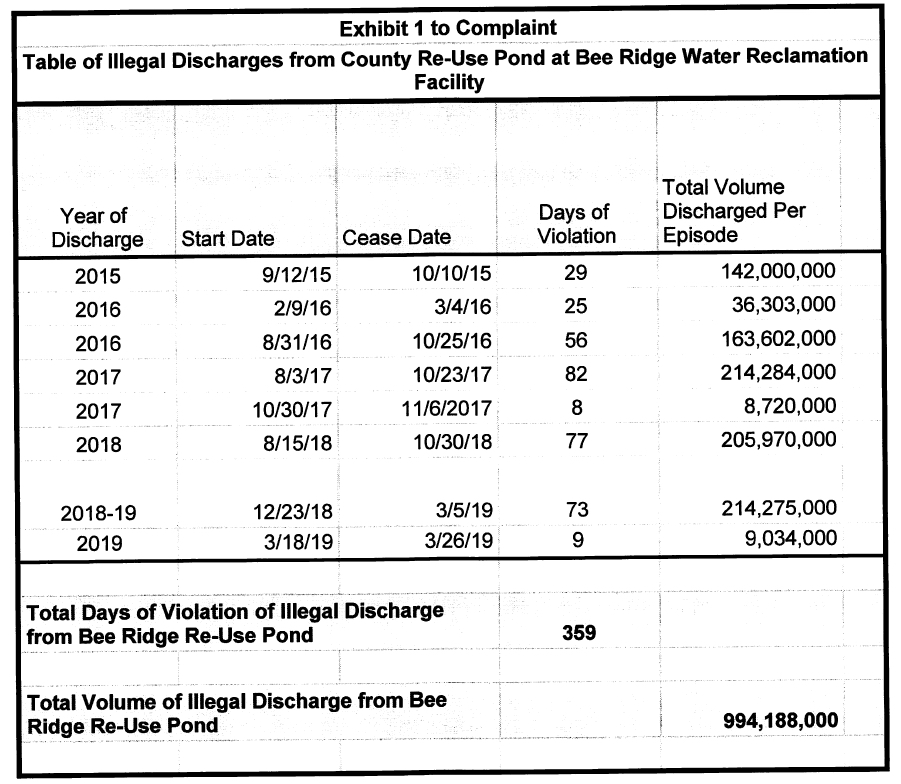
According to an exhibit filed with the lawsuit, the nonprofits contend that the county illegally has discharged close to 1 billion gallons from the Bee Ridge pond since September 2015: 994,188,000 gallons. The highest volume for a continuous period, that exhibit shows, was 214,284,000 gallons from Aug. 3, 2017 to Oct. 23, 2017 — 82 days.
This is an exhibit filed with the federal lawsuit. Image courtesy U.S. District Court for the Middle District of Florida
The suit asks the court to make the county cease the illegal discharges. Additionally, it calls for the assessment of
civil penalties against the county of up to $37,500 per day for each violation on or before Nov. 2, 2015 and $54,833 per day for each violation after Nov. 2, 2015.
Since at least 2013, the complaint continues, the county “has reported numerous discharges of Reclaimed Water from the Bee Ridge storage pond into the stormwater system,” and those discharges “have increased in duration and volume over time, with the knowledge of the County and with no adequate measures taken to prevent or cease these discharges.”
Moreover, the suit contends, “The County has reported numerous overflows of raw sewage from the County’s sewer lines, manholes, pump stations” and various other sections of its overall collection system.
The spills are documented in forms the county had to file with the Florida Department of Environmental Protection (FDEP), the complaint points out.
“The County’s discharges of raw sewage, partially treated sewage and/or treated reclaimed water … degrade water quality and harm aquatic life in [the affected] waters,” the complaint adds.
Members of the Suncoast Waterkeeper in Sarasota and Manatee counties “who reside in the vicinity of the waters affected by Sarasota County’s violations … have reasonably founded fears that the high nutrients contained [n the spills] have contributed to the conditions exacerbating Red Tide,” the complaint points out.
An August 2018 satellite image shows the presence of red tide in area waters. Image courtesy City of Sarasota
The organizations filed suit, they write, because “neither the [Environmental Protection Agency] nor the state of Florida has commenced or is diligently prosecuting an action to redress the violations alleged …”
The Feb. 20 letter the nonprofits sent the county served as the required 60-day notice before the filing of the complaint. The filing occurred on April 22 in the U.S. District Court for the Middle District Court in Tampa.
On April 22, county Media Relations Officer Drew Winchester released the following statement: “Sarasota County is aware of the civil litigation related to reclaimed water storage at the Bee Ridge Water Reclamation Facility. We are committed to improving our utilities infrastructure as water quality is a top priority for the county.”
As a matter of policy, county staff does not comment on litigation.
Commission frustrations
The Herald-Tribune article was the focus of county commissioners’ comments during the March 29 budget workshop.
For example, referring to slides about the Bee Ridge plant, Chair Charles Hines told Schroyer that details about staff plans to reduce the level of nutrients in the reclaimed water need to be part of any report Schroyer provides the board.
This is another slide presented on March 29 that drew commission criticism. Image courtesy Sarasota County
Schroyer did point out that staff has been working on a project that will see the construction of two aquifer recharge wells able to handle 18 million gallons per day at the Bee Ridge facility. The estimated $14.2-million initiative is fully funded, he added.
The estimated completion of the new wells is Dec. 31, 2023, according to a county fact sheet issued in April.
Later during the March 29 discussion, Commissioner Maio referenced the board members having been “hit with a lot of emails” after the Herald-Tribune article was published. “We need to get the word out” about the plans for those wells, he stressed. “We do not promote that!”
“Part of your job,” Commissioner Detert told Schroyer, “is to keep us informed as to what the needs are, so we don’t get [an unexpected headline].”
After the federal lawsuit was filed, county Communications staff issued the fact sheet about the Bee Ridge Water Reclamation Facility, noting that the plant is one of three such operations in the county.
In 2018, the fact sheet said, the county treated 5.1 billion gallons of wastewater countywide.
The Bee Ridge plant dates to 1994, the sheet continued. It has the capacity to treat 12 million gallons per day.
Sarasota County has repeatedly discharged excess reclaimed water from the Bee Ridge Wastewater Treatment Facility to surface waters in the Phillippi Creek watershed since at least 2013, according to the Sarasota Herald Tribune (Wed. 3.20.19).
"These spills have sent raw sewage streaming into streets, storm drains and/or adjacent surface waters, posing serious public health threats and creating a severe nuisance in exposing substantial numbers of people to raw sewage,” the letter states. “These spills have been caused by a variety of poor or inadequate system maintenance, operation, repair, replacement and rehabilitation practices."
According to the County’s own information, this direct discharge has occurred continuously since Dec. 12, 2018 at an average rate of between 2.5 million and 3 million gallons each day, with an average nitrogen concentration of 17.9 milligrams per Liter. That concentration is more than ten times the state's maximum acceptable limit of 1.65 mg per Liter.
Dead fish on Sarasota beaches in 2018-19
The resulting nitrogen load from this extended “event” is over 33,000 pounds -- virtually the same magnitude as the County's 2016 estimate for all of the septic systems in the Phillippi Creek watershed for an entire year.
According to stormwater experts, this is a serious matter, and does real damage to the County’s reputation and credibility. Given the scientific evidence that nitrogen is a key fuel source for red tide, it is not acceptable that this has been occurring since 2013. While all the while Sarasota County Government has touted to the public its commitment to water quality. Someone needs to be held accountable.
The Suncoast Waterkeeper has identified this long term and blatant violation and sent a Notice of Intent to File Suit under the Clean Water Act to Sarasota County on Feb. 20, 2019. We fully support their efforts as someone needs to be looking out for the best interest of the County’s residents.
This letter from Adrien Lucas went to several federal and state environmental agencies. This was one that went to US Fish and Wildlife.
March 17, 2017
To: US Fish & Wildlife Service - East Region
Supervisory Fish and Wildlife Biologists
Professional Biology Series Staff
My name is Adrien Lucas, I live in Sarasota, FL and have been working on an environmental battle against Sarasota County in relation to the publicly owned lands that surround the Celery Fields regional stormwater facility. The Celery Fields grew from a county project created mainly to alleviate flooding downstream in our Phillippi Creek basin that ultimately flows into the Sarasota bay.
The Celery Field was an accidental “eco” invitation to endangered and threatened birds who began showing up in droves, creating a birder’s paradise. The county recognized this and developed trails, planting native plants in addition to working with the Sarasota chapter of Audubon, creating a facility for Audubon volunteers to engage visitors. It is our town’s “Central Park” and is known worldwide by birders who travel here for the parks amazing opportunities to see endangered and threatened birds up close in their natural habitat.
Celery Fields from the hill
Recently our County has accepted two offers for two separate parcels adjacent to the park. One is for what the buyer calls a 16-acre recycling plant and waste transfer facility. The recycling would be of construction debris and lawn scraps, filled with pesticides. This particular business will be adjacent to the headwaters of Phillippi Creek. The other parcel of land is for a company called Restaurant Depot. Both of these businesses will introduce major truck traffic in an area where protected bird species are beginning to thrive.
Celery Fields wetlands
We have evidence that these lands may fall under National Estuary protections. I have heard from Sarasota Audubon's conservation chair, Robert Wright, there are reports that blue crab and snook have been found at the headwaters of Phillippi Creek which begins at the Celery Fields. We are trying to get the document from Mote Marine Laboratory because the information came from there I have not heard back from them yet with Mr. Wright just reporting it at a recent meeting.
In 2016, Mote Marine Laboratory released about 40 snook at eight different release sites to document which shoreline habitat types juvenile snook prefer along Phillippi Creek -- a 7-mile, estuarine tidal creek system that offers diverse habitats for young snook.
Phillippi Creek, Sarasota County
As far as I can determine, Sarasota County documents pertaining to these county lands for sale show nothing from county staff reports in their studies that include documenting the adjacent wildlife and sea life found living on these lands or next to these lands. Isn’t it the county’s duty to perform these studies in conjunction with state agencies to determine if these properties do not show benefit to the species I mentioned? Furthermore, public opinion is held by many different groups that the county should not have put these lands up for sale at all, due to not only the fragility of the Celery Fields but additional traffic to an already congested two-lane road is going to get worse with the introduced truck traffic. These lands must be recognized as useful lands that are needed for the birds that live in the Celery Fields.
We have had two protest rallies, good news coverage and, at the public hearing for the Restaurant Depot parcel, we managed to get a stay of 30 days because the buyer could not satisfy our Sarasota County Charter in relation to full disclosure of the owners who are trying to buy the land. This has bought us a little bit of time but we are deeply concerned that the county is not going to listen to us and it will be too late if we cannot stop the construction and sales of this property. The second public hearing for this particular parcel has been rescheduled for April 26 at the County Commission.
I am desperate to try and stop the sales of the lands the county has put up for sale and appreciate any insight you can provide in what I need to do to begin the process to have studies done for the above reasons.
I was given information that your department has the authority under 50402 Code of Federal Regulations to require and process impact studies and enforce of federal laws under Section 9 USC on violations of the act.
I believe our county has failed to apply to the Army Corps of Engineers for any studies about what I am writing to you about. These studies must be performed prior to putting the lands in question up for sale and now two of the parcels are under contract to be sold. This information appears to not have been disclosed to the potential buyers either. With Mote Marine Laboratory’s snook study and reported sightings of snook in the headwaters of the Phillippi Creek (that begins at the Celery Field stormwater facility) plus documented sightings of endangered and threatened bird species who may be nesting in adjacent retention pond areas, I see the potential future of EPA pollution dangers given the top of the watershed to the bay.
Is there any way you can assist us in starting this process with the Army Corps of Engineers?
Caracara - a species of concern - Chuck Behrmann, Celery Fields
I thank you for your consideration and appreciate any help you may provide in telling me what documents I need to file or if you know who will file them for us.
I am available anytime to discuss this urgent matter. We are running out of time.