Friday, June 14, 2019

Wastewater Consent Order: Upgrade Water Treatment to AWT and Pay Fine

Courtesy of the Sarasota News Leader


Subscribe to the SNL


County would have to convert Bee Ridge Water Reclamation Facility to advanced treatment complex and pay $610,000 fine in latest draft of state consent order involving millions of gallons of spills


County countered at one point with proposal to construct more sewer systems in Phillippi Creek Basin
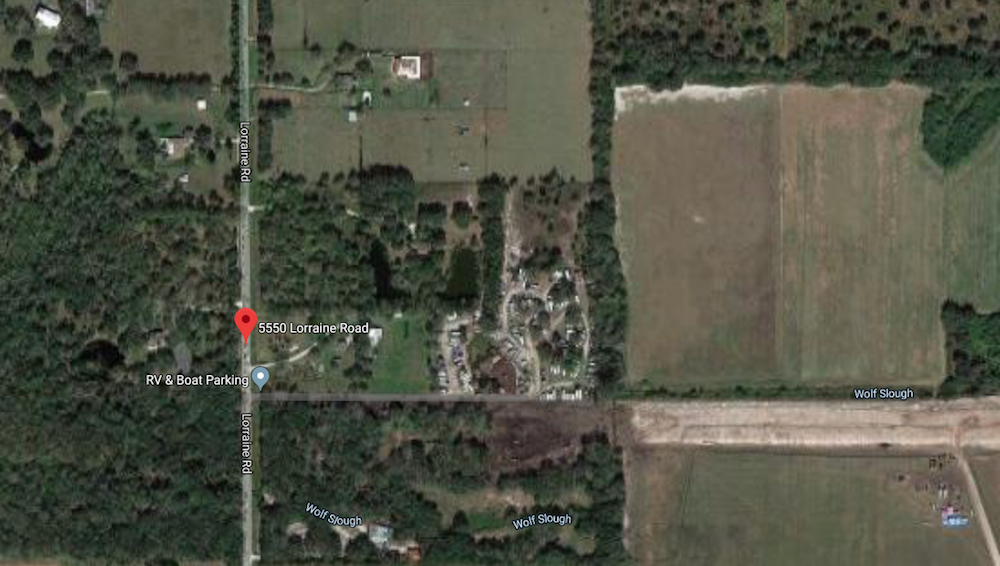
An aerial map shows the location of the Bee Ridge Water Reclamation Facility. Image from Google Maps

The latest draft of a consent order between the Florida Department of Environmental Protection (FDEP) and Sarasota County regarding spills from the county’s Bee Ridge Water Reclamation Facility calls for the conversion of that operation to an Advanced Wastewater Treatment plant by Dec. 31, 2024, The Sarasota News Leader has learned.
The proposed order also would require the county to pay $610,000 in state penalties.
The negotiations between FDEP and county staff members follow 24 incidents associated with the Bee Ridge plant since the summer of 2018, the draft order points out:
  • From Aug. 16, 2018 through Oct. 30, 2018, the draft says, the county discharged 205,197,000 gallons of treated effluent from the reclaimed water storage pond at the Bee Ridge site.
  • From Dec. 23, 2018 through March 12 of this year, discharges of treated effluent from that pond “were reported to have totaled 218,252,000 gallons.”
  • From March 18 through March 26, another 9,034,000 gallons was discharged from the pond.
Additionally, the draft order says that “22 wastewater spills (treated and untreated)” were associated with the Central County Water Reclamation Facility. One of them, the draft notes, “was treated effluent.” That facility is located at 7905 McIntosh Road in Sarasota.
Another 18 spills of untreated wastewater have been associated with the Venice Gardens Water Reclamation Facility, the draft says. That facility stands at 375 Venice E. Blvd. in Venice.
The county “failed to provide timely construction of wastewater facilities necessary to provide proper disposal, resulting in the multi-week discharges of treated effluent from the overflow weir in the reuse storage pond at the Bee Ridge Facility,” in violation of state regulations, the draft adds. FDEP has found that more than 420,000,000 gallons of treated effluent was discharged from the pond on the Bee Ridge plant site, the draft says.
In responding to News Leader requests for copies of FDEP documents, department spokeswoman Dee Ann Miller wrote in a June 11 email, “Protecting Florida’s environment and public health and safety is DEP’s top priority and we take every unauthorized discharge seriously.”
She added, “The Draft Consent Order includes corrective actions for the reuse disposal capacity issue as well as for the raw spills in the collection systems of all the county’s facilities (Bee Ridge and Central County and Venice Gardens). These include both short-term and long-term remedies. In the short-term the Bee Ridge facility will construct the necessary infrastructure to dispose of [its] reuse water in an existing Underground Injection Control well at the Central County Facility. This will cease the discharge,” she pointed out while the county undertakes a long-term fix, “which includes new Aquifer Recharge Wells being constructed.”
The conversion of the Bee Ridge plant to an Advanced Wastewater Treatment facility, Miller continued, “will significantly improve the quality of reuse water being utilized for irrigation in the watershed and reduce the amount of nutrients potentially running off into Sarasota Bay.”
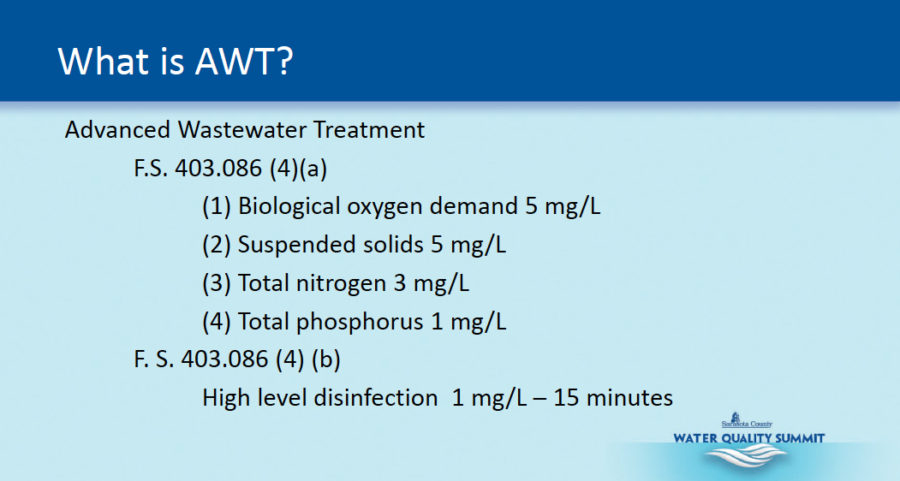


A graphic shown to participants at the June 5 Water Quality Summit explains advanced wastewater treatment. ‘F.S.’ refers to the Florida Statutes. Image courtesy Sarasota County

Miller also pointed out that for the draft order to be “finalized and executed it must be approved by the County Commission. Once it is executed, it will be a legally enforceable agreement.”
In early May, Mike Mylett, interim director of the county’s Public Utilities Department, told the commissioners that staff estimated the expense of converting all three county water reclamation facilities to advanced treatment centers would range between $70 million and $90 million.
Last week, during the county’s Water Quality Summit, Mylett told the approximately 650 people present that the expense for just the Bee Ridge facility would be between $50 million and $100 million. He also noted that of the three county water reclamation plants, only the Bee Ridge facility sits on a site large enough to make such a conversion possible.
On May 8, commissioners indicated a willingness to issue bonds to provide the necessary funding for major water quality projects, given the high bond ratings the county has received from the major rating agencies.
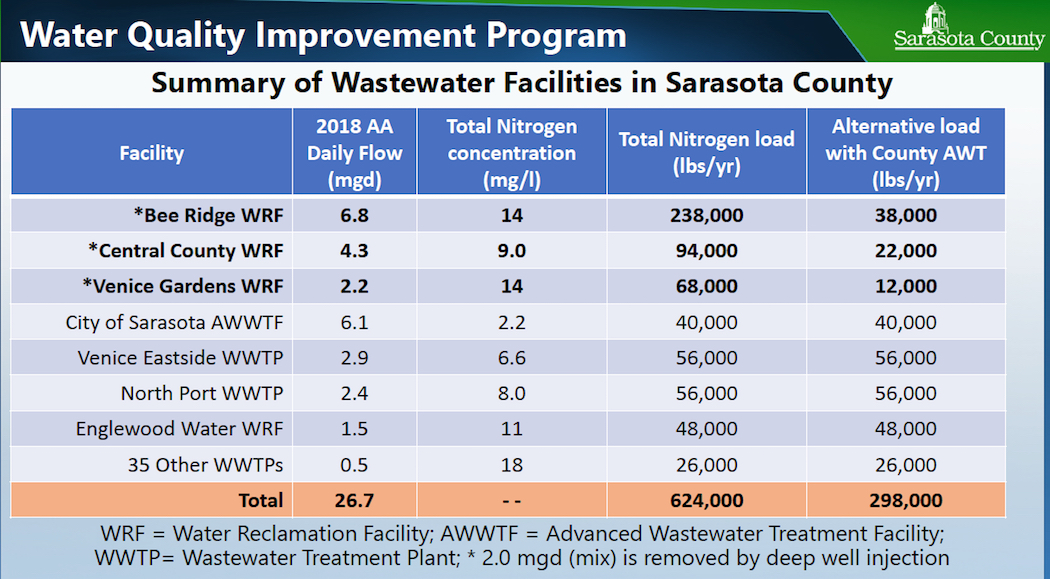


This graphic shows details about the nitrogen loads from water reclamation plants in the county. It was shown to the County Commission on May 8. Image courtesy Sarasota County

During that early May discussion, Walter also cautioned the commissioners that if they do not pursue measures to improve the quality of water in the bays — in the face of data showing demonstrated seagrass loss — then it is likely they will have to contend with state and federal regulatory action dictating such steps.
As negotiations proceed on the FDEP consent order, some discussion of potential expenses could arise as the County Commission conducts its annual, intensive workshops to finalize the county budget for the next fiscal year. Those sessions are scheduled for June 18 and 19, with a third set for June 21, in the event the board needs more time than the first two days will allow.
The commissioners this year have told staff that they do not want to raise the millage rate, though it will increase because of the voter-approved referendum allowing the county to issue $65 million in bonds to finance the North Extension and other improvements to The Legacy Trail.
Typically, during the June budget workshops, county administrative staff will bring to the board’s attention any new proposals for spending since the previous budget workshop. The last discussions the commission conducted about the fiscal year 2020 budget were on May 17.
Given the FDEP proposed fine of $610,000, staff next week may ask for direction — or offer suggestions — about how that could be covered.
A counterproposal
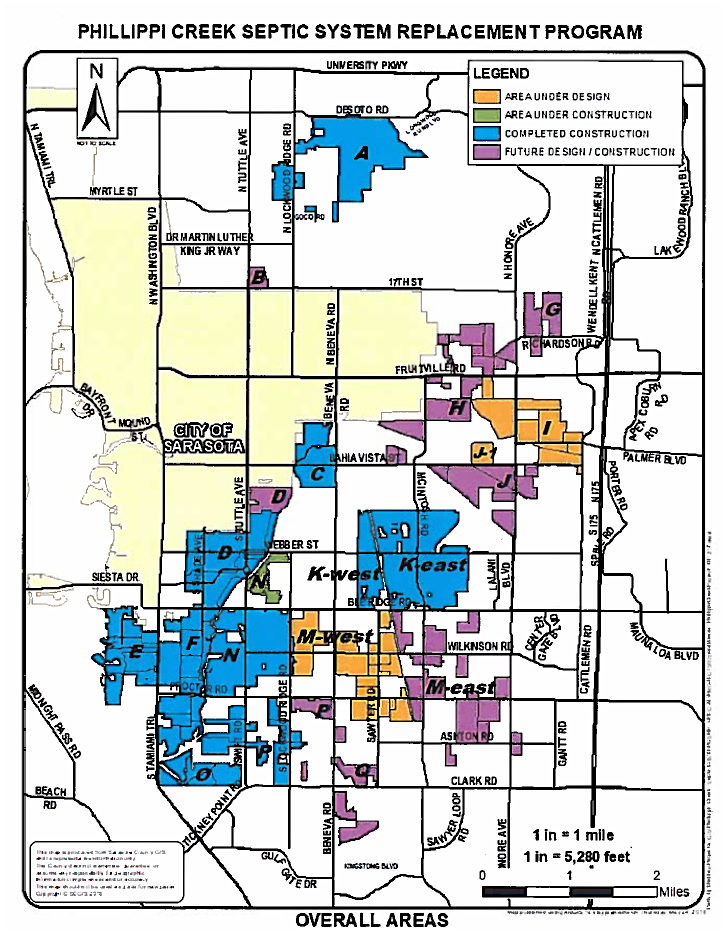


This November 2018 graphic shows the Phillippi Creek Septic Replacement System. Image courtesy Sarasota County

An earlier version of the draft order, which the Sierra Club provided to the News Leader, called for the county to eliminate septic tanks and connect homes to sewer systems in two more areas of the Phillippi Creek Basin — Areas M West and D4. That work would have been in lieu of converting the Bee Ridge plant to an Advanced Wastewater Treatment facility.
In a June 3 letter to FDEP, Cris Costello, organizing manager of the Sierra Club in Osprey, wrote that the county’s discharges between Aug. 16, 2018 and Oct. 22, 2018 “had an average nitrogen concentration of 19.3 mg/L [milligrams per liter], based upon County Discharge Monitoring Reports (DMRs) submitted to FDEP …” That equates, Costello continued, to 33,101 pounds of nitrogen discharged directly to Phillippi Creek. Based on scientific calculations Costello cited, that is more nitrogen than the load produced by all the septic systems the county was proposing to hook up to new sewer lines in the Phillippi Creek watershed, her letter pointed out.
Mylett, the county’s interim director of Public Utilities, told the County Commission in early May that an advanced wastewater treatment system would reduce the nitrogen load to 3 mg per liter.
“Ironically,” Costello pointed out in her letter, “the majority of this direct loading to Phillippi Creek also occurred during the County’s fertilizer ‘restricted period’ of June 1 through September 30, in conflict with the intent of the County’s own fertilizer ordinance to limit nitrogen loads.”
Scientists consistently point to nitrogen as the primary food for the red tide algae. (See the related stories in this issue.)
Costello then noted that the county’s discharge of reclaimed water between Dec. 23, 2018 and March 24 of this year had an average nitrogen concentration of 14.9 mg per liter, based upon the county DMRs submitted to FDEP. Those discharges, she wrote, equated to 28,235 pounds of nitrogen going into Phillippi Creek, which also was greater than the annual loading from all the septic systems the county was proposing to hook up to sewer lines in Areas M West and D4.
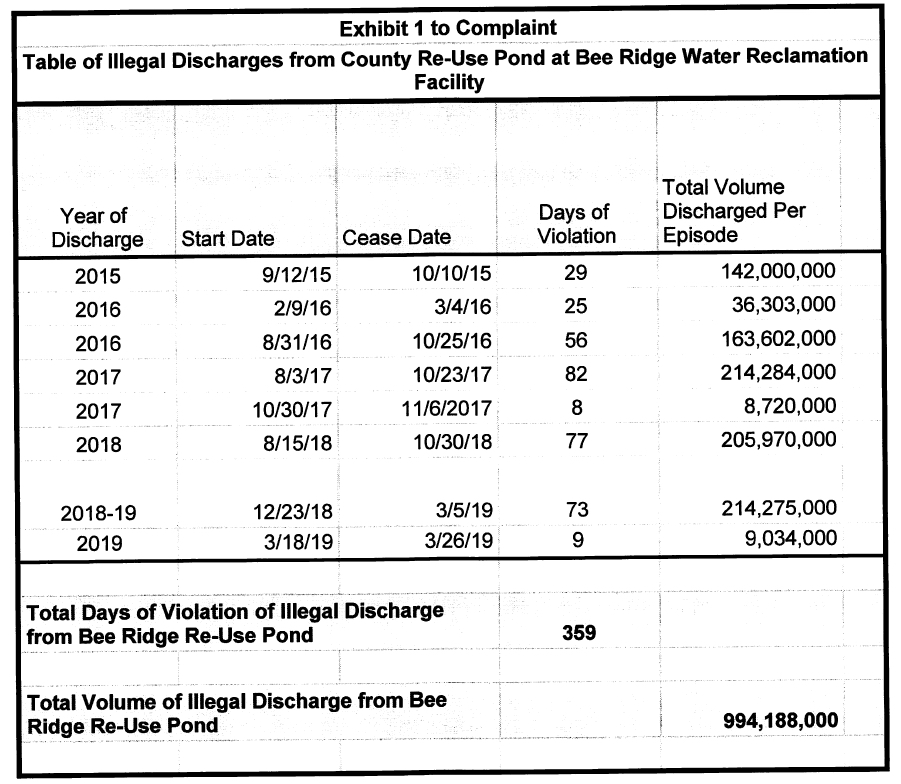


This is an exhibit filed with the federal lawsuit. Image courtesy U.S. District Court for the Middle District of Florida

As county staff negotiates with FDEP, county leaders also are in the midst of a federal lawsuit regarding the discharges from the water reclamation plants. That complaint was filed this spring by three nonprofit organizations: the Suncoast WaterkeeperOur Children’s Earth Foundation and the Ecological Rights FoundationThe nonprofits have alleged county violations of the U.S. Clean Water Act, contending that the county illegally discharged “raw sewage, partially treated sewage and/or treated reclaimed water into Phillippi Creek, Cowpen Slough, Whitaker Bayou, and streams and other waters that are tributaries to Sarasota Bay, Roberts Bay, Dona/Roberts Bay and the Gulf of Mexico in or adjoining Sarasota County.”
Give-and-take of the negotiations
As negotiating has continued over both the short- and long-term solutions, the latest version of the FDEP consent order calls for the county “to cease all unauthorized discharges of treated wastewater from the Bee Ridge Facility” by Aug. 30.
An earlier version of the document cited July 19 as the date and did not specify the Bee Ridge plant.
Additionally, within five days of the effective date of the order, the county is to retain the services of a professional engineer registered in the State of Florida to design the proposed short-term modifications of its wastewater treatment facilities, “effluent disposal systems, and effluent conveyance systems.” The county also would have to complete an engineering report “demonstrating that, after implementation of the [short-term] modifications, the Facilities will not discharge air or water contaminants in sufficient quantity … so as to contribute significantly to the pollution problems within the State.”
Moreover, the latest draft says the county would agree to pay FDEP $2,000 per day in penalties “for each and every day [the county] fails to timely comply with any of the requirements of this Consent Order, other than unauthorized discharges.”
An earlier version put the penalties at $2,500 per day.
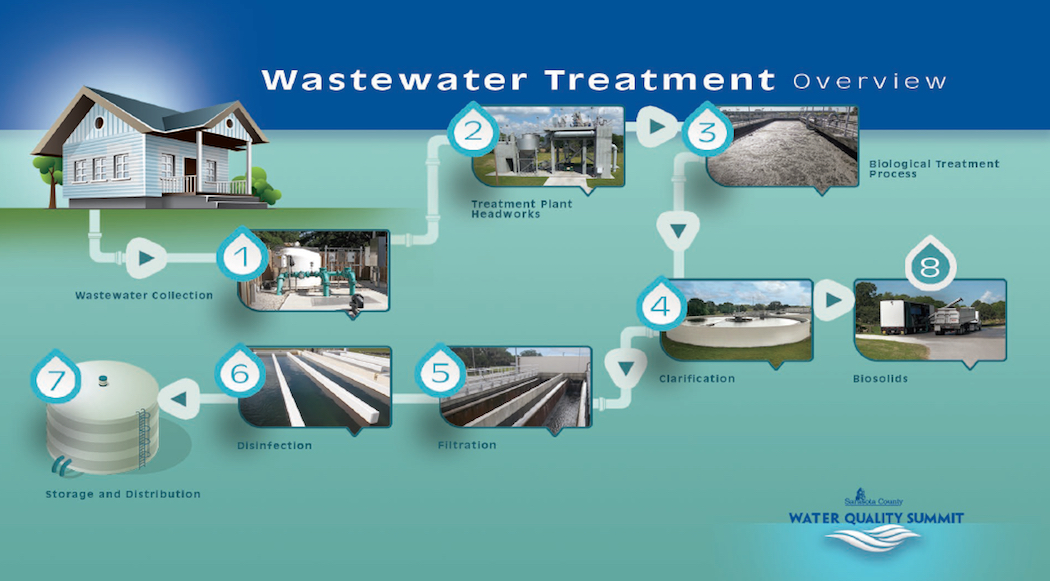


This graphic, presented to county Water Quality Summit attendees, shows how wastewater treatment functions. Image courtesy Sarasota County

A separate section of the latest draft also specifies penalties for unauthorized discharges “from any part of any of the [county’s] wastewater collection and transmission systems, wastewater treatment works, reuse or disposal systems, conveyance or storage systems, and residual management systems,” as follows:
  • $500 for up to 5,000 gallons.
  • $1,000 for 5,001 to 10,000 gallons.
  • $2,500 for 10,001 to 25,000 gallons.
  • $5,000 for 25,001 to 100,000 gallons.
  • $10,000 for any discharge in excess of 100,000 gallons.
Further, the draft calls for the county to submit to FDEP a written report every six months containing information about the status of the projects outlined in the order, as well as “any reasons for noncompliance.”
An earlier version required a report every calendar quarter.
A months-long process
In her June 11 email to the News Leader, Miller of FDEP wrote, “In the event of a discharge, our response is threefold: (1) work with the facility to identify any releases and ensure the release is stopped as quickly as possible; (2) gather and analyze information surrounding the circumstances of the reported incident to evaluate it from a regulatory perspective to determine if there were any violations; (3) identify any further corrective actions needed, including solutions to avoid future discharges and possible enforcement.”
Miller continued, “DEP has a number of enforcement tools we are able to use to address any identified violations. The nature of the violation and circumstances surrounding the event are used in the determination of which one is best suited. Along with the possibility of fines and penalties, which is one enforcement tool, enforcement can also be requiring necessary restoration and/or remediation actions through a Compliance Assistance Offer, Consent Order or other enforcement mechanism.”
On Jan. 28, Miller wrote, FDEP sent a warning letter to Sarasota County, notifying county leaders “of possible violations of law for which Sarasota County Utilities may be responsible at the county’s Bee Ridge and Central facilities.”
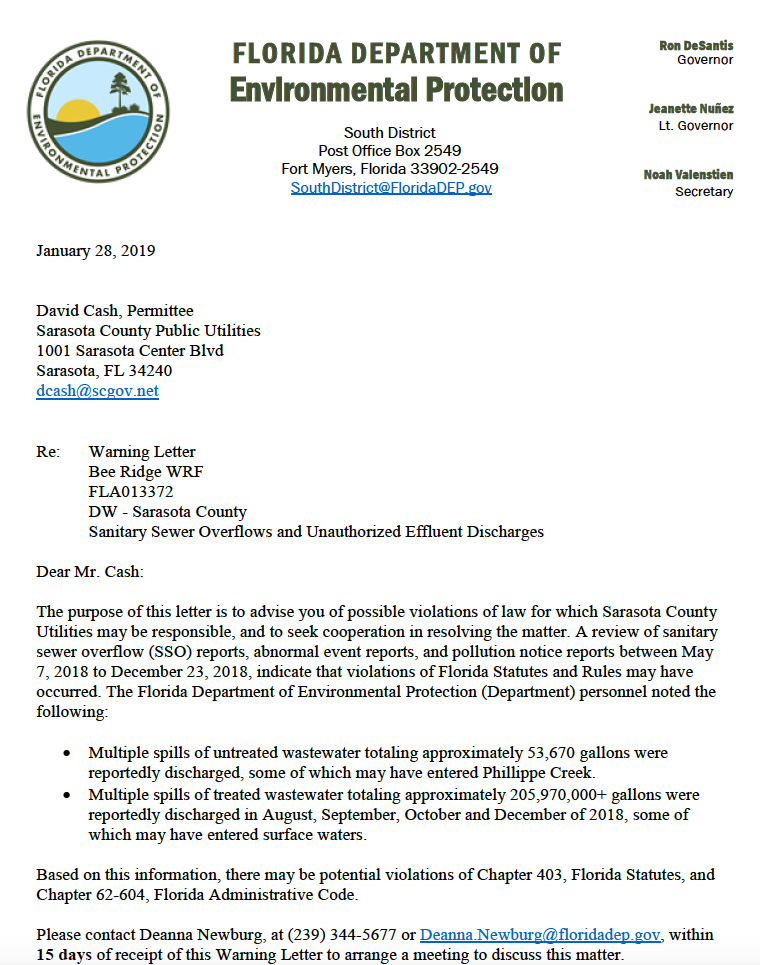


This is a portion of the warning letter FDEP sent the county in January. Image courtesy FDEP

She added that the warning letter required the county to set up a meeting to discuss the matter within 15 days.
“This meeting was held on March 4, 2019,” Miller continued. At that time, [FDDP] staff “made it clear that the county must immediately implement a daily notification protocol during discharge events and that they are to make it their top priority to explore every opportunity to temporarily divert water to reduce or eliminate the discharge and to consider upgrading their plant to advanced waste treatment (AWT) and constructing additional permittable treated wastewater disposal capacity on an accelerated schedule,” Miller explained.



Subscribe to the SNL

Friday, June 7, 2019

Hines: Sell Surplus Public Parcel at Celery Fields to developer for affordable housing


Courtesy of the Sarasota News Leader

Subscribe to the SNL

County Commission needs to take action on its own — perhaps selling surplus land to a private developer — to spur affordable housing projects, chair says


During a June 4 discussion, Chair Charles Hines and other commissioners broached the idea again of selling county property for affordable housing projects. Focus centered on a surplus 10-acre parcel next to the Celery Fields that is known as the Southwest Quad, as well as a portion of a 115-acre site adjacent to Newtown Estates.
Perhaps the county could sell 20 acres of the latter, Hines said, for a workforce housing initiative.
In December 2017, Hines first talked of the potential of the Newtown property. He raised the issue as his board debated negotiations with the City of Sarasota in an effort to settle a dispute over a final county payment city staff argued that the county owed into the Downtown Sarasota Community Redevelopment Area (CRA) Trust Fund.
The North Sarasota parcel is just east of the Betty J. Johnson North Sarasota Library in Newtown.
When the county purchased the land approximately six years ago, the intent was for it to become a major athletic complex for North County. However, after the Great Recession struck, the plans were put on hold.
In December 2018, Sarasota City Commissioner Willie Shaw brought up the property in a discussion about the city board’s efforts to spur more affordable housing projects.
In response, City Manager Tom Barwin said he had asked County Administrator Jonathan Lewis about the land when he saw Lewis at a recent luncheon. Lewis told him that the land remained listed among properties for the county’s Parks, Recreation and Natural Resources Department (PRNR). However, Barwin added, Lewis indicated the County Commission would be open to discussing the future of the site.
When The Sarasota News Leader asked county staff for a comment on Barwin’s remarks after the City Commission’s Dec. 3, 2018 meeting, Media Relations Officer Ashley Lusby reported in an email, “The county has not changed its plan for the north county land. The county is still following the parks master plan for that location to be the North County Sports Complex.”

A 2013 graphic shows the 115-acre property planned for the North County Sports Complex. Image courtesy Sarasota County

On June 4, Hines acknowledged that county staff had continued to focus on the property for a purpose consistent with planning for future parks.
Commissioner Alan Maio said he doubted staff would come back to the board with a proposal entailing the utilization of a portion of the property for workforce housing. “We need to make those policy decisions.”
Maio also suggested that if the board were to put property it owns on the market — “and not at sky-high prices” — with the necessary rezoning completed beforehand to facilitate development, “that eliminates the last supposed obstacle to [creation of an affordable housing project],” which is the cost of land.
As for the Southwest Quad: Hines pointed out that some advocates of the Celery Fields have proposed the county keep that property free of development. “That’s not gonna happen. That’s never been one of our ideas.”
Commissioner Nancy Detert noted that she has been advocating for a project on property next to the Celery Fields for months. An apartment complex would be one possibility on the Southwest Quad, she continued. Another, she said, is a tiny homes project. “I still like tiny houses. I think that’s an absolute perfect spot for tiny houses, because [such a project] goes with the whole ambiance [of the Celery Fields].”
In April 2018 and again in September 2018, representatives of a group called the Fresh Start Initiative worked — at the commission’s behest — to propose what they characterized as compatible uses of the four county parcels known as “the Quads” adjacent to the Celery Fields.

A graphic prepared for the Fresh Start Initiative in early 2018 shows potential for compatible development near the Celery Fields. Image courtesy Fresh Start Initiative

Although the Celery Fields began and still functions as a major county stormwater project, it has acquired an international reputation for the vast variety of birds seen there throughout the year, especially during the winter migratory season.
Yet a third surplus county parcel that potentially could serve as an affordable housing project site is close to the county’s Emergency Operations Center on Cattlemen Road, Hines pointed out on June 4. “It’s been sitting there [for about 10 years].”
The land once was home to the county Building Department, he said.
Frustrations, fixes and a new focus
Exactly six months ago, Hines reminded his colleagues on June 4, the commissioners expressed frustration that ordinance changes they had sought in an effort to make affordable housing proposals more enticing to developers were not coming fast enough from staff in forms for them to enact.
“I don’t think anyone on this board is satisfied with the progress that’s been made,” Maio said at the time.
Since then — on March 13 — the board has approved one further change in the county’s Unified Development Code. That modification allows half-dwelling units no larger than 750 square feet, enabling developers to double the density of projects if they construct the smaller apartments or condominiums.
Altogether, Maio pointed out on June 4, the board has voted on about half-a-dozen changes to county regulations — reducing impact fees and capacity fees and reducing parking requirements, for other examples — to encourage private companies to build workforce housing.

This is an example of a half dwelling unit, as presented to the County Commission in May 2018. Image courtesy Sarasota County

Two more measures are in the works, he continued. One involves accessory buildings, such as dwelling units over garages; the other pertains to creation of apartments in upper stories over retail centers, especially those older complexes that might no longer be as active commercially but still have plenty of available parking.
Yet, those two latter changes would not be necessary, Maio stressed, if the board were to try to work with a private developer on a sale of property it owns.
Referencing the Newtown land Hines had mentioned earlier, Maio concurred that 20 acres might be appropriate for a project. “I just don’t think [developers] realize what they could build there and how affordable it could be.”
“What has been holding up a private sector developer from coming in here and saying, ‘I’ll do a 300-, 400-unit project” designed for workers such as firefighters, law enforcement officers and teachers, Hines asked. “The impediment’s been fees, regulations and land costs.”
Referring to the ordinance changes Maio had noted, Hines said he felt that it was even more important for the county to make land available.
The ombudsman proposal and a tangential request

This is the cover of the 2018 Blueprint for Workforce Housing. Image courtesy City of Sarasota

During the June 4 discussion, Hines also pointed out that, when the county received the Blueprint for Workforce Housing that it and the City of Sarasota had commissioned from the Florida Housing Coalition, one of the recommendations the document contained called for the hiring of an ombudsman whose sole responsibility would be to work on workforce housing projects.
“I wouldn’t be opposed to one dedicated staffer [in the county’s Planning and Development Services Department],” Maio said, preferably if the person’s salary could be covered by permitting fees. If that funding source could be used, Maio added, “Hire them as soon as possible.”
Yet, Commissioner Detert responded, the Office of Housing and Community Development already has that responsibility, and that department is a joint initiative of the City and County of Sarasota.
She also brought up the fact that the county used to help first-time homeowners by providing down payments on houses.
For 25 years, she pointed out, she owned a mortgage business in the county. She talked about one client who was able to get help through the Down Payment Assistance Program. “It gives people a hand up, not a handout,” she explained.
To qualify for the help, she said, a person had to learn how to manage a budget, for example.
The money the county lent the homebuyer became a lien, she continued. When the house was sold, Detert added, the money for the down payment came back to the county, which could put the funds to use for another person’s down payment.
She wanted to know what became of that program, she said.

This information is included in a March fact sheet that county staff provided about affordable housing initiatives in the county. Image courtesy Sarasota County

Deputy County Administrator Steve Botelho, who was sitting in for County Administrator Jonathan Lewis, told her that staff would check on that. He added that he expected a memo with the results of the research could be provided to the commissioners prior to their next regular meetings, in July.
Detert also asked staff to look into all the current activities of the Sarasota Housing Authority and the Office of Housing and Community Development.
Botelho replied that he would make certain that information was in the memo, as well.
Detert pointed out that Don Hadsell, the long-time director of both programs, recently retired. Detert said she recently asked her county assistant to contact the new director, saying Detert wanted to set up an appointment for a meeting. The response Detert’s assistant received, Detert continued, was a question about why Detert wanted to have that meeting.
“What does it say on the outside of that building [where the Office of Housing and Community Development operates]?” Detert added of her reaction. “That ought to be a tipoff.”
Detert then asked Matt Osterhoudt, director of the county’s Planning and Development Services Department, to ensure that the memo Botelho promised the board also would have a “fleshed-out summary” of how both the city’s Housing Authority and the Office of Housing and Community Development function. She suggested that the results could lead to County Commission tweaks about the operations of the latter agency.


Subscribe to the SNL

Tuesday, June 4, 2019

HB 7103 - another road to nowhere for Ron DeSantis?

Another Opinion: Save Florida’s shreds of growth control

DeSantis signs "Roads to Nowhere"
When Gov. Ron DeSantis put his signature on a bill authorizing three unnecessary, ridiculously expensive “toll roads to nowhere” that would plow across millions of acres of undisturbed land at Florida’s heart, he put his self-claimed reputation as a champion of the state’s fragile, threatened environment in jeopardy.
Now, he faces an even tougher challenge. Within the next few weeks, legislation will land on his desk that will gut Florida’s already-weak oversight of rampant, irresponsible development. Like the toll roads, these bills were mostly concocted in secret through last-minute, legislative machinations.
The state’s most respected smart-growth groups are aiming most of their firepower at the blandly titled HB 7103, “Community Development and Housing.”
This would be the last nail in the coffin for Florida’s once-innovative comprehensive planning laws enacted in the 1980s. These laws require each community to enact blueprints for growth, making sure new developments meet minimum standards for flood protection, infrastructure and the like. The plan becomes local government’s guidebook: every development decision must be consistent with the plan.
Once upon a time, there was a state agency to review development proposals, the Department of Community Affairs. But in 2011, Gov. Rick Scott got rid of the “job killer,” as he called it, and folded its remaining duties into the Department of Economic Opportunity. Scott and the Republican-led Legislature also crippled the concept of concurrency — a requirement that schools, parks and adequate roads be in place before development is completed. And they starved the state’s 11 regional planning councils of money.
There was one safeguard left. Citizens had the right go to court and challenge a bad decision by their local government: a condo tower that exceeds a height limit, an apartment complex in a neighborhood of single-family homes.
But if HB 7103 becomes law, that final right to protest will be crushed. Citizen challenges will face a tilted burden of proof — and the requirement to pay the opposing side’s legal fees if they lose. Basically, all a developer would have to do to win is to send a squadron of high-priced attorneys into battle — and then punish anyone audacious enough to challenge their profiteering with crippling legal fees.
This isn’t the only reason this bill deserves a veto. It also deters local governments from requiring developers to include affordable housing in their projects. Any government that does so, this legislation says, will have to repay the developer for any financial losses.
If he signs it, it’s game over for DeSantis, the warrior intent on protecting Florida’s threatened water resources and natural beauty. He’ll be exposed as something worse than an honest shill for the kind of reckless environmental destruction that most Floridians decry. He’ll be the person who was willing to trick people into thinking he cared — before he stripped them of the ability to defend this state’s endangered environment against irresponsible, predatory development.
Governor, please veto 7103. Do the right thing, and reclaim some of the faith you’ve lost.

Monday, June 3, 2019

Sierra Florida to FDEP: Sarasota wastewater management system is in disarray

Letter from Sierra Club to FDEP regarding Sarasota County's wastewater treatment failures:

Sierra Club Florida supports the original mitigation in FDEP’s draft consent order requiring that Sarasota County upgrade their wastewater treatment plans to meet advanced wastewater treatment (AWT). We oppose Sarasota County’s (County) counter offer to delete this mitigation requirement in favor of connecting more wastewater flows from onsite sewer treatment and disposal systems (OSTDS). In fact, the state of Sarasota County wastewater management system is in such disarray with excessive discharges, nutrient concentrations, and spills that we would support FDEP limiting any additional flows being accepted from OSTDS or new development until the County has at least committed to upgrade to AWT. 

Full letter from Cris Costello of the Sierra Club here (also below the image)


Among the points made:

Sarasota County acquired several AWT facilities, shut them down, and diverted that water to its own non-AWT facilities

5. Based upon Sarasota County’s 2001 Bee Ridge Water Reclamation Facility (WRF) WRF Expansion Facilities Plan, the Bee Ridge WWTF was originally AWT but was converted to secondary treatment with filtration. In addition, it is our understanding that Sarasota County has purchased and decommissioned at least four WWTFs (Siesta Key Utilities, South Gate, Gulf Gate, and Aqua Utilities) that were previously meeting AWT standards. This wastewater, formerly treated to AWT standards, has been diverted to the County’s non-AWT plants where the resulting effluent now has significantly higher nutrient concentrations. 
ii. The County’s discharge of 205,197,000 gallons of reclaimed water between 8/16/18 and 10/22/18 had an average nitrogen concentration of 19.3 mg/L, based upon County Discharge Monitoring Reports (DMRs) submitted to FDEP, equates to 33,101 pounds of nitrogen discharged directly to Phillippi Creek.
. . . nitrogen levels in Sarasota’s bays have been documented, by Sarasota County, as increasing over the past 20 years. This increase has been accompanied by a documented decrease of seagrass coverage in recent years. 


====


Entire Text:


June 3, 2019
Jon Iglehart Director, South District Florida Department of Environmental Protection
2295 Victoria Avenue
Suite 364
Fort Myers, FL 33901
RE: Consent Order to Sarasota County Utilities

Dear Mr. Iglehart:

Please accept this as an interjection in the matter of FDEP’s consent order to Sarasota County Utilities on behalf of Sierra Club Florida. Specifically, Sierra Club Florida supports the original mitigation in FDEP’s draft consent order requiring that Sarasota County upgrade their wastewater treatment plans to meet advanced wastewater treatment (AWT). We oppose Sarasota County’s (County) counter offer to delete this mitigation requirement in favor of connecting more wastewater flows from onsite sewer treatment and disposal systems (OSTDS). In fact, the state of Sarasota County wastewater management system is in such disarray with excessive discharges, nutrient concentrations, and spills that we would support FDEP limiting any additional flows being accepted from OSTDS or new development until the County has at least committed to upgrade to AWT. We present the following in support of this position:

1. A “preliminary planning level” estimate of costs to upgrade to AWT and cap on costs by the end of the year as proffered by the County does not appear to be a good faith effort to address the issue.

2. The County’s proposed mitigation seems counter-productive at this point; the County is not in a position to take on more flows without satisfactorily addressing their disposal capacity and nutrient issues.

3. Since the County seems to want to estimate nitrogen loads regarding OSTDS:

i. Based upon information from the Florida Department of Health cited by Dr. Mary Lusk
with the University of Florida-IFAS Extension (Septic Systems 101), the average gross and net nitrogen loadings for an OSWDTS are 11.2 and 7.8 grams of nitrogen per person per day, respectively. These would equate to gross and net loadings of 19.8 and 13.8 pounds of nitrogen per household per year, respectively, assuming 2.2 people per household. The net 13.8 pounds of nitrogen per household per year is still conservative since it does not consider denitrification, which likely occurs due to the unique hydrogeology of areas like Sarasota County. The County’s 25 pounds reflects the gross nitrogen load, and basically assumes that all of the OSTDS are failing. Therefore the County’s estimated nitrogen load reduction of 35,000 pounds from 14,000 OSTDS should actually be 19,230 pounds, which is still conservative since it does not consider denitrification.

ii. The County’s discharge of 205,197,000 gallons of reclaimed water between 8/16/18 and 10/22/18 had an average nitrogen concentration of 19.3 mg/L, based upon County Discharge Monitoring Reports (DMRs) submitted to FDEP, equates to 33,101 pounds of nitrogen discharged directly to Phillippi Creek. This event loading is greater than the annual loading from all the OSTDS that the County is proposing to hook up as mitigation. Ironically, the majority of this direct loading to Phillippi Creek also occurred during the County’s fertilizer “restricted period” of June 1 through September 30, in conflict with intent of the County’s own fertilizer ordinance to limit nitrogen loads.

iii. The County’s discharge of 227,287,000 gallons of reclaimed water between 12/23/18 and 3/24/19 had an average nitrogen concentration of 14.9 mg/L, based upon County DMRs submitted to FDEP, equates to 28,235 pounds of nitrogen discharged directly to Phillippi Creek. This event loading is also greater than the annual loading from all the OSTDS that County is proposing to hook up as mitigation.

4. Based upon the DMR’s submitted by Sarasota County to FDEP, the average nitrogen concentrations in 2018 from the Bee Ridge, Central County, and Venice Gardens Wastewater Treatment Facilities (WWTFs) were 18.3 mg/L, 7.66 mg/L, and 14.2 mg/L, respectively. These reflect the average nitrogen concentrations of the “treated” wastewater or reclaimed water. This is not just reflective of the nutrients that might be directly (and illegally) discharged, but of those which are being put into the environment to irrigate lawns, landscapes and golf courses. The application of the County’s effluent reclaimed water is resulting in the application of significant and year-round nitrogen in addition to nitrogen fertilizer to the environment. This is in direct conflict with the intent of the Sarasota County’s own fertilizer regulations that bans the application of nitrogen fertilizer between June 1 and September 30; and limits the total nitrogen application to 4 pounds per 10,000 square feet per year. Sierra Club believes that upgrading their WWTFs to meet the AWT for nitrogen of 3 mg/L, or even better the nutrient numeric criteria for freshwater streams of 1.65 mg/L, would put Sarasota County in a position to eliminate nitrogen loads to the extent practical. It is noted that the City of Sarasota’s wastewater is currently meeting the numeric nutrient criteria for both nitrogen and phosphorus, so such a goal is in fact practical and achievable.

5. Based upon Sarasota County’s 2001 Bee Ridge Water Reclamation Facility (WRF) WRF Expansion Facilities Plan, the Bee Ridge WWTF was originally AWT but was converted to secondary treatment with filtration. In addition, it is our understanding that Sarasota County has purchased and decommissioned at least four WWTFs (Siesta Key Utilities, South Gate, Gulf Gate, and Aqua Utilities) that were previously meeting AWT standards. This wastewater, formerly treated to AWT standards, has been diverted to the County’s non-AWT plants where the resulting effluent now has significantly higher nutrient concentrations. Conservatively assuming that the combined flow from these 4 WWTFs was 4.0 million gallons a day (the combined permitted capacity of these 4 WWTFs exceeded 8 mgd) and given the average 2018 nitrogen concentration difference between the Bee Ridge Plant of 18.3 mg/L and the AWT limit of 3 mg/L, equates to an additional annual nitrogen load of 187,000 pounds. This represents not only a huge step backwards but results in an increased nitrogen load to the environment that is almost 10 times greater than that of the County’s proposed but misdirected and inadequate mitigation (19,320 pounds).

6. Finally, nitrogen levels in Sarasota’s bays have been documented, by Sarasota County, as increasing over the past 20 years. This increase has been accompanied by a documented decrease of seagrass coverage in recent years. It is not unreasonable to conclude that the increase in nitrogen is in part due to Sarasota County’s poor wastewater planning and misdirected public investments, resulting in illegal spills and discharges of nitrogen-rich wastewater to the waters of the State as well as to the landscape that drain to state waters. Since the City of Sarasota’s existing WWTF exceeds AWT standards; the Bee Ridge WWTF met AWT prior to being downgraded by Sarasota County; and numerous private WWTFs were meeting AWT prior to being purchased and deactivated by Sarasota County, the technology to meet AWT is both practical and possible. Therefore, it is demonstrated both possible and practical for Sarasota County to convert their WWTFs to AWT and the Sierra Club supports FDEP’s consent order to require such for the Bee Ridge and Central County Plants but also advocates the upgrading of the Venice Gardens WWTF to AWT, given its high nitrogen levels, to mitigate for past, present, and future nutrient loads.

Thank you for considering Sierra Club’s concerns and our position in support of a strong Consent Order that will go further than Sarasota County’s proposed amended Draft to assure future compliance with the law. We would appreciate the opportunity for additional review and comment as the Department’s enforcement action matures towards resolution.
Sincerely,

Cris Costello Organizing Manager Sierra Club 2127 S. Tamiami Trail Osprey, FL 34229 941-914-0421 cris.costello@sierraclub.org

cc: Jennifer Carpenter, Assistant Director of District Management, FDEP


======


Sunday, June 2, 2019

Sarasota GOP, Martin Hyde and PACs targeted in complaints


Zac Anderson

A series of complaints lodged with the Florida Elections Commission allege they violated election laws in 2017.

A series of complaints lodged with the Florida Elections Commission alleges that the Republican Party of Sarasota County, former Sarasota City Commission candidate Martin Hyde and two political committees associated with Sarasota County School Board Member Eric Robinson violated election laws in 2017.


>>>More on Eric Robinson here

Hyde said he is “not going to try and defend” what he did and has offered to settle the complaint against him and pay a fine. He said he was “unaware it was a breach of the rules” and blames Sarasota GOP Vice Chairman Jack Brill for giving him bad advice.


>>>More on Jack Brill here

Brill and Robinson declined to comment because the cases are ongoing.

City elections are nonpartisan and candidates are prohibited from advertising their party affiliations.

The complaints allege that Hyde, the Sarasota GOP and the committees chaired by Robinson schemed to get around the prohibition on partisan campaigning by moving money from Hyde to a political committee and ultimately to the party, which paid for a mailer saying the party backed Hyde in the March 14 election.

“This is an unusual case in that it peels back the curtain and very clearly shows how the money’s being manipulated,” said Ron Meyer, the Tallahassee attorney representing Michael Belval, a Sarasota resident who filed the complaint.

Meyer said it is no secret that political committees often are used to move money around and “obfuscate what is the overarching purpose of the election code, and that is to show who gave it and who got it.” But such accusations can be hard to prove. The difference in this case is that Hyde openly discussed the arrangement during a radio interview.

“We know it goes on,” Meyer said. “It doesn’t usually get detected because it is something that’s covert and rarely do the participants in these kinds of transactions come forward and acknowledge what they’re doing.”

Hyde gave $4,000 to the Making a Better Tomorrow political action committee on Feb. 13, 2017. That same day the Legal Reform Now Committee gave $4,000 to the Republican Party of Sarasota County.

Robinson is the chairman and treasurer of Making a Better Tomorrow and also served in those roles for Legal Reform Now before that organization shut down last year. He also is the Sarasota GOP’s accountant and past chair.

On March 22, 2017, the Sarasota GOP gave Andrick & Associates in Sarasota two checks totaling $4,302.26 for “mailers,” according to campaign finance reports.

“Hyde’s funneling of money through other political organizations to the Republican Party of Sarasota County so that it would produce a partisan mailer, constitutes a direct violation” of state law, according to the complaint.

The complaint also notes that the scheme was “confirmed by Hyde himself” during an interview with radio host Cathy Antunes, who asked Hyde why he contributed the $4,000 to Making a Better Tomorrow.An

“That $4,000 went to a mailer that was sent from the GOP supporting me,” Hyde said during the interview, which was conducted during the campaign and is posted on YouTube.

Antunes then asked Hyde why he didn’t use his own campaign account to pay for the mailer.

“It’s a nonpartisan race,” Hyde said. “As it relates to coming from my campaign, my campaign can’t directly send something out notifying ... me as a Republican, so it was suggested that Republican Party didn’t have the resources to fund a city mailer so I sent the money to a PAC and it came from there, simple as that.”

“It was a mechanism to get money to the GOP,” Hyde added.

Coordinating on partisan ads

Citing a 2003 advisory opinion, the complaint says state law prohibits candidates from trying to get around the prohibition on partisan campaigning by coordinating with other groups to do partisan ads.

“Political advertisements done by others in consultation with a candidate must meet the nonpartisan requirement,” the complaint states.

Additionally, the Sarasota GOP violated a state law that prohibits political parties from accepting contributions that are earmarked “for the partial or exclusive use of a particular candidate,” according to the complaint.

The political committees controlled by Robinson also are accused of multiple legal violations.

In an interview with the Herald-Tribune, Hyde said he didn’t intend to break the law but made the mistake of “taking advice from people who I thought would know what they were doing because they’ve been involved in American campaigns for a long time now.”

“I was a babe in the woods,” Hyde added, pointing to the fact that he admitted what he did to Antunes as evidence he didn’t know it was unlawful.

“I didn’t do much of a job of covering up,” Hyde said. “I didn’t know I was supposed to cover up.”

Hyde blamed Brill for the legal entanglement, saying Brill “should have known better, there’s no question.” Hyde said Brill came up with the idea of the Sarasota GOP sending out the mailer and asked Hyde to pay for it.

“I suggested sending the check to the Republican Party,” Hyde said. “He told me to send it to the PAC. He gave me an address to send it to.”

Critics of Robinson have called him the “prince of dark money” and say he has become an expert at shifting political contributions around to hide the true source of funding for attack ads and other political communications.

“Looking back it looks like somebody trying to filter, launder, clean money,” Hyde said. “I’ve never had to do that ... I don’t think it’s a good idea, I don’t think it’s appropriate and if I had my druthers and my time back I wouldn’t do it. I literally didn’t give it a second thought. I just assumed it was well within the bounds of normal practice given that it was the vice chairman of the party telling me to do it.”

Meyer said he views the entire scheme as “a serious transgression.”

“It really goes against what the law is intended to ensure,” he said. “And that is transparency so that anybody can see who’s giving the money and who’s getting the money in political races.”

Meyer said the four cases tentatively are scheduled to go before the Florida Elections Commission in August. Hyde also said he was told his case will be heard in August.

An investigator for the commission has completed his inquiry into the complaints, copies of which were obtained by the Herald-Tribune. The next step is for the commission’s general counsel to present the cases at a hearing, either with recommendations for settlements or that probable cause exists of election law violations, Meyer said.

If any of the cases are not settled and there is a recommendation that probable cause of a violation exists, the commission would vote on whether to accept the recommendation and refer the case for a hearing in front of the Florida Division of Administrative Hearings, Meyer said.

The only penalty that the FEC can impose is fines, Meyer said.

“I’ll pay whatever it costs and accept my punishment and sanction, whatever it is,” Hyde said, adding: “It was an expensive mistake but not ruinous.”