As many know, Jon Thaxton and Steve Suau were two of the key people behind the creation of the Celery Fields Water Management facility quite a few years ago.
They're still concerned with water, and will be giving several talks on the results of a year's research on nutrients in our soil, and how they affect our bays and waterways. It's a wake-up call for us all.
Jon and Steve will be at the Robert L. Anderson Administration Center in Venice this Tuesday (March 10) shortly after 1:30 pm presenting to the Board of Sarasota County Commissioners.
Replacement of septic tanks and upgraded stormwater systems also would make big impact, Jon Thaxton tells Siesta Key Association members
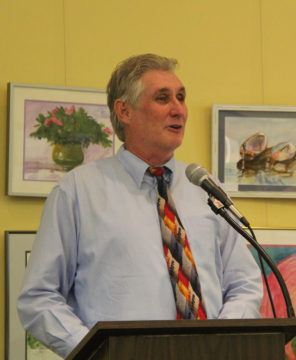
Former County Commissioner Jon Thaxton addresses Siesta Key Association members on Oct. 4. Rachel Hackney photo
Education is perhaps the biggest key to mitigating red tide blooms, former Sarasota County Commissioner Jon Thaxton told about 45 people at the Oct. 4 Siesta Key Association (SKA) meeting.
“I think ignorance is probably our greatest enemy in this fight,” he said.
Thaxton acknowledged that he was one of the primary proponents of the county’s ban on nitrogen-based fertilizer use during the rainy season each year, as well as the force behind creation of the county’s Stormwater Utility, which was the first in the state.
The nitrogen human beings add to the environment is one of the major feeders of the algae that causes red tide, Karenia brevis, he pointed out.
In response to questions from audience members, Thaxton suggested that county staff could put notices in utility bills to remind customers each year of the nitrogen fertilizer ban from June through September. He called that a “really, really simple way to get the messaging out.”
When one audience member questioned whether law care company employees adhere to the county’s ordinance, Thaxton replied, “I have less of a concern with the professionals than I do with the non-professionals.”
People who are in the law care business have to take a course that explains the facets of the county’s regulations, he pointed out.
Then he invited the audience members to visit a store such as Lowe’s or Home Depot and look at “these mountainous stacks of fertilizer.” If they went back four days later, all of it would be gone, he added, with homeowners primarily having been the purchasers.
Thaxton said people think using more fertilizer is better, likening that to the rationale a person who feels poorly often utilizes: If one aspirin will help, “two pills will make me feel great.”
Yet, Thaxton explained, “Over-fertilizing actually harms the lawns.”
Much better enforcement of county regulations would help with red tide, too, he continued. However, he cautioned that enforcement without education angers people and makes them even less likely to follow the rules.
“Today, you will hear no state or local elected official looking to compromise the integrity of any rule, law or ordinance that protects our waterways,” he pointed out. Yet, when the Gulf of Mexico once again is clear, he added, efforts will resume to reduce pollution prevention.
“As a community,” Thaxton said, “we need to remember the suffering that we have now. … This is a systemic, land-use created issue.”
This is a Karenia brevis cell. Image courtesy of Mote Marine Laboratory
As a senior vice president for community investments with the Gulf Coast Community Foundation, Thaxton reported, “We are already starting to see evictions and children missing school” because of the downturn in business resulting from national publicity about the current red tide bloom, which worsened this summer. In another 30 to 60 days, he added, he believes more families will lose their homes, as many people working in service industry jobs have lost income.
“You have yet to see the economic impact of this red tide,” Thaxton said. If the current bloom subsides, and the area experiences no problems for the next three to four years, he predicted it would take that long for the economy to recover.
The feeding of the algae
“Red tide is always in the Gulf of Mexico,” Thaxton explained. “The blooms come and go.” What makes them worse — such as the one Southwest Florida and the Panhandle and Palm Beach County have experienced, he continued — is the nitrogen-rich water the algae feeds on as it comes near the shoreline.
“If you have this toxic organism and you are now actually feeding it,” he said, the bloom “is now going to be significantly more intense” and cover a larger area of the coast.
Some researchers believe that nitrogen from the decomposing fish killed by Karenia brevisalso has been feeding the algae, Thaxton noted.
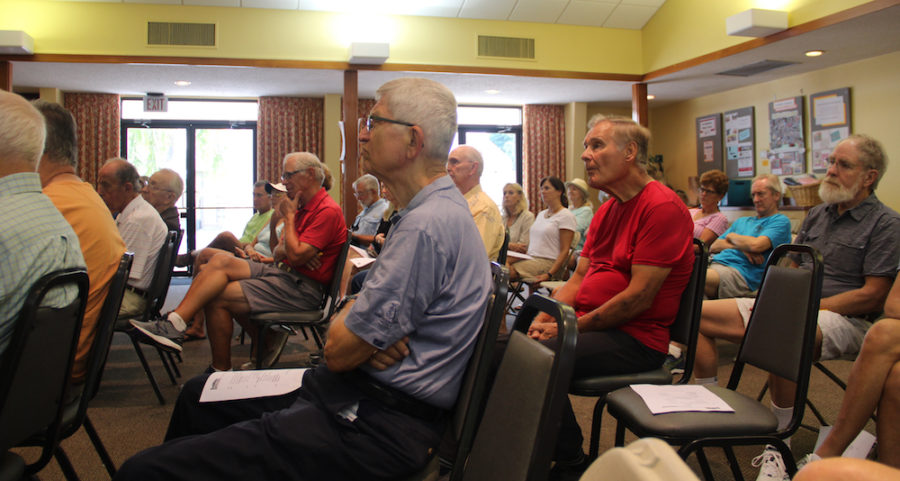
SKA members listen to Jon Thaxton’s remarks on Oct. 4. Rachel Hackney photo
Leaking septic tanks are a source of the nitrogen along with fertilizers, he pointed out.
Robert Luckner, a member of the SKA’s Environmental Committee, noted that when the county won voter support in 2009 for the most recent penny tax to support a variety of infrastructure projects, about $20 million of the resulting revenue was to have been put toward new sewer systems to replace septic tanks. Yet, Luckner said, based on research he has undertaken, less than one-quarter of that money has been spent on that initiative since 2009.
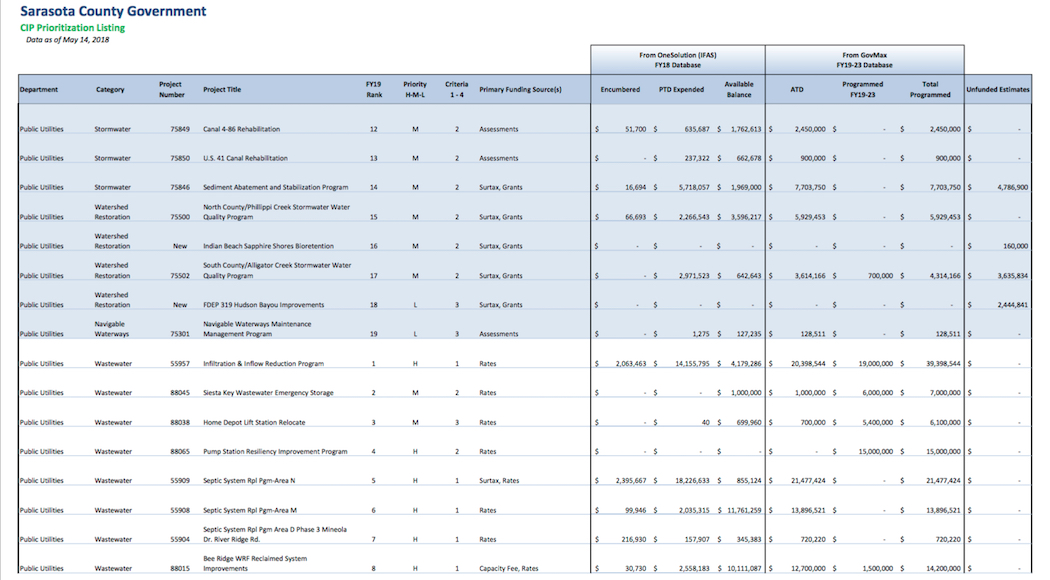
(In the 2019 fiscal year budget, which the County Commission adopted on Sept. 27, $32.5 million has been allocated to a variety of wastewater projects, including more septic tank replacements. In an update provided to the board during a May 25 budget workshop, staff proposed slightly less than $2.5 million just for the septic tank replacement program, with the funds coming out of surtax revenue and income from utility payments. The county has budgeted another $2,390,000 for stormwater projects. The fiscal year began on Oct. 1.)
Unfortunately, Thaxton told Luckner, in the 1960s and 1970s, the county paid the “lion’s share” of the expense for new developments. It was cheaper to put in septic tanks, he continued, than to build sewer systems. Although the federal government began providing funds in the 1970s for central sewer systems, Thaxton added, county leaders waited until the 1990s to “really aggressively begin removing septic tanks,” and by that time, the federal assistance had ceased.
Thus, Thaxton said, county taxpayers and residents with septic tanks have had to bear most of the cost for the conversions to central sewer systems.
County Commission Chair Nancy Detert recently told him, he said, that the allocation for such conversions in the county will end around 2020 or 2022, “and we still have a lotof septic tanks that are in the water table, which is really a shame.”
This section of the updated Sarasota County Capital Improvement Program proposed for 2019, as of May, lists septic tank replacement initiatives, among others. Image courtesy Sarasota County
In response to another question, Thaxton said that replacing the oldest septic tanks with central sewer systems would have “a huge impact. … All the barrier islands should be a priority area” for the endeavor, he added.
Other efforts that would be very helpful, Thaxton continued, would be the updating of stormwater runoff regulations and a review of land development regulations to determine other potential mitigation measures.
Stormwater systems remove only 40% of the nitrogen and phosphorous before the water makes it to the bays and the Gulf, he explained. If improved systems could increase that to 60%, he pointed out, that would have a significant impact.
“I believe all of this can happen without impeding any of the economic development, growth, commerce that we have. … It’s just about doing something a little bit better.”
Yet another recommendation Thaxton offered is making the collection of data a priority. Then scientists would be able to show the most cost-effective ways to keep the largest portion of man-made nitrogen out of the waterways. “Right now, there’s no focus on that at all; there’s just not.”
One audience member noted that he recently had learned that scientists have developed methods for identifying specific sources of nitrogen in the water.
“I don’t like pointing fingers,” Thaxton replied.
However, Thaxton continued, the City of Venice is looking at using meters at its eight major stormwater outfalls into the Gulf of Mexico, so city staff members can record water quality and water quantity data in real time. They could use the information to detect how much nitrogen is going into the Gulf, he added, as well as the types of nitrogen.
Not all of the approximately nine different types, he said, serve as food for the red tide algae.
Note: The Tischler Report that's the subject of these essays can be found here.
Land-use profit/loss study is valuable planning tool
By JON THAXTON Posted Mar 14, 2000 at 12:01 AM Updated May 8, 2006 at 7:42 AM
On Feb. 28, the Sarasota County Economic Development Board received a completely different kind of consultant’s report. Unlike the typical report that estimates the cost to build a library or repair a road, this report attempts to quantify the bottom-line profit or loss for the daily services government provides to our homes, our children and our businesses.
The concept is simple business mathematics: First you determine the price of production, subtract gross receipts, and the result equals your net profit or loss. Only in this case we are not talking about hypothetical widgets or doorstops, we’re talking about homes, businesses and schools and libraries.
The county contracted the economic consulting firm, Tischler and Associates, to estimate the fiscal and economic impacts of selected prototypical land uses in Sarasota County. In other words, compare how much it costs the county to produce the infrastructure (roads, schools, water, sewer, etc.), against how much money the county receives in taxes (real estate, gas, tourist, etc.) and fees (storm-water, recycling, utility, etc.).
The results are not what you might expect.
Most residential housing developments turned out to be a financial burden on the county. According to the Tischler report, a typical Sarasota subdivision, where lot sizes average 75 by 125 feet, and prices range from $150,000 to $230,000, costs the county $1.53 for every $1 of revenue it generates. OUCH! No higher math skills needed here. Surprisingly, even apartment complexes with 5.5 units per acre cost the county $2.65 for every dollar of revenue they generated.
The only residential land uses that cost the county less money for services than the revenue they generated were more expensive 5-acre ranchettes (57 cents spent for every dollar generated) and mobile home parks (75 cents spent for every dollar generated). Agriculture, commercial buildings and industrial sites also fared well in the fiscal and economic impact study, all costing significantly less money to service than the revenue they generate.
So how can these findings help us plan for a better community? First, the age-old assumption that agricultural and park lands take property off the tax rolls and would be more productive as subdivisions, is, at least in my opinion, officially hogwash. Using data from specific land uses in Sarasota, the Tischler report confirms that simply because a property produces more taxes, it does not assure that it will not be a liability to taxpayers. This may in part explain the multi-hundred-million-dollar revenue shortages needed for roads, schools and water.
A second point to consider when using this report for community planning is that it is only one of many planning tools required to make a community a quality place to live, work and play. We don’t want housing options to be limited to mobile home parks and expensive ranchettes out in the boondocks.
A significant force that affected the calculations found in this report is schools. Unlike typical residential suburban developments, commercial buildings, agriculture, industrial parks, rural residential and mobile home parks do not produce large numbers of school-age children. So, do we begin to award special benefits to those land uses that produce a positive revenue flow and penalize the less “profitable” ones? I personally do not want to live in a community that targets childless development. Education, just like ignorance, is a community expense -- only education is cheaper. We all share in the costs and benefits. Likewise, it is disturbing to imagine a community where affordable housing options are discouraged and forced into neighboring counties.
While the Tischler report raised as many questions as it answered, it was money well spent by the commissioners. The report has given us invaluable information to consider in our community planning process. However, it is somewhat unsettling now to realize how many decisions were made in the past without the benefit of this knowledge.
Tax base needs to be built upon a balance of various land uses
I believe that the Tischler report has influenced both nongovernmental initiatives and numerous, though not all, County Commission development decisions.
In 1999 the County Commission and the Economic Development Board hired Tischler & Associates to conduct an economic and fiscal impact analysis for 19 prototypical Sarasota County land uses. The economic analysis measured broad impacts to the general economy, and the fiscal impact analysis determined the cost and revenues from new development on the county budget.
The report concluded that most forms of residential development are likely to generate budget deficits. The findings suggested that developing residential homes from vacant land produced a net tax loss, despite an increase in gross tax revenues. Ultimately, the cost of infrastructure and services required by the new residential development exceeds the increased tax revenues generated. The report also concluded that many forms of commercial development, high-end residential development and agriculture produced a net tax benefit to the county budget.
When the report was issued in February 2000, many in the residential development industry feared the Tischler report would be misinterpreted and misused by government officials and anti-growth advocates as a means to stop growth. In response to these fears, I wrote a guest column, published in the Herald-Tribune, that suggested the report’s conclusions should not be used as a single factor to determine whether development should be approved or what kind of development should be approved. Instead, I argued, the information should be used as a tool, along with many other tools available to the community, to support an appropriate rate, form and amount of new development.
Last week two groups with completely different positions asked me: What has been done with the Tischler report? Has the county used the report’s findings to influence development decisions? Or has the report found a comfortable place on that notorious government shelf where it will forever remain dormant and unused?
I believe that the Tischler report has influenced both nongovernmental initiatives and numerous, though not all, County Commission development decisions.
While the Tischler report and many other studies have demonstrated a potential net negative fiscal impact for many forms of residential development, a decision to approve only “profitable” forms of development isn’t that simple. Unlike a for-profit corporation, government’s role often is to provide services that are not profit centers, such as indigent health care and education.
One of the main reasons that many forms of residential development don’t “pay their own way” is schools. Residential development that doesn’t generate school-age children was found to produce a net tax benefit. Conversely, most homes priced in the affordable and work-force ranges produce net tax revenue losses. Then are we to approve only childless and million-dollar homes? That is not the kind of community that I want to live in, and it certainly isn’t the standard that has made Sarasota the community that it is today.
Managing a viable community involves a great deal more than one economic measurement of profit and loss. A tax base built upon a balance of various land uses is essential to a stable economy and a livable community. This often requires using revenue from one land use to support another.
That is not to say the Tischler report has been ignored -- it has not. The report provided additional evidence that the county needs to diversify its ad valorem tax base, to reduce dependence on residential properties. The county also refocused its economic development strategies based upon this finding. Nonpolluting “export” industries with high-paying jobs have become the target for economic development policies, replacing a priority on tourism and housing development.
Additionally most elected officials now realize that growth, simply for the sake of adding properties to the tax rolls is not a sound reason to approve development. It may have been valid at one time, or under different funding scenarios, but not anymore. Today’s development should be scrutinized at a higher level that includes a comprehensive balance of benefits and responsibilities.
Sarasota County Commissioner Jon Thaxton (District 5) served on the state’s Impact Fee Task Force.
Former county commissioner Jon Thaxton presented a fine, thoughtful overview of comprehensive planning from the late 70s to the present time at CONA Sarasota on April 9.
It's a story of a giant pendulum swing from an era that foresaw the dangers of unregulated growth (sprawl, traffic, uncoordinated planning and pervasive dysfunctionality) and put agencies and rules in place to address those dangers, to the present time in which layers of prudent oversight at the regional and state levels have been dismantled.
That leaves local government -- and citizens -- to work out the difficult implications and impacts of large scale planning. Who provides the vision if citizens feel local governance is inadequate, who has their back?
In the Q & A after his talk, Thaxton addresses questions arising from current planning issues in the city and county.
The first segment begins with Ben Cannon talking about residents' concerns with a plan at the Raquet Club behind Trader Joe's. Thaxton begins at about the 16-minute mark:
Great Round Table with Alan Cohn on WWSB last evening. Entire show is below - a few highlights:
Rob Wright holding up County document showing that properties at "The Quad" - the parcels at Apex Rd. and Palmer Blvd. - were included as part of the Celery Fields as environmental lands. These are the very lands the County now has put out to bid and rezone for industrial use. This appears at 10 min, 21 seconds in the video below.
County Map shows Apex/Palmer quadrant as part of Celery Fields - total compatibility.
See also Cathy Antunes' comments at 12:50 on the failure of the County to update its Critical Area Plan for 25 years on this land. I.e., NO PART of the county's land use - surplusing, bidding, C.A.P., rezoning -- indicates proper care and stewardship of these lands.
See also:
15:30 "Who's defining the value of an area?" asks Cathy Antunes. Special interests vs. public interests.
16:20 - Jon Thaxton: - The Comprehensive Plan is designed to adjudicate these issues.
16:35 - Notification - Rob Wright, former county employee: "The first thing you do is notify stakeholders" of what is planned before executing the plan.
18:20 - Compatibility. Wright notes that Gabbert's plan is totally incompatible with existing uses of surrounding lands.
19:50 - Thaxton - It's less campaign contributions than commissioners' philosophies on growth, and especially the Comprehensive Plan: "What do the policies direct them to do with this decision they must make?"
BETTER GOVERNMENT ASSOCIATION OF SARASOTA COUNTY INVITES YOU TO A FREE NON-PARTISAN FORUM ON REFORMING OUR LOCAL ELECTIONS
1. OPEN PRIMARY AND RUNOFF: Should all registered voters (Republicans, Democrats and independents) vote in a primary for all local elected officials, with the top two candidates, regardless of party, going to a run-off election if none of them receives a majority in the primary?
2. NONPARTISAN BALLOTS FOR NON-POLITICAL POSITIONS: Should all County candidates for elected office EXCEPT County Commission and Charter Review Board (e.g. Sheriff, County Clerk, Supervisor of Elections, Tax Collector, Property Appraiser, Prosecutor, Public Defender, Hospital Board, etc.) appear on the ballot without partisan identification?
3. DISTRICT ONLY VOTING FOR BOARDS: Should County Commissioners, Hospital Board, School Board, and Charter Review Board members be elected only by the voters in their district?
4. AND OTHER IDEAS?
JON THAXTON, Senior Vice President for Community Investment, Gulf Coast Community Foundation and former County Commissioner
CATHY ANTUNES, President, Citizens for Sarasota County and public interest activist
Moderator: FRANK ALCOCK, Professor of Political Science, New College of Florida
This piece about growth by Sarasotan Kevin Cooper leaves us a bit unclear. It ends:
"Growth is the inevitable indication of a desirable community. Given the fact that Sarasota’s net internal decline has increased over the last 10-years, while at the same time continuing to grow, it would appear that the area is becoming increasingly more desirable."
What is the significance of the observation? Lots of things are "desirable." Some are so desirable they are overrun, plundered, or destroyed. To have a desirable community, if that's what Mr. Cooper means, in part means knowing how to keep it intact.
Sarasota has traditionally opted for slow growth, which has helped maintain its desirability, relative to other counties around the state. What's needed is a sensible self-determining plan to ensure that it continues to be desirable, rather than overrun by those seeking to cash in on market trends.
Former County Commissioner Jon Thaxton had more to say about this matter of self-determination in the Alternative Visions Forum recently sponsored by the Better Government Association.
SUBJECT: ALTERNATIVE VISIONS FOR SARASOTA COUNTY (AND HOW TO GET THERE).
Free and public invited. Presented by the Better Government Association of Sarasota County, a non-partisan, non profit organization. Questions and discussion will follow the presentations.
For more information , please call (941) 923-0671.