Three candidates for the District 5 seat on the Sarasota County Commission address questions from the Argus Foundation on a variety of issues.
District 5 is generally the southernmost district, including much of North Port.
The candidates in alphabetical order are Ron Cutsinger (R), Chris Hanks (R) and Alice White (D). Argus executive director Christine Robinson asked the questions.
The zoom session has not been edited in any manner, but simply replays the video posted by Argus to YouTube.
Questions for District 5 Candidates from the Argus Foundation
BOARD of Sarasota County Commissioners POLICY AGENDA 2020:
Top Priorities
Future of County Administration Location j
Medical Examiner / Coroner / Emergency Services Building
Mote Funding: If, When, How
Affordable and Workforce Housing
Solutions to Ensure Wastewater at AWT Standards
Modern Mobility/Transit
High Priorities
• Bay Park Conservancy
• Sports Tourism Development Strategy: Goals, Best Practices, Report with Options, County Role and Direction
• Progress on Design and/or Funding for “Gap” Roads
• Road Resurfacing: Service Level, Direction and Funding Increase Decision
• Stormwater Policy and Management: Direction, Project Priorities and Funding Mechanism
Here [above] is the County Commission board policy agenda for 2020. This was set by the commission at their December 2019 retreat. Do you agree with this list? What do you think is the most important issue for the county and what would you specifically do to tackle that issue? What is the most important issue for your district and what would you do to tackle that issue?
Businesses have been shut down or severely scaled back due to COVID-19. Do you believe county government has a role in jumpstarting the economy when we open back up for business? Why or why not? If you do, what would you do to jumpstart the economy?
What is your opinion of CRAs (Community Redevelopment Agencies), and how well you think they have worked in Sarasota County? Would you expand this program in other areas of the county? If so, how many areas? If so, how would you make up for the loss in tax revenue to the general fund? If not, what can be done to help blighted areas of the county?
What is your opinion of the county property tax rate and what area of the county budget do you think we spend too much on, what area too little on?
Give the county a grade on their relationships with the municipalities? What would you do to further improve the relationships?
Water Quality. There are many aspects to it - Septic to sewer, stormwater run-off, advanced wastewater treatment, agriculture, old infrastructure, fertilizer run-off, sewer spills, red tide, etc. What area of water quality do you think the county should be focusing its attention and funding on and why?
Do you believe the county has kept its promises to North Port with the extension of the Legacy Trail? What would you do as a county commissioner to ensure that the Legacy Trail extension to North Port is completed expeditiously?
What is your opinion on growth? What, if anything, should be done to stop or control it?
According to the county, in fiscal year 2020, Sarasota County will spend $9,011,146 in budgets to Health and Human Services, 12th Judicial Court Administration and the Sarasota County Sheriff’s Office for mental health and supportive services. Of the local mental health and supportive services Sarasota County funds, the county's contribution represents approximately 24% of the total $36,984,582 spent. The remaining funding is contributed by multiple partners, including Federal and State grants, local philanthropic organizations, private donors and insurance. What is your position on the proposed mental health care district in Sarasota County- would you create it, what should it look like, and would you increase taxes to provide more money for the district?
Transportation is an important issue in Sarasota County. The county is coming up with a modern mobility plan. What do you think of eliminating SCAT routes in favor of modern mobility?
A conversation about urban planning, transportation, commuting, and about how zoning works and sometimes doesn't. With Cathy Antunes and Andrew Georgiadis, in Sarasota, FL. Antunes often writes about development, growth, and dark money at The Detail. Georgiadis is an urban planner with Plusurbia. They spoke on Feb. 6, 2020 at Fogartyville.
Sarasota County Council of Neighborhood Associations - CONA
Monday, April 8, 2019 7 p.m.
city transportation
master plan
coming to Sarasota
On April 8, 2019, please join CONA-Sarasota County Council of Neighborhood Associations, when the chief transportation planner for the city of Sarasota, Colleen McGue, will present Sarasota in Motion, a preview of the city master plan development regarding transportation that will kick off this Spring.
More than just a traffic plan, the city planners also are looking at how to move people around the city safely and comfortably on foot, on bicycles, on improved transit service, and in new ways such as automated and connected vehicles, water taxi, and more .
Ms. McGue will give citizens an insight into the process for development of the plan and enough information to determine what their role will be in that process during input from the community and the public participation opportunities.
Widening of Clark Road to six lanes from I-75 to Ibis Street and realignment of Lorraine Road to be focus of proposed county Comprehensive Plan amendment
Goal is to provide better road network connecting new developments east of I-75
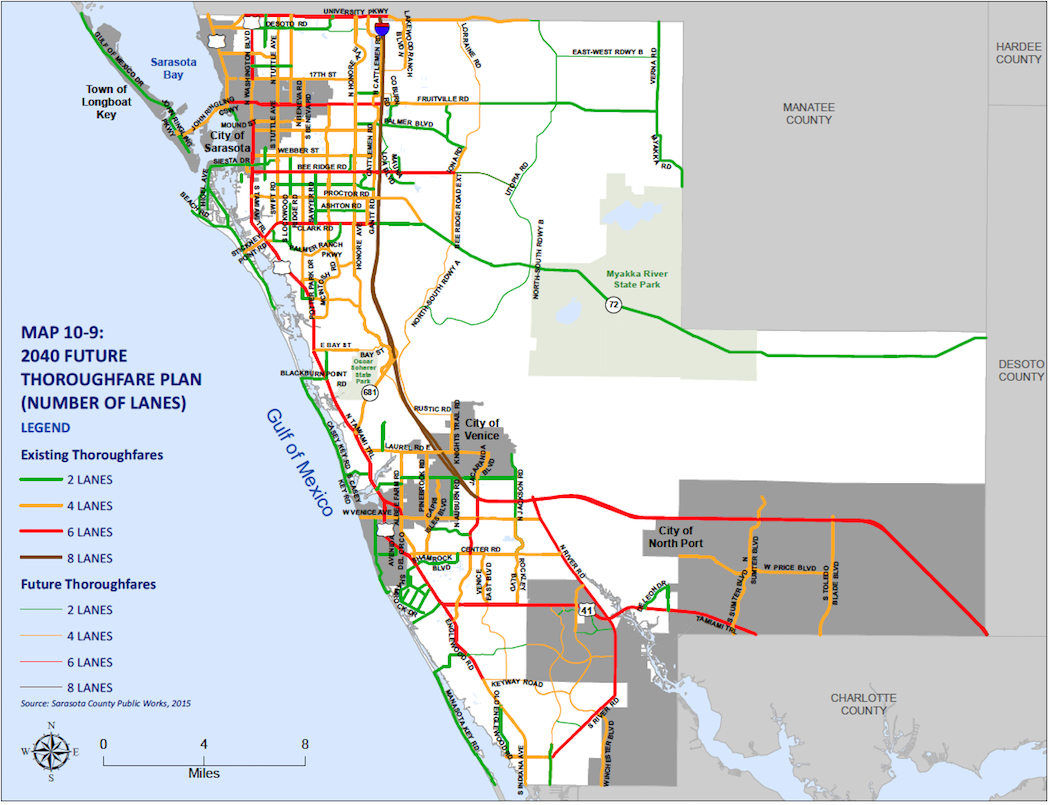
This Future Thoroughfare Map in the county Comprehensive Plan shows ‘North South Roadway A.’ Image courtesy Sarasota County
The Sarasota County Commission has authorized county staff to work on a plan to realign Lorraine Road “to provide a connected network of future roadways east of I-75 to support future development.”
If ultimately approved, part of the process would lead to the reclassification of Clark Road as a six-lane major arterial from Interstate 75 to Ibis Street. Additionally, Clark would become a four-lane major arterial from Ibis Street to Lorraine Road.
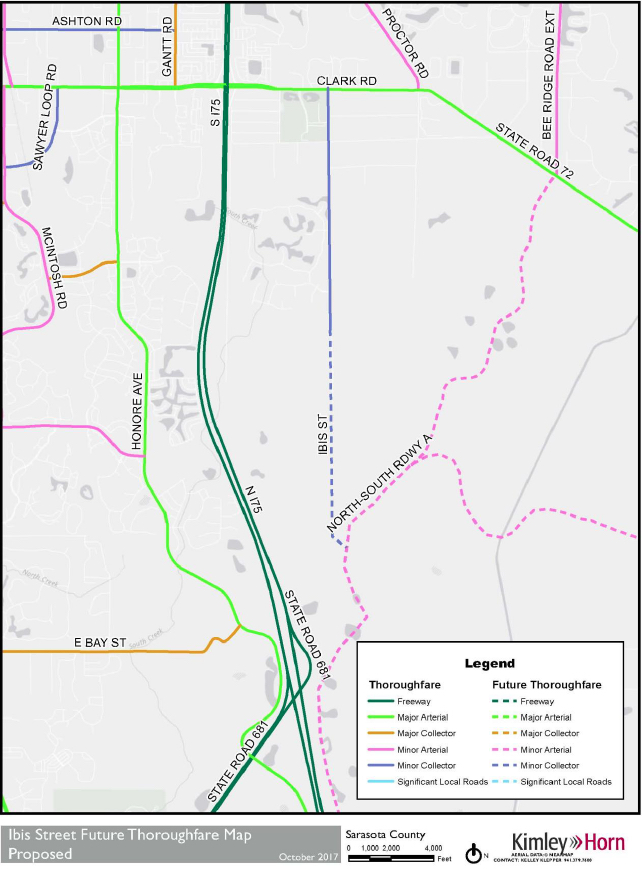
An Ibis Road extension was added to the Future Thoroughfare Maps in 2018, a March 12 staff memo noted.
The Florida Department of Transportation (FDOT) defines “arterial” as a divided or undivided roadway that provides a continuous route, serving through traffic, high traffic volumes and long average trip lengths.
The status of Ibis Road was a point of contention during public hearings last year as the County Commission addressed petitions for the Grand Lakes development east of Interstate 75, near Clark Road. Because the Ibis Road extension will not be completed until possibly decades from now — as county staff had testified — residents of the Serenoa Lakes and Serenoa communities stressed to the County Commission that Ibis Street is the only immediate access to their homes and the Grand Lakes site. Those residents would be the closest neighbors to Grand Lakes.
A map shows the location of Ibis Street and the planned extension, east of the site where Grand Lakes is planned. Image courtesy Sarasota County
On a unanimous vote of approval of its March 12 Consent Agenda, the commission formally gave staff the go-ahead to initiate a Comprehensive Plan amendment to the county’s Future Thoroughfare Maps that would not only realign the routing of Lorraine Road — which runs north-south — but also classify Dove Street as a two-lane minor collector.
In December 2016, the memo explained, the commission adopted an updated version of the county’s Comprehensive Plan. In that document, the Future Thoroughfare Plan Maps included Lorraine Road from Clark Road south, “roughly paralleling I-75 …” Lorraine Road then was planned to proceed east along Rustic Road to an intersection with Knights Trail Road.
Lorraine Road was identified on the map as “North South Roadway A.”
Several developments that the County Commission already has approved and others that have been planned “are connected to or utilizing the thoroughfare from Clark Road south to the northern limits of the City of Venice,” where it meets Knights Trail Road, the memo continued. Work on the rerouting of Lorraine Road “presents an opportunity,” the memo said, to analyze possible positive benefits. For example, the memo noted, connectivity could be enhanced, more limited environmental impacts might result and overall infrastructure costs could be reduced.
“Conceptually, staff would examine routing Lorraine Road eastward to Knights Trail Road, north of Knights Trail Park, proximate to the [county landfill],” instead of south of Knights Trail Park along Rustic Road, the memo added.
A graphic presented to the County Commission in March 2018 shows planned Sarasota 2050 villages in the vicinity of the Grand Lakes site. Image courtesy Sarasota County
As for Dove Street: The memo explained that a second facet of the proposed amendment would add that street as a two-lane minor collector from Clark Road to Lorraine Road.
FDOT defines “collector” as a divided or undivided roadway that serves as a link between arterials and local roads “or major traffic generators.” FDOT adds, “Collectors may include minor state roads, major county roads, and major urban and suburban streets.”
With the County Commission’s approval last week of the plans for the amendment, the next step will be the scheduling of a neighborhood workshop, so staff can discuss the plans and then listen to public comments about the proposals.
In response to aSarasota News Leader question, county Media Relations Officer Ashley Lusby wrote in a March 20 email that staff has not yet set a date for that workshop.
The process also will entail public hearings before both the county Planning Commission and the County Commission.
County Commission approves scope of work for process, which will include broad public engagement, staff says
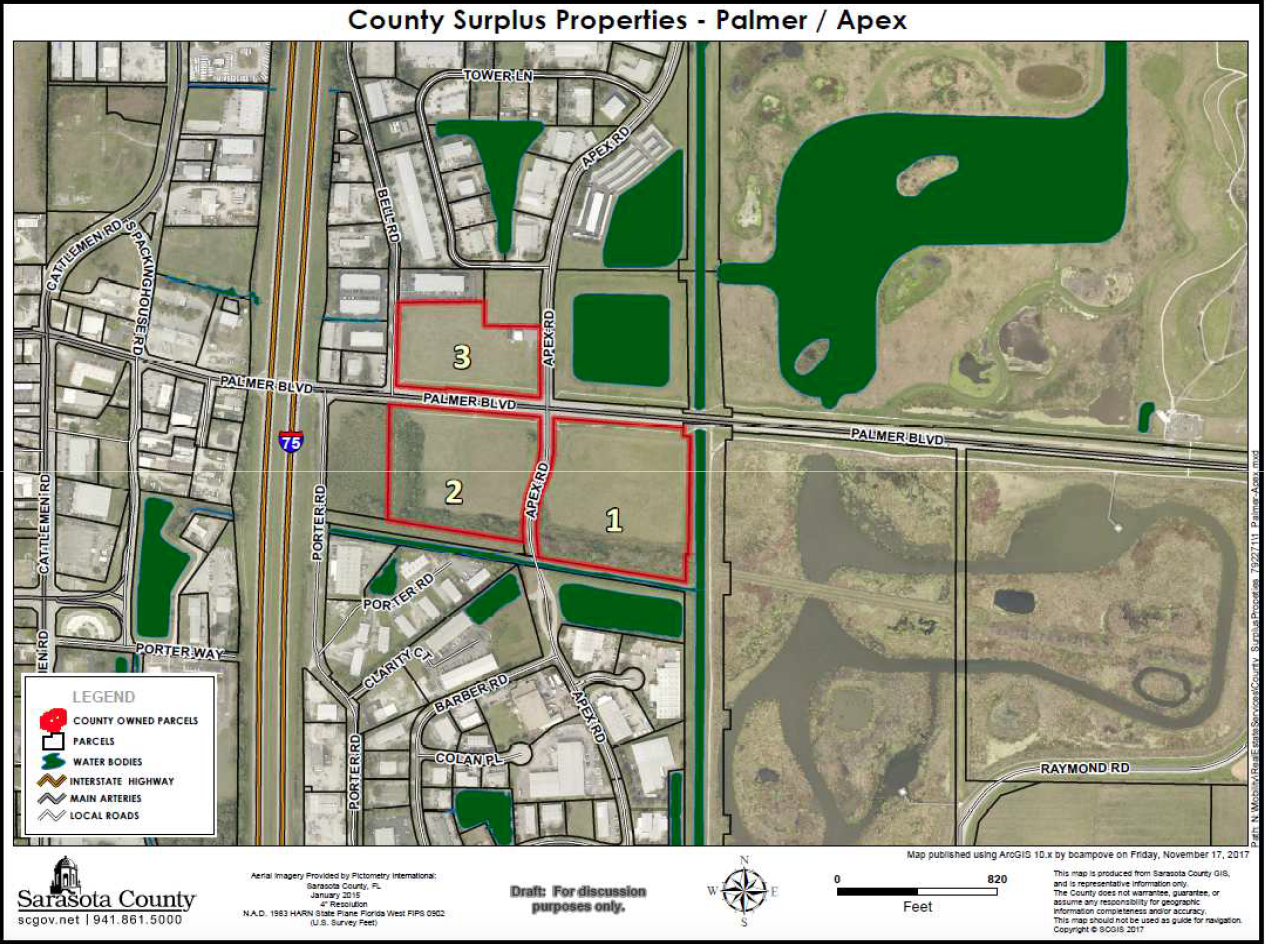
A graphic shows the three ‘Quads’ parcels (outlined in red) originally under consideration for sale as surplus land. The Southeast and Southwest Quads (Nos. 1 and 2) are not on the market, at commission direction. Image courtesy Sarasota County
Supporters of the ecotourism that has flourished at the Celery Fields in the eastern part of Sarasota County have urged the county commissioners for more than two years to approve only compatible uses if they allow development on adjacent, county-owned property known as the “Quads.”
Last fall, the board members listened to a consultant staff had hired to determine how the county should market one of those parcels, to maximize the county’s proceeds from a sale. Afterward, then-Commissioner Paul Caragiulo suggested that the commission have staff undertake an in-depth analysis of the Quads in the current context of neighboring properties, including residential areas.
This week, county Planner Steve Kirk presented a proposal for a scope of work designed to accomplish what Caragiulo had sought. The commissioners unanimously approved it.
Staff expects the work to be completed and brought before the commission in October or November, Kirk said on Jan. 30.
Additionally, one of the leaders of a Celery Fields advocacy group — the Fresh Start Initiative — voiced support for the outline of the CAP process county Planning and Development Services Department staff had outlined in a memo to the board.
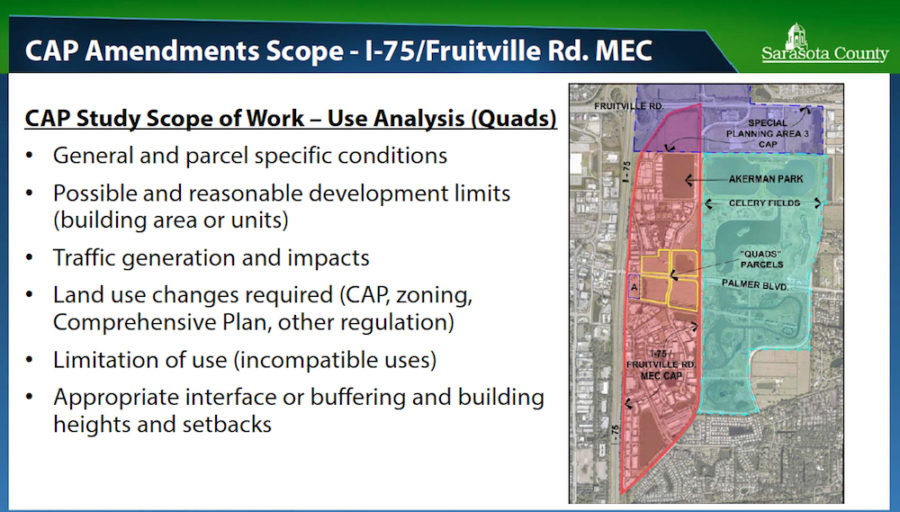
“The excellent planning memorandum clearly indicates that this holds promise for a new vision of these public lands and the Celery Fields area,” Tom Matrullo told the commission. Noting that the scope of work will examine the gamut of appropriate issues — mobility, buffering, “[p]ossible and reasonable development limits,” building heights and setbacks, and limitation of incompatible uses — Matrullo added, “All of this is music to the ears of our communities.”
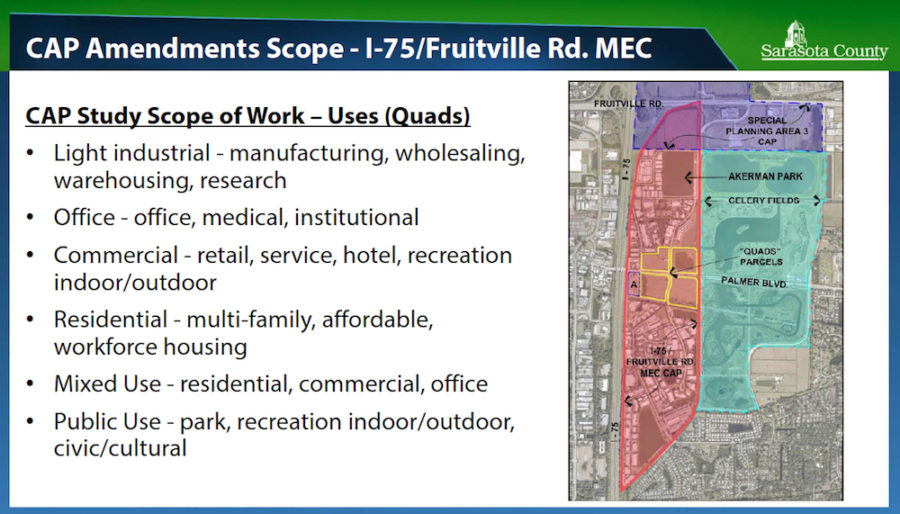
These are potential uses of the Quads, as indicated in a county staff presentation on Jan. 30. Image courtesy Sarasota County
Among the potential uses of the Quads that Matt Osterhoudt, director of Planning and Development Services, and Kirk outlined in a Jan. 29 memo to the commission are a hotel, indoor and outdoor recreational facilities, affordable or workforce housing, a park, and civic or cultural amenities, Matrullo pointed out.
However, Matrullo did ask the board members, “as fiduciary stewards of our public lands, “to ensure the scope of work is open, transparent and inclusive.”
Speaking on behalf of residents of the area around the Celery Fields, Matrullo recommended that the commission make it “unambiguously clear that no preference or deference will be given” to any group during the public engagement process staff has outlined. He added that his coalition’s goal is for “all citizens [to be] equal stakeholders.”
He further asked that staff make sure every public meeting during the analysis be advertised broadly and that it be open to everyone who wants to attend it.
During his presentation, Kirk explained that staff plans “multiple forms of engagement at various stages of the study process.” Among the people staff will seek to involve, Kirk pointed out, are surrounding property owners and tenants, neighborhood and citizen organizations, and users of the Celery Fields.
Commissioner Nancy Detert told Kirk she is interested in uses of the property that the commission could pursue. Kirk replied that staff would consider all the possibilities without making judgment on how appropriate any of them might be.
“I think part of the study will be looking at the specific conditions of these parcels and the area,” he added. “Out of that, I think, will come some facts that may illustrate what the appropriate uses might be. … Certainly, the public input is going to provide us lots of information and direction for that.”
Detert referenced the fact that when the CAP — known as the I-75/Fruitville Road Major Employment Center Critical Area Plan — was approved in 1985, the area it encompassed was planned largely for industrial uses — “things nobody wanted to look at.” “Now,” she continued, “you have homes out there,” and the residents are asking for a variety of different uses.
An area in transition
These are facets of the analysis staff will undertake for the I-75/Fruitville Road CAP. Image courtesy Sarasota County
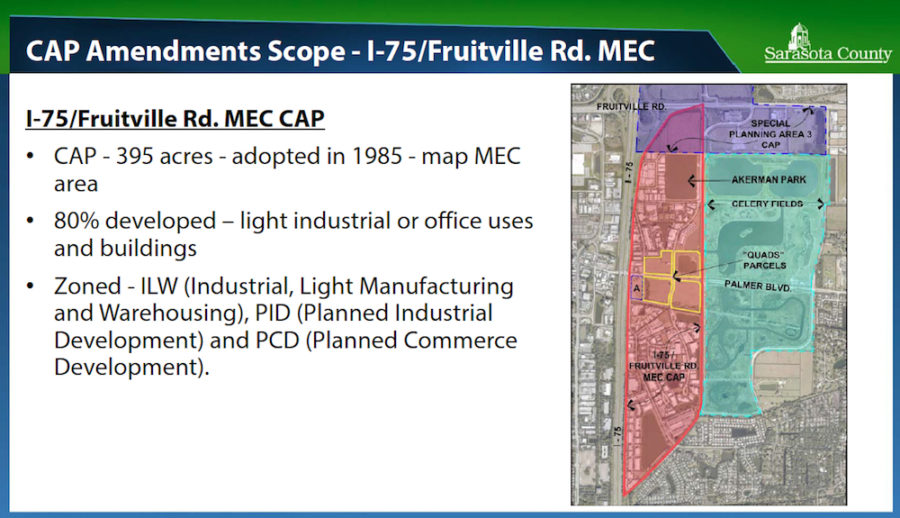
As Kirk explained to the board on Jan. 30, the I-75/Fruitville Road CAP encompasses 395 acres. Eighty percent of the area has been developed, mostly with light industrial and office uses, along with some other buildings.
The Quads are all zoned Open Use Rural, a designation, Commissioner Alan Maio noted, that no longer complies with the county’s land-use development guidelines.
About 2.4 acres of the Northwest Quad, Kirk continued, is the site of a future fire station. The design and rezoning process for that project is expected to be back before the board for approval in June or July, he added.
“I do not want to see this [analysis] delay the construction of the fire station,” Maio told Kirk. Funding already has been programmed out of the revenue from fire assessments county property owners pay, Maio added. The firefighters assigned to that station, he pointed out, are in “trailers, [and] extremelyexpensive, extremely expensive, equipment [is] under some sort of Quonset hut or tent.”
Maio said he realized staff had to follow the county’s process for the design of the fire station and the rezoning of the site for the new facility. Still, he added, he was concerned that the June/July timeline could get pushed back to August/September.
As Kirk continued his presentation, he noted that the Northeast Quad has sufficient stormwater capacity, so stormwater retention planning would not have to be incorporated into any uses of the other Quads.
Because of the stormwater pond on the Northeast Quad, he also noted, no construction can occur on that parcel.
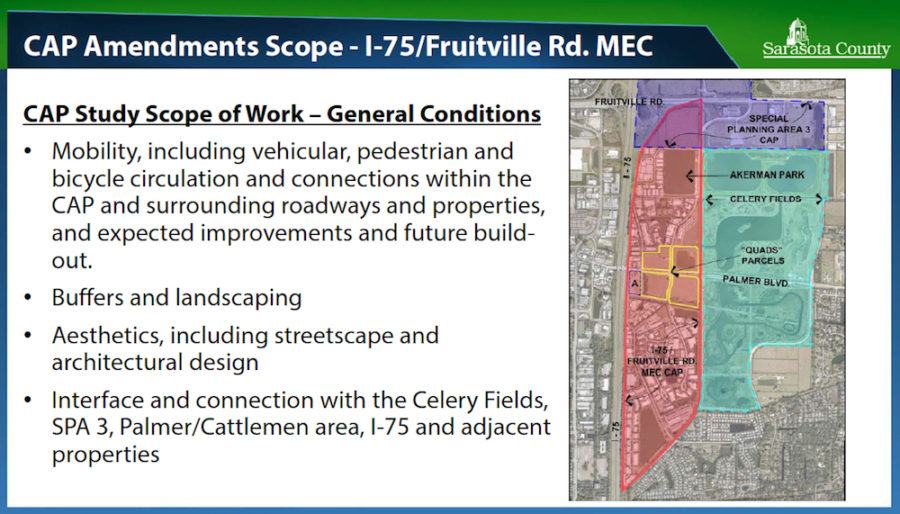
These are additional elements of the scope of work approved by the commission on Jan. 30. Image courtesy Sarasota County
As for the Southeast Quad: The commissioners in November 2017 agreed to remove it from the county’s surplus lands list, which was designed to ensure property the county does not need can be sold. The board members agreed that, because of its proximity to the Celery Fields, it should not be marketed.
The Northwest and Southwest Quads remain on the surplus list, Kirk reminded the commission.
In 2017, advocates of the Celery Fields fought an application for a construction and yard waste recycling facility, which was proposed for the Southwest Quad. On a split vote in August 2017, the commissioners voted to deny the necessary petitions for that project.
Earlier, an application for a 60,000-square-foot wholesale restaurant supply warehouse on the Northwest Quad was withdrawn. That occurred after questions arose about the fact that not all the owners of the company that had petitioned for approval of the project had been disclosed, which was a violation of county regulations. However, the applicants’ agent, Sarasota attorney Charles Bailey III, cited community opposition to the plans as the main reason his clients chose to back away.
In late November 2017, in the aftermath of those situations, Commissioner Maio won his colleagues’ approval for the hiring of a consultant to determine the best marketing strategy for the county to sell the Northwest Quad, so the board could get as much money as possible for the property. The board at that time was looking to plug revenue gaps in its budgets for the next several years.
However, after listening to a representative of the consulting firm in October 2018, Commissioner Caragiulo cited ongoing concerns about the insufficiency of the road infrastructure in the area of the Quads. In fact, questions about the traffic in and out of the proposed construction and yard waste recycling plant was one of the primary reasons Caragiulo said he decided to vote against that project in 2017.
This graphic explains part of the history of the I-75/Fruitville Road CAP. Image courtesy Sarasota County
The commissioners subsequently agreed to allow the Fresh Start Initiative, representing 50 homeowner associations in the vicinity of the Celery Fields, to propose potential uses for the Quads.
At the end of a Sept. 14, 2018 presentation, the Fresh Start group pleaded with the board to pursue commonsense planning for the Quads, given the international popularity of the Celery Fields as a bird-watching park.
Then-Chair Detert responded that no decisions would be made that day, as more extensive commission discussion would be necessary.
A Florida Department of Transportation (FDOT) plan to create a large Diverging Diamond interchange at Fruitville Road could render impossible a design for an innovative, walkable small town that's been gathering momentum for nearly 10 years.
More than 10 years ago, [a group of] property owners began working on the development with Sarasota County Commissioners and one common goal.
"[It was] designed around pedestrians walk-ability, mixed use and dispersing traffic through a whole street grid," said Steve Suau, the engineer working on the Fruitville Initiative.
The Fruitville Initiative would resemble a new downtown that was all set to break ground by the end of this year.
That is, until Thursday (6.21.18) when the Florida Department of Transportation unveiled its plan to put a diverging diamond here at a public hearing.
Comments from community leaders and developers of the Fruitville Initiative:
Channeling more traffic through the proposed Lakewood Ranch / Fruitville Road intersection could "implode" the walkable street grid that is essential to the plan, said Steve Suau, a stormwater expert who was part of the original community effort.
"That just defeats the whole purpose of dispersing traffic and walkability," he added.
"I think it would destroy it entirely," said Keith Gelder, vp of Stock Development, which recently purchased land to develop within the Initiative. He added:
"There was a very significant effort, a planning effort for the Fruitville Initiative, conducted over the last eight or nine years, with a tremendous amount of community input to try to create a nice new urbanism concept of a walkable community. What FDOT is proposing simply destroys that."
A public meeting at Selby Library on Thursday, June 21, apparently didn't answer anyone's questions. FDOT representatives said they were hearing these concerns for the first time, despite a paper trail going back years. It includes a 2014 letter from the former head of FDOT, Billy Hattaway, which states:
Our goal is to design an interchange . . . that is not only safe and operationally efficient but contextual to the planned Fruitville multi-way boulevard and surrounding compact, walkable, mixed-use development. We welcome the opportunity to continue working with the County and stakeholders in achieving that objective. (Italics added)
FDOT plans Diverging Diamonds at Fruitville, Bee Ridge, and Clark Roads
Right now, the Fruitville Road project is in the design phase. It's not funded for construction but FDOT officials will meet in the summer to discuss development for the year 2024 or sooner if Sarasota County makes the project a priority. Once approved, construction is expected to cost $86,000,000.
Convene broad-based group to tackle Ringling Causeway congestion
Traffic backs up on the Ringling Causeway on Wednesday, Jan. 14. City Commissioner Eileen Normile has called for a "traffic summit" of local and state officials to consider solutions for the causeway's seasonal traffic jams.
STAFF PHOTO / RACHEL S. O'HARA
Published: Friday, February 20, 2015 at 1:00 a.m.
Last Modified: Thursday, February 19, 2015 at 7:02 p.m.
Talk about the Ringling Causeway traffic usually involves a lot of waiting. Waiting in your car or truck for the line of vehicles in front of you to start moving. Waiting for the city, county or state to do something to relieve the congestion.
But some of the Sarasota city commissioners are tired of waiting.
One of them, Eileen Normile, suggested at Tuesday's commission meeting that the city convene a "traffic summit" of local and state officials, urban design experts and others.
The intent would be to explore ideas about how to get traffic moving on the causeway and at its intersections with U.S. 41 at one end and St. Armands Circle at the other.
Two of Normile's colleagues -- Susan Chapman and Suzanne Atwell -- voice support for the summit.
It's an idea that the public, public officials and local businesses should get behind.
Inconvenience and safety
Vehicle counts on the causeway and its main intersections are rising higher than normal for the tourist season, as noted in an editorial last week and in a recent story by the Herald-Tribune's Josh Salman.
The traffic tie-ups are not only an inconvenience for drivers -- turning what is normally a 10-minute trip on the causeway into an ordeal of an hour or more. They pose a safety issue for residents of -- or visitors to -- St. Armands, Lido and Longboat who need emergency medical care on the mainland.
With major residential and commercial developments underway or planned, on and near the U.S. 41/causeway intersection, the time to seek solutions is now.
A traffic summit is a good place to start, and, as Normile said, the sooner one is held, the better.
As we said last week, studies should be conducted to determine where most of the traffic is coming from and where it's going. Among many other questions are whether existing roads and other infrastructure can be adapted to accommodate more traffic, what compromises are acceptable and what is the cost of doing nothing.
Roundabouts are planned for the U.S. 41/causeway intersection and nearby U.S. 41/Fruitville Road, but those would be built years from now -- if they're ever built.
Normile suggested that some "short-term mitigation" is needed now, perhaps a right-turn lane from U.S. 41 to Fruitville. Chapman said mass transit must be part of any solution.
Both those ideas and others should be explored at the traffic summit.
Many potential participants
Normile proposed that the summit include the city's engineering staff and urban design studio as well as representatives from Sarasota County and the state Department of Transportation.
We would add that an official with the county's transit system should be part of the mix, along with Longboat Key officials, St. Armands and downtown merchants, real-estate developers and brokers, community activists, and the operator of the popular shuttle service that serves Longboat Key and Anna Maria Island.
All interested parties should participate, and all ideas should be on the table.
Just make sure the traffic summit is scheduled at a time that will allow everyone to get there. That might take awhile.
Comment from Bill Zoller:
Well, in reality, it was time to talk traffic a long time ago...before it became untenable! Just as it was time to talk traffic before the comp plan amendments and rezonings for the UTC were granted. Just as it was time to talk traffic when most large projects were being considered. It is inexcusable for our elected officials to approve these sorts of things before they have figured out the impacts. One may ask: is there even a shred of integrityamong our county commissioners who continue to foist these situations on the citizens in order to benefit ... their major campaign contributors? Perhaps their integrity is on the level of a commissioner's thinking that heading up Argus, a major lobbying group here in Sarasota, while serving on the BCC, is not a conflict of interest. How about the fact that, while counties and municipalities around the area are raising their impact fees now that the "crash" is behind us, Sarasota County Commissioners seem content to keep their rates artificially low ... in the face of these untenable traffic situations? Is this what they call "Integrity"? What is wrong with this picture?
Can you think of what this county needs, in one word? Hint: it begins with "I".
In 2010, Lakewood Ranch development received approval to increase their Sarasota 2050 project from 57 units to over 5,000 housing units in exchange for open space, walkable communities and included paying for the new roads needed by the development.
The developers signed an agreement with Sarasota County called the Adequate Facilities and Transportation Agreement (AFTA) which clearly outlines who pays for the roads needed by the new development.
'SMR or Lakewood Ranch Stewardship district will remain responsible for constructing all on site and site related roadways,at its own expense...
'Lakewood Ranch Boulevard, from Communications Parkway to Fruitville Road: construct two lanes prior to first construction plan; (and) two additional lanes...'
'Jensen has also proposed four lanes for the road - instead of the two he's required to build - and for the county to pay the difference.'
This article refers to comments made by Rex Jensen of the Lakewood Ranch SMR development company. (see attached link to article)
So when did it change from Lakewood Ranch development paying for all four lanes of Lakewood Ranch Boulevard to where they are only required to pay for two lanes? When did we get stuck with the bill for paying for 2 lanes?
This is one example of how existing Sarasota County taxpayers will be subsidizing new development in the rural lands. There were several 2050 developments approved to date and more expected. We have no idea how much subsidizing new development will cost the Sarasota County taxpayers in the near future.
So join us in sending your objections to the state. Send your objections to: