Sarasota County Drainage Project Protects Celery Fields
SARASOTA, FL – Sightseers in northeastern Sarasota County enjoy a natural bird habitat, walking trails, and scenic overviews in an area once flourishing with stalks of celery. An old machine that used to harvest celery and a series of canals remain as reminders of what local residents still call the celery fields. Even evidence of the annual flooding is gone.
Farmers designed the fields to retain water and nourish the celery crops, but development to the south continually flooded as new building subdivisions increased runoff and decreased the ability of the ground to absorb water. The slight southern slope of the land and the loss of natural turf, due to development, caused flooding when heavy rains fell.
The situation became critical in 1992 when 22 inches of rain fell over three days, and the resulting runoff inundated more than 200 homes in the former celery fields.
According to Kirk Bagley, Sarasota County drainage operations manager, the county not only wanted to find a way to safely reroute the water from the inhabited areas, but also ensuring that when flood waters were moved, they did not flood other homes.
Engineers analyzed the area’s flooding patterns and north-south water flows, and then developed a plan to control the water through a series of canals, ponds and mechanical flow devices. They created computer simulations with various flooding conditions and, upon review of the data, the design appeared to stop the damage without flooding other areas.
The county purchased the remaining former celery fields – more than 300 acres of property cut with ditches and framed by a series of canals. The design incorporated the canal infrastructure and added diversion gates, outflow pipes and controls.
After three years of construction on the first two phases of the project, the test came in November and December 1997 when two 100-year events (a level of flooding that has a 1% chance of occurring in any given year) deluged the flood-prone area. The design worked. Nearby homes were spared from flooding.
The county installed automated monitoring stations that allowed staff to watch the water levels remotely. Because of this remote operation, Bagley and his staff can track the amount of water in the canals, measure accrued rainfall, graph results and make appropriate decisions about holding and releasing runoff from the facility and control flow into the system.
To pay for the project, Sarasota County put into place a funding plan often used by cities: the county’s water division localized assessments. This way only those residents who benefited from the project paid for it, instead of taxing all county residents.
“We couldn’t do what we’ve done without the basin assessments,” Bagley said. “With them we don’t have to compete for the county’s general fund dollars.”
The county supplemented assessments for the $27 million project with a grant from the Southwest Florida Water Management District and funds from the state of Florida.
The celery fields project contained a hidden bonus for the county. The grass marsh created on the site lured many birds to nest in its high grasses and weeds. People drove for miles to watch the migrations.
A partnership between the county and the Audubon Society developed to enhance the natural bird habitat. Plans for a third phase will increase walking trails, picnic areas, park amenities and natural landscaping. Visitors will find signs that identify birds and plantings amid the pines, salt myrtles, and wax myrtles.
Water brought new life to the celery fields. What started as nourishment for agricultural land became aggravation for flooded homesteads, returned as a natural habitat for birds and became a great place for people to visit and enjoy the view.
While Florida builds new highways, and Pat Neal, Hi Hat Ranch and Skye Ranch demand that we pay for new roads, and our Board blesses more pavement, more housing, more cars every chance it gets, a few birds might be threatened in Sarasota.
County Commission approves scope of work for process, which will include broad public engagement, staff says
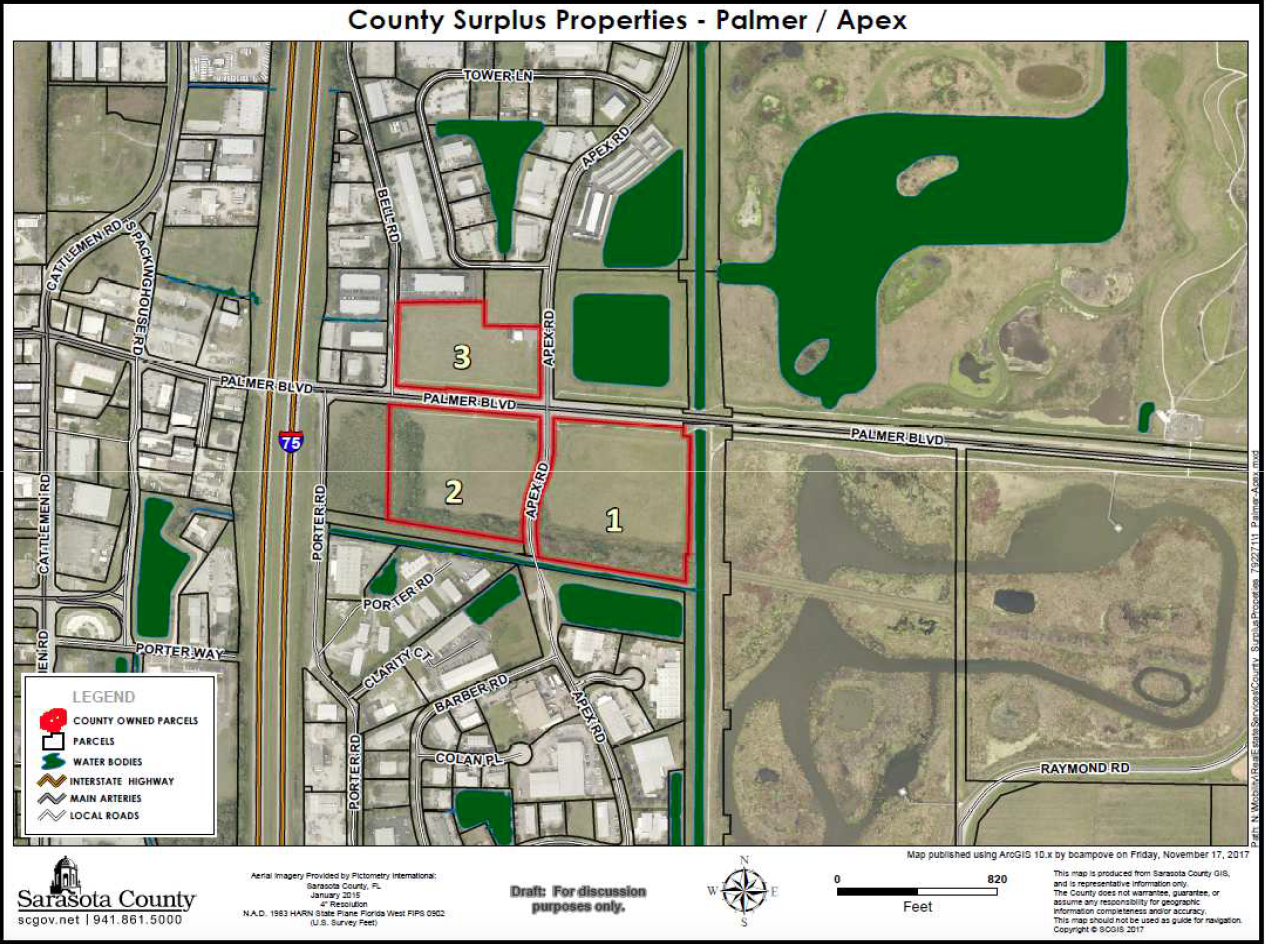
A graphic shows the three ‘Quads’ parcels (outlined in red) originally under consideration for sale as surplus land. The Southeast and Southwest Quads (Nos. 1 and 2) are not on the market, at commission direction. Image courtesy Sarasota County
Supporters of the ecotourism that has flourished at the Celery Fields in the eastern part of Sarasota County have urged the county commissioners for more than two years to approve only compatible uses if they allow development on adjacent, county-owned property known as the “Quads.”
Last fall, the board members listened to a consultant staff had hired to determine how the county should market one of those parcels, to maximize the county’s proceeds from a sale. Afterward, then-Commissioner Paul Caragiulo suggested that the commission have staff undertake an in-depth analysis of the Quads in the current context of neighboring properties, including residential areas.
This week, county Planner Steve Kirk presented a proposal for a scope of work designed to accomplish what Caragiulo had sought. The commissioners unanimously approved it.
Staff expects the work to be completed and brought before the commission in October or November, Kirk said on Jan. 30.
Additionally, one of the leaders of a Celery Fields advocacy group — the Fresh Start Initiative — voiced support for the outline of the CAP process county Planning and Development Services Department staff had outlined in a memo to the board.
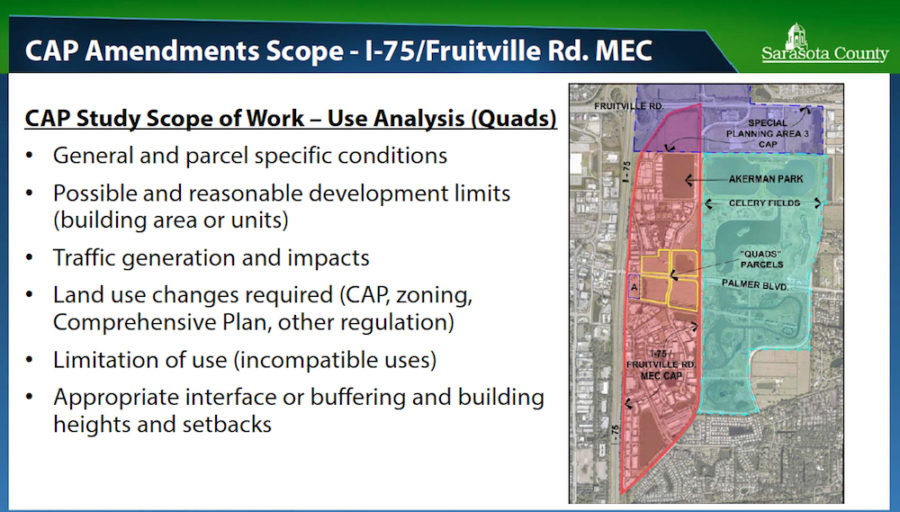
“The excellent planning memorandum clearly indicates that this holds promise for a new vision of these public lands and the Celery Fields area,” Tom Matrullo told the commission. Noting that the scope of work will examine the gamut of appropriate issues — mobility, buffering, “[p]ossible and reasonable development limits,” building heights and setbacks, and limitation of incompatible uses — Matrullo added, “All of this is music to the ears of our communities.”
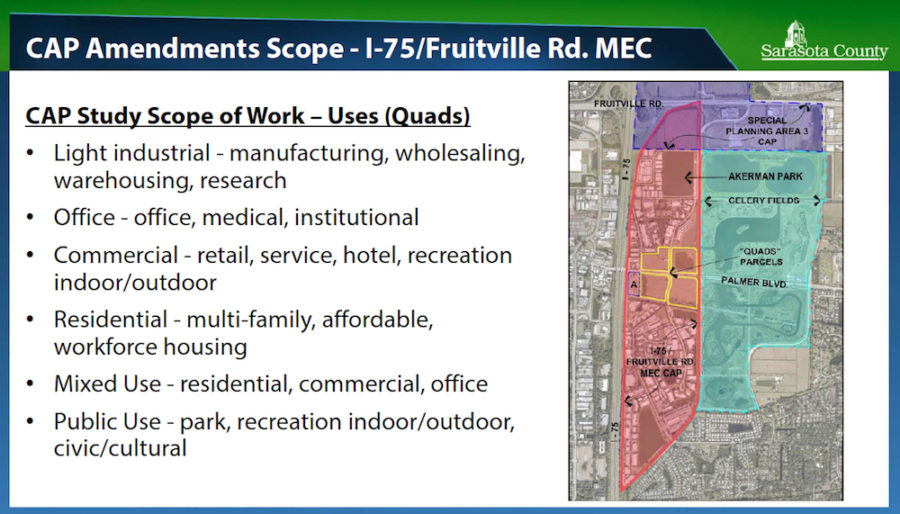
These are potential uses of the Quads, as indicated in a county staff presentation on Jan. 30. Image courtesy Sarasota County
Among the potential uses of the Quads that Matt Osterhoudt, director of Planning and Development Services, and Kirk outlined in a Jan. 29 memo to the commission are a hotel, indoor and outdoor recreational facilities, affordable or workforce housing, a park, and civic or cultural amenities, Matrullo pointed out.
However, Matrullo did ask the board members, “as fiduciary stewards of our public lands, “to ensure the scope of work is open, transparent and inclusive.”
Speaking on behalf of residents of the area around the Celery Fields, Matrullo recommended that the commission make it “unambiguously clear that no preference or deference will be given” to any group during the public engagement process staff has outlined. He added that his coalition’s goal is for “all citizens [to be] equal stakeholders.”
He further asked that staff make sure every public meeting during the analysis be advertised broadly and that it be open to everyone who wants to attend it.
During his presentation, Kirk explained that staff plans “multiple forms of engagement at various stages of the study process.” Among the people staff will seek to involve, Kirk pointed out, are surrounding property owners and tenants, neighborhood and citizen organizations, and users of the Celery Fields.
Commissioner Nancy Detert told Kirk she is interested in uses of the property that the commission could pursue. Kirk replied that staff would consider all the possibilities without making judgment on how appropriate any of them might be.
“I think part of the study will be looking at the specific conditions of these parcels and the area,” he added. “Out of that, I think, will come some facts that may illustrate what the appropriate uses might be. … Certainly, the public input is going to provide us lots of information and direction for that.”
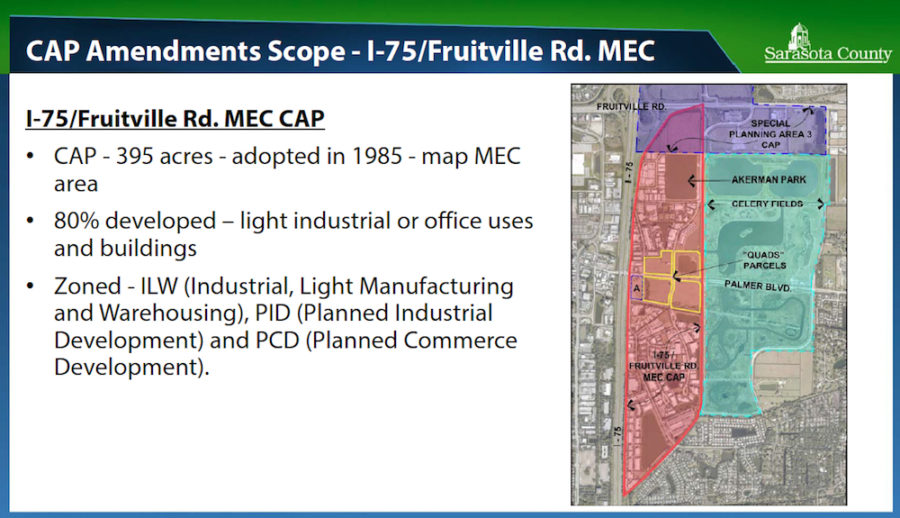
Detert referenced the fact that when the CAP — known as the I-75/Fruitville Road Major Employment Center Critical Area Plan — was approved in 1985, the area it encompassed was planned largely for industrial uses — “things nobody wanted to look at.” “Now,” she continued, “you have homes out there,” and the residents are asking for a variety of different uses.
An area in transition
These are facets of the analysis staff will undertake for the I-75/Fruitville Road CAP. Image courtesy Sarasota County
As Kirk explained to the board on Jan. 30, the I-75/Fruitville Road CAP encompasses 395 acres. Eighty percent of the area has been developed, mostly with light industrial and office uses, along with some other buildings.
The Quads are all zoned Open Use Rural, a designation, Commissioner Alan Maio noted, that no longer complies with the county’s land-use development guidelines.
About 2.4 acres of the Northwest Quad, Kirk continued, is the site of a future fire station. The design and rezoning process for that project is expected to be back before the board for approval in June or July, he added.
“I do not want to see this [analysis] delay the construction of the fire station,” Maio told Kirk. Funding already has been programmed out of the revenue from fire assessments county property owners pay, Maio added. The firefighters assigned to that station, he pointed out, are in “trailers, [and] extremelyexpensive, extremely expensive, equipment [is] under some sort of Quonset hut or tent.”
Maio said he realized staff had to follow the county’s process for the design of the fire station and the rezoning of the site for the new facility. Still, he added, he was concerned that the June/July timeline could get pushed back to August/September.
As Kirk continued his presentation, he noted that the Northeast Quad has sufficient stormwater capacity, so stormwater retention planning would not have to be incorporated into any uses of the other Quads.
Because of the stormwater pond on the Northeast Quad, he also noted, no construction can occur on that parcel.
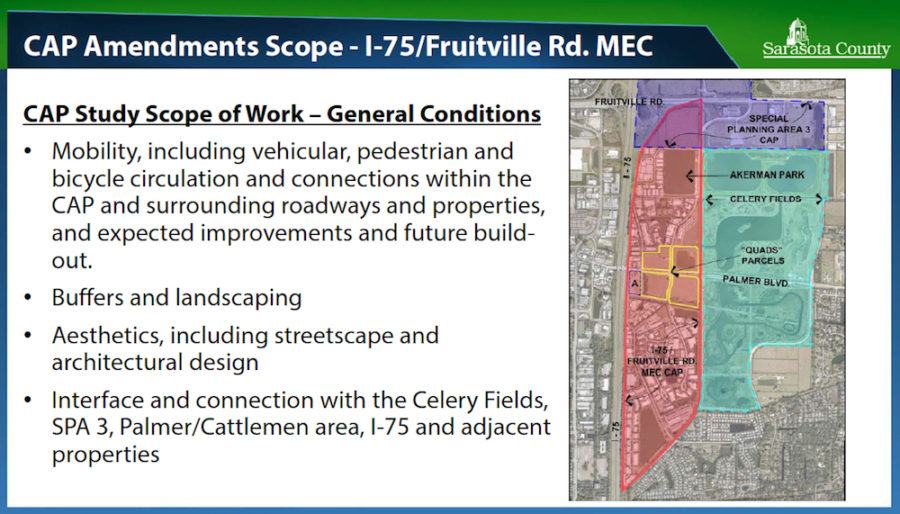
These are additional elements of the scope of work approved by the commission on Jan. 30. Image courtesy Sarasota County
As for the Southeast Quad: The commissioners in November 2017 agreed to remove it from the county’s surplus lands list, which was designed to ensure property the county does not need can be sold. The board members agreed that, because of its proximity to the Celery Fields, it should not be marketed.
The Northwest and Southwest Quads remain on the surplus list, Kirk reminded the commission.
In 2017, advocates of the Celery Fields fought an application for a construction and yard waste recycling facility, which was proposed for the Southwest Quad. On a split vote in August 2017, the commissioners voted to deny the necessary petitions for that project.
Earlier, an application for a 60,000-square-foot wholesale restaurant supply warehouse on the Northwest Quad was withdrawn. That occurred after questions arose about the fact that not all the owners of the company that had petitioned for approval of the project had been disclosed, which was a violation of county regulations. However, the applicants’ agent, Sarasota attorney Charles Bailey III, cited community opposition to the plans as the main reason his clients chose to back away.
In late November 2017, in the aftermath of those situations, Commissioner Maio won his colleagues’ approval for the hiring of a consultant to determine the best marketing strategy for the county to sell the Northwest Quad, so the board could get as much money as possible for the property. The board at that time was looking to plug revenue gaps in its budgets for the next several years.
However, after listening to a representative of the consulting firm in October 2018, Commissioner Caragiulo cited ongoing concerns about the insufficiency of the road infrastructure in the area of the Quads. In fact, questions about the traffic in and out of the proposed construction and yard waste recycling plant was one of the primary reasons Caragiulo said he decided to vote against that project in 2017.
This graphic explains part of the history of the I-75/Fruitville Road CAP. Image courtesy Sarasota County
The commissioners subsequently agreed to allow the Fresh Start Initiative, representing 50 homeowner associations in the vicinity of the Celery Fields, to propose potential uses for the Quads.
At the end of a Sept. 14, 2018 presentation, the Fresh Start group pleaded with the board to pursue commonsense planning for the Quads, given the international popularity of the Celery Fields as a bird-watching park.
Then-Chair Detert responded that no decisions would be made that day, as more extensive commission discussion would be necessary.
Adrien Lucas speaks to Critical Times about the effort to protect the Celery Fields from a most inappropriate development:
Mark Vance videos a few of the more than 200 species of birds that have flocked to the Celery Fields:
Jeanne Dubi tells videographer Darryl Saffer about programs and the varied uses of the Celery Fields. Dubi is president of Sarasota Audubon.
At WSLR 96.5 FM, David G. Johnson and Tom Matrullo spoke with Tom Walker and Bob Connors. The conversation starts at the 36 minute point on the 8.16.17 show here.
I know you are all well aware of the parcels up for rezoning, sale and development at the Corner of Apex Road and Palmer Boulevard. I also know that several groups have and are organizing protests against the sale of these sites for commercial development. This letter is on behalf of Sarasota Audubon Society which speaks for itself and no others.
A BENEFICIAL COLLABORATION
The Collaboration between Sarasota County and Sarasota Audubon was specifically entered into in order to enhance and develop the Celery Fields as a haven for wildlife and for passive recreation. Working together, we have achieved that goal. The Celery Fields is one of the most well-known birding hotspots in Florida, hosting visitors from all over the world (see attached visitor logs). The financial impact of a prime birding site cannot be overstated; birders spend lots of money in pursuit of their hobby. In order for the Celery Fields to maintain its prime eco-tourism reputation, Audubon and the County are continually improving habitat, and therefore the Celery Fields experience for all. The investment by Sarasota Audubon of $1.4 million at the Celery Fields is testament to the area's rich birdlife.
THE IMPACT OF HEAVY AND NEARBY COMMERCIAL DEVELOPMENT
I want to make a few points about birds: The Fields provide forage for 3 Federally listed species of birds, for 8 Florida listed species and provides safe nesting for 48 bird species (see attached Celery Fields checklist). This is a phenomenal number in such an urban area. However, some of these birds (and ecotourism) will be at risk for the following reasons:
Noise and ground vibration of traffic, especially heavy trucks, impact breeding rates of birds
An inadequate buffer zone between the Fields and commercial development will push birds further into the Fields setting up competition for food, thereby reducing survival rates
The eco-tourism aspects of the Fields will be degraded due to increased commercial interests
In view of our concerns for the future use of the sites at the corners of Apex and Palmer, we request the BCC deny the proposed rezone action and create an advisory group of affected citizen stakeholders to Work with County staff in determining a land use suitable to the affected parties and the citizens of Sarasota County. The recommendations of this group will be presented to the BCC for further action if necessary.
We are grateful for the BCC's Support of Sarasota Audubon over all these years and hope we can continue to work together for the benefit of wildlife and the eco-tourism sector.
This Wednesday March 1 is a public hearing that could industrialize public lands in a healthy space devoted to birds, clean water and air, to life.
There are much higher uses of these 40 acres we own at Apex and Palmer. Please join the effort to protect our birds - some of whom are already threatened - and our green natural space, our families and kids. Come to the hearing Wednesday if you can, and share this flyer freely with anyone who cares - thank you. (If you'd like a pdf file of the flyer, email us at sarasotavision@gmail.com and we'll send it to you).
Restaurant Depot seeking approval for a truck-heavy 60,000 s.f. equipment supply operation.
Letter from Adrian Lucas to the Board of Sarasota County Commissioners regarding a proposal to use 11 acres of Pineland Reserve for a shooting range. A public hearing will be held Tuesday, Feb. 10, 2015 at the County Admin Building in Venice, FL:
Sarasota County Commissioners,
Although I believe in my heart this email will fall on blind eyes, I am hopeful tomorrow you will consider not voting in favor of the Comp Plan / Pinelands Reserve's 11 acres being chopped down for a shooting range. We have an accessible, fabulous shooting range in Manatee County; the Manatee Gun and Archery Club, within driving distance for all who live near the Pinelands Reserve and who wish to practice shooting their guns, bows or taking out clay pigeons. An additional shooting range just seems like another unnecessary redundancy and waste of important land when the Manatee G&A is just about an hour's drive away, and a pretty drive at that.
What I DO know is each time Sarasota County commissioners' green lights the continued slicing and gutting of this counties natural assets, it is you, our Commissioners' who are adding additional stress to the wildlife residents of this county. And planet for that matter. Yes you.
We are all in this ecosystem together and each time a swath of land is cut down, any sporting activities, be it hunting, bird watching, butterfly observing, hiking, is being diminished. Not all of us have the luxury to travel to another state to hunt or watch birds and wildlife; we are fortunate as residents of this county to be able to do this.
The Pineland Reserve is a local treasure as showcased on the Sarasota County website under Pinelands Preserve "Natural Lands" and while there may be 6000 acres, each time you chip away, you chip away the wildlife that lives there. Considering the beautiful pamphlet by Sarasota County showcasing the birds who live there, "Birds of Pinelands Preserve" by eliminating 11 acres to a shooting range, the sound of bullets/noise pollution coupled with the potential lead pollution is a scientifically sound argument that a vote in favor of the shooting range will hurt wildlife in the surrounding preserve.
I won't waste your time with the consideration of privatization of public conservation lands, I know that will fall on deaf ears and with all due respect, I know who your real constituents are, it certainly isn't nature or to an average person of Sarasota. So let's get back to the land, enough of my jabs.
11 acres may not seem like a huge chunk of land to you but in consideration of the wildlife that lives in this Pineland Reserve, it's a huge chunk of land for the species who live there. When Audubon reports for the past 50 years show a massive decline in their annual bird counts and the Monarch butterfly is being considered for addition to the U.S. endangered list, it indicates there is a problem. When the SRQ County pamphlet shows that there are just "limited sightings" of certain birds, some of those birds are shy and difficult to view, however, a large number of the birds on the county list (if not all) are declining in number nationally. And the problem exists from lack of places for these species to live and eat. And the places that do exist for these creatures are being dangerously impaired and harmed by pesticides.
The Pinelands Preserve is an oasis for numerous creatures. We, and you, are responsible to ensure that these species exist for future generations.
If you all continue to chop, hack, slice and dice public conservation lands then you are in deep denial of the legacy you leave for your own children and the people of Sarasota County.
Next Tuesday there is a Sarasota County Commission meeting to discuss re-zoning 44 acres of conservation lands in the Pinelands Reserve so that a private shooting range, blasting lead shot and PAH-laden so-called clay pigeons across the countryside, can be established. If this goes forward uncontested, the way will be clear for the rezoning, reclassification, recertification, re-what-have-you of any conservation lands in the county. The County is nominally the applicant, a feeble stab at establishing a public benefit component to this flagrant privatization of public land. I urge you all, and anyone else you can bring, to join me at this meeting to speak our piece.
What is our piece, exactly? There are two parts:
1. First, and most important, is the precedent this will set if it is allowed to move forward. All the protections afforded to Conservation Lands will have been swept aside, and pieces will be carved out until the county is unrecognizable
....
Voters again and again taxed themselves to conserve natural lands. The purpose of conservation land, (the Pinelands Reserve is listed, page 3-39, LMP) is "for the conservation of Sarasota County’s natural heritage.” (see below, LMP, page 3-15)
....
Pinelands Reserve, Sarasota County
2/ Second, to legally get this ill-considered measure through, the County will have to argue that the gun range is an environmentally benign activity. Here's why that argument falls apart before it even starts:
1. Lead shot. Nationwide, 9,000 gun ranges shoot 100-150 million pounds of lead shot every year. While best management calls for periodic soil scraping, separation of the lead, and then replacement of the soil, many ranges have always left the lead in place, and continue to do so.
There are three sources of lead in humans. Paint, dust & soil, and drinking water. Two of those three are present at a shooting range.
Lead shot oxidizes and becomes water soluble. In that state, it will attach to molecules in storm water, and migrate into both ground water and surface waters used for drinking. Florida's sandy soil is highly conducive to this migration.
2. Clay pigeons. These targets are not clay any more, but are made of some 30% petroleum pitch or coal tar products. They contain such high loads of PAH (polycyclic aromatic hydrocarbons) that UK oil seed farmers have filed injunctions against farmers shooting skeet over oil seed fields. Very high levels of PAH in the oil seed resulted in thousands of tons of the agricultural product being incinerated as hazardous waste, at great expense. Remington. a major manufacturer of targets, claims on the box that they do not biodegrade. Gun magazine blogs say that the best way to get rid of the shattered targets is to crush them with your boots or run over them with your ATV until they are reduced to grit.
A single firing position will contaminate 2-5 acres. Most ranges have several firing positions. The clay target fragments are found in a fan shape 65'-250' from the firing position. Lead shot accumulates in a fan 375'- 600' out.
So far, only wild pigs have been observed eating the targets and gradually becoming sick. That said, EPA risk assessment has been performed for the humans who use or live near these facilities, and the results indicate significant risks to human health.
Please join me at the Board of County Commissioners meeting. Register to speak. If someone steals your thunder, or you change your mind, you are not obligated to speak. But this is a bad one. I hope to see you there.
This nest is in Fort Myers, in a pine tree near a very busy road. These pine trees have value as habitat, even in isolation.
Sarasota County's contention that these pines are not valuable unless they are part of a clustered system is inconsistent with bird nesting behavior.
This eagle nest is no doubt close to a fishing source so mom and dad can feed their eaglets.