Roads are the key to developing in rural lands. And just as East Sarasota is facing new development, so is a giant segment of Central Florida.
A bill coming up in the state legislature sponsored by State Senate president Bill Galvano of Bradenton commits billions of dollars to create new roads opening a large swath of rural Florida, and possibly further enriching the already-richest man in Florida.
A wide spectrum of organizations including the 1000 Friends of Florida, the Florida Sierra Club including the Manatee-Sarasota Group (see newsletter p.5), Defenders of Wildlife and many more organizations oppose this plan. Here's how your organization can join:
======
From the Florida Sierra Club - note: all you have to do is send the name of your organization and signer to Cris Costello - see below for details.
Hi all, We are organizing sign on letters to oppose the Transportation Corridors bills. If you have any connections with organizations that you think might be interested in joining the fight, please take a minute to encourage them to do so. Everything you need is in the message below.
Our efforts are starting to make a difference, but we still need your help to spread the word - Thank you! - Tim
(1) Sign the letters to the Senate and House (attached).(2) Prepare for the worst by signing the veto letter to DeSantis (attached).(3) Spread the word to get calls in to representatives to "vote no" on HB 7113/SB 7068.
The content is identical in both attached letters except that the Senate and House letters ask for opposition to the bills and the Governor letter asks for a veto of the bills.
Please consider signing on to one or both of these letters. We are looking for signatures as soon as possible but you probably have through this week. If the bills are not stopped in the Senate and House we will need to get the veto letter to DeSantis as soon as the House passes the bill.
Refer to 1000 Friends of Florida resource page for more info and to the Defenders of Wildlife map that shows lands and waters that could be impacted, including existing conservation lands and lands in the Florida Forever list that have yet to be acquired.
Contact us with any questions. And please forward to any and all organizations with which you work. Thanks in advance!
--
Tim Martin
Conservation Committee Chair for the Florida Chapter of the Sierra Club
===
Sarasota advocate William Zoller:
This issue is one of the constants that we all must contend with in the face of the continuing, inexorable growth of Florida. The governments, both State and local, have never properly planned for the growth, and have never been able to deal adequately with it. This is empirically obvious every time you get in a car, on a bike, or in a bus...traffic is a mess. This proposal can be viewed as an effort to "get ahead" of the need, but the problem is, roads are the major generator of development, which creates even more "need". Rural, agricultural land continues to be converted from growing food, lumber, and other necessities, into growing houses and shopping centers. After tourism, agriculture is the biggest industry in Florida. As we reduce available land for this important economic factor, and replace it with residential growth that costs the economy (it is a Ponzi Scheme), we dig our hole deeper. More roads in undeveloped areas is a quick fix that simply will create more problems. We need ways to deal with growth that do not create an even bigger problem.
New roads in undeveloped areas are not a solution....they are the problem.
Why did Sarasota's wastewater system suffer a billion gallons of overflow and spillage over the past 5 years? Why is the wastewater treated only to a level of 17-18 mg of nitrogen? Why are there spills and breaking pipes throughout the system? This panel attempts to address these issues, and their potential downstream effects - e.g., red tide.
This, while his Republican-led Florida State Legislature focuses on ripping through the heartland with new highways, looking out for the interests of developers and once again denying the will of the people by short-changing funding—by hundreds of millions of dollars -- for the purchase and preservation of Florida lands as intended in Amendment One, approved by 75% of the voters in 2014.
There are only two ways to fix this. Either hope that the industry folks who lobby for municipal water treatment projects can outspend the highway construction and home development lobbyists and get the Governor and the Republican-led State Legislature to change their ways, or rally the voters to a cry of “It’s the environment, Stupid” to replace “It’s the economy, Stupid” and work harder than ever to throw the bums in Tallahassee out the door in the next election.
Two important and controversial matters are listed for routine Sarasota City Commission approval Monday. The public can speak for three minutes each.
After 1:30 p.m. is a push by city staff for final approval of an agreement to put 53 acres of public bayfront property in the hands of certain business interests calling themselves the Bay Park Conservancy, for up to 45 years.
Although a Herald-Tribune column rejected my previous call for delay as “B.S.”, that delay has brought important improvements in the agreement, after the city attorney was finally brought into the drafting as I asked.
However, the changes are not nearly enough to protect valid public interests. The City Commission has a history of flawed contracts that cost taxpayers millions, so you would think they would want to get this one right.
As I suggested, and some commissioners agreed, the redraft now calls for approval of one phase of the Bay Park project at a time, rather than a huge commitment of taxpayer dollars all at one time. However, it still commits only city taxpayers to funding and relegates the promises of philanthropic donations through BPC to mere proposals which BPC is explicitly not obligated to fulfill.
Remember Benderson Park, where promoters promised $20 million in donations which never materialized but instead repeatedly sought and got more taxpayer dollars? Again, that should be a lesson learned. Especially with BPC now competing with the Van Wezel Foundation, Sarasota Orchestra, Selby Gardens, Mote and others for donors to fund expensive new projects.
My suggestion: The city should say, “Show me the money.” Amend the draft agreement to provide that no permit is issued for a Bay Park phase and no taxpayer money spent until BPC has raised all promised donations, for construction and for an endowment to fund maintenance and operation, and those funds are in a secure account.
The agreement also needs major improvements which I have specified regarding public records, conflicts of interest, design, contracts, restaurant leases, the BPC board and otherwise. There are far too many “shalls” for the city and “mays” for BPC.
Monday’s other action, after 6 p.m., is city staff’s insane scheme for a “road diet” to reduce Fruitville Road downtown from four to two lanes. This is being pushed by developers — and staff routinely backs developers — north of Fruitville.
It is also part of the push by staff to embrace traffic congestion to somehow force us out of our cars to walk or bike wherever we need to go, and ride buses that get caught in traffic too. The developers love that because, if you don’t need to worry about traffic, why control development?
In 2003, staff sought a road diet for U.S. 41 by Gulfstream Avenue along the bayfront but was shot down by an outraged public. They got the same reception three years ago for the Fruitville scheme and laid low while trying to build support, only to now raise it suddenly for approval.
To make things worse, staff has paired its road diet with a plan to put barriers along Second and Fourth streets (on either side of Fruitville) to prevent traffic from going straight in some places and turning in others, and requiring cars to move slowly behind bikes in the same lane, all deliberately to chase cars off those roads as well.
It is to be hoped that this irresponsibility is rejected once and for all.
On Monday, the city commissioners should disregard pressure from staff and special interests and do their diligent duty to protect the public they were elected to serve.
Dan Lobeck is a Sarasota city resident, business owner and attorney and president of Control Growth Now. www.controlgrowthnow.org
Office of the County Attorney and county administrator to check on population data that could be utilized legally and timeline board would have to pursue
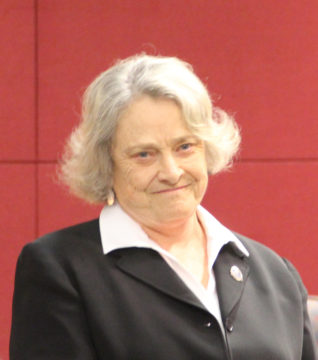
Commissioner Nancy Detert. File photo
Before the Sarasota County Commission potentially launches an initiative to redraw its district boundaries, board members this week asked the Office of the County Attorney and County Administrator Jonathan Lewis to provide the answers to a number of questions.
Among the issues raised by Commissioner Nancy Detert’s proposal for redistricting, commissioners want to know what data legally could be used for such a process. Commissioner Christian Ziegler noted, for example, that he believed theAmerican Community Survey undertaken by the U.S. Census Bureau in 2015 provides an estimate of the county’s population.
Additionally, Ziegler said during the board’s April 9 meeting, the commissioners will need to know the timeline they would have to follow with redistricting to enable Sarasota County Supervisor of Elections Ron Turner and his staff to comply with state regulations in preparing for the 2020 elections.
The commissioners, by consensus, made the staff research a formal assignment. Lewis said he expected to have the information ready in May.
The impetus for the discussion, as Detert noted in late February, is the November 2018 passage of a Sarasota County Charter amendment implementing a Single-Member District process. That calls for a voter to cast a ballot in the primary and general election just for a commission candidate in the district within which the voter and the candidate live. Previously, every registered county voter has been able to cast a ballot for a candidate in each commission contest in a general election.
Detert said she had reviewed figures for the five districts drawn and approved by the County Commission in 2012, after the 2010 Census. She told her colleagues on April 9 that she found the districts “are totally out of balance.” Detert added, “It didn’t make any difference before, ’cause you just had to live in your district …”
“We have the right to change our own boundaries,” Detert pointed out. “It’s our right and responsibility. We don’t have to wait for the next Census.”
She fears, she said, that if the board does not undertake redistricting prior to the November 2020 General Election, losers in County Commission races could bring suit, contending that the districts had population imbalances.
These are the results of the Nov. 6, 2018 vote on the Single-Member Districts Charter amendment. Image courtesy Sarasota County Supervisor of Elections Office
She had spoken with Supervisor of Elections Turner, Detert added. “He’s totally willing to be as cooperative as he possibly can.” In fact, she noted, he had offered to make one of his staff available to assist the board in redrawing district lines.
He also told her, Detert said, that the redistricting would not cause a problem for his staff in terms of precincts, because the Supervisor of Elections (SOE) Office adjusts precincts “all the time.”
Detert further proposed that the commissioners “make this the most open, transparent and, frankly, televised exercise that the county’s ever been through.”
Software is available to help the board members undertake the modification of the district boundaries themselves, she noted.
Further, by ensuring public involvement in the process, and openness of the meetings, she continued, the effort could prove to be an educational one for county residents. “I think that people’s civics have gotten a little fuzzy over the past years. … People don’t understand that government has some rules … and timelines.”
Additionally, Detert said, “I think we all need to work on restoring the average person’s faith in their own government.
Detert asked County Attorney Frederick “Rick” Elbrecht to read the appropriate section of the Florida Constitution that covers local government redistricting.
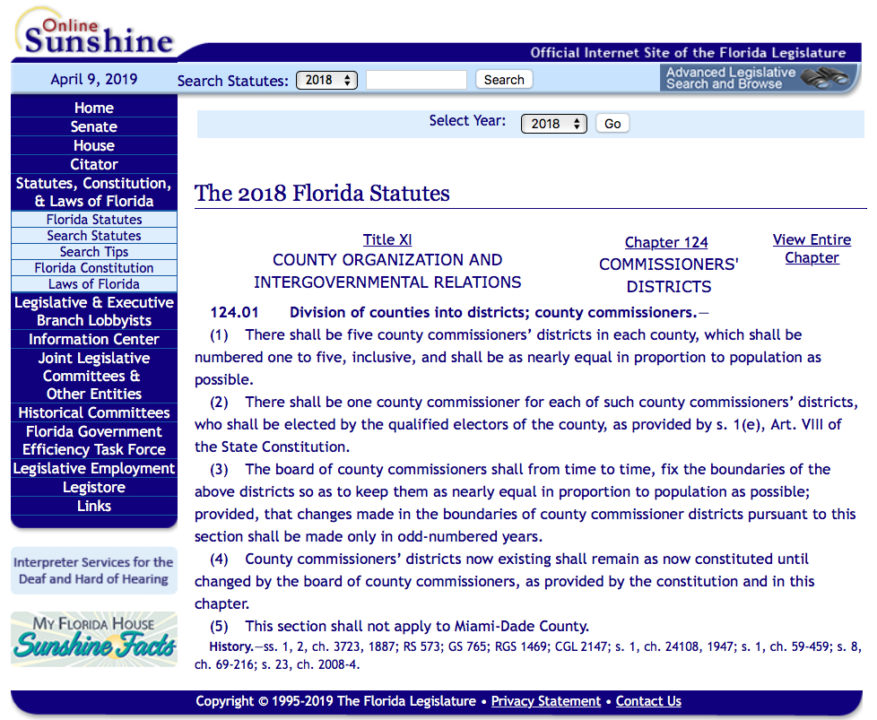
Elbrecht referencedFlorida Statute 124.01, which says, “The board of county commissioners shall from time to time, fix the boundaries of the [board’s] districts so as to keep them as nearly equal in proportion to population as possible …”
This is Section 124.01 of the Florida Statutes. Image courtesy Florida Legislatue
Additionally, Elbrecht said, the Sarasota County Charter calls for the redistricting process to include a public hearing, after proper notice and copies of the proposed district maps have been made available for people to review. The commission has “a deal of discretion” in the process, he added, “as long as it’s done reasonably and in a non-discriminatory manner.”
Commissioners’ concerns aired
Ziegler was the first commissioner to respond with questions, though he said, “I like the idea of being fully transparent and engaging the public …”
When Ziegler asked Detert what data she had relied on to determine the districts are out of balance, she replied that she had asked the Supervisor of Elections Office for the voter registration figures for the districts. However, she said she believed those numbers also reflect the population of each district.
In response to a request fromThe Sarasota News Leader following the April 9 discussion, Rachel Denton, communications and voter outreach manager for the Sarasota County Supervisor of Elections Office, provided the following current figures for each County Commission district. The numbers include voters whose addresses are withheld for confidential reasons, she said, as well as those whose addresses are a matter of public record:
County Commission District 1: 56,198.
County Commission District 2: 60,695.
County Commission District 3: 64,574.
County Commission District 4: 63,295.
County Commission District 5: 73,007.
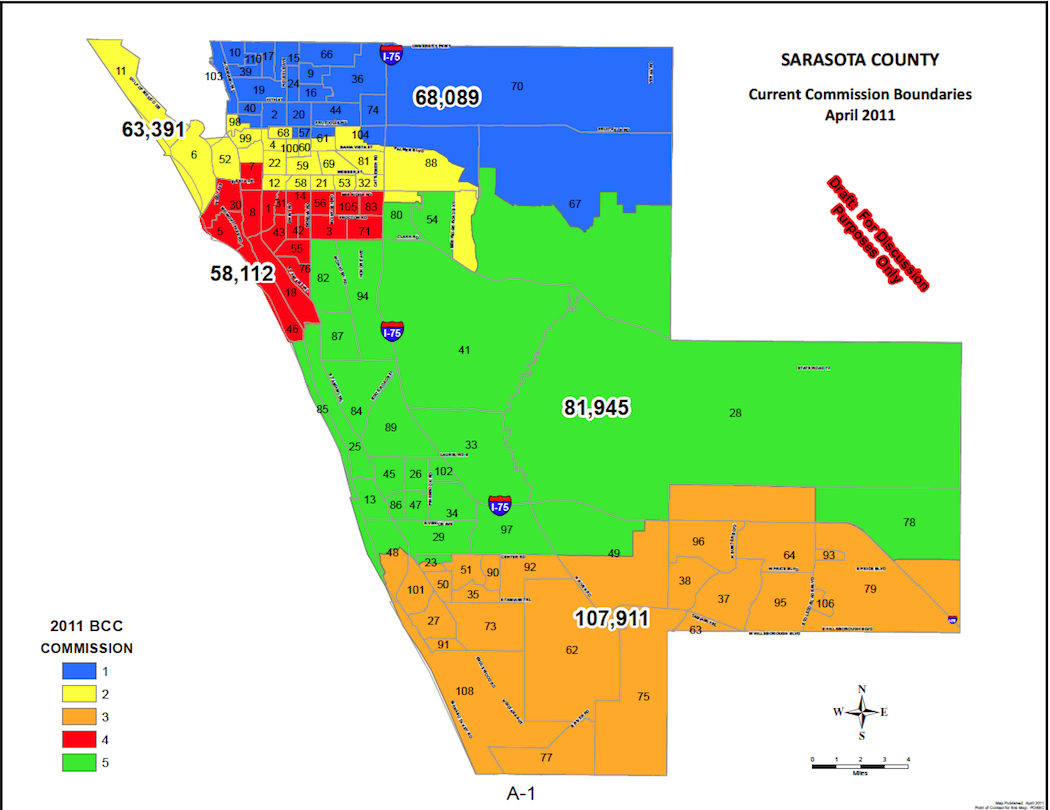
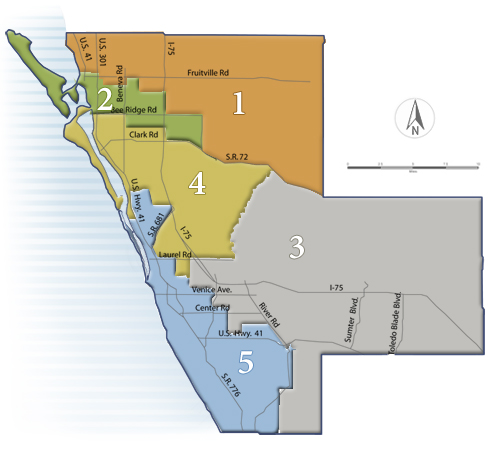
These are the County Commission districts with population figures current as of April 2011. Image courtesy Sarasota CountyA graphic shows the current County Commission districts. Image courtesy Sarasota County government
During the discussion, Detert referenced population figures Lewis had provided for a recent community meeting, illustrating the growth of the city of North Port. When she asked Lewis about those, he explained that they were provided by the University of Florida’s Bureau of Economic and Business Research (BEBR). However, he added, the BEBR numbers are not sufficiently detailed to help staff determine district population counts.
Adocument the BEBR released in April 2018 estimated the Sarasota County population at 417,442, with a projection that it could climb as high as 447,600 by 2020 — or even drop to 413,200.
After Ziegler suggested on April 9 that the potential might exist of using the 2015 Census Bureau information, Chair Charles Hines noted that a lot of areas of the county have grown considerably since then. “I think we need a lot more research …”
County Attorney Elbrecht pointed out that the state statute calls for use of population numbers, not voter registration figures.
Ziegler also asked how long the redistricting process would take.
Referencing the state law, Elbrecht explained that the new boundaries would have to be in place before the end of this year. The statute says, “[T]hat changes made in the boundaries of county commissioner districts pursuant to this section shall be made only in odd-numbered years.”
Chair Hines asked how long a person would have to reside in a district before the person legally could seek a County Commission seat.
Chair Charles Hines. File photo
After reviewing the County Charter, Elbrecht said that Section 6.7 requires an individual to have been a resident of the district six months before qualifying to run for the County Commission district seat.
“There’s no guarantee that we have to work around [a commissioner’s] house,” Detert said.
Ziegler emphasized that the board members were not trying to contravene the will of the voters who approved the Single-Member District Charter amendment in November 2018. What the commission is trying to do, he said, is “fill] in those gaps” that were not detailed in the amendment language. “We’re in kind of an awkward limbo, if you will. … This is basically an effort toclearlylay out what the ground rules are and how this is going to work …”
“Well put,” Hines replied.
When Detert proposed a motion calling for redrawing the district maps, Ziegler asked, “Are we ready to make that statement today?”
Hines agreed with Ziegler again. “The assumption is the [population] numbers are out of whack,” Hines said. However, he continued, that determination needs to be made before the commission embarks on redistricting.
“It seems it would be hard to go too much further,” County Administrator Lewis added, without knowing the legal precedents regarding data that could be used for redistricting between the decennial Census counts and the timeline that would have to be followed.
“I think you got enough to get started,” Hines told Lewis.
Many have learned a great deal from the county's Civics 101 course as well as from other offerings from the County - if you've not participated, now's your chance:
Currently Neighborhood Services is offering the following approved courses:
9629298 Neighborhood-level Energy and Water Conservation (1 CEU)
9629299 Neighborhood Initiative Grant Application Seminar (2 CEUs)
Please contact Neighborhood Services at neighbor@scgov.net if you have a group of 15 or more and are interested in scheduling private instruction, or if you would like to be added to a group notification list for a future session.
These courses fall into the county's “Neighborhood University” and are targeted at HOA Board members, Community Association Managers, and other neighborhood leaders looking for ways to improve their neighborhood governance and lands.
In addition, another event already scheduled is more similar to Civics 101. The GO Symposium will be a four-day series of presentations from county government agencies, including County Administration, the Offices of the Supervisor of Elections, Property Appraiser, Tax Collector, Clerk of the Court and County Comptroller, and the Sheriff; and the Twelfth Judicial Circuit Court.
Attendees may register for 1, 2, 3 or all 4 days of learning. More information and links to register can be found on our Neighborhood Services web page.
Info provided by Miranda Lansdale, Community Outreach Specialist - her contact info is below.
Sarasota County Government | Planning and Development Services Department
Neighborhood Services
1660 Ringling Blvd, Sarasota, FL 34236
Phone: 941-202-2294
Email: mlansdale@scgov.net
Web: www.scgov.net
The FDEP (Florida Dept. of Environmental Protection) has issued a Consent Order to Sarasota County. It requires Sarasota to move to Advanced Water Treatment, to rid our canals and bays of nitrogen-rich discharges that feed Karenia Brevis -- Red Tide.
The upcoming planning workshop about the future of our public lands near the Celery Fields (the Quads) is open to new ideas -- alternatives to heavy industry included -- but don't plan to propose them at the workshop -- Send them in advance, says lead planner Steve Kirk.
Last fall, the Board of Sarasota County Commissioners directed Planning to undertake a new Critical Area Plan study of our public lands at the Celery Fields known as the "Quad Parcels," or just "Quads." It's an opportunity to take a new look at what is there and what might be possible, if, for example, new conditions, or a change in the roads, were in place.
Critical Area Plan Scope
On Jan. 29, the Planning Dept. issued a memorandum outlining the Scope of Work for this study. That memo is here.
Lead County Planner Steve Kirk has been consistently helpful in answering our questions about the process. The County is looking at a date in mid-May for the workshop, probably to be held in the evening. The date and venue have not yet been finalized.
Note: Mr. Kirk says staff will review and discuss with the public proposals previously submitted by the Fresh Start Initiative. Also, some new proposals are being developed within our communities. Anyone who has a new proposal is invited to submit it to Mr. Kirk at any time -- his contact information is at the end of this post.
Below are the responses thus far to our queries:
The public workshop will be an informal event and staff will be flexible in how it concludes. Timing speakers would be unnecessary, however, domination of discussions will be discouraged.
Any input regarding CAP should be directed to me at my address, phone number or email address below.The intent of the workshop is to present to the public all the information the staff has at the time, and then hear ideas and feedback from those in attendance. The staff presentation will include any ideas related to the CAP or the County properties previously provided by the public, including those previously put forth by Fresh Start. We will also include anything else we receive prior to the workshop. It will be made clear in our presentation that we will continue to take public input, and will welcome conversations on the CAP issues after the workshop, and until the CAP study is completed.
The staff is beginning the study and preparing for the public workshop.
We will record audio of the workshop.
The work of the study will continue after the public workshop and should be completed within the 9 month period.
As stated in the scope of work, once completed, a presentation and discussion of the study will be scheduled with the County Commission. What happens after completion of the study is at the discretion of the Commission and I would not speculate on what action they may take. However, should the Commission direct staff to amend the Critical Area Plan or rezone any of the County owned properties, the public hearing processes as required and outlined in the UDC and CAP regulations will be followed. The County owned “Quads” parcels are all zoned Open Use Rural (OUR), and industrial uses are not permitted. The establishment of an industrial use would require a change of zoning to a district permitting such use.
If the Board directs staff to rezone any of the parcels, staff would prepare and process a rezone application as required by the UDC including all necessary documentation. The preparation and processing of such an application, including public hearings, would likely take a minimum of 6 months.The CAP study authorized by the Board, on which we are now working, is not an application to amend the CAP or rezone any property. It is intended to provide the Board with information to inform decisions in the area of the CAP.Notice of the public workshop will be posed on the Planning and Development Services Calendar on-line at https://www.scgov.net/government/planning-and-development-services/pds-calendar.This calendar will link to documents related to the workshop. I cannot at this point tell you exactly when this will be posted, but approximately 2 weeks before the workshop.
Sarasota County is under fire for the massive amount of treated wastewater that has spilled from its Bee Ridge treatment facility into local waterways. Three nonprofits have told the county they plan to sue if it cannot figure out how to stop the spillage.
The issue, said Suncoast Waterkeeper founder and executive director, Justin Bloom, is much more complicated than just an overflow of wastewater.
Sarasota County’s issues are two-fold, he said.
"Part one is the collection system, which is in disrepair and spills sewage, particularly when it rains a lot,” he explained. “Part two is the reuse system. It’s not a problem with their capacity to treat gallons of sewage. They’re able to treat the sewage the way the treatment facility is designed. The problem is there’s not a lot of demand for the treated wastewater.”
Mike Mylett, division manager for water and wastewater for Sarasota County public utilities, said demand for reclaimed water is down because of a wet winter season.
“People aren’t irrigating as much as they normally do so there’s more reclaimed water (left over).”
Bloom, however, argues that the reason demand is down is more complicated than that.
“There’s so much nitrogen in this partially treated wastewater that the end users don’t want it,” he said
Weir where excess water from Bee Ridge Water Treatment Plant is discharged
He added that documentation shows Sarasota County’s treated wastewater has 18 or 19 milligrams per liter of nitrogen. He used other plants like the city of Sarasota's and Bradenton's as a comparison, both of which have three or less miligrams per liter of nitrogen in their treated wastewater.
Rich plantlife in overflow pond beyond Water Treatment Plant Weir
“It is acknowledged throughout the scientific community that human sources of nitrogen significantly fuels red tide,” Bloom said. “So I'm making a connection between these failing sewage systems in Sarasota and throughout the region and increased nitrogen in our local waterways which fuels red tide."
This isn't the first time an area city has dealt with wastewater spillage into major waterways. In 2016 and 2017, the City of St. Petersburg was under scrutiny for the hundreds of millions of treated sewage waters that flowed into local waterways.
Stopping the Sarsota County spillage is an issue that needs to be addressed immediately, said Bloom.
He claims, currently, the Bee Ridge treatment facility is spilling multiple gallons of treated wastewater on a daily basis into a wetland that leads to Phillippi Creek.
A long-term solution is already underway, according to Mylett. He said the county is working with the Florida Department of Environmental Protection to install two aquifer recharge wells to hold excess water.
The wells will cost about $14.2 million, and Mylett said funds are already secured.
“It’s part of the utility rates. That’s a normal capital improved project budgeted item.”
As far as addressing how the wastewater is treated and the amount of nitrogen in it, Sarasota County has not made any public statements about if they will be making changes.
Bloom said the county would benefit from upgrading the treatment system sooner rather than later. Coastal areas like Sarasota, he explained, must get in front of water pollution in whatever way they can.
“We know how to keep this out of our streams and creeks and estuaries. It's expensive, but the technology is there. We're learning more and more about how (wastewater) contributes a significant amount - more than I think was originally realized - of pollution, particularly nitrogen pollution in our estuaries.," he said. "We know how to fix it and the municipalities needs to step up and fix their systems.”
Sarasota County Council of Neighborhood Associations - CONA
Monday, April 8, 2019 7 p.m.
city transportation
master plan
coming to Sarasota
On April 8, 2019, please join CONA-Sarasota County Council of Neighborhood Associations, when the chief transportation planner for the city of Sarasota, Colleen McGue, will present Sarasota in Motion, a preview of the city master plan development regarding transportation that will kick off this Spring.
More than just a traffic plan, the city planners also are looking at how to move people around the city safely and comfortably on foot, on bicycles, on improved transit service, and in new ways such as automated and connected vehicles, water taxi, and more .
Ms. McGue will give citizens an insight into the process for development of the plan and enough information to determine what their role will be in that process during input from the community and the public participation opportunities.





9(MDAyMTYyMTU5MDEyOTc4NzE4ODNmYWEwYQ004))
