County Commission needs to take action on its own — perhaps selling surplus land to a private developer — to spur affordable housing projects, chair says
Hines voices frustration that, in spite of County Code changes designed to facilitate such developments, no private developer has proceeded with one
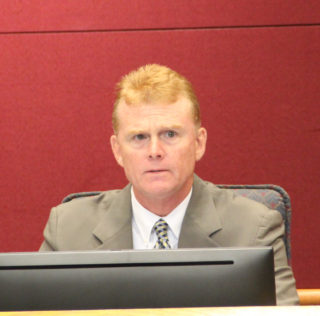
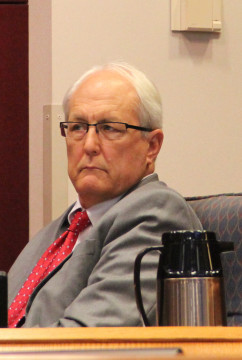
Chair Charles Hines. File photo
Because private companies have not been coming to the Sarasota County Commission to propose affordable housing projects, the board chair told his colleagues this week that he believes the commissioners themselves need to take action that will spur such initiatives.
And he wants to see some action before the board begins its annual summer recess in July. That vacation officially starts on July 22. The last regular meetings for the board are set for July 9 and 10.
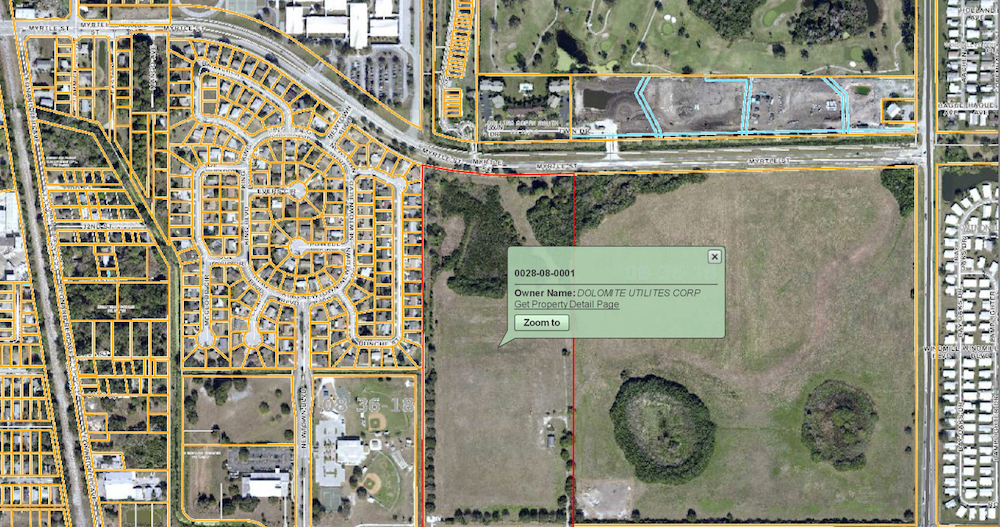
During a June 4 discussion, Chair Charles Hines and other commissioners broached the idea again of selling county property for affordable housing projects. Focus centered on a surplus 10-acre parcel next to the Celery Fields that is known as the Southwest Quad, as well as a portion of a 115-acre site adjacent to Newtown Estates.
Perhaps the county could sell 20 acres of the latter, Hines said, for a workforce housing initiative.
In December 2017, Hines first talked of the potential of the Newtown property. He raised the issue as his board debated negotiations with the City of Sarasota in an effort to settle a dispute over a final county payment city staff argued that the county owed into the Downtown Sarasota Community Redevelopment Area (CRA) Trust Fund.
The North Sarasota parcel is just east of the Betty J. Johnson North Sarasota Library in Newtown.
When the county purchased the land approximately six years ago, the intent was for it to become a major athletic complex for North County. However, after the Great Recession struck, the plans were put on hold.
In December 2018, Sarasota City Commissioner Willie Shaw brought up the property in a discussion about the city board’s efforts to spur more affordable housing projects.
In response, City Manager Tom Barwin said he had asked County Administrator Jonathan Lewis about the land when he saw Lewis at a recent luncheon. Lewis told him that the land remained listed among properties for the county’s Parks, Recreation and Natural Resources Department (PRNR). However, Barwin added, Lewis indicated the County Commission would be open to discussing the future of the site.
When The Sarasota News Leader asked county staff for a comment on Barwin’s remarks after the City Commission’s Dec. 3, 2018 meeting, Media Relations Officer Ashley Lusby reported in an email, “The county has not changed its plan for the north county land. The county is still following the parks master plan for that location to be the North County Sports Complex.”
A 2013 graphic shows the 115-acre property planned for the North County Sports Complex. Image courtesy Sarasota County
On June 4, Hines acknowledged that county staff had continued to focus on the property for a purpose consistent with planning for future parks.
Commissioner Alan Maio said he doubted staff would come back to the board with a proposal entailing the utilization of a portion of the property for workforce housing. “We need to make those policy decisions.”
Maio also suggested that if the board were to put property it owns on the market — “and not at sky-high prices” — with the necessary rezoning completed beforehand to facilitate development, “that eliminates the last supposed obstacle to [creation of an affordable housing project],” which is the cost of land.
As for the Southwest Quad: Hines pointed out that some advocates of the Celery Fields have proposed the county keep that property free of development. “That’s not gonna happen. That’s never been one of our ideas.”
Commissioner Nancy Detert noted that she has been advocating for a project on property next to the Celery Fields for months. An apartment complex would be one possibility on the Southwest Quad, she continued. Another, she said, is a tiny homes project. “I still like tiny houses. I think that’s an absolute perfect spot for tiny houses, because [such a project] goes with the whole ambiance [of the Celery Fields].”
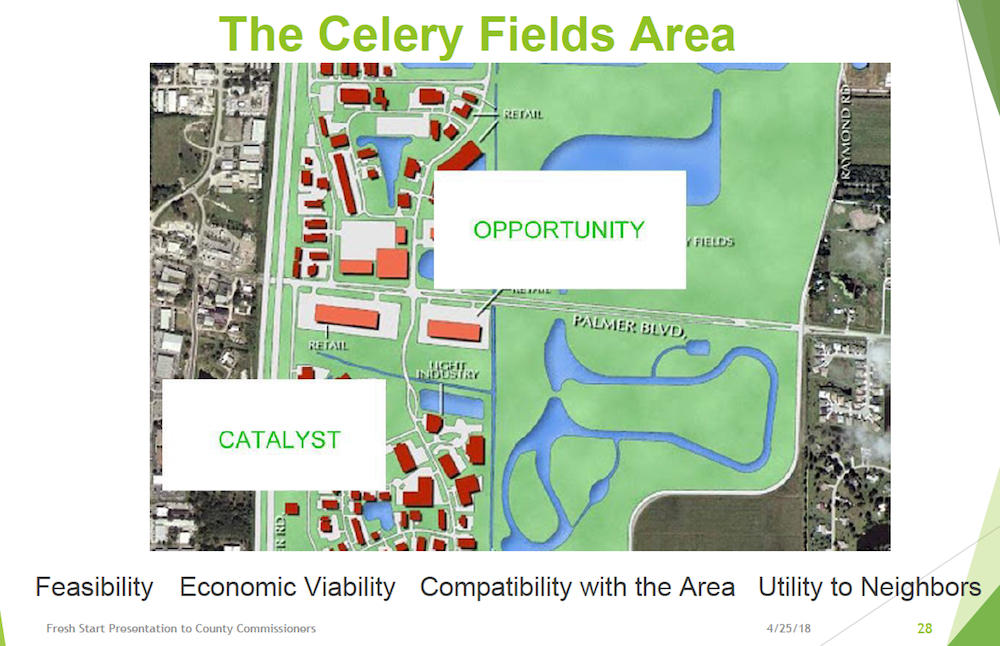
In April 2018 and again in September 2018, representatives of a group called the Fresh Start Initiative worked — at the commission’s behest — to propose what they characterized as compatible uses of the four county parcels known as “the Quads” adjacent to the Celery Fields.
A graphic prepared for the Fresh Start Initiative in early 2018 shows potential for compatible development near the Celery Fields. Image courtesy Fresh Start Initiative
Although the Celery Fields began and still functions as a major county stormwater project, it has acquired an international reputation for the vast variety of birds seen there throughout the year, especially during the winter migratory season.
Yet a third surplus county parcel that potentially could serve as an affordable housing project site is close to the county’s Emergency Operations Center on Cattlemen Road, Hines pointed out on June 4. “It’s been sitting there [for about 10 years].”
The land once was home to the county Building Department, he said.
Frustrations, fixes and a new focus
Exactly six months ago, Hines reminded his colleagues on June 4, the commissioners expressed frustration that ordinance changes they had sought in an effort to make affordable housing proposals more enticing to developers were not coming fast enough from staff in forms for them to enact.
“I don’t think anyone on this board is satisfied with the progress that’s been made,” Maio said at the time.
Since then — on March 13 — the board has approved one further change in the county’s Unified Development Code. That modification allows half-dwelling units no larger than 750 square feet, enabling developers to double the density of projects if they construct the smaller apartments or condominiums.
Altogether, Maio pointed out on June 4, the board has voted on about half-a-dozen changes to county regulations — reducing impact fees and capacity fees and reducing parking requirements, for other examples — to encourage private companies to build workforce housing.
This is an example of a half dwelling unit, as presented to the County Commission in May 2018. Image courtesy Sarasota County
Two more measures are in the works, he continued. One involves accessory buildings, such as dwelling units over garages; the other pertains to creation of apartments in upper stories over retail centers, especially those older complexes that might no longer be as active commercially but still have plenty of available parking.
Yet, those two latter changes would not be necessary, Maio stressed, if the board were to try to work with a private developer on a sale of property it owns.
Referencing the Newtown land Hines had mentioned earlier, Maio concurred that 20 acres might be appropriate for a project. “I just don’t think [developers] realize what they could build there and how affordable it could be.”
“What has been holding up a private sector developer from coming in here and saying, ‘I’ll do a 300-, 400-unit project” designed for workers such as firefighters, law enforcement officers and teachers, Hines asked. “The impediment’s been fees, regulations and land costs.”
Referring to the ordinance changes Maio had noted, Hines said he felt that it was even more important for the county to make land available.
The ombudsman proposal and a tangential request
This is the cover of the 2018 Blueprint for Workforce Housing. Image courtesy City of Sarasota
“I wouldn’t be opposed to one dedicated staffer [in the county’s Planning and Development Services Department],” Maio said, preferably if the person’s salary could be covered by permitting fees. If that funding source could be used, Maio added, “Hire them as soon as possible.”
Yet, Commissioner Detert responded, the Office of Housing and Community Development already has that responsibility, and that department is a joint initiative of the City and County of Sarasota.
She also brought up the fact that the county used to help first-time homeowners by providing down payments on houses.
For 25 years, she pointed out, she owned a mortgage business in the county. She talked about one client who was able to get help through the Down Payment Assistance Program. “It gives people a hand up, not a handout,” she explained.
To qualify for the help, she said, a person had to learn how to manage a budget, for example.
The money the county lent the homebuyer became a lien, she continued. When the house was sold, Detert added, the money for the down payment came back to the county, which could put the funds to use for another person’s down payment.
She wanted to know what became of that program, she said.
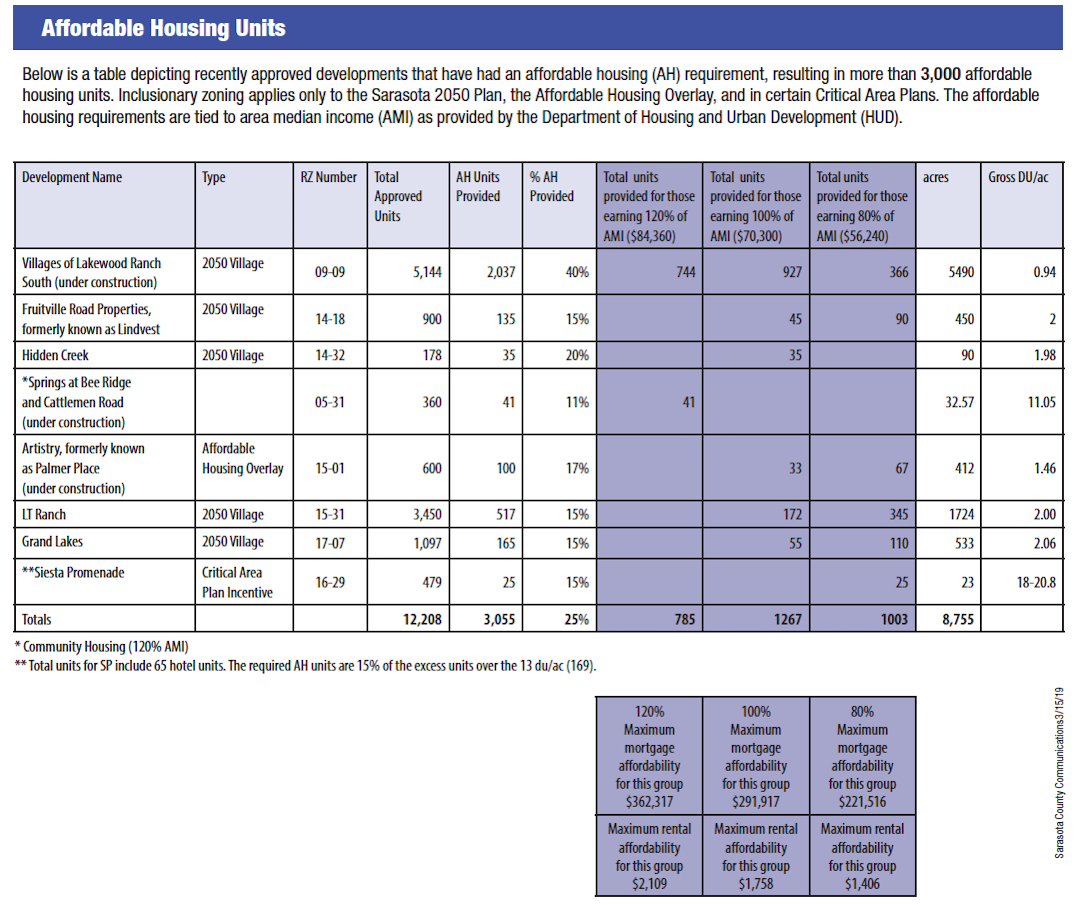
This information is included in a March fact sheet that county staff provided about affordable housing initiatives in the county. Image courtesy Sarasota County
Deputy County Administrator Steve Botelho, who was sitting in for County Administrator Jonathan Lewis, told her that staff would check on that. He added that he expected a memo with the results of the research could be provided to the commissioners prior to their next regular meetings, in July.
Botelho replied that he would make certain that information was in the memo, as well.
Detert pointed out that Don Hadsell, the long-time director of both programs, recently retired. Detert said she recently asked her county assistant to contact the new director, saying Detert wanted to set up an appointment for a meeting. The response Detert’s assistant received, Detert continued, was a question about why Detert wanted to have that meeting.
“What does it say on the outside of that building [where the Office of Housing and Community Development operates]?” Detert added of her reaction. “That ought to be a tipoff.”
Detert then asked Matt Osterhoudt, director of the county’s Planning and Development Services Department, to ensure that the memo Botelho promised the board also would have a “fleshed-out summary” of how both the city’s Housing Authority and the Office of Housing and Community Development function. She suggested that the results could lead to County Commission tweaks about the operations of the latter agency.
Another Opinion: Save Florida’s shreds of growth control
DeSantis signs "Roads to Nowhere"
When Gov. Ron DeSantis put his signature on a bill authorizing three unnecessary, ridiculously expensive “toll roads to nowhere” that would plow across millions of acres of undisturbed land at Florida’s heart, he put his self-claimed reputation as a champion of the state’s fragile, threatened environment in jeopardy.
Now, he faces an even tougher challenge. Within the next few weeks, legislation will land on his desk that will gut Florida’s already-weak oversight of rampant, irresponsible development. Like the toll roads, these bills were mostly concocted in secret through last-minute, legislative machinations.
The state’s most respected smart-growth groups are aiming most of their firepower at the blandly titled HB 7103, “Community Development and Housing.”
This would be the last nail in the coffin for Florida’s once-innovative comprehensive planning laws enacted in the 1980s. These laws require each community to enact blueprints for growth, making sure new developments meet minimum standards for flood protection, infrastructure and the like. The plan becomes local government’s guidebook: every development decision must be consistent with the plan.
Once upon a time, there was a state agency to review development proposals, the Department of Community Affairs. But in 2011, Gov. Rick Scott got rid of the “job killer,” as he called it, and folded its remaining duties into the Department of Economic Opportunity. Scott and the Republican-led Legislature also crippled the concept of concurrency — a requirement that schools, parks and adequate roads be in place before development is completed. And they starved the state’s 11 regional planning councils of money.
There was one safeguard left. Citizens had the right go to court and challenge a bad decision by their local government: a condo tower that exceeds a height limit, an apartment complex in a neighborhood of single-family homes.
But if HB 7103 becomes law, that final right to protest will be crushed. Citizen challenges will face a tilted burden of proof — and the requirement to pay the opposing side’s legal fees if they lose. Basically, all a developer would have to do to win is to send a squadron of high-priced attorneys into battle — and then punish anyone audacious enough to challenge their profiteering with crippling legal fees.
This isn’t the only reason this bill deserves a veto. It also deters local governments from requiring developers to include affordable housing in their projects. Any government that does so, this legislation says, will have to repay the developer for any financial losses.
If he signs it, it’s game over for DeSantis, the warrior intent on protecting Florida’s threatened water resources and natural beauty. He’ll be exposed as something worse than an honest shill for the kind of reckless environmental destruction that most Floridians decry. He’ll be the person who was willing to trick people into thinking he cared — before he stripped them of the ability to defend this state’s endangered environment against irresponsible, predatory development.
Governor, please veto 7103. Do the right thing, and reclaim some of the faith you’ve lost.
Letter from Sierra Club to FDEP regarding Sarasota County's wastewater treatment failures:
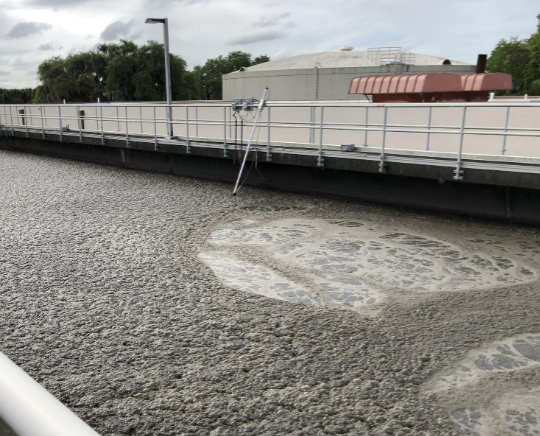
Sierra Club Florida supports the original mitigation in FDEP’s draft consent order requiring that Sarasota County upgrade their wastewater treatment plans to meet advanced wastewater treatment (AWT). We oppose Sarasota County’s (County) counter offer to delete this mitigation requirement in favor of connecting more wastewater flows from onsite sewer treatment and disposal systems (OSTDS). In fact, the state of Sarasota County wastewater management system is in such disarray with excessive discharges, nutrient concentrations, and spills that we would support FDEP limiting any additional flows being accepted from OSTDS or new development until the County has at least committed to upgrade to AWT.
Sarasota County acquired several AWT facilities, shut them down, and diverted that water to its own non-AWT facilities
5. Based upon Sarasota County’s 2001 Bee Ridge Water Reclamation Facility (WRF) WRF Expansion Facilities Plan, the Bee Ridge WWTF was originally AWT but was converted to secondary treatment with filtration. In addition, it is our understanding that Sarasota County has purchased and decommissioned at least four WWTFs (Siesta Key Utilities, South Gate, Gulf Gate, and Aqua Utilities) that were previously meeting AWT standards. This wastewater, formerly treated to AWT standards, has been diverted to the County’s non-AWT plants where the resulting effluent now has significantly higher nutrient concentrations.
ii. The County’s discharge of 205,197,000 gallons of reclaimed water between 8/16/18 and 10/22/18 had an average nitrogen concentration of 19.3 mg/L, based upon County Discharge Monitoring Reports (DMRs) submitted to FDEP, equates to 33,101 pounds of nitrogen discharged directly to Phillippi Creek.
. . . nitrogen levels in Sarasota’s bays have been documented, by Sarasota County, as increasing over the past 20 years. This increase has been accompanied by a documented decrease of seagrass coverage in recent years.
====
Entire Text:
June 3, 2019
Jon Iglehart Director, South District Florida Department of Environmental Protection
2295 Victoria Avenue
Suite 364
Fort Myers, FL 33901
RE: Consent Order to Sarasota County Utilities
Dear Mr. Iglehart:
Please accept this as an interjection in the matter of FDEP’s consent order to Sarasota County Utilities on behalf of Sierra Club Florida. Specifically, Sierra Club Florida supports the original mitigation in FDEP’s draft consent order requiring that Sarasota County upgrade their wastewater treatment plans to meet advanced wastewater treatment (AWT). We oppose Sarasota County’s (County) counter offer to delete this mitigation requirement in favor of connecting more wastewater flows from onsite sewer treatment and disposal systems (OSTDS). In fact, the state of Sarasota County wastewater management system is in such disarray with excessive discharges, nutrient concentrations, and spills that we would support FDEP limiting any additional flows being accepted from OSTDS or new development until the County has at least committed to upgrade to AWT. We present the following in support of this position:
1. A “preliminary planning level” estimate of costs to upgrade to AWT and cap on costs by the end of the year as proffered by the County does not appear to be a good faith effort to address the issue.
2. The County’s proposed mitigation seems counter-productive at this point; the County is not in a position to take on more flows without satisfactorily addressing their disposal capacity and nutrient issues.
3. Since the County seems to want to estimate nitrogen loads regarding OSTDS:
i. Based upon information from the Florida Department of Health cited by Dr. Mary Lusk
with the University of Florida-IFAS Extension (Septic Systems 101), the average gross and net nitrogen loadings for an OSWDTS are 11.2 and 7.8 grams of nitrogen per person per day, respectively. These would equate to gross and net loadings of 19.8 and 13.8 pounds of nitrogen per household per year, respectively, assuming 2.2 people per household. The net 13.8 pounds of nitrogen per household per year is still conservative since it does not consider denitrification, which likely occurs due to the unique hydrogeology of areas like Sarasota County. The County’s 25 pounds reflects the gross nitrogen load, and basically assumes that all of the OSTDS are failing. Therefore the County’s estimated nitrogen load reduction of 35,000 pounds from 14,000 OSTDS should actually be 19,230 pounds, which is still conservative since it does not consider denitrification.
ii. The County’s discharge of 205,197,000 gallons of reclaimed water between 8/16/18 and 10/22/18 had an average nitrogen concentration of 19.3 mg/L, based upon County Discharge Monitoring Reports (DMRs) submitted to FDEP, equates to 33,101 pounds of nitrogen discharged directly to Phillippi Creek. This event loading is greater than the annual loading from all the OSTDS that the County is proposing to hook up as mitigation. Ironically, the majority of this direct loading to Phillippi Creek also occurred during the County’s fertilizer “restricted period” of June 1 through September 30, in conflict with intent of the County’s own fertilizer ordinance to limit nitrogen loads.
iii. The County’s discharge of 227,287,000 gallons of reclaimed water between 12/23/18 and 3/24/19 had an average nitrogen concentration of 14.9 mg/L, based upon County DMRs submitted to FDEP, equates to 28,235 pounds of nitrogen discharged directly to Phillippi Creek. This event loading is also greater than the annual loading from all the OSTDS that County is proposing to hook up as mitigation.
4. Based upon the DMR’s submitted by Sarasota County to FDEP, the average nitrogen concentrations in 2018 from the Bee Ridge, Central County, and Venice Gardens Wastewater Treatment Facilities (WWTFs) were 18.3 mg/L, 7.66 mg/L, and 14.2 mg/L, respectively. These reflect the average nitrogen concentrations of the “treated” wastewater or reclaimed water. This is not just reflective of the nutrients that might be directly (and illegally) discharged, but of those which are being put into the environment to irrigate lawns, landscapes and golf courses. The application of the County’s effluent reclaimed water is resulting in the application of significant and year-round nitrogen in addition to nitrogen fertilizer to the environment. This is in direct conflict with the intent of the Sarasota County’s own fertilizer regulations that bans the application of nitrogen fertilizer between June 1 and September 30; and limits the total nitrogen application to 4 pounds per 10,000 square feet per year. Sierra Club believes that upgrading their WWTFs to meet the AWT for nitrogen of 3 mg/L, or even better the nutrient numeric criteria for freshwater streams of 1.65 mg/L, would put Sarasota County in a position to eliminate nitrogen loads to the extent practical. It is noted that the City of Sarasota’s wastewater is currently meeting the numeric nutrient criteria for both nitrogen and phosphorus, so such a goal is in fact practical and achievable.
5. Based upon Sarasota County’s 2001 Bee Ridge Water Reclamation Facility (WRF) WRF Expansion Facilities Plan, the Bee Ridge WWTF was originally AWT but was converted to secondary treatment with filtration. In addition, it is our understanding that Sarasota County has purchased and decommissioned at least four WWTFs (Siesta Key Utilities, South Gate, Gulf Gate, and Aqua Utilities) that were previously meeting AWT standards. This wastewater, formerly treated to AWT standards, has been diverted to the County’s non-AWT plants where the resulting effluent now has significantly higher nutrient concentrations. Conservatively assuming that the combined flow from these 4 WWTFs was 4.0 million gallons a day (the combined permitted capacity of these 4 WWTFs exceeded 8 mgd) and given the average 2018 nitrogen concentration difference between the Bee Ridge Plant of 18.3 mg/L and the AWT limit of 3 mg/L, equates to an additional annual nitrogen load of 187,000 pounds. This represents not only a huge step backwards but results in an increased nitrogen load to the environment that is almost 10 times greater than that of the County’s proposed but misdirected and inadequate mitigation (19,320 pounds).
6. Finally, nitrogen levels in Sarasota’s bays have been documented, by Sarasota County, as increasing over the past 20 years. This increase has been accompanied by a documented decrease of seagrass coverage in recent years. It is not unreasonable to conclude that the increase in nitrogen is in part due to Sarasota County’s poor wastewater planning and misdirected public investments, resulting in illegal spills and discharges of nitrogen-rich wastewater to the waters of the State as well as to the landscape that drain to state waters. Since the City of Sarasota’s existing WWTF exceeds AWT standards; the Bee Ridge WWTF met AWT prior to being downgraded by Sarasota County; and numerous private WWTFs were meeting AWT prior to being purchased and deactivated by Sarasota County, the technology to meet AWT is both practical and possible. Therefore, it is demonstrated both possible and practical for Sarasota County to convert their WWTFs to AWT and the Sierra Club supports FDEP’s consent order to require such for the Bee Ridge and Central County Plants but also advocates the upgrading of the Venice Gardens WWTF to AWT, given its high nitrogen levels, to mitigate for past, present, and future nutrient loads.
Thank you for considering Sierra Club’s concerns and our position in support of a strong Consent Order that will go further than Sarasota County’s proposed amended Draft to assure future compliance with the law. We would appreciate the opportunity for additional review and comment as the Department’s enforcement action matures towards resolution.
Sincerely,
Cris Costello Organizing Manager Sierra Club 2127 S. Tamiami Trail Osprey, FL 34229 941-914-0421 cris.costello@sierraclub.org
cc: Jennifer Carpenter, Assistant Director of District Management, FDEP
A series of complaints lodged with the Florida Elections Commission allege they violated election laws in 2017.
A series of complaints lodged with the Florida Elections Commission alleges that the Republican Party of Sarasota County, former Sarasota City Commission candidate Martin Hyde and two political committees associated with Sarasota County School Board Member Eric Robinson violated election laws in 2017.
Hyde said he is “not going to try and defend” what he did and has offered to settle the complaint against him and pay a fine. He said he was “unaware it was a breach of the rules” and blames Sarasota GOP Vice Chairman Jack Brill for giving him bad advice.
Brill and Robinson declined to comment because the cases are ongoing.
City elections are nonpartisan and candidates are prohibited from advertising their party affiliations.
The complaints allege that Hyde, the Sarasota GOP and the committees chaired by Robinson schemed to get around the prohibition on partisan campaigning by moving money from Hyde to a political committee and ultimately to the party, which paid for a mailer saying the party backed Hyde in the March 14 election.
“This is an unusual case in that it peels back the curtain and very clearly shows how the money’s being manipulated,” said Ron Meyer, the Tallahassee attorney representing Michael Belval, a Sarasota resident who filed the complaint.
Meyer said it is no secret that political committees often are used to move money around and “obfuscate what is the overarching purpose of the election code, and that is to show who gave it and who got it.” But such accusations can be hard to prove. The difference in this case is that Hyde openly discussed the arrangement during a radio interview.
“We know it goes on,” Meyer said. “It doesn’t usually get detected because it is something that’s covert and rarely do the participants in these kinds of transactions come forward and acknowledge what they’re doing.”
Hyde gave $4,000 to the Making a Better Tomorrow political action committee on Feb. 13, 2017. That same day the Legal Reform Now Committee gave $4,000 to the Republican Party of Sarasota County.
Robinson is the chairman and treasurer of Making a Better Tomorrow and also served in those roles for Legal Reform Now before that organization shut down last year. He also is the Sarasota GOP’s accountant and past chair.
On March 22, 2017, the Sarasota GOP gave Andrick & Associates in Sarasota two checks totaling $4,302.26 for “mailers,” according to campaign finance reports.
“Hyde’s funneling of money through other political organizations to the Republican Party of Sarasota County so that it would produce a partisan mailer, constitutes a direct violation” of state law, according to the complaint.
The complaint also notes that the scheme was “confirmed by Hyde himself” during an interview with radio host Cathy Antunes, who asked Hyde why he contributed the $4,000 to Making a Better Tomorrow.An
“That $4,000 went to a mailer that was sent from the GOP supporting me,” Hyde said during the interview, which was conducted during the campaign and is posted on YouTube.
Antunes then asked Hyde why he didn’t use his own campaign account to pay for the mailer.
“It’s a nonpartisan race,” Hyde said. “As it relates to coming from my campaign, my campaign can’t directly send something out notifying ... me as a Republican, so it was suggested that Republican Party didn’t have the resources to fund a city mailer so I sent the money to a PAC and it came from there, simple as that.”
“It was a mechanism to get money to the GOP,” Hyde added.
Coordinating on partisan ads
Citing a 2003 advisory opinion, the complaint says state law prohibits candidates from trying to get around the prohibition on partisan campaigning by coordinating with other groups to do partisan ads.
“Political advertisements done by others in consultation with a candidate must meet the nonpartisan requirement,” the complaint states.
Additionally, the Sarasota GOP violated a state law that prohibits political parties from accepting contributions that are earmarked “for the partial or exclusive use of a particular candidate,” according to the complaint.
The political committees controlled by Robinson also are accused of multiple legal violations.
In an interview with the Herald-Tribune, Hyde said he didn’t intend to break the law but made the mistake of “taking advice from people who I thought would know what they were doing because they’ve been involved in American campaigns for a long time now.”
“I was a babe in the woods,” Hyde added, pointing to the fact that he admitted what he did to Antunes as evidence he didn’t know it was unlawful.
“I didn’t do much of a job of covering up,” Hyde said. “I didn’t know I was supposed to cover up.”
Hyde blamed Brill for the legal entanglement, saying Brill “should have known better, there’s no question.” Hyde said Brill came up with the idea of the Sarasota GOP sending out the mailer and asked Hyde to pay for it.
“I suggested sending the check to the Republican Party,” Hyde said. “He told me to send it to the PAC. He gave me an address to send it to.”
Critics of Robinson have called him the “prince of dark money” and say he has become an expert at shifting political contributions around to hide the true source of funding for attack ads and other political communications.
“Looking back it looks like somebody trying to filter, launder, clean money,” Hyde said. “I’ve never had to do that ... I don’t think it’s a good idea, I don’t think it’s appropriate and if I had my druthers and my time back I wouldn’t do it. I literally didn’t give it a second thought. I just assumed it was well within the bounds of normal practice given that it was the vice chairman of the party telling me to do it.”
Meyer said he views the entire scheme as “a serious transgression.”
“It really goes against what the law is intended to ensure,” he said. “And that is transparency so that anybody can see who’s giving the money and who’s getting the money in political races.”
Meyer said the four cases tentatively are scheduled to go before the Florida Elections Commission in August. Hyde also said he was told his case will be heard in August.
An investigator for the commission has completed his inquiry into the complaints, copies of which were obtained by the Herald-Tribune. The next step is for the commission’s general counsel to present the cases at a hearing, either with recommendations for settlements or that probable cause exists of election law violations, Meyer said.
If any of the cases are not settled and there is a recommendation that probable cause of a violation exists, the commission would vote on whether to accept the recommendation and refer the case for a hearing in front of the Florida Division of Administrative Hearings, Meyer said.
The only penalty that the FEC can impose is fines, Meyer said.
“I’ll pay whatever it costs and accept my punishment and sanction, whatever it is,” Hyde said, adding: “It was an expensive mistake but not ruinous.”
HB 7103 will make a losing party, in consistency challenges, automatically liable for a prevailing party’s attorney fees. This will effectively end citizen enforcement of local comprehensive plans.
If HB 7103 becomes law, local communities will likely see more developments that do not comply with local protections for water resources and environmentally sensitive lands. This is of grave concern to the Everglades and clean water advocacy communities.
Please contact Governor DeSantis today and ask him to veto HB7103.
The Sarasota County Water Quality Summit will bring together local, regional and state experts to discuss water quality issues. Free and open to the public, the summit will be held 1-6:30 p.m. June 5 (Wednesday) in the auditorium at Riverview High School, 1 Ram Way in Sarasota.
On Monday, June 10, CONA will host Larry Brand, who will discuss research he has been conducting for decades into our blue-green algae and red tide blooms and his findings regarding their environmental causes and human health consequences. His peer-reviewed scientific research has been featured recently in media articles, news programs, and at a sold-out presentation by Suncoast Waterkeeper.
As part of its 2016 update of the Sarasota County Comprehensive Plan, the County Commission approved a new transportation policy that reflected the Florida Statute changes. That policy, 1.3.12, says, “Sarasota County shall continue to review individual applications for rezoning, special exceptions, and approvals under the Land Development Regulations for safety, adequate ingress and egress, compatibility, operational issues at impacted intersections and circulation, as provided in the County Code, but shall not apply traffic concurrency standards to them. The county will review proposed Comprehensive Plan Amendments and Critical Area Plans, and take into consideration their effects on the multi-modal transportation system and the adopted levels of service, and any need for facility improvements they cause or exacerbate.”
However, Matt Osterhoudt, director of the county’s Planningand Development Services Department, explained to the board on May 21, the commission never actually approved changes to the applicable county ordinance to reflect the Comprehensive Plan modifications.
As a result, following endorsements from eight speakers, the commission did just that, on a 4-0 vote. (Commissioner Michael Moran was absent from the meeting.)
Included among the changes is language that establishes traffic impact analysis and site access assessment requirements for specific types of projects.
Osterhoudt emphasized that “more of a robust analysis” of traffic impacts is warranted with proposed Comprehensive Plan amendments and Critical Area Plans (CAPs). Those reviews would include the adopted levels of service for the roads that would be affected, he said.
“Level of Service” refers to a driver’s assessment of how well traffic flows on a road, with “A” being the best level and “F” the worst.
Former Commissioner Christine Robinson of Venice — who had to step down from the board in November 2016 because of term limits — was among those eight people who applauded staff’s efforts to take the steps necessary to amending the County Code.
Former County Commissioner Christine Robinson. Image courtesy Sarasota County
Representing the Argus Foundation of Sarasota, which she serves as executive director, Robinson also pointed out that the County Commission adopted the use of mobility fees, “as a result of a technical report that was brought to [the board].” Those fees replaced the previously used transportation impact fees, she noted, which could be used just for the road network. Conversely, Robinson pointed out, mobility fees paid by developers can be used for sidewalks, for example.
“It’s up to you to decide how to use those [mobility] fees,” she told the commissioners.
Earlier on May 21, Paula Wiggins, manager of the county’s Transportation Planning Division, pointed out that mobility fees would not produce enough revenue to cover the implementation of the county’s 2040 Thoroughfare Plan. However, Wiggins noted, staff has plans for a mobility fee update in 2020.
Another speaker during the later public hearing on May 21, Dave Langhout, vice president of Kolter Homes and past president of the Manatee-Sarasota Building Industry Association, offered the latter organization’s full support of the changes in the Code of Ordinances. “I can’t help but just use one word,” he added: “Finally.”
The lone person who did not endorse the revision of the county regulations was Pine Shores Estates resident Sura Kochman. Her neighborhood borders the site of the planned Siesta Promenade mixed-use development on the northwest corner of U.S. 41 and Stickney Point Road.
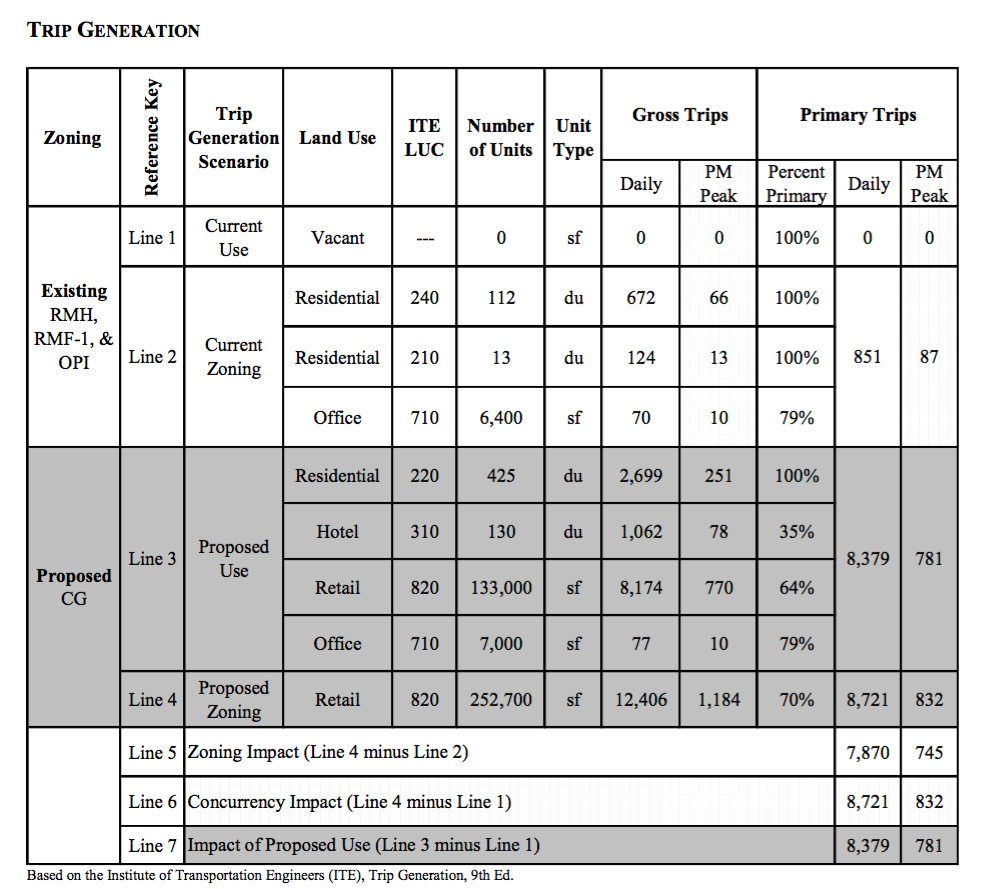
A table in a county staff report in August 2018 offers these details about anticipated traffic generation related to Siesta Promenade. Image courtesy Sarasota County
During her public hearing remarks, she quoted from a June 10, 2015 memorandum from then-County Attorney Stephen DeMarsh to the commission: “If a local government adopts a mobility fee system as an alternative to concurrency, the alternative mobility funding system adopted may not be used to deny, time, or phase an application for site plan approval, plat approval, final subdivision approval, building permits, or the functional equivalent of such approvals. Notably missing from this list are rezones, special exceptions, [developments of regional impact] and similar board-level discretionary approvals. As the statue is currently written, if the Board repeals concurrency and adopts a mobility fee system, it may not only deny Comprehensive Plan amendments because of traffic impacts, but also may deny or condition rezones and similar development approvals because of adverse traffic impacts so long as any conditions imposed do not constitute a concurrency system.”
Deputy County Attorney Alan Roddy. File photo
If the ordinance changes proposed that day were approved, Kochman asked on May 21, “Does this opinion still apply?”
(Opponents of Siesta Promenade have pointed to the thousands of extra vehicles it will add to one of the county’s most congested intersections.)
Deputy County Attorney Alan Roddy, who said he believed he actually wrote the 2015 memorandum, explained that it applied to the situation prior to the 2016 update of the Comprehensive Plan. Therefore, the opinion Kochman read would not apply if the proposed amendment to the County Code were approved.
In making the motions necessary to put the changes in effect in Chapter 94, Article 7, of the County Code of Ordinances, Commissioner Alan Maio said, “I was here in 2015. It’s exactly as Mr. Roddy said. … This is not a policy change. It’s just enacting what we did in 2016.”
A map submitted to the county shows the area where the density change is being sought. Image courtesy Sarasota County
The Sarasota County Commission has authorized staff to proceed outside the normal cycle with a proposed, privately initiated revision of the Sarasota 2050 Plan that could lead to a significant increase in the number of new homes planned near the intersection of Fruitville Road and Utopia Road.
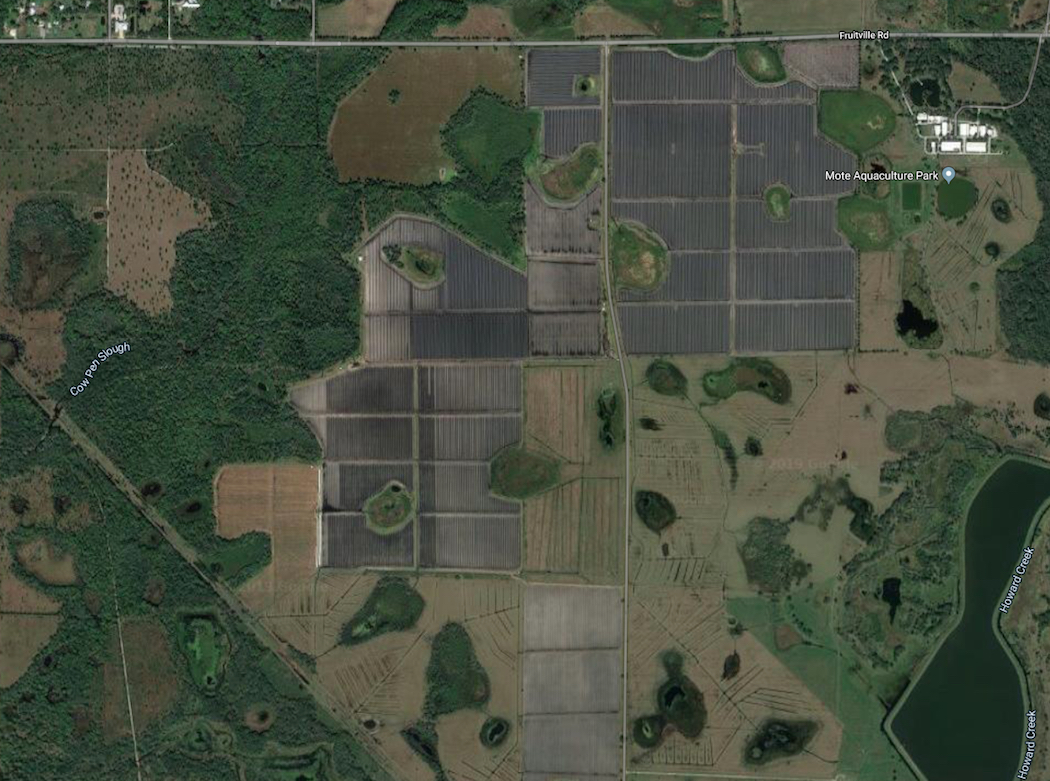
The property is close to the Mote Aquaculture Park, based on documents filed with the county.
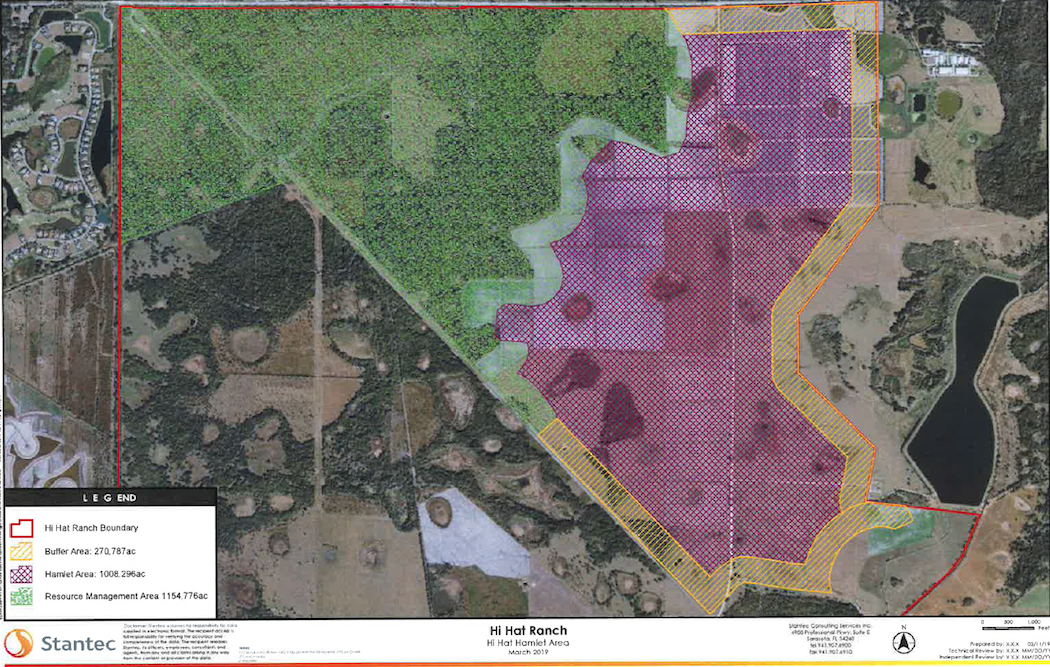
Owned by Hi Hat Ranch LLLP of Sarasota, the approximately 1,000-acre parcel is designated for a 2050 Plan Hamlet, which, the County Code says, is “entitled to a base residential density of 0.29 dwelling units per acre of Developed Area.” The maximum density allowed within the Developed Area is one dwelling unit per acre.
The owners of Hi Hat Ranch are seeking to change the designation of the property to Village Land Use, which has a maximum density of five dwelling units per gross developable area, or six, if the additional units are planned for affordable housing.
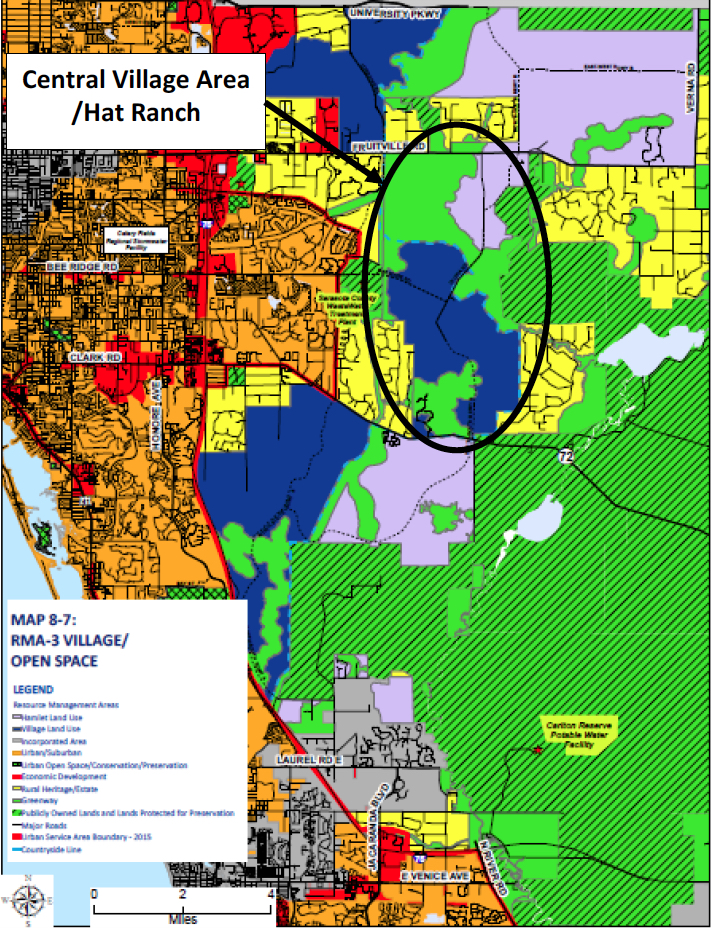
The property is in what has been classified as the Central Village Area of the county’s 2050 Resource Management Area, according to a May 21 county staff memo. The owners wanted staff to process the proposed Comprehensive Plan amendment at the same time staff works on a Development of Critical Concern (DOCC) for Hi-Hat Ranch, the memo said.
“The balance of the Hi-Hat Ranch lands are designated Village Land Use and Greenway,” the memo pointed out.
County staff has scheduled a Neighborhood Workshop on the proposed amendment on Tuesday, June 4. The session will be held from 6 to 7 p.m. at St. Margaret Episcopal Church, which is located at 8700 State Road 72 (Clark Road).
A graphic included with the May 21 county staff memo shows more details of the affected portion of the Sarasota 2050 Resource Management Area. Image courtesy Sarasota County
As part of their May 21 Consent Agenda of routine business items, the county commissioners — without any comment — agreed unanimously that staff could work on the proposed Comprehensive Plan amendment outside the annual cycle approved for such staff undertakings.
The County Code that covers the Sarasota 2050 Plan explains that the Hamlet Planned Development District “provides for detached residential uses, protected open space, Public/Civic uses and limited neighborhood type commercial. The district is not commercial in character.” The Code adds, “Hamlets are collections of rural homes and lots clustered together around a crossroads that may include small-scale commercial, Public/Civic buildings or shared amenities.”
The maximum number of dwelling units is 400, the County Code notes, but the “Preferred Size” is 50 to 150 dwelling units
At least 60% of the area must remain open space, the County Code points out.
An aerial map shows most of the property where the modification is being sought. Utopia Road is the north-south road west of the Mote Aquaculture Park. Image from Google Maps
On the other hand, the Code says, “A Village is a collection of Neighborhoods that have been designed so that a majority of the housing units are within a walking distance or one-quarter mile radius of a Neighborhood Center. A Village shall be supported by a mixed-use Village Center (designed specifically to serve the daily and weekly retail, office, and Public/Civic use and services needs of Village residents), and the Village shall generally be surrounded by large expanses of Open Space that are designed to protect the character of the rural landscape and provide separation between the Village and existing low density rural development.”
A minimum of 50% of the space must remain open, except for Villages in the Clark Road Properties area of the county, which is south of Clark Road and east of Interstate 75.
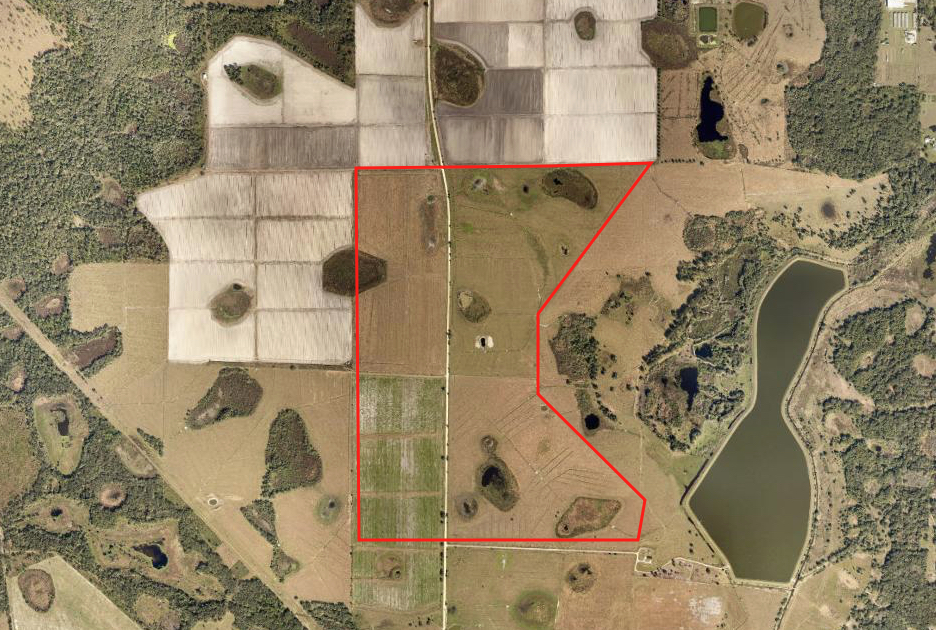
A Sarasota News Leader review of Hi Hat Ranch parcels on the Sarasota County Property Appraiser’s website found several out of which the designated Hamlet area appears to have been carved. One of them, which comprises 378 acres, had a value of $3,006,700 in 2018, county records show. A portion of that parcel has been deeded to the City of Sarasota, which has a water reclamation distribution system in that area.
This is one of the Hi Hat Ranch LLLP parcels affected by the Comprehensive Plan amendment that is being sought. Its 2018 value is more than $3 million, the Sarasota County Property Appraiser’s Office records show. Image from the Sarasota County Property Appraiser’s Office
A second parcel, which contains about 388 acres, had a 2018 value of $3,319,700, according to Property Appraiser William Furst’s office’s records.
Hi Hat Ranch LLLP lists its address as 11708 Fruitville Road in the documents it has filed with the Florida Division of Corporations. Its registered agent is Richard E. Turner Jr. of the same address.
A News Leader check of the Property Appraiser’s Office records found 22 parcels in the county belonging to Hi Hat Ranch LLLP. All but five of them came under ownership of the company in August 1988, the records show.